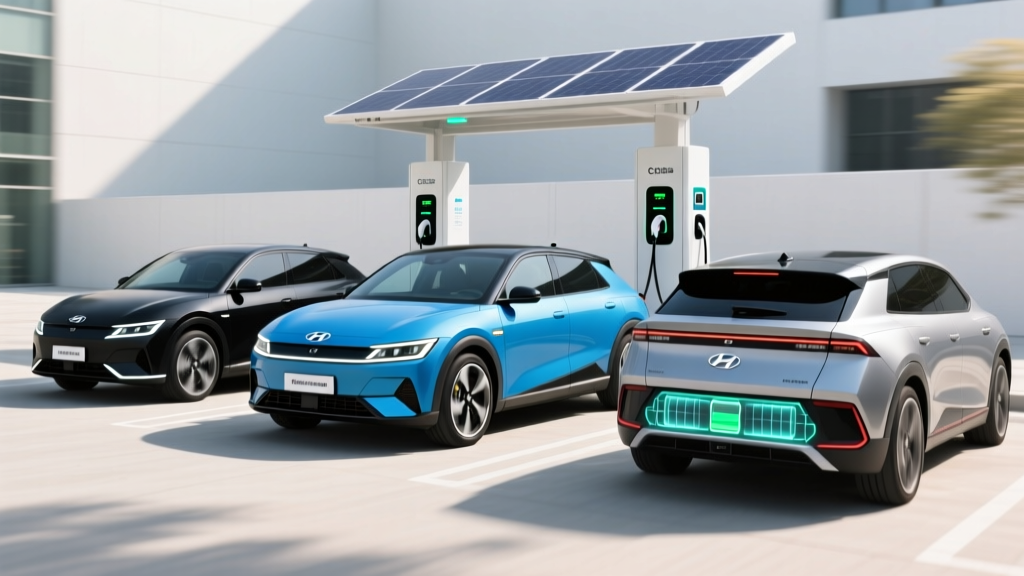
The Hyundai Ioniq 5 remains one of the most compelling electric crossovers on the market, thanks to its 800-volt architecture, retro-futuristic styling, and a trim lineup that spans from an accessible Standard Range to the high-performance N variant. But with four distinct trims and multiple battery and drivetrain configurations, choosing the right Ioniq 5 requires understanding exactly what each trim delivers — and what it costs after incentives.
This guide breaks down every 2026 Hyundai Ioniq 5 trim with the exact numbers that matter: EPA range, real-world efficiency, DC fast-charge speeds, battery chemistry, pricing, and federal tax credit eligibility under current IRS §30D rules.
2026 Hyundai Ioniq 5 Trim Lineup at a Glance
Hyundai offers the 2026 Ioniq 5 in four primary trims. The SE and SEL share the same powertrain options, while the Limited adds premium features and the N variant sits in its own performance category. Here is the core specification matrix:
| Spec | SE Standard Range | SE / SEL (Long Range RWD) | SE / SEL / Limited (Long Range AWD) | Ioniq 5 N |
|---|---|---|---|---|
| Battery (usable) | 58 kWh (LFP) | 77.4 kWh (NMC) | 77.4 kWh (NMC) | 84.0 kWh (NMC) |
| EPA Range | 244 mi | 318 mi | 290 mi | 221 mi |
| Horsepower | 168 hp | 225 hp | 320 hp | 641 hp (N Grin Boost) |
| 0–60 mph | ~7.4 sec | ~7.0 sec | ~4.5 sec | ~3.4 sec |
| Drivetrain | RWD | RWD | Dual-motor AWD | Dual-motor AWD |
| Max DC Fast Charge | ~150 kW | ~238 kW | ~238 kW | ~238 kW |
| 10–80% DCFC Time | ~22 min | ~18 min | ~18 min | ~18 min |
| Base MSRP | $42,600 | $46,650 | $50,150 | $67,900 |
Sources: fueleconomy.gov, Hyundai USA specifications.
Real-World Range: What to Expect Beyond the EPA Sticker
The Long Range RWD Ioniq 5 carries a 318-mile EPA estimate. In real-world mixed driving, expect ~270–290 miles. Sustained highway speeds above 70 mph reduce efficiency to roughly 250–265 miles. In cold weather (below 30°F), range can drop 20–30%, yielding as little as ~220–250 miles on the Long Range RWD. The AWD trims lose roughly 8–10% range compared to RWD equivalents year-round.
The Ioniq 5's efficiency varies significantly by trim. The Long Range RWD achieves 132 MPGe combined (roughly 25 kWh/100 mi), making it one of the more efficient midsize electric crossovers. The AWD versions drop to approximately 113–116 MPGe, and the performance-oriented N variant falls to 85 MPGe — a direct trade-off for its 641-hp output.
For the Standard Range model with its 58 kWh LFP battery, the 244-mile EPA figure holds up reasonably well in city driving, but highway-heavy commutes will see closer to 200–215 miles. LFP chemistry does offer one advantage here: it tolerates regular 100% charging better than NMC, so you can charge to full daily without the long-term degradation concerns that NMC owners manage by staying at 80%.
Charging Speed: The 800V Advantage Explained
The Ioniq 5's headline feature is its 800-volt electrical architecture, shared with the Kia EV6 and Genesis GV60 on Hyundai's E-GMP platform. This enables dramatically faster DC fast charging than the 400V systems used by most competitors.
| Charging Level | Power / Rate | Miles of Range Added | Notes |
|---|---|---|---|
| Level 1 (120V household) | ~1.4 kW | ~3–5 mi/hr | Emergency/trickle only; ~60+ hours for full charge |
| Level 2 (240V home) | 10.9 kW | ~36–44 mi/hr | Full charge in ~7–8 hours (Long Range) |
| DC Fast Charge (peak) | Up to 238 kW (LR) | ~180–220 mi in 18 min | Requires 350 kW-capable CCS/NACS station |
| DC Fast Charge (Standard Range) | Up to ~150 kW | ~130–150 mi in 22 min | LFP battery charges at lower peak rate |
On a 350 kW Electrify America or Tesla Supercharger (with NACS adapter, now included on 2025+ models), the Long Range Ioniq 5 sustains over 200 kW from roughly 10% to 55% state of charge before tapering. The 10–80% sprint completes in approximately 18 minutes under ideal thermal conditions. Preconditioning the battery — which the Ioniq 5 does automatically when a DC fast charger is set as your navigation destination — is critical to achieving these speeds, especially in cooler weather.
The Standard Range model charges at a lower peak rate due to its smaller LFP pack, but 22 minutes for 10–80% is still competitive with many rivals that cost significantly more.
For home charging, the onboard 10.9 kW charger means a 48-amp Level 2 circuit adds roughly 40 miles of range per hour. A full overnight charge from 10% takes about 7 hours for the Long Range battery — easily managed with a standard Level 2 home installation.
Trim-by-Trim Breakdown: Which Ioniq 5 Fits Your Needs?
SE Standard Range — The Value Entry Point
At $42,600, the SE Standard Range is one of the most affordable ways into the Ioniq 5 lineup. You get the same distinctive design, the same wheelbase, and Hyundai's full suite of driver-assist features. The trade-off is the 244-mile EPA range and 168 hp, which is adequate for commuting but not thrilling. The LFP battery is a plus for buyers who plan to charge to 100% daily and keep the car long-term, as LFP chemistry degrades more slowly under high state-of-charge conditions.
SE and SEL Long Range — The Sweet Spot
The SE Long Range RWD starts at $46,650 and delivers the Ioniq 5's best range figure: 318 miles EPA. The SEL adds heated front seats, a power liftgate, wireless phone charging, and additional USB-C ports for roughly $3,000 more. Both trims include the full 77.4 kWh NMC battery and 225 hp, which provides confident highway merging. For most buyers, the SEL Long Range RWD represents the best balance of range, features, and value in the lineup.
Limited AWD — Premium and Capable
Starting at $50,150 (AWD), the Limited adds ventilated front seats, a panoramic sunroof, a head-up display with augmented reality navigation, a premium Bose audio system, and Hyundai's Highway Driving Assist 2 (HDA2) with lane-change assist. The dual-motor AWD system produces 320 hp and drops the 0–60 time to about 4.5 seconds. Range falls to 290 miles EPA — still ample for road trips with the 18-minute DC fast-charge capability.
Ioniq 5 N — The Performance Outlier
The N variant is a fundamentally different vehicle wearing the same body. At $67,900, it features an 84 kWh battery, N-tuned adaptive suspension, electronically controlled limited-slip differential, N-specific brake system, and the ability to simulate gear shifts and engine sounds for track engagement. With N Grin Boost engaged, it produces 641 hp and hits 60 mph in approximately 3.4 seconds. The cost is range: just 221 miles EPA. This is a weekend toy and track-day companion, not a road-trip cruiser.
Pricing, Tax Credits, and Total Cost
- Maximum credit: Up to $7,500 ($3,750 for critical minerals + $3,750 for battery components)
- MSRP cap: SUVs/vans must be under $80,000 — all Ioniq 5 trims qualify on price
- Buyer income cap: AGI ≤ $150,000 (single), $225,000 (head of household), $300,000 (joint)
- Battery sourcing: Critical minerals and component requirements phase in annually; verify current-year compliance on IRS qualified vehicles list
- Point-of-sale transfer: Eligible buyers can transfer the credit to the dealer for an immediate price reduction at purchase
Note: Battery sourcing and critical mineral requirements tighten each year. Always confirm the specific Ioniq 5 trim's eligibility on the IRS website or with a tax professional before purchase.
| Trim | Base MSRP | Est. After $7,500 Credit | As-Tested (Typical Options) |
|---|---|---|---|
| SE Standard Range | $42,600 | ~$35,100 | $43,500–$44,500 |
| SE Long Range RWD | $46,650 | ~$39,150 | $47,500–$49,000 |
| SEL Long Range RWD | $49,650 | ~$42,150 | $51,000–$53,000 |
| Limited AWD | $54,650 | ~$47,150 | $56,000–$58,000 |
| Ioniq 5 N | $67,900 | ~$60,400 | $69,000–$72,000 |
As-tested prices reflect typical destination charges, popular packages, and dealer-installed accessories. Tax credit amounts depend on individual eligibility and current-year sourcing rules.
Interior Space, Cargo, and Daily Livability
The Ioniq 5 rides on a 118.1-inch wheelbase — longer than the Tucson — and Hyundai uses that flat-floor E-GMP platform to deliver genuinely spacious interior dimensions:
- Front legroom: 41.7 inches
- Rear legroom: 39.4 inches (class-leading for the segment)
- Cargo volume (rear seats up): 27.2 cu ft
- Cargo volume (rear seats folded): 59.3 cu ft
- Front trunk (frunk): 0.85 cu ft (RWD) / 0.42 cu ft (AWD) — enough for a charging cable bag, not a grocery run
The dual 12.3-inch displays (instrument cluster and infotainment) run Hyundai's latest software with wireless Apple CarPlay and Android Auto. Physical buttons for climate control remain — a practical choice over the touch-only approach of some competitors. The center console slides forward and back (the "Universal Island"), creating pass-through space useful in tight parking spots.
One notable drawback: the Ioniq 5 does not have a rear wiper on pre-2025 models; Hyundai added one for the 2025 refresh, which carries into 2026. Towing capacity is limited to 1,650 pounds (AWD) — enough for a small utility trailer, but not a camper. The Ford Mustang Mach-E and Tesla Model Y both offer similar or slightly lower tow ratings.
Driver Assistance and Safety Technology
All Ioniq 5 trims come with Hyundai SmartSense, which includes forward collision-avoidance assist, lane-keeping assist, blind-spot monitoring, and adaptive cruise control. The SEL and Limited trims add Highway Driving Assist 2 (HDA2), which provides lane-centering and automatic lane changes on divided highways. This is an SAE Level 2 driver-assistance system — you must keep your hands on the wheel and eyes on the road at all times. It is not autonomous driving.
The Ioniq 5 has earned top safety marks: a 5-star overall NHTSA rating and an IIHS Top Safety Pick+ designation when equipped with specific headlights. The battery pack is housed in a reinforced structure beneath the floor, contributing to the vehicle's low center of gravity and strong crash-test performance.
Warranty Coverage
Hyundai backs the Ioniq 5 with one of the strongest warranty packages in the EV segment:
- New vehicle limited: 5 years / 60,000 miles
- Powertrain: 10 years / 100,000 miles
- EV battery: 10 years / 100,000 miles (covers capacity loss below 70% of original)
- Complimentary maintenance: 3 years / 36,000 miles
- Roadside assistance: 5 years / unlimited miles
The 70% capacity retention threshold on the battery warranty is standard for the industry, but Hyundai's 10-year/100,000-mile term exceeds the 8-year/100,000-mile federal minimum. For long-term owners, this is a meaningful advantage over brands offering only 8-year coverage.
Pros and Cons
- Class-leading 18-minute 10–80% DC fast charging
- Spacious rear seat (39.4" legroom)
- Strong 10-year/100,000-mile battery warranty
- LFP option for longevity-conscious buyers
- Physical climate controls retained
- Top Safety Pick+ from IIHS
- Vehicle-to-load (V2L) power capability
- Frunk is nearly useless (under 1 cu ft)
- Towing limited to 1,650 lbs
- No one-pedal driving mode (i-PEDAL exists but limited regen strength)
- Real-world highway range falls ~15% below EPA
- Infotainment can lag on cold-boot
- Standard Range trim's 168 hp feels underpowered for merging
How the Ioniq 5 Compares to Key Competitors
The Ioniq 5's closest rivals include the Tesla Model Y, Ford Mustang Mach-E, and Kia EV6 (its platform sibling). Against the Model Y, the Ioniq 5 offers a more comfortable ride, better interior material quality, and faster peak charging — but the Tesla's Supercharger network access (though now largely available to Hyundai via NACS adapters) and slightly higher cargo volume remain advantages. The Mach-E offers similar range and a sportier driving feel, but its charging speeds lag behind the Ioniq 5's 800V system. The EV6 is mechanically nearly identical but trades the Ioniq 5's upright crossover styling for a sleeker, lower-slung profile with slightly less rear headroom.
- Commuter (under 60 mi/day): SE Standard Range is ideal — lower cost, LFP longevity, charge nightly at home.
- Road-trip family: SEL Long Range RWD offers 318 mi EPA, 18-min fast charging, and rear-seat space for car seats.
- Snow-belt buyer: Limited AWD provides 320 hp dual-motor traction, premium winter features, and HDA2 for highway slogs.
- Performance enthusiast: Ioniq 5 N is a legitimate track-capable EV, but accept the 221-mile range trade-off.
- Towing buyer: Look elsewhere — 1,650-lb capacity is inadequate for most campers or boat trailers.
Frequently Asked Questions
What is the real-world range of the Hyundai Ioniq 5?
The Long Range RWD carries a 318-mile EPA estimate, but expect approximately 270–290 miles in mixed real-world driving. Highway-only trips at 75+ mph reduce this to roughly 250–265 miles. Cold weather below freezing can drop range by 20–30%. The AWD trims achieve about 8–10% less range than their RWD equivalents.
How fast does the Ioniq 5 charge at home and on the road?
On a Level 2 home charger (240V, 48 amps), the Ioniq 5 charges at up to 10.9 kW, adding roughly 40 miles of range per hour and achieving a full charge in about 7–8 hours. On a 350 kW DC fast charger, Long Range models peak at 238 kW and complete a 10–80% charge in approximately 18 minutes. The Standard Range model peaks around 150 kW with a 10–80% time of about 22 minutes.
Does the Hyundai Ioniq 5 qualify for the federal EV tax credit?
Most Ioniq 5 trims qualify for up to $7,500 under IRS §30D, subject to buyer income limits ($150K single / $300K joint AGI), the $80,000 SUV MSRP cap (all trims fall below this), and current-year battery sourcing and critical mineral requirements. The credit can be transferred to the dealer at point of sale for an immediate price reduction. Always verify the specific trim's eligibility on the IRS qualified vehicles list before purchasing.
Is the Ioniq 5 worth buying over the Tesla Model Y?
It depends on your priorities. The Ioniq 5 charges faster (18 min vs ~25 min for 10–80% on comparable Model Y trims), offers a more refined ride quality, and includes a longer powertrain warranty (10 years vs 4 years). The Model Y provides slightly more cargo space, access to Tesla's software ecosystem, and marginally better real-world efficiency. With Hyundai now including a NACS adapter, Supercharger access is no longer a Tesla-exclusive advantage.
What is the biggest drawback of the Ioniq 5?
The most common owner complaint is the small frunk (under 1 cubic foot on AWD models), which limits front-trunk utility. Other notable drawbacks include modest towing capacity (1,650 lbs), the lack of a true one-pedal driving mode, and real-world highway range that falls noticeably short of the EPA estimate — particularly on the AWD and N trims.