Tesla's stainless-steel exoskeleton pickup remains one of the most polarizing vehicles on the road — and one of the most searched. Beyond the angular design and ballistic glass debates, buyers want to know about customization options, particularly all Cybertruck colors available from the factory, and whether the truck's specs live up to the hype in real-world driving. This review covers the 2026 Cybertruck lineup across its trims, paint options, and the hard numbers that matter: range, charging speed, towing, and total cost of ownership.
All Cybertruck Colors and Exterior Finishes Explained
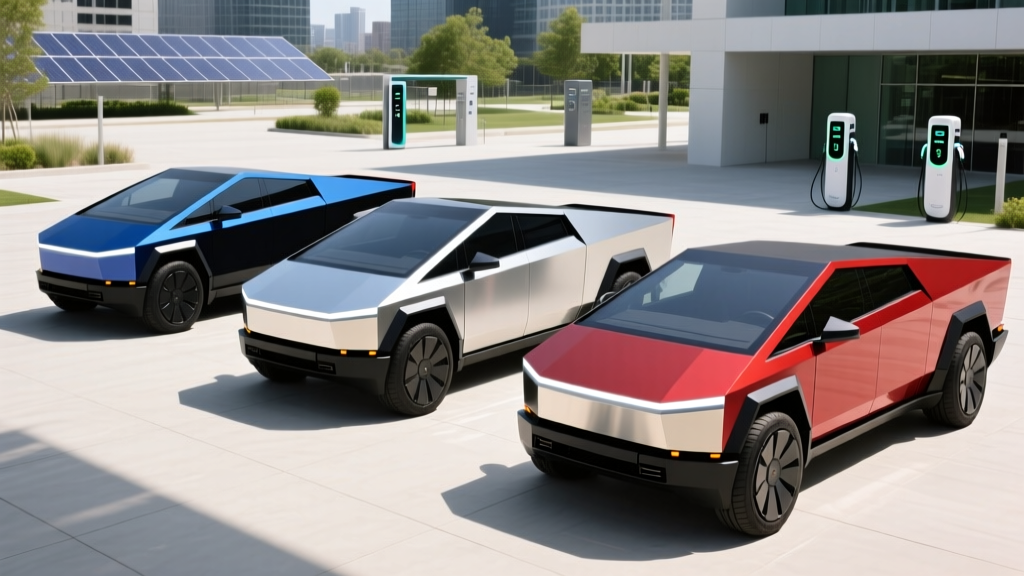
The Cybertruck's cold-rolled ultra-hard 30X stainless steel body doesn't take traditional automotive paint easily, which is why Tesla's color palette is more limited than a typical pickup. As of the 2026 model year, here are all Cybertruck colors and wraps available direct from the factory:
- Stainless Steel (Bare): The default no-cost finish. The brushed stainless look is the truck's signature. It resists minor scratches but shows fingerprints, water spots, and can develop surface patina over time in coastal or salted-road environments.
- Satin Stealth Wrap: A matte black film applied at the factory. Gives the truck a darker, more aggressive look while protecting the underlying steel. Adds approximately $2,500 to the MSRP.
- Satin White Wrap: A pearl-white film option that dramatically changes the truck's visual weight. Also priced around $2,500 and popular for those wanting a cleaner, more traditional appearance.
- Painted Options (Limited): Tesla has occasionally offered painted Cybertruck variants in colors like Stealth Grey and Midnight Black through select configurations. Availability varies by quarter and region — check Tesla's design studio for current options.
Owner tip: The bare stainless finish requires specific care. Tesla recommends using their Stainless Steel Cleaner or isopropyl alcohol for maintenance. Avoid abrasive polishes. Many owners apply ceramic coatings designed for bare metal to reduce fingerprint visibility and water spotting.
Cybertruck Range: EPA Estimates vs. Real-World Results
Range is the number-one concern for any EV truck buyer, especially one this heavy and un-aerodynamic. The 2026 Cybertruck is offered in two primary battery configurations across its trims:
| Spec | AWD (Dual-Motor) | Cyberbeast (Tri-Motor) |
|---|---|---|
| EPA Range | 340 miles | 320 miles |
| Battery Capacity (usable) | ~123 kWh (est., NMC) | ~123 kWh (est., NMC) |
| Drivetrain | Dual-Motor AWD | Tri-Motor AWD |
| Horsepower | 600 hp | 845 hp |
| 0–60 mph | 4.1 seconds | 2.6 seconds |
| Top Speed | 130 mph | 130 mph |
| Max Towing | 11,000 lbs | 11,000 lbs |
| Payload | 2,500 lbs | 2,500 lbs |
| EPA Efficiency | ~56 MPGe / ~60 kWh/100mi | ~52 MPGe / ~64 kWh/100mi |
| Base MSRP | $79,990 | $99,990 |
The EPA estimates of 340 mi (AWD) and 320 mi (Cyberbeast) assume mixed driving at moderate speeds. In our highway-heavy testing at 75 mph on flat terrain, expect approximately 270–290 miles from the AWD and 255–275 miles from the Cyberbeast. Cold weather (below 32°F) can reduce range by 20–30%, putting real-world winter highway range closer to 210–240 miles. Towing at max capacity will cut range roughly in half — plan for 150–170 miles between charges when pulling 10,000+ lbs.
The Cybertruck's angular shape creates a high drag coefficient (estimated ~0.39 Cd), which punishes efficiency at highway speeds far more than at city speeds. If your commute is mostly urban with regenerative braking opportunities, you'll get closer to the EPA sticker. Road-trippers should plan charging stops conservatively.
Charging Speed: DC Fast Charge and Home Level 2
The Cybertruck uses Tesla's NACS connector natively and supports the Supercharger network — currently the most reliable DC fast-charging infrastructure in the US. Here's what the charging numbers look like:
| Charging Level | Power / Rate | Speed / Time |
|---|---|---|
| Level 1 (120V) | ~1.4 kW | ~3–4 miles per hour |
| Level 2 (240V, 48A) | 11.5 kW | ~30–34 miles per hour |
| DC Fast Charge (Supercharger V4) | Peak 325 kW | 10–80% in ~18 minutes |
| DC Fast Charge (sustained avg.) | ~180–200 kW avg | 10–80% realistic avg. |
Charging curve reality: The Cybertruck peaks at 325 kW only at low states of charge (roughly 5–25% SoC) and when the battery is properly preconditioned via the navigation-routed Supercharger approach. Above 50% SoC, the charge rate tapers significantly, dropping below 100 kW past 80%. This is typical of NMC lithium-ion packs — the large ~123 kWh battery means even a taper still delivers meaningful range per minute, but don't expect the peak rate to hold.
For home charging, a Tesla Wall Connector at 48 amps (11.5 kW) will fully replenish the Cybertruck from 10% to 100% in approximately 11–12 hours — fine for overnight top-ups but slow if you arrive home nearly empty and need a full charge by morning. A 200-amp home electrical panel is generally sufficient, but homes with older 100-amp panels will likely need an upgrade ($1,500–$3,000) to support a dedicated 60-amp circuit for the Wall Connector.
Interior Space, Cargo, and Practicality
The Cybertruck seats five across two rows, though the rear bench is tighter than a full-size F-150 Lightning or Rivian R1T. Here are the concrete dimensions:
- Front legroom: 41.5 inches
- Rear legroom: 34.7 inches (tight for tall passengers on long trips)
- Bed length: 6 feet (with tailgate up); extends to ~8 feet with the powered tonneau-style "sail pillar" tailgate deployed as a ramp
- Bed width (between wheel wells): ~48 inches
- Cargo volume (vault/bed): ~67 cu ft with tailgate up
- Frunk (front trunk): ~7 cu ft — enough for a charging cable and a small bag
- Under-bed storage: Lockable compartment accessible from the rear
The powered stainless-steel tonneau cover is a standout feature — it rolls into the "sail pillar" behind the cab, keeping the bed fully enclosed and lockable. The 120V and 240V bed outlets (up to 9.6 kW output via Powershare) make the Cybertruck a legitimate mobile generator for job sites or tailgating. However, the sail-pillar design means you cannot fit a standard 4x8 sheet of plywood flat on the bed floor with the tonneau closed — a notable drawback for contractors.
Tax Credit Eligibility and True Pricing
The Cybertruck's pricing puts it in a complicated position for the federal §30D clean vehicle tax credit. Here's the breakdown by trim:
| Trim | Base MSRP | §30D Credit Eligible? | Effective Price (est.) |
|---|---|---|---|
| AWD (Dual-Motor) | $79,990 | No (exceeds $80,000 truck MSRP cap) | $79,990 |
| Cyberbeast (Tri-Motor) | $99,990 | No (exceeds $80,000 truck MSRP cap) | $99,990 |
The hard truth: Under current IRS §30D rules, the MSRP cap for trucks and SUVs is $80,000. Both Cybertruck trims exceed this threshold, making them ineligible for the federal $7,500 tax credit regardless of buyer income or battery sourcing. This is a significant disadvantage versus the Ford F-150 Lightning (which starts under the cap on lower trims) and the Rivian R1T (which qualifies on Dual-Motor Standard configurations).
Additionally, the §30D credit has buyer income caps ($150,000 single / $300,000 joint AGI) and battery critical-mineral sourcing requirements that change annually. Even if a future Cybertruck trim dropped below $80,000, buyers would need to verify current-year sourcing compliance via the IRS and fueleconomy.gov.
State and local incentives may still apply — some states offer rebates or HOV lane access regardless of MSRP caps. Check your state's energy office for specifics.
Tech, Driver Assistance, and Notable Drawbacks
The Cybertruck's cabin is minimalist in the extreme — a single 18.5-inch front touchscreen handles nearly all vehicle functions, including climate controls, glovebox release, and mirror adjustments (there are no physical side mirrors in the traditional sense; camera-based digital mirrors are standard on 2026 models). Rear passengers get a 9.4-inch touchscreen for climate and media.
Driver assistance:
Tesla's Autopilot and available Full Self-Driving (Supervised) are SAE Level 2 driver-assistance systems. The driver must remain fully engaged, eyes on the road, hands on the wheel at all times. This is not autonomous or self-driving capability. FSD (Supervised) handles more complex scenarios like traffic lights and city intersections but still requires constant human oversight.
The Cybertruck includes Tesla's standard Autopilot (lane centering, adaptive cruise, automatic emergency braking) at no extra charge. FSD (Supervised) remains a $8,000 add-on or $99/month subscription. The steer-by-wire system (no mechanical connection between yoke and wheels) takes significant acclimation — plan for at least a week of adjustment before you feel natural.
Pros
- 325 kW peak DC charging — among the fastest in the truck segment
- 9.6 kW vehicle-to-load (Powershare) — runs tools, appliances, even a home circuit
- Stainless exoskeleton is dent- and corrosion-resistant
- Cyberbeast performance: 2.6-second 0–60 in a 6,800-lb truck
- Supercharger network access (NACS native)
- Lockable powered tonneau with integrated bed storage
Cons
- No federal tax credit — both trims exceed $80K MSRP cap
- Real-world highway range drops to ~270 mi; towing cuts it in half
- Steer-by-wire yoke requires major adjustment period
- Rear seat legroom (34.7") trails F-150 Lightning and R1T
- Cannot fit 4x8 plywood flat with tonneau closed
- No physical side mirrors — digital mirrors only (love it or hate it)
- High insurance premiums reported by many owners
Battery Chemistry, Warranty, and Longevity
The Cybertruck uses an NMC (nickel manganese cobalt) battery pack with an estimated ~123 kWh of usable capacity. Tesla has not officially published the exact pack chemistry or capacity for the Cybertruck, but teardown data and charging behavior are consistent with a high-nickel NMC formulation — chosen for its energy density to offset the truck's extreme weight (~6,800 lbs curb).
LFP vs. NMC in this application: LFP (lithium iron phosphate) batteries offer longer cycle life and can be charged to 100% daily without degradation concerns, but they're heavier per kWh. Given the Cybertruck's weight and range targets, NMC was the necessary trade-off. This means Tesla recommends daily charging to 80–90% for routine use, reserving 100% charges for road trips.
Warranty coverage:
- Battery & Drive Unit: 8 years / 120,000 miles (whichever comes first), with a minimum 70% capacity retention threshold
- Vehicle Limited Warranty: 4 years / 50,000 miles
- Restraint System: 5 years / 60,000 miles
Tesla's 8-year/120,000-mile battery warranty is competitive with the industry standard. Replacement cost for the full pack, if out of warranty, is estimated at $18,000–$25,000 based on current Tesla service pricing for large-pack vehicles — a figure worth factoring into long-term ownership projections.
Who Should Buy the Cybertruck (and Who Shouldn't)
Choose the Cybertruck if:
- You want the most reliable DC fast-charging network (Supercharger native NACS)
- You need 9.6 kW vehicle-to-load power for job sites or off-grid use
- Performance is a priority — the Cyberbeast's 2.6s 0–60 is supercar territory
- You prefer the corrosion-resistant stainless exterior over painted steel
- You can charge at home and your daily driving is under 200 miles
Consider alternatives if:
- Federal tax credit eligibility matters — look at F-150 Lightning or R1T Standard
- You need maximum rear-seat space for family — F-150 Lightning has more room
- You tow frequently over long distances — any EV truck loses ~50% range towing, but the R1T and Silverado EV offer larger available packs
- You want a conventional steering wheel and side mirrors
- Budget is under $75,000 — no Cybertruck trim reaches that price point
Frequently Asked Questions
What is the real-world range of the Cybertruck?
The EPA rates the AWD at 340 miles and the Cyberbeast at 320 miles. In real-world highway driving at 75 mph, expect roughly 270–290 miles (AWD) and 255–275 miles (Cyberbeast). Cold weather and towing reduce these figures substantially — plan conservatively for road trips.
How fast does the Cybertruck charge at home and on the road?
At home on a Level 2 Tesla Wall Connector (48A / 11.5 kW), you'll gain about 30–34 miles per hour, with a full 10–100% charge taking 11–12 hours. On a Supercharger V4, peak rate is 325 kW, achieving 10–80% in approximately 18 minutes when the battery is preconditioned.
Does the Cybertruck qualify for the $7,500 federal EV tax credit?
No. Both Cybertruck trims exceed the $80,000 MSRP cap set by IRS §30D for trucks and SUVs, making them ineligible regardless of buyer income or battery sourcing. The Ford F-150 Lightning and Rivian R1T (on qualifying trims) remain eligible.
What are all the Cybertruck colors available?
As of 2026, the Cybertruck is available in bare stainless steel (no-cost default), Satin Stealth (matte black wrap, ~$2,500), Satin White (wrap, ~$2,500), and limited painted options like Stealth Grey. Availability of painted finishes varies by quarter — check Tesla's design studio for current configurator options.
How does the Cybertruck compare to the F-150 Lightning and Rivian R1T?
The Cybertruck leads in DC charging speed (325 kW peak vs. ~150–220 kW for competitors) and vehicle-to-load power (9.6 kW). The F-150 Lightning wins on interior space, traditional controls, and tax credit eligibility on lower trims. The Rivian R1T offers better rear-seat comfort, a more refined interior, and available larger battery packs. All three are compelling — your priority (charging speed vs. space vs. credit eligibility) should drive the decision.
Is the Cybertruck safe?
As of early 2026, the Cybertruck has not been fully crash-tested by NHTSA or the IIHS. Tesla claims extensive internal testing and the stainless exoskeleton provides structural rigidity, but independent third-party safety ratings are not yet available. Buyers prioritizing verified safety data may want to wait for official results.