The Verdict: A Capable Crossover With a Towing Caveat
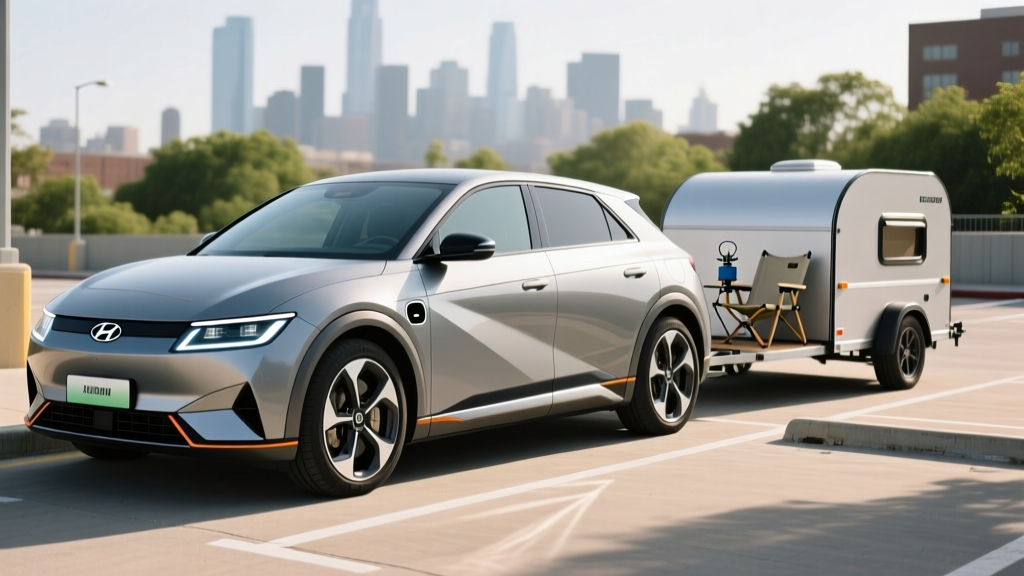
The Hyundai Ioniq 5 has carved out a massive slice of the EV market by blending retro-futuristic styling with 800V ultra-fast charging architecture. But for buyers looking to haul a small camper, jet skis, or a utility trailer, the Hyundai Ioniq 5 towing capacity is the critical spec. For the 2025 and 2026 model years, Hyundai has significantly upgraded the Ioniq 5's towing capability, moving it from a niche commuter to a legitimate light-duty hauler.
When properly equipped with the factory-installed tow hitch and harness, the Dual Motor AWD Ioniq 5 can tow up to 2,300 pounds. The Single Motor RWD version is limited to 1,650 pounds. While this doesn't rival body-on-frame trucks, it is highly competitive for the compact/midsize electric crossover segment, matching or beating key rivals like the Tesla Model Y and Ford Mustang Mach-E.
Towing Specs and Real-World Impact
Towing with an EV is fundamentally different than towing with an internal combustion engine. Electric motors provide instant torque, which is excellent for getting a trailer moving, but the aerodynamic drag and weight of a trailer will drastically reduce your driving range.
| Spec | RWD (Single Motor) | AWD (Dual Motor) |
|---|---|---|
| Max Towing Capacity | 1,650 lbs | 2,300 lbs |
| Horsepower | 168 hp | 320 hp |
| Torque | 258 lb-ft | 446 lb-ft |
| 0-60 mph (unloaded) | 7.5 sec | 4.5 sec |
| Drivetrain | Rear-Wheel Drive | All-Wheel Drive |
When towing near the 2,300-pound limit, expect the Ioniq 5's range to drop by approximately 30% to 50%, depending on speed, terrain, and trailer aerodynamics. If you are towing a boxy camper at 70 mph, the range penalty will be severe. A streamlined teardrop trailer at 55 mph will be much more manageable.
Range, Efficiency, and the "Real-World" Reality
For 2025/2026, Hyundai transitioned the Ioniq 5 (in certain trims and markets) to the Next-Gen battery platform, utilizing NMC (Nickel Manganese Cobalt) chemistry for high-density models to maximize range and towing endurance. The standard-range models often utilize LFP (Lithium Iron Phosphate), which is heavier (reducing range slightly) but offers superior longevity and can be charged to 100% daily without degradation concerns.
Range Reality Check: 2026 Ioniq 5 AWD (Long Range)
EPA Estimated: ~305 miles (Standard trim) / ~260 miles (N Line/XRT)
Real-World Highway (70 mph): Expect ~240-260 miles.
Real-World Cold Weather (Below 32°F): Expect ~190-220 miles.
Towing (2,000 lbs trailer): Expect ~130-160 miles max.
According to data from fueleconomy.gov, the AWD Long Range Ioniq 5 achieves an impressive 110 MPGe combined, consuming roughly 30 kWh per 100 miles. When towing, that consumption figure will easily jump to 50-60 kWh per 100 miles.
Charging Speed: The 800V Advantage
The Ioniq 5's standout feature remains its 800V electrical architecture. While most competitors (and many newer EVs) use 400V systems, the Ioniq 5 can utilize 350 kW DC fast chargers to peak at incredibly high rates, provided the battery is preconditioned via the navigation system.
| Charging Method | Power Output | Speed / Time |
|---|---|---|
| Level 1 (120V Household) | ~1.4 kW | ~3-4 miles per hour |
| Level 2 (240V Home Charger) | 10.9 kW | ~32 miles per hour (10-100% in ~7.5 hrs) |
| DC Fast Charge (350 kW) | Peak ~240 kW | 10-80% in ~18 minutes |
Note: The charge curve tapers significantly above 80% State of Charge (SoC) to protect battery health. For road trips, plan to charge from 10% to 80% and hit the road; pushing to 100% at a DC charger wastes time.
Pricing, Trims, and Federal Tax Credits
With the opening of the Hyundai Metaplant America in Georgia, the Ioniq 5 is now US-built, which drastically changes its tax credit eligibility under the IRS §30D rules. Because it is assembled in North America, it qualifies for the point-of-sale transfer, meaning the dealership can deduct the credit directly from your purchase price.
| Trim Level | Est. MSRP (2026) | Est. Federal Credit | Effective Price |
|---|---|---|---|
| SE Standard Range (RWD) | $42,500 | Up to $7,500 | ~$35,000 |
| SEL (AWD) | $49,500 | Up to $7,500 | ~$42,000 |
| Limited (AWD) | $54,000 | Up to $7,500 | ~$46,500 |
IRS §30D Eligibility Rules (Current Year):
- MSRP Cap: The Ioniq 5 is an SUV/Crossover, so the MSRP must be under $80,000 (all trims qualify).
- Income Cap: Buyer AGI must not exceed $150k (Single), $225k (HOH), or $300k (Joint).
- Battery Sourcing: To get the full $7,500, battery components and critical minerals must meet US/FTA sourcing thresholds. Hyundai's US production has largely secured this, but always verify with the dealer's tax credit documentation.
Interior, Tech, and Cargo Utility
The Ioniq 5 utilizes a flat floor and a stretched 118.1-inch wheelbase, providing limousine-like rear legroom (39.4 inches). The dual 12.3-inch panoramic screens run Hyundai's latest infotainment suite with native wireless Apple CarPlay and Android Auto.
Cargo Volume: 27.2 cu ft behind the rear seats, expanding to 59.3 cu ft with seats folded. The front trunk (frunk) is relatively small on AWD models (roughly 0.85 cu ft) but larger on RWD models, useful for storing charging cables rather than luggage.
Standout Tech: Vehicle-to-Load (V2L) capability allows you to power external devices (up to 3.6 kW) using the car's battery. This is a massive bonus for camping or tailgating, allowing you to plug in a coffee maker, laptops, or even a small TV directly into the car.
Pros, Cons, and Competition
Pros
- 800V Charging: 10-80% in 18 minutes remains class-leading.
- Towing Upgrade: 2,300 lbs (AWD) beats the base Model Y and Mach-E.
- V2L Capability: Turns the car into a mobile generator.
- Ride Comfort: Excellent suspension tuning and cabin quietness.
Cons
- Towing Range Loss: Expect to stop every 120 miles when hauling heavy.
- Wiper/Software Quirks: Earlier models had software bugs; ensure OTA updates are current.
- Frunk Size: Very small on AWD models compared to Tesla.
- No Rear Wiper (Pre-2025): A major annoyance for muddy road trips (fixed on newer trims).
Compared to the Tesla Model Y, the Ioniq 5 offers a more comfortable ride and faster peak charging, though the Model Y's Supercharger network (now accessible to Hyundai via NACS adapters or native ports on newer models) remains a road-trip advantage. The Ford Mustang Mach-E offers sportier handling but falls short on rear-seat space and charging speed.
Frequently Asked Questions
Does the Hyundai Ioniq 5 come with a tow hitch from the factory?
Not standard. You must order the vehicle with the factory-installed tow hitch and harness package to achieve the 2,300-lb rating. Aftermarket hitches may void the warranty or not be rated for the vehicle's electrical integration.
What is the warranty coverage on the Ioniq 5 battery?
Hyundai provides an industry-leading warranty: 10 years or 100,000 miles for the battery and powertrain, and 5 years/60,000 miles for the basic vehicle. This covers battery degradation if it falls below a specified capacity threshold (typically 70%).
Is the Ioniq 5 safe for towing in snow or rain?
Yes, the AWD system provides excellent traction. However, the added weight of a trailer increases stopping distances significantly. Ensure your trailer has functioning electric brakes and use a high-quality brake controller.
Can I use a weight-distribution hitch with the Ioniq 5?
Hyundai generally does not recommend weight-distribution hitches for unibody crossovers like the Ioniq 5. Always consult the owner's manual or a Hyundai dealer for the specific towing guide for your model year.