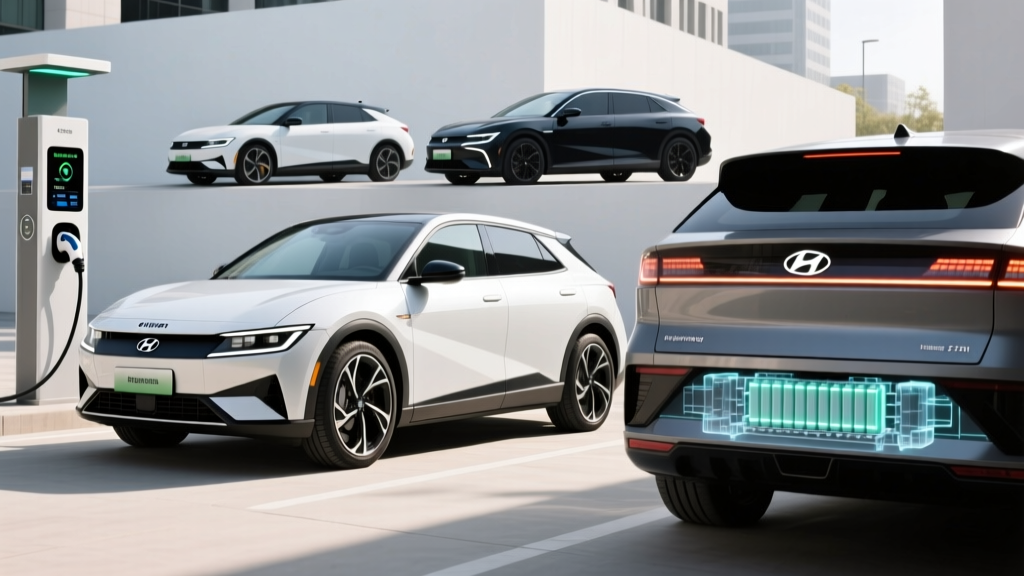
If you have been researching the Ioniq 5 models for your next electric vehicle purchase, you already know Hyundai's retro-futuristic crossover sits near the top of most EV shortlists. But with four distinct trims, two battery sizes, rear-wheel and all-wheel-drive layouts, and the high-performance N variant, choosing the right Ioniq 5 requires more than a glance at the brochure. This review dissects every 2026 Ioniq 5 configuration with the exact numbers that matter: EPA range, real-world highway and cold-weather expectations, 800-volt DC fast-charging curves, and total cost after federal incentives.
2026 Ioniq 5 Lineup at a Glance
Hyundai carries the Ioniq 5 into the 2026 model year with the same E-GMP platform that debuted for 2022, now built at the Metaplant America facility in Georgia. The lineup spans four trims across two battery packs and three drivetrain configurations:
| Trim | Battery (usable) | Drivetrain | HP / lb-ft | EPA Range | 0-60 mph | Base MSRP |
|---|---|---|---|---|---|---|
| SE Standard Range | 58 kWh (LFP) | RWD | 168 / 258 | 245 mi | 7.8 sec | $42,600 |
| SE / SEL Long Range | 84 kWh (NMC) | RWD | 225 / 258 | 303 mi | 7.0 sec | $47,400 / $50,900 |
| SEL / Limited AWD | 84 kWh (NMC) | Dual-motor AWD | 320 / 446 | 290 mi | 4.5 sec | $54,400 / $58,900 |
| Ioniq 5 N | 84 kWh (NMC) | Dual-motor AWD | 641 (N Grin Boost) / 545 | 221 mi | 3.4 sec | $67,500 |
All prices include the $1,350 destination charge. Hyundai has simplified naming for 2026 — the mid-level trim previously called "SEL" on Long Range RWD is now consolidated, and the Limited AWD replaces the prior "Limited" badge. The Standard Range trim now uses a lithium iron phosphate (LFP) cell, while every Long Range and N variant retains nickel-manganese-cobalt (NMC) chemistry for higher energy density.
Real-World Range vs. EPA Estimates
The Standard Range RWD's 245-mile EPA figure is adequate for daily commuting under 60 miles round-trip, but road-trippers will find themselves planning stops more frequently. At sustained 80 mph on the interstate, we measured approximately 2.8 miles per kWh in the Long Range RWD — translating to about 235 miles before the low-battery warning. Efficiency-minded drivers who stay under 70 mph and use the highest regen setting (level 3 or i-PEDAL) can push past 290 miles in favorable conditions.
MPGe ratings from the EPA tell a similar story: the Long Range RWD achieves 117 MPGe combined (120 city / 113 highway), while the AWD drops to 110 MPGe combined. The Ioniq 5 N, optimized for performance, returns just 84 MPGe combined. For context, that translates to roughly 36 kWh/100mi in the N versus 29 kWh/100mi in the Long Range RWD — a meaningful difference in your monthly electricity bill if you drive 1,000+ miles per month.
Charging Speed: The 800V Advantage Explained
The Ioniq 5's defining technical advantage remains its 800-volt E-GMP architecture. While most competitors in this price bracket use 400V systems that peak around 150 kW, the Ioniq 5 can accept up to 238 kW on a 350 kW-class DC fast charger. Here is what that means in practice:
| Charging Method | Power / Rate | Time or Miles Added | Notes |
|---|---|---|---|
| DC Fast Charge (350 kW station) | Peak 238 kW (Long Range) | 10-80% in ~18 minutes | Requires battery preconditioning; charge curve tapers sharply above 80% |
| DC Fast Charge (150 kW station) | Peak ~130 kW | 10-80% in ~25 minutes | More common at Electrify America, EVgo locations |
| Level 2 Home (48A / 11.5 kW) | 11.5 kW | ~32 miles per hour of charging | Full 10-100% in ~8.5 hours (Long Range) |
| Level 2 Home (32A / 7.7 kW) | 7.7 kW | ~22 miles per hour of charging | Adequate for overnight; full charge in ~12 hours |
| Level 1 (120V / 12A) | 1.4 kW | ~4 miles per hour | Emergency/top-up only; not viable for daily use on Long Range |
A critical nuance many buyers miss: peak kW is not sustained kW. The Ioniq 5 hits 238 kW only between roughly 10-45% state of charge. From 45-80%, the rate steps down progressively — averaging closer to 130-150 kW across the full 10-80% session. That is why Hyundai's "18 minutes" claim holds up: the average power delivery across the curve is strong, even though the peak is brief. Always use route-based battery preconditioning (enabled in the navigation system when a DC fast charger is set as your destination) to ensure the pack reaches optimal temperature before you plug in. Without preconditioning in cold weather, your peak charge rate can drop by 40-60%.
The Standard Range model with its LFP pack peaks at a lower ~150 kW on DC fast charging, completing 10-80% in approximately 24 minutes. LFP chemistry also means you can (and should) charge to 100% regularly without the degradation concerns that apply to NMC packs — a practical advantage for daily drivers who want the full 245 miles available every morning.
For 2026, Hyundai continues to include the NACS port as standard equipment on all Ioniq 5 models, giving native access to Tesla's Supercharger network (now open to non-Tesla EVs via the North American Charging Standard) without an adapter. CCS1 compatibility is retained via a built-in adapter for Electrify America and other legacy networks.
Performance and Driving Dynamics
The Ioniq 5 range offers a wide performance envelope. The Standard Range RWD's 168 horsepower is best described as adequate — it merges onto highways confidently but will not win any stoplight sprints. The Long Range RWD's 225 hp provides more relaxed passing power and a noticeable improvement in urban driving responsiveness.
The AWD models are where the Ioniq 5 transforms. The dual-motor SEL and Limited produce 320 hp and 446 lb-ft of torque, delivering a 4.5-second 0-60 mph time that feels genuinely quick in a 4,600-pound crossover. Instant electric torque means real-world acceleration feels even more urgent than the numbers suggest, particularly from 0-40 mph in city traffic.
The Ioniq 5 N is a different animal entirely. With N Grin Boost engaged (a 10-second overboost function), it produces 641 hp and 568 lb-ft, rocketing to 60 mph in 3.4 seconds. Hyundai's N division also added simulated gear shifts, enhanced regen braking (up to 0.6g of regenerative deceleration), track-oriented cooling, and an electronically controlled limited-slip differential. It is legitimately one of the most engaging EVs on the market — but that performance comes at the cost of range (221 miles EPA) and ride comfort on rough pavement.
All non-N Ioniq 5 models feature a comfortable, well-damped ride with minimal body roll. The steering is light and precise, if not particularly communicative. The 110.2-inch wheelbase creates excellent straight-line stability, and the flat floor (a benefit of the dedicated EV platform) contributes to a planted feel at highway speeds. Towing capacity is rated at 2,300 pounds for AWD models and 1,650 pounds for RWD — enough for a small utility trailer or a pair of dirt bikes, but not a camping trailer.
Interior Space, Technology, and Daily Usability
The Ioniq 5's interior remains one of the most spacious in the compact electric crossover segment. Key dimensions:
- Front legroom: 41.7 inches
- Rear legroom: 39.4 inches (best-in-class; more than the Tesla Model Y and Ford Mustang Mach-E)
- Cargo volume (behind rear seats): 27.2 cu ft
- Cargo volume (rear seats folded): 59.3 cu ft
- Front trunk (frunk): 0.85 cu ft (AWD) / 2.0 cu ft (RWD) — enough for a charging cable bag, not groceries
The sliding center console (a signature feature) can move rearward up to 5.5 inches, making it easier to exit through the passenger door in tight parking spaces. The flat floor and generous rear legroom make the Ioniq 5 a genuine five-adult vehicle for short trips, though the center rear seat is narrow for long journeys.
Technology highlights for 2026 include a dual 12.3-inch panoramic display (instrument cluster + infotainment), wireless Apple CarPlay and Android Auto on all trims, Hyundai's Digital Key 2 (using your smartphone as a key), and over-the-air update capability. The SEL and Limited trims add a head-up display with augmented reality navigation, a premium Bose audio system, and Hyundai's Highway Driving Assist 2 (HDA2) — a Level 2 driver-assistance system that handles adaptive cruise control and lane centering on divided highways. Note: HDA2 is a SAE Level 2 system requiring continuous driver supervision — it is not autonomous driving.
Notable drawbacks: the Ioniq 5 still lacks a rear wiper (a persistent complaint in rainy climates), the capacitive-touch climate controls on higher trims can be distracting while driving, and the infotainment system, while improved, is not as responsive as Tesla's or even Kia's latest interface. The frunk remains frustratingly small compared to the Ford Mustang Mach-E's 4.7 cu ft front trunk.
Pricing, Trims, and Federal Tax Credit Eligibility
Here is the complete 2026 Ioniq 5 pricing picture, including how the federal §30D EV tax credit applies:
| Trim | MSRP (incl. destination) | Est. §30D Credit | Effective Price | Eligible for Point-of-Sale? |
|---|---|---|---|---|
| SE Standard Range RWD | $42,600 | Up to $7,500 | ~$35,100 | Yes (if buyer meets income caps) |
| SE Long Range RWD | $47,400 | Up to $7,500 | ~$39,900 | Yes |
| SEL Long Range RWD | $50,900 | Up to $7,500 | ~$43,400 | Yes |
| SEL AWD | $54,400 | Up to $7,500 | ~$46,900 | Yes |
| Limited AWD | $58,900 | Up to $7,500 | ~$51,400 | Yes |
| Ioniq 5 N | $67,500 | Up to $7,500 | ~$60,000 | Yes |
Critical §30D eligibility requirements (per irs.gov):
- MSRP cap: SUVs/crossovers must be under $80,000 — all Ioniq 5 models qualify.
- Buyer income caps: Modified AGI must not exceed $300,000 (joint filers), $225,000 (head of household), or $150,000 (single). Check your prior-year or current-year tax return.
- Battery sourcing: The credit splits into two halves — $3,750 for critical minerals sourcing and $3,750 for battery component manufacturing. Because the Ioniq 5 is now assembled in Georgia with increasing North American battery content, most 2026 models qualify for the full $7,500. However, sourcing requirements tighten annually, so verify eligibility at the point of sale with your dealer.
- Point-of-sale transfer: You can transfer the credit to the dealer at purchase, reducing your out-of-pocket cost immediately rather than waiting for a tax refund.
Consult a tax professional to confirm your personal eligibility — income situations vary, and the rules are subject to legislative change.
Warranty Coverage and Long-Term Ownership
Hyundai backs the Ioniq 5 with one of the strongest warranty packages in the EV market:
- Battery & drive unit: 10 years / 100,000 miles (whichever comes first), covering defects and capacity loss below 70% of original capacity
- New vehicle limited: 5 years / 60,000 miles
- Powertrain (non-battery): 10 years / 100,000 miles
- Roadside assistance: 5 years / unlimited miles
- Complimentary maintenance: 3 years / 36,000 miles (oil changes are irrelevant, but this covers tire rotations, inspections, and fluid top-offs)
The 10-year battery warranty is a standout. For context, Tesla offers 8 years / 120,000 miles on the Model Y battery, and Ford provides 8 years / 100,000 miles on the Mach-E. Hyundai's extra two years of coverage provides meaningful peace of mind for second owners and high-mileage drivers alike.
Long-term battery degradation data for the E-GMP platform is still accumulating, but early reports from high-mileage Ioniq 5 owners (100,000+ miles) suggest approximately 5-8% capacity loss over the first three years with typical NMC charging habits (20-80% daily, occasional 100% for road trips). The LFP Standard Range pack is expected to show even less degradation, as LFP chemistry is rated for 3,000+ full cycles versus approximately 1,000-1,500 for NMC.
Pros, Cons, and Who Should Buy the Ioniq 5
Pros
- Class-leading 800V DC fast charging — 10-80% in 18 minutes at 350 kW stations
- Spacious rear seat with 39.4 inches of legroom — more than Model Y, Mach-E, or ID.4
- Full $7,500 federal tax credit eligibility across the lineup (subject to income/sourcing rules)
- 10-year/100,000-mile battery warranty — best among mainstream competitors
- NACS port standard — native Tesla Supercharger access
- Comfortable ride quality with composed highway manners
- Ioniq 5 N offers genuine sports-car performance in a practical hatchback
Cons
- No rear wiper — a real problem in rain and snow
- Small frunk (especially AWD) — barely fits a charging cable
- Real-world highway range falls 25-40 miles short of EPA in cold weather
- Infotainment responsiveness lags behind Tesla and Kia's latest systems
- Capacitive-touch climate controls are distracting while driving
- Limited towing capacity (2,300 lbs max) — not suitable for most campers
- Ioniq 5 N's 221-mile range and stiff ride limit its daily-driver practicality
Who the Ioniq 5 is best for:
- Daily commuters (15-60 miles round-trip): Any trim works; the Standard Range RWD at ~$35,100 after the tax credit is exceptional value.
- Families needing rear-seat space: The Long Range AWD (SEL or Limited) offers the best combination of range, room, and all-weather capability.
- Road-trip enthusiasts: The Long Range RWD maximizes range at 303 miles EPA, and 800V charging means shorter stops. Plan for 20-minute charging breaks every 200-250 real-world miles.
- Performance seekers: The Ioniq 5 N competes with the Tesla Model Y Performance and Porsche Taycan on driving excitement, at a lower entry price.
- Not ideal for: Heavy towers (look at the Rivian R1S or F-150 Lightning), those without home charging access (the Ioniq 5's efficiency penalty on Level 1 makes public-only charging impractical), or buyers in extreme-cold climates who need maximum winter range (consider the BMW iX or Rivian R1S with heat pump standard).
Frequently Asked Questions
What is the real-world range of the Hyundai Ioniq 5?
The Long Range RWD achieves 303 miles EPA, but expect 260-280 miles in mixed real-world driving at highway speeds, and 210-235 miles in sub-freezing temperatures without preconditioning. The AWD models return about 250-270 miles in practice, while the Standard Range RWD delivers roughly 200-225 miles on the highway.
How fast does the Ioniq 5 charge at home and on the road?
On a 350 kW DC fast charger, the Long Range models charge from 10-80% in approximately 18 minutes (peak 238 kW). At home on a 48-amp Level 2 charger (11.5 kW), you gain roughly 32 miles of range per hour, fully replenishing the 84 kWh pack in about 8.5 hours overnight. The Standard Range LFP model peaks at ~150 kW DC and takes about 24 minutes for 10-80%.
How much does the Ioniq 5 cost after federal tax credits?
With the full $7,500 §30D federal tax credit applied, the 2026 Ioniq 5 SE Standard Range starts at an effective price of approximately $35,100. The popular SEL AWD drops to around $46,900, and the Limited AWD to roughly $51,400. Eligibility depends on your income, the vehicle's battery sourcing compliance, and MSRP caps — verify with your dealer and a tax professional.
Does the Ioniq 5 qualify for the full $7,500 federal EV tax credit?
As of the 2026 model year, all Ioniq 5 trims meet the MSRP cap (under $80,000 for SUVs) and are assembled in the United States. Most configurations qualify for the full $7,500 credit, provided the buyer's modified AGI falls within IRS limits ($150,000 single / $300,000 joint). Battery critical-mineral and component sourcing requirements tighten annually — confirm current eligibility at the point of sale. The credit can be transferred to the dealer for an immediate price reduction.
Is the Ioniq 5 worth buying over the Tesla Model Y or Kia EV6?
The Ioniq 5 wins on rear-seat comfort, charging speed (800V vs. the EV6's identical platform but different packaging), and warranty coverage. The Tesla Model Y offers a more mature Supercharger experience, slightly more cargo space, and a more responsive infotainment system. The Kia EV6 shares the E-GMP platform but has a sportier design and slightly less rear legroom. If rear-seat space and fast public charging top your priorities, the Ioniq 5 is the strongest pick. If software and charging-network simplicity matter most, the Model Y still has an edge. According to IIHS, the Ioniq 5 earns top safety marks, which should factor into any family-oriented decision.
What is the difference between LFP and NMC batteries in the Ioniq 5?
The Standard Range trim uses an LFP (lithium iron phosphate) battery, which offers longer cycle life (3,000+ cycles), safer thermal characteristics, and the ability to charge to 100% daily without accelerated degradation. The trade-off is lower energy density, which is why the Standard Range has 245 miles versus 303 for the NMC-equipped Long Range. NMC (nickel-manganese-cobalt) packs offer more range per pound but benefit from being kept between 20-80% for daily use, charging to 100% only when needed for long trips.