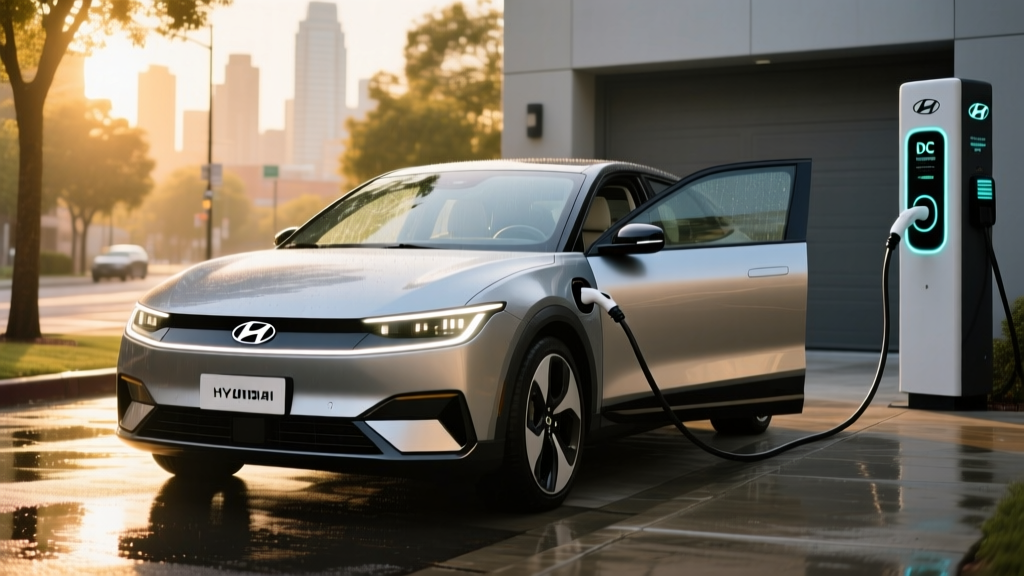
The 2024 Hyundai Ioniq 5 remains one of the most compelling electric crossovers on the used and leftover-new market heading into 2026. Built on Hyundai's Electric-Global Modular Platform (E-GMP) with an 800-volt architecture, it delivers class-leading DC fast-charging speeds, a spacious cabin, and a retro-futuristic design that still turns heads. But with the refreshed 2025 Ioniq 5 (and the high-performance Ioniq 5 N) now on dealer lots, is the 2024 model still a smart buy? This review breaks down every spec that matters — from real-world range to tax-credit math — so you can decide with confidence.
2024 Ioniq 5 at a Glance: Core Specifications
| Spec | SE/SEL RWD | SEL/Limited AWD |
|---|---|---|
| EPA Range | 303 miles | 260 miles |
| Battery (usable) | 77.4 kWh (NMC) | 77.4 kWh (NMC) |
| Horsepower | 168 hp | 320 hp |
| 0-60 mph | 7.0 sec | 4.5 sec |
| Drivetrain | Rear-Wheel Drive | Dual-Motor AWD |
| Max DC Fast Charge | ~240 kW (peak) | ~240 kW (peak) |
| 10-80% DC Time | ~18 min (ideal) | ~18 min (ideal) |
| Level 2 Home Charge | 10.9 kW (~44 mi/hr) | 10.9 kW (~44 mi/hr) |
| MPGe (combined) | 114 MPGe | 98 MPGe |
| Efficiency | 30 kWh/100 mi | 34 kWh/100 mi |
| Cargo (rear seats up) | 27.2 cu ft | 27.2 cu ft |
| Cargo (seats folded) | 59.3 cu ft | 59.3 cu ft |
| Frunk | 0.85 cu ft (AWD) / 2.1 cu ft (RWD) | 0.85 cu ft |
| Base MSRP (2024) | $41,800 (SE Std Range) / $45,850 (SE Long Range) | $50,350 (SEL AWD) / $54,200 (Limited AWD) |
| Battery Warranty | 10 years / 100,000 miles | |
| Vehicle Warranty | 5 years / 60,000 miles | |
Sources: EPA fueleconomy.gov, Hyundai Motor America press materials.
Real-World Range: What the EPA Sticker Doesn't Tell You
Real-World Expectation: ~250-275 miles highway (RWD); ~215-240 miles highway (AWD). In freezing temperatures (below 32°F), expect a 20-30% reduction — bringing the RWD to roughly 210-240 miles and the AWD to 180-210 miles on a full charge.
The 2024 Ioniq 5's EPA range figures are competitive, but real-world results depend heavily on your driving profile. In our experience and consistent with third-party testing from outlets like Edmunds and InsideEVs, the RWD Long Range model delivers between 250 and 275 miles at sustained highway speeds of 70-75 mph in moderate temperatures (55-80°F). City driving with frequent regenerative-braking opportunities pushes efficiency closer to — and sometimes above — the EPA number.
The AWD model's lower EPA rating (260 miles) reflects the energy cost of the front motor and additional weight. On highway road trips, plan for 215-240 miles of usable range before you'll want to stop. Cold weather is the great equalizer: the Ioniq 5 uses a heat pump (standard on all trims), which helps, but lithium-ion chemistry inherently loses efficiency in freezing temps. If your commute is short and you can garage-charge, the cold-weather hit is manageable. If you're doing 300-mile winter road trips through the Rockies, you'll need to plan charging stops carefully.
One ownership note: the Ioniq 5's battery management system maintains a relatively large top and bottom buffer. This protects long-term battery health but means the 77.4 kWh usable capacity is already net of that buffer — you won't see the full gross capacity available for driving.
Charging Speed: The 800-Volt Advantage
The 2024 Ioniq 5's headline technical feature is its 800-volt electrical architecture, shared with the Kia EV6 and Genesis GV60. Most mainstream EVs use 400V systems; doubling the voltage allows the Ioniq 5 to accept significantly higher DC fast-charging power without requiring thicker, heavier cables.
| Charging Level | Power (kW) | Speed (approx.) | Use Case |
|---|---|---|---|
| Level 1 (120V household) | ~1.4 kW | ~5 miles/hour | Emergency top-up, overnight trickle |
| Level 2 (240V home/public) | 10.9 kW (max onboard) | ~44 miles/hour | Daily home charging, full overnight refill |
| DC Fast Charge (350 kW station) | Peak ~240 kW | 10-80% in ~18 min | Road trips, rapid top-ups |
| DC Fast Charge (150 kW station) | ~150 kW (sustained) | 10-80% in ~25 min | Common public charging |
| DC Fast Charge (50 kW station) | ~50 kW | 10-80% in ~60 min | Older public chargers |
The critical nuance for buyers: kW is power (charge rate), kWh is energy (battery capacity). A 240 kW peak doesn't mean you sustain that rate for the entire session. The Ioniq 5's charge curve peaks around 235-240 kW at low state-of-charge (roughly 10-30%), then tapers progressively. From 50-80%, you'll see roughly 120-150 kW, and above 80% the rate drops sharply to protect the battery. This is why manufacturers quote 10-80% times rather than 0-100%.
At a 350 kW Electrify America or Tesla Supercharger (with NACS adapter, available from Hyundai), the Ioniq 5 can genuinely add ~200 miles in 18-20 minutes under ideal conditions. At the more common 150 kW chargers still widespread across the U.S., expect 10-80% in roughly 25 minutes — still excellent for road-trip stops.
For home Level 2 charging, the 10.9 kW onboard charger means a full 10-100% refill takes about 7-8 hours on a 48-amp Level 2 station (like a ChargePoint Home Flex or Wallbox Pulsar Plus). Most owners plug in overnight and wake up to a full battery every morning, which is the ideal EV ownership pattern.
Performance and Driving Dynamics
The RWD model's 168 hp is adequate for commuting and highway merging but won't thrill anyone. The 7.0-second 0-60 time is leisurely by EV standards. The AWD dual-motor setup transforms the car: 320 hp and a 4.5-second 0-60 time deliver the effortless, instant-torque acceleration that EVs are known for. The AWD system also provides genuine all-weather confidence — torque distribution adjusts automatically, and the low center of gravity (battery pack under the floor) keeps body roll well-controlled in corners.
Ride quality is firm but compliant, tuned more for European-style composure than plush American isolation. Road noise is moderate — improved over earlier Hyundai EVs but not class-leading. The steering is precise if slightly numb, and the one-pedal driving mode (i-Pedal) offers strong regenerative braking that can bring the car to a full stop without touching the brake pedal.
Towing capacity is rated at 1,650 lbs with the factory tow hitch — enough for a small utility trailer or a pair of dirt bikes, but not for any serious camping trailer. If towing is a priority, the Ford Mustang Mach-E or Rivian R1S are better choices.
Pricing, Trims, and Federal Tax Credit Eligibility
The 2024 Ioniq 5 was offered in four main trims, all with the 77.4 kWh Long Range battery (a Standard Range SE with a 58 kWh pack was also available early in the model year):
| Trim | Drivetrain | 2024 MSRP | Est. After §30D Credit* |
|---|---|---|---|
| SE Standard Range | RWD | $41,800 | ~$34,300 |
| SE Long Range | RWD | $45,850 | ~$38,350 |
| SEL Long Range | RWD | $47,400 | ~$39,900 |
| SEL AWD | AWD | $50,350 | ~$42,850 |
| Limited AWD | AWD | $54,200 | ~$46,700 |
*Estimated price assumes full $7,500 federal tax credit eligibility. Actual eligibility depends on buyer income, battery component sourcing, and MSRP caps. See IRS guidelines below.
- MSRP Cap: SUVs/crossovers must be ≤$80,000 MSRP — all 2024 Ioniq 5 trims qualify.
- Buyer Income Cap: Modified AGI ≤$150,000 (single), ≤$225,000 (head of household), ≤$300,000 (joint). Check your most recent tax year.
- Battery Sourcing: Increasingly strict critical-mineral and battery-component requirements apply. As of 2024, the Ioniq 5 (built in Georgia at Hyundai's Metaplant) meets partial or full credit depending on the specific battery cell batch — verify via the IRS qualified vehicle list or ask your dealer for the VIN-specific credit report.
- Point-of-Sale Transfer: Starting 2024, buyers can transfer the credit to the dealer for an immediate price reduction at purchase, rather than waiting to claim it on their tax return.
Important caveat: Battery sourcing rules tightened significantly in 2024 and continue to evolve. Some Ioniq 5 VINs qualify for the full $7,500, some for $3,750, and some for $0, depending on when and where the battery cells were manufactured. Always verify with the dealer's IRS compliance tool before signing. Tax credit rules are subject to change — consult a tax professional or irs.gov for your specific situation.
Interior, Cargo, and Daily Usability
The Ioniq 5's cabin is one of its strongest selling points. The flat floor (enabled by the skateboard-style battery pack) creates an airy, open feel. Rear legroom is generous at 39.4 inches — adults sit comfortably on long trips. The sliding center console ("Universal Island") can move forward or back, creating flexible storage between the front seats.
Cargo space behind the rear seats is 27.2 cubic feet — competitive with the Tesla Model Y (30.2 cu ft) and larger than the Ford Mustang Mach-E (29.7 cu ft behind the second row is close, but the Ioniq 5's boxier shape makes loading easier). Fold the rear seats and you get 59.3 cu ft, enough for a weekend's worth of camping gear or a Costco haul.
The frunk (front trunk) is disappointingly small: just 2.1 cu ft on RWD models and 0.85 cu ft on AWD models — barely enough for a charging cable bag. This is because the 800V power electronics and HVAC components occupy the space where a larger frunk would be.
Tech highlights include dual 12.3-inch displays (instrument cluster and infotainment on one curved panel), wireless Apple CarPlay and Android Auto (on lower trims — the Limited requires a USB cable), Hyundai's Bluelink connected services, and a head-up display with augmented-reality navigation on the Limited trim. The infotainment system is responsive and logically laid out, with physical buttons for climate control — a welcome choice over touch-only interfaces.
Driver Assistance and Safety
Hyundai SmartSense on the 2024 Ioniq 5 includes forward collision-avoidance assist (with pedestrian, cyclist, and junction-turning detection), blind-spot collision-avoidance, rear cross-traffic collision-avoidance, lane-keeping assist, lane-following assist, highway driving assist (HDA), and adaptive cruise control with stop-and-go. The Limited trim adds Highway Driving Assist 2 (HDA2), which adds lane-change assist and machine-learning-based adaptive cruise that mimics your driving style.
The HDA system is competent for long highway stretches — it keeps the car centered and maintains distance smoothly — but it requires hands on the wheel and does not support hands-free operation like GM's Super Cruise or Ford's BlueCruise. It's a solid Level 2 system, not a differentiator versus competitors.
Safety ratings are excellent: the 2024 Ioniq 5 earned an IIHS Top Safety Pick+ award and a 5-star overall NHTSA rating.
Pros, Cons, and Who Should Buy
- Class-leading 800V DC fast charging (~18 min 10-80%)
- Spacious, well-designed interior with flat floor
- 10-year/100,000-mile battery warranty (best in class)
- Standard heat pump for better cold-weather efficiency
- Vehicle-to-load (V2L) capability — power devices from your car
- Strong safety ratings (IIHS TSP+, NHTSA 5-star)
- Competitive pricing, especially after tax credits
- Tiny frunk (0.85-2.1 cu ft)
- No rear wiper (2024 model; added in 2025 refresh)
- AWD range drops to 260 miles EPA
- RWD model feels underpowered (168 hp)
- Limited trim requires USB cable for smartphone integration
- No hands-free driving assist (only hands-on-wheel)
- Charging port on the driver side rear — awkward at some pull-through chargers
- Daily commuters with home charging: Ideal. Plug in overnight, wake up to 300 miles, and rarely visit a gas station. The 10-year warranty gives peace of mind.
- Families needing space: Strong choice. The flat floor, generous rear legroom, and boxy cargo area work well for car seats and strollers.
- Road trippers: Viable with planning. The 18-minute fast-charge capability means stops are shorter than most competitors, but 260-mile AWD range means more frequent stops than a Tesla Model Y Long Range (310+ mi).
- Cold-climate drivers: The heat pump helps, but expect meaningful range loss. Garage parking and preconditioning are your friends.
- Towing buyers: Look elsewhere. 1,650-lb capacity is minimal.
2024 Ioniq 5 vs. Key Competitors
In the midsize electric crossover segment, the 2024 Ioniq 5 competes directly with the Tesla Model Y, Ford Mustang Mach-E, Kia EV6, and Volkswagen ID.4. Here's how it stacks up on the metrics that matter:
| Spec | 2024 Ioniq 5 (RWD LR) | 2024 Tesla Model Y (LR) | 2024 Ford Mach-E (ER RWD) | 2024 Kia EV6 (RWD LR) |
|---|---|---|---|---|
| EPA Range | 303 mi | 310 mi | 250 mi | 310 mi |
| Peak DC Charge | ~240 kW | ~250 kW | ~150 kW | ~240 kW |
| 10-80% DC Time | ~18 min | ~20 min | ~35 min | ~18 min |
| Base MSRP | $45,850 | $44,990 | $48,995 | $46,700 |
| Battery Warranty | 10/100,000 | 8/120,000 | 8/100,000 | 10/100,000 |
The Ioniq 5 and EV6 share the E-GMP platform and are nearly identical mechanically — choose based on design preference and dealer experience. The Model Y offers slightly more range and access to the Supercharger network (though Hyundai now offers a NACS adapter for Supercharger access). The Mach-E lags on charging speed but offers a sportier driving feel.
Frequently Asked Questions
What is the real-world range of the 2024 Ioniq 5?
Expect 250-275 miles in real-world mixed driving for the RWD Long Range model (EPA 303 mi), and 215-240 miles for the AWD (EPA 260 mi). Highway driving at 75+ mph and cold weather below freezing will reduce range by 15-30%.
How fast does the 2024 Ioniq 5 charge at home and on the road?
At home on a Level 2 (240V, 48-amp) charger, the Ioniq 5 charges at up to 10.9 kW, adding about 44 miles of range per hour — a full charge takes roughly 7-8 hours. On a 350 kW DC fast charger, it peaks around 240 kW and charges from 10-80% in approximately 18 minutes under ideal conditions.
Does the 2024 Ioniq 5 qualify for the $7,500 federal EV tax credit?
It can, but eligibility depends on the specific VIN's battery sourcing, the buyer's income (AGI caps apply), and the vehicle's MSRP (all trims fall under the $80,000 SUV cap). Battery sourcing requirements tightened in 2024, so some VINs qualify for the full $7,500, some for $3,750, and some for $0. Verify via the IRS qualified vehicle list and your dealer before purchasing.
Is the 2024 Ioniq 5 worth buying vs. the 2025 refresh?
The 2025 Ioniq 5 adds a rear wiper, a slightly larger battery (84 kWh usable), Tesla NACS charge port native (no adapter needed), and minor styling tweaks. If you find a well-priced 2024 model (especially with the $7,500 credit applied), it remains an excellent value. The 800V charging architecture, safety ratings, and 10-year warranty are identical across both years.
What is the battery warranty on the 2024 Ioniq 5?
Hyundai covers the high-voltage battery for 10 years or 100,000 miles (whichever comes first), with a capacity retention threshold of 70%. If the battery degrades below 70% of its original capacity within that period, Hyundai will repair or replace it. This is one of the longest battery warranties in the EV market.
Can I use Tesla Superchargers with the 2024 Ioniq 5?
Yes, with Hyundai's NACS adapter (sold separately or included depending on purchase timing). The 2024 Ioniq 5 uses a CCS1 charge port natively. The adapter allows access to Tesla's Supercharger network, which significantly expands your road-trip charging options. The 2025 refresh switches to a native NACS port.