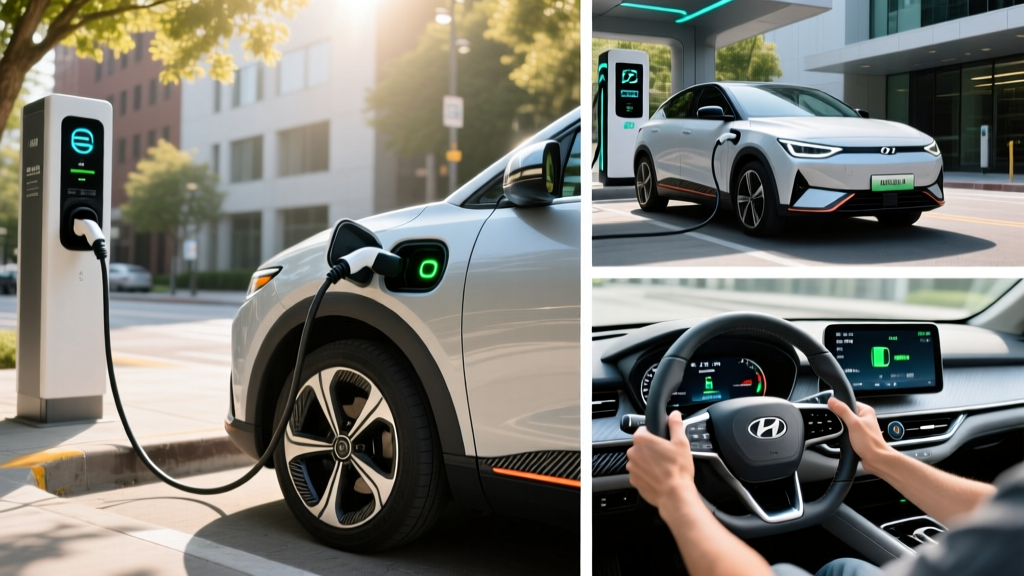
The 2023 Hyundai Ioniq 5 remains one of the most compelling electric crossovers on the used and certified-pre-owned market in 2026. Built on Hyundai's Electric-Global Modular Platform (E-GMP) with an 800-volt architecture, it delivers class-leading DC fast-charging speeds, a spacious cabin, and retro-futuristic styling that still turns heads. With the 2025 refresh adding a body and XRT variant, the 2023 model year now represents a value sweet spot — particularly for buyers seeking a proven platform at a discount.
This review covers the 2023 Ioniq 5 across every metric that matters to EV buyers: real-world range, charging speed, pricing after tax credits, and how it stacks up against the Tesla Model Y, Ford Mustang Mach-E, and Kia EV6.
2023 Hyundai Ioniq 5: Key Specifications at a Glance
| Specification | SEL RWD (Std Range) | SEL/Limited RWD (Long Range) | SEL/Limited AWD (Long Range) |
|---|---|---|---|
| EPA Range | 220 mi | 303 mi | 260 mi |
| Battery (Usable) | 58 kWh (NMC) | 77.4 kWh (NMC) | 77.4 kWh (NMC) |
| Horsepower | 168 hp | 225 hp | 320 hp |
| 0-60 mph | ~7.2 sec | ~7.0 sec | ~5.1 sec |
| Peak DC Fast Charge | ~175 kW | ~240 kW | ~240 kW |
| 10-80% DC Charge Time | ~22 min | ~18 min | ~18 min |
| Level 2 (240V) Rate | 10.9 kW | 10.9 kW | 10.9 kW |
| MPGe (Combined) | 114 MPGe | 114 MPGe | 101 MPGe |
| Base MSRP (2023) | $41,450 | $43,950 | $47,650 |
Sources: EPA fueleconomy.gov, Hyundai Motor America
Real-World Range: What the EPA Sticker Doesn't Tell You
- EPA Combined: 303 miles
- Real-World Highway (70 mph, 75°F): ~250–270 miles
- Real-World City/Mixed: ~280–295 miles
- Cold Weather (below 32°F): ~210–240 miles (20–30% reduction)
The 303-mile EPA figure for the Long Range RWD is legitimate, but as with every EV, real-world results depend heavily on driving style, speed, and temperature. In highway testing at sustained 70–75 mph speeds, the Ioniq 5 Long Range RWD typically delivers 250–270 miles before needing a charge. This is because EV efficiency drops significantly at higher speeds — aerodynamic drag scales with the square of velocity, and the Ioniq 5's boxy crossover profile doesn't help.
Around town, where regenerative braking recaptures energy and speeds are lower, you'll see results much closer to the EPA sticker — often 280–295 miles on a full charge. In cold weather (below freezing), expect a 20–30% range reduction due to battery chemistry limitations and cabin heating demands. The Ioniq 5 uses a heat pump (standard on Long Range trims), which helps mitigate winter losses compared to resistive heating, but physics still applies. Preconditioning the battery while plugged in — using the Hyundai app to warm the cabin and battery before departure — can recover some of that lost range.
The AWD Long Range variant sacrifices range for traction and power: its EPA rating is 260 miles, with real-world highway driving yielding approximately 215–235 miles. The Standard Range RWD (220 EPA) is best suited for urban commuters with home charging access; road-trippers should look past it.
Charging Speed: The Ioniq 5's Biggest Advantage
The 2023 Ioniq 5's 800-volt electrical architecture is the feature that most clearly separates it from competitors still running 400V systems. Here's what that means in practice:
| Charging Level | Power / Rate | Time (Long Range 77.4 kWh) | Miles Added per Hour |
|---|---|---|---|
| Level 1 (120V household) | ~1.4 kW | ~55 hours (0-100%) | ~4 mi/hr |
| Level 2 (240V, 48A home charger) | 10.9 kW | ~7.5 hours (0-100%) | ~35 mi/hr |
| DC Fast Charge (350 kW station) | Peak ~240 kW | ~18 min (10-80%) | ~650 mi/hr (peak) |
At a 350 kW-capable DC fast charger (Electrify America, EVgo, or similar), the Long Range Ioniq 5 can peak at approximately 240 kW. In optimal conditions — battery preconditioned, starting at ~10% State of Charge — you'll add roughly 200 miles of range in 15 minutes. The 10-80% charge takes about 18 minutes, which is among the fastest in its class.
However, understanding the charge curve is essential. The 240 kW figure is a peak, not a sustained rate. Charging speed tapers as the battery fills: you'll see peak speeds between roughly 10–40% SoC, then a gradual step-down through 60%, and a sharp taper above 80%. Charging from 80-100% on DC fast charge can take nearly as long as 10-80%. For road trips, plan to charge to 80% and move on — it's faster overall than waiting for a full battery.
For home Level 2 charging, the onboard charger maxes out at 10.9 kW. On a 48-amp, 240V circuit (the most common home EV charger installation), you'll add approximately 35 miles of range per hour, or fully recharge overnight in about 7.5 hours. Note: the Ioniq 5 uses the CCS1 connector for DC fast charging and the J1772 connector for Level 2. Hyundai has announced a transition to the Tesla NACS connector for future model years, but the 2023 model requires a NACS-to-CCS adapter (available from Hyundai and third parties) to access Tesla Supercharger stalls.
Performance and Driving Dynamics
The dual-motor AWD Ioniq 5 produces 320 horsepower and 446 lb-ft of torque, launching it to 60 mph in approximately 5.1 seconds. That's genuinely quick for a family crossover and puts it in the same ballpark as the Ford Mustang Mach-E GT (though not the Mach-E GT Performance Edition). The instant torque delivery makes highway merging and passing effortless.
The RWD Long Range variant's 225 hp and 7.0-second 0-60 time are adequate for daily driving but won't thrill enthusiasts. The Standard Range RWD, at 168 hp, feels noticeably less urgent.
Ride quality is a strong suit. The Ioniq 5's E-GMP platform positions the battery low and between the axles, giving it a planted, composed feel. The suspension absorbs bumps well, and cabin noise is minimal at highway speeds. Hyundai offers multiple regenerative braking levels, adjustable via steering-wheel paddles, including an i-Pedal mode for one-pedal driving that brings the car to a complete stop without touching the brake pedal.
Towing capacity is rated at 1,650 pounds (with trailer brakes) — enough for a small utility trailer or a pair of dirt bikes, but not a camper. This is a limitation compared to the Rivian R1S or even the Tesla Model Y (3,500 lbs), so heavy tow needs should look elsewhere.
Pricing, Trims, and Federal Tax Credit Eligibility
The 2023 Ioniq 5 launched with three main trim levels: SE, SEL, and Limited. Here's the original MSRP structure and what to expect on the used/CPO market in 2026:
| Trim | Original MSRP | Est. Used/CPO (2026) | Federal Tax Credit (New, §30D) |
|---|---|---|---|
| SE Standard Range RWD | $41,450 | $27,000–$31,000 | Up to $7,500* |
| SEL Long Range RWD | $43,950 | $30,000–$34,000 | Up to $7,500* |
| SEL Long Range AWD | $47,650 | $33,000–$37,000 | Up to $7,500* |
| Limited Long Range AWD | $52,200 | $36,000–$41,000 | Up to $7,500* |
*Tax credit shown for original new purchase under IRS §30D rules. Eligibility depends on buyer income, battery sourcing, and MSRP caps. See below.
Does the 2023 Ioniq 5 Qualify for the Federal EV Tax Credit?
When purchased new, the 2023 Ioniq 5 was eligible for up to $7,500 under IRS §30D, subject to these requirements:
- Buyer income caps: Modified AGI ≤ $150,000 (single), $225,000 (head of household), $300,000 (joint)
- MSRP cap: Vehicle MSRP must not exceed $80,000 for SUVs/crossovers (all Ioniq 5 trims qualify)
- Battery sourcing: The $7,500 credit splits into two halves — $3,750 for critical minerals sourcing and $3,750 for battery component manufacturing. Sourcing requirements tighten annually. For the 2023 model year, most Ioniq 5 vehicles qualified for the full $7,500, but verify specifics with your tax professional
- Assembly: Must be assembled in North America (the Ioniq 5 is assembled in Ulsan, South Korea — this became a point of contention; Hyundai later shifted some production to the U.S. for 2024+ models)
Important for 2026 buyers: If you're purchasing a used 2023 Ioniq 5, the Used EV Tax Credit (IRC §25E) may apply instead — up to $4,000 or 30% of the sale price (whichever is less), with lower income caps ($75,000 single / $150,000 joint) and a $25,000 maximum vehicle price. Always confirm eligibility with a tax professional and check current IRS guidance.
Interior, Cargo Space, and Technology
The Ioniq 5's interior is one of its strongest selling points. Hyundai's "Living Space" design philosophy creates an airy, minimalist cabin with a flat floor (no transmission tunnel) and a sliding center console that can move forward or back to create extra space between the front seats. The universal "island" armrest doubles as a storage cubby and device tray.
Cargo volume:
- Behind rear seats: 27.2 cu ft
- Rear seats folded: 59.3 cu ft
- Front trunk (frunk): 0.85 cu ft (AWD) / 2.0 cu ft (RWD) — enough for a charging cable bag, not much more
Passenger space:
- Front legroom: 41.7 inches
- Rear legroom: 39.4 inches — generous for a compact crossover, and the flat floor makes the middle seat usable
- Headroom front/rear: 39.6 / 38.6 inches
The dual 12.3-inch displays (instrument cluster and infotainment) are integrated into a single curved panel on higher trims. The infotainment system supports wireless Apple CarPlay and Android Auto, over-the-air updates, and Hyundai's Digital Key (phone-as-key via NFC). Physical climate controls are a welcome touch — no fumbling through touchscreen menus to adjust the temperature.
Driver assistance (Hyundai SmartSense): The 2023 Ioniq 5 includes Highway Driving Assist 2 (HDA2), which combines adaptive cruise control with lane-centering and automatic lane-change assist. This is an SAE Level 2 system — it assists with steering, acceleration, and braking, but the driver must remain fully engaged with hands on the wheel and eyes on the road. It is not autonomous driving. The system is competent on highways but can be overly cautious in merging situations. A hands-free system like GM's Super Cruise it is not.
- Frunk is very small, especially on AWD models
- No rear wiper (a common complaint; rain/snow accumulates on the rear glass)
- Rear visibility is somewhat compromised by thick C-pillars
- Infotainment can be laggy compared to Tesla or Rivian systems
- CCS1 connector requires an adapter for Tesla Supercharger access
- Towing limited to 1,650 lbs
Pros and Cons
✓ Pros
- Class-leading 800V DC fast charging (~18 min 10-80%)
- Spacious, flat-floor cabin with excellent rear legroom
- Comfortable ride quality and low cabin noise
- Strong value with competitive MSRP
- Standard heat pump (Long Range) for cold-weather efficiency
- 10-year/100,000-mile battery warranty
- V2L (Vehicle-to-Load) capability — power devices from the car
✗ Cons
- Real-world highway range falls 30–50 mi below EPA
- Tiny frunk, especially on AWD
- No rear wiper
- Towing capacity only 1,650 lbs
- CCS1 connector limits Supercharger access without adapter
- Infotainment not as responsive as competitors
- AWD range penalty is steep (~43 mi less than RWD)
How It Compares: Ioniq 5 vs. Key Rivals
| Spec | Hyundai Ioniq 5 (LR RWD) | Tesla Model Y (LR) | Ford Mach-E (ER RWD) | Kia EV6 (LR RWD) |
|---|---|---|---|---|
| EPA Range | 303 mi | 330 mi | 312 mi | 310 mi |
| Battery | 77.4 kWh NMC | ~75 kWh NMC | 91 kWh NMC | 77.4 kWh NMC |
| Peak DC Charge | ~240 kW | ~250 kW | ~150 kW | ~240 kW |
| 10-80% DC Time | ~18 min | ~25 min | ~38 min | ~18 min |
| 0-60 mph | 7.0 sec | 5.0 sec (AWD) | 6.1 sec | 7.2 sec |
| Cargo (rear seats up) | 27.2 cu ft | 30.2 cu ft | 29.7 cu ft | 24.4 cu ft |
| Connector | CCS1 | NACS | CCS1 | CCS1 |
Sources: fueleconomy.gov, manufacturer specifications
Choose the Ioniq 5 if: You prioritize fast DC charging, a comfortable and spacious cabin, and strong value. The 800V architecture means shorter road-trip charging stops than the Mach-E, and the interior feels more premium and practical than the Model Y's minimalist approach.
Choose the Model Y if: You want the longest range, the Supercharger network (no adapter needed), and the most cargo space. Tesla's software and Autopilot/FSD ecosystem are also more mature.
Choose the Mach-E if: You prefer a more traditional car-like driving experience and Ford's dealer network for service. But its slower charging is a real road-trip penalty.
Choose the EV6 if: You want the same E-GMP platform and charging speed in a sportier, lower-slung package — but sacrifice some rear headroom and cargo space.
Warranty and Ownership Costs
Hyundai's warranty coverage is among the best in the industry:
- Battery: 10 years / 100,000 miles (capacity retention threshold: 70% of original capacity)
- Powertrain: 10 years / 100,000 miles
- New Vehicle (bumper-to-bumper): 5 years / 60,000 miles
- Roadside Assistance: 5 years / unlimited miles
- Complimentary Maintenance: 3 years / 36,000 miles (oil changes don't apply, but tire rotations, inspections, and cabin filter replacements are covered)
The battery uses NMC (Nickel Manganese Cobalt) chemistry, which offers higher energy density than LFP but requires more careful charge management for longevity. Best practice: set daily charging to 80% and only charge to 100% before long trips. Avoid leaving the car at 100% SoC for extended periods, especially in hot weather.
For total cost of ownership, the Ioniq 5 benefits from lower "fuel" costs (electricity at $0.13–0.18/kWh nationally translates to roughly $0.04–0.06 per mile, versus $0.12–0.16/mile for a 25-MPG gas car at $3.50/gallon), reduced maintenance (no oil changes, fewer brake replacements due to regen), and strong depreciation stability. Insurance costs tend to be slightly above average for the segment — expect $150–$220/month depending on your profile and location.
Who Should Buy the 2023 Hyundai Ioniq 5?
Best for: Daily commuters with home Level 2 charging who take occasional road trips. The Ioniq 5 excels as a comfortable, fast-charging daily driver with enough range for most commutes and weekend trips. Families will appreciate the spacious rear seat and cargo area.
Not ideal for: Heavy towers (1,650-lb limit), frequent long-distance road-trippers in cold climates (range loss + charging stops add up), or buyers who need Supercharger network access without adapter hassle. If you tow a camper regularly or live in a charging desert, consider a longer-range option or a PHEV.
Frequently Asked Questions
What is the real-world range of the 2023 Hyundai Ioniq 5?
The Long Range RWD delivers approximately 250–270 miles in real-world highway driving (EPA rates it at 303 mi). City and mixed driving gets closer to 280–295 miles. In cold weather below freezing, expect 210–240 miles. The AWD variant yields roughly 215–235 miles on the highway.
How fast does the Ioniq 5 charge at home and on the road?
At home on a Level 2 (240V, 48A) charger, the onboard charger accepts up to 10.9 kW, adding about 35 miles per hour — a full overnight charge in ~7.5 hours. On a 350 kW DC fast charger, it peaks at ~240 kW and charges from 10-80% in approximately 18 minutes, one of the fastest in its class thanks to its 800V architecture.
Does the 2023 Ioniq 5 qualify for the $7,500 federal tax credit?
When purchased new, it was eligible for up to $7,500 under IRS §30D, subject to buyer income caps ($150K single/$300K joint), MSRP under $80,000 (all trims qualify), and battery sourcing requirements. However, because the 2023 Ioniq 5 was assembled in South Korea, some early 2023 buyers did not qualify under the final-assembly requirement until Hyundai adjusted production. For used purchases in 2026, the §25E Used EV Credit (up to $4,000) may apply. Consult a tax professional and IRS.gov for current rules.
Is the Ioniq 5 worth buying vs. the Tesla Model Y?
The Ioniq 5 charges faster on DC (18 min vs. ~25 min 10-80%), has a more comfortable ride, and offers a more traditional, premium interior. The Model Y wins on range (330 vs. 303 mi EPA), cargo space (30.2 vs. 27.2 cu ft), Supercharger network access, and software maturity. If fast charging and cabin comfort matter most, the Ioniq 5 is the pick. If range and charging infrastructure convenience are paramount, the Model Y edges ahead.
What connector does the 2023 Ioniq 5 use?
The 2023 Ioniq 5 uses CCS1 for DC fast charging and J1772 for Level 2 AC charging. It does not natively use the Tesla NACS connector, but Hyundai offers an adapter that enables access to Tesla Supercharger stalls (V3 and V4). Future Hyundai models are transitioning to native NACS.
How long will the Ioniq 5 battery last?
Hyundai warranties the battery for 10 years/100,000 miles with a 70% capacity retention threshold. Based on NMC chemistry degradation data from similar E-GMP vehicles, most owners can expect 85–90% capacity retention at 100,000 miles with proper charging habits (daily 80% limit, avoiding extended 100% SoC, minimizing DC fast charging to >90%). Battery replacement, if ever needed out of warranty, is estimated at $8,000–$14,000 depending on labor and sourcing.