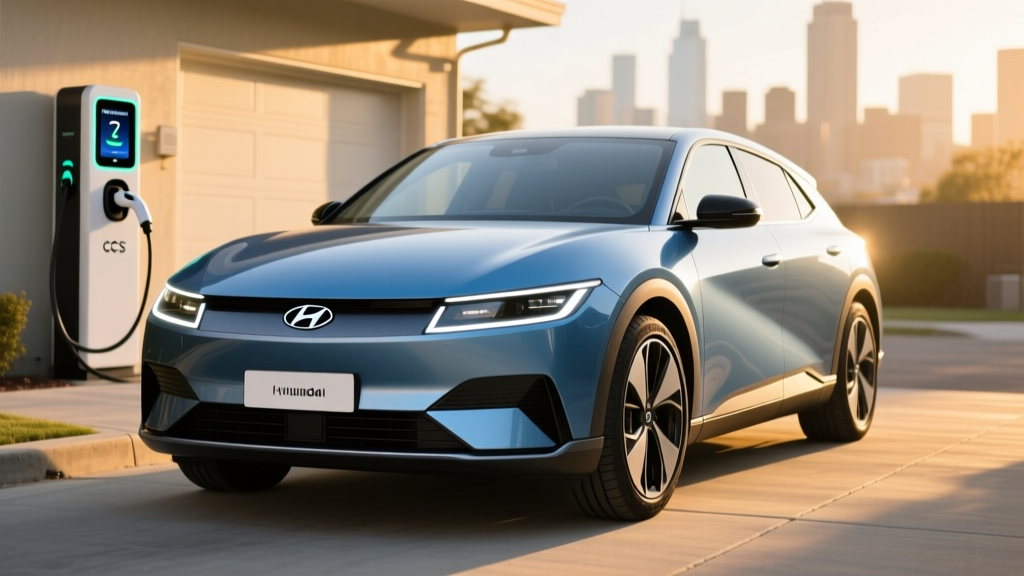
The Hyundai Ioniq 4 enters the 2026 model year as a midsize electric crossover positioned squarely between the compact Ioniq 5 and the three-row Ioniq 7. Built on Hyundai Motor Group's E-GMP (Electric Global Modular Platform) architecture — the same 800-volt underpinning that gives the Ioniq 5 and Kia EV6 their class-leading charge speeds — the Ioniq 4 aims to offer a more aerodynamic, slightly larger alternative to its hatchback sibling. We've spent time with the specifications, charging data, and ownership economics to give you the numbers that actually matter.
The Ioniq 4 Long Range RWD carries an EPA-estimated 330 miles of range. In real-world highway driving at 70-75 mph, expect approximately 275–295 miles in mild conditions (60–75°F). In cold weather (below 32°F), range drops to roughly 230–260 miles due to battery resistance and cabin heating demands. The AWD variant sees EPA range fall to 290 miles, with real-world highway figures around 245–265 miles. These losses are consistent with NMC lithium-ion packs across the industry — plan your road-trip charging stops accordingly.
Range, Battery, and Efficiency
The 2026 Ioniq 4 is offered with two battery configurations. The Standard Range model uses a 63.0 kWh (usable) lithium iron phosphate (LFP) pack, while the Long Range variant steps up to an 84.0 kWh (usable) nickel manganese cobalt (NMC) battery. This chemistry split is deliberate: LFP offers superior cycle life and can be routinely charged to 100% without degradation concern, making it ideal for daily commuting. NMC delivers higher energy density for maximum range but benefits from an 80% daily charge ceiling for longevity.
| Spec | Standard Range RWD | Long Range RWD | Long Range AWD |
|---|---|---|---|
| Battery (usable) | 63.0 kWh (LFP) | 84.0 kWh (NMC) | 84.0 kWh (NMC) |
| EPA Range | 245 mi | 330 mi | 290 mi |
| Efficiency (MPGe) | 118 MPGe | 125 MPGe | 107 MPGe |
| kWh/100 mi | 28 | 27 | 31 |
| Horsepower | 168 hp | 225 hp | 320 hp |
| 0–60 mph | 7.8 sec | 6.7 sec | 4.5 sec |
| Drivetrain | RWD | RWD | AWD (dual-motor) |
| Max DC Charge Rate | 150 kW | 240 kW | 240 kW |
| Base MSRP | $40,200 | $45,700 | $49,200 |
The Long Range RWD's 125 MPGe combined (27 kWh/100 mi) makes it one of the most efficient midsize crossovers in its class. For context, that translates to roughly $0.045–$0.06 per mile when charging at home on a national-average electricity rate of $0.16/kWh, compared to approximately $0.12–$0.15 per mile for a 28 MPG gas crossover at $3.50/gallon. Data sourced from fueleconomy.gov.
Charging Speed: DC Fast and Home Level 2
Hyundai's 800V E-GMP architecture remains the Ioniq 4's biggest charging advantage. The Long Range models accept a peak 240 kW on DC fast chargers, while the Standard Range LFP model tops out at 150 kW. But peak rate alone doesn't tell the full story — the charge curve matters more for real stops.
| Charging Level | Standard Range (63 kWh) | Long Range (84 kWh) |
|---|---|---|
| Level 1 (120V, 1.4 kW) | ~4 mi/hr added | ~5 mi/hr added |
| Level 2 (240V, 10.9 kW) | ~34 mi/hr · full in ~6.5 hr | ~36 mi/hr · full in ~8.5 hr |
| DC Fast (10–80%) | ~22 min (150 kW peak) | ~18 min (240 kW peak) |
| DC Fast (10–90%) | ~32 min | ~28 min |
The Long Range's 10–80% in approximately 18 minutes is achieved only on 350 kW-class chargers (such as Electrify America's latest stalls or Tesla Supercharger V4 with magic dock). On a 150 kW charger — still common on many networks — expect 10–80% in roughly 28–32 minutes. The charge curve tapers significantly above 80% SoC; that's why we quote 10–80% times rather than 0–100%. Charging past 80% can add another 20+ minutes for relatively few miles gained.
The onboard AC charger is 10.9 kW, meaning a properly installed 48-amp Level 2 home charger (like a ChargePoint Home Flex or Wallbox Pulsar Plus on a 60-amp circuit) will replenish the Long Range battery from empty in about 8.5 hours — easily overnight. Preconditioning the battery via the navigation-linked charging prep feature is critical in cold weather; without it, DC fast-charge speeds can be cut by 40–60% until the pack warms up.
Performance and Driving Dynamics
The dual-motor AWD variant's 320 horsepower and 4.5-second 0–60 mph time put it in quick-crossover territory, though not quite in the performance-EV bracket occupied by the Tesla Model Y Performance or Porsche Macan EV. The RWD Long Range's 225 hp and 6.7-second sprint are more than adequate for highway merging and daily driving.
Ride quality benefits from the E-GMP's low center of gravity and multi-link rear suspension. The Ioniq 4 is tuned slightly softer than the Ioniq 5, prioritizing comfort over sportiness — a deliberate choice for the family-crossover buyer. Regenerative braking offers four levels via steering-wheel paddles, including a true one-pedal-driving "i-Pedal" mode that brings the car to a complete stop without touching the brake pedal.
Pricing, Trims, and Federal Tax Credit
| Trim | Drivetrain | Base MSRP | Est. After §30D Credit* |
|---|---|---|---|
| SE Standard Range | RWD | $40,200 | $32,700 |
| SEL Long Range | RWD | $45,700 | $38,200 |
| Limited Long Range | RWD | $49,900 | $42,400 |
| SEL Long Range AWD | AWD | $49,200 | $41,700 |
| Limited Long Range AWD | AWD | $53,500 | $46,000 |
*§30D credit estimates assume full eligibility. Verify current rules at IRS.gov.
- MSRP cap: SUVs/crossovers must be ≤$80,000 — all Ioniq 4 trims qualify.
- Buyer income cap: Modified AGI ≤$150,000 (single), ≤$225,000 (head of household), ≤$300,000 (joint).
- Battery sourcing: Critical minerals and battery components must meet escalating domestic/free-trade-agreement percentages. Hyundai has been shifting supply chains, but eligibility for the full $7,500 vs. the partial $3,750 can change mid-year. Always check the latest DOE/Fuel Economy credit list before purchasing.
- Point-of-sale transfer: You can elect to transfer the credit to the dealer at purchase, reducing your out-of-pocket cost immediately rather than waiting for a tax refund.
- Not refundable: If your tax liability is less than the credit amount, the excess is not refunded. Consult a tax professional.
Interior Space, Cargo, and Technology
The Ioniq 4's wheelbase stretches to approximately 114.2 inches, yielding generous rear-seat legroom of 41.5 inches — competitive with the Toyota RAV4 and noticeably more than the Tesla Model Y's rear quarters. Front legroom measures 41.7 inches, and headroom is ample thanks to the flat floor and dedicated EV skateboard architecture.
Cargo volume behind the second row comes in at 27.2 cubic feet, expanding to 59.3 cubic feet with the 60/40 split rear seats folded. The front trunk (frunk) adds a modest 0.85 cubic feet on AWD models and 1.6 cubic feet on RWD — enough for a charging cable kit and small bag but not a major storage area.
Technology highlights include:
- Dual 12.3-inch curved displays (instrument cluster + infotainment) running Hyundai's latest ccNC operating system
- Wireless Apple CarPlay and Android Auto
- Hyundai Digital Key 2 (UWB-based phone-as-key with NFC backup)
- Vehicle-to-load (V2L) capability — 3.6 kW output via interior outlet and exterior adapter, enough to power campsite equipment or serve as emergency home backup
- Over-the-air (OTA) software updates for powertrain calibration, infotainment, and ADAS improvements
- Highway Driving Assist 2 (HDA2) — a SAE Level 2 driver-assistance system combining adaptive cruise with lane centering; the driver must remain engaged at all times
Hyundai's Highway Driving Assist 2 and Smart Cruise Control are SAE Level 2 systems. They do NOT make the Ioniq 4 a self-driving vehicle. You must keep your hands on the wheel and eyes on the road at all times. The system can fail to detect stationary objects, construction zones, and faded lane markings. It is not a substitute for an attentive driver.
Warranty Coverage
Hyundai backs the Ioniq 4 with one of the strongest warranty packages in the EV market:
- Battery: 10 years / 100,000 miles (capacity retention guaranteed above 70% of original)
- Electric powertrain (motor, inverter, reducer): 10 years / 100,000 miles
- New vehicle limited: 5 years / 60,000 miles
- Roadside assistance: 5 years / unlimited miles
- Complimentary maintenance: 3 years / 36,000 miles (oil changes don't apply, but covers cabin filter, tire rotation, multi-point inspections)
The 10-year battery warranty is a significant advantage over competitors like the Tesla Model Y (8 years/120,000 miles) and Volkswagen ID.4 (8 years/100,000 miles). The 70% capacity retention threshold is industry-standard — if your battery degrades below that within the warranty window, Hyundai will repair or replace it at no cost.
Ioniq 4 vs. Key Competitors
| Spec | Hyundai Ioniq 4 LR RWD | Tesla Model Y LR RWD | Kia EV6 LR RWD | VW ID.4 Pro S RWD |
|---|---|---|---|---|
| EPA Range | 330 mi | 320 mi | 310 mi | 291 mi |
| Battery (usable) | 84.0 kWh (NMC) | ~75 kWh (NMC) | 77.4 kWh (NMC) | 82.0 kWh (NMC) |
| DC Fast Charge (10–80%) | ~18 min | ~25 min | ~18 min | ~29 min |
| MPGe (combined) | 125 | 123 | 134 | 115 |
| Base MSRP | $45,700 | $44,990 | $44,900 | $44,995 |
| Battery Warranty | 10 yr/100k mi | 8 yr/120k mi | 10 yr/100k mi | 8 yr/100k mi |
The Ioniq 4's primary advantage over the Model Y is charging speed on non-Tesla networks and a longer battery warranty. The EV6 shares the E-GMP platform and nearly identical charge times but offers a sportier driving position and slightly less rear-seat space. The ID.4 trails on range and charge speed but often comes in at a lower out-the-door price with aggressive dealer incentives.
Pros, Cons, and Who Should Buy
- Class-leading 10–80% DC fast-charge time (~18 min on 350 kW)
- 330-mile EPA range (Long Range RWD)
- 10-year/100,000-mile battery warranty
- V2L capability for camping and emergency power
- Spacious rear seat (41.5" legroom) with flat floor
- LFP option for daily 100% charging without degradation worry
- Strong efficiency (125 MPGe combined)
- Small frunk (1.6 cu ft RWD / 0.85 cu ft AWD)
- HDA2 is competent but not as polished as GM Super Cruise on highways
- Charging speed advantage only realized on 350 kW chargers
- Tax credit eligibility subject to battery-sourcing rule changes
- Rear visibility compromised by thick C-pillars
- No NACS port standard (CCS1 with NACS adapter availability varies)
- Choose the Ioniq 4 Long Range RWD if you want maximum range and efficiency for commuting and road trips, can charge at home overnight, and value a 10-year battery warranty.
- Choose the Ioniq 4 AWD if you live in a snowy climate, need the traction and 4.5-second 0–60 for highway confidence, and can accept the ~40-mile range trade-off.
- Choose the Standard Range (LFP) if you commute under 50 miles daily, want to charge to 100% every night without battery-health concern, and want the lowest entry price.
- Look elsewhere if you need three rows (consider the Ioniq 7 or Kia EV9), want access to Tesla Superchargers natively without an adapter, or prioritize hands-free highway driving (GM Super Cruise or Ford BlueCruise vehicles).
Frequently Asked Questions
What is the real-world range of the 2026 Hyundai Ioniq 4?
The EPA rates the Long Range RWD at 330 miles. In real-world highway driving at 70–75 mph in moderate temperatures, expect approximately 275–295 miles. In cold weather (below freezing), plan for 230–260 miles. The Standard Range LFP model delivers roughly 200–215 real-world highway miles.
How fast does the Ioniq 4 charge at home and on DC fast chargers?
On a 350 kW DC fast charger, the Long Range model charges from 10–80% in approximately 18 minutes. On a 150 kW charger, that stretches to about 28–32 minutes. At home on a 10.9 kW Level 2 charger, a full charge takes roughly 8.5 hours for the Long Range and 6.5 hours for the Standard Range.
Does the 2026 Ioniq 4 qualify for the federal EV tax credit?
All Ioniq 4 trims fall under the $80,000 SUV MSRP cap. Buyer income must not exceed $150,000 (single) / $300,000 (joint). Battery component and critical mineral sourcing requirements apply and can change mid-year — check the DOE eligibility list and IRS §30D guidance before purchasing. The credit can be transferred to the dealer at point of sale to reduce your purchase price directly.
Is the Ioniq 4 worth buying over the Tesla Model Y?
The Ioniq 4 offers faster DC charging on non-Tesla networks, a longer battery warranty (10 vs. 8 years), and a more traditional crossover interior layout. The Model Y counters with native Supercharger network access, slightly lower starting price, and a more extensive service-center footprint. If you road-trip frequently in areas with sparse Supercharger coverage, the Ioniq 4's CCS compatibility with Electrify America and other networks may be more practical. If Supercharger density matters most in your region, the Model Y retains an edge.
What is the difference between LFP and NMC batteries in the Ioniq 4?
The Standard Range uses an LFP (lithium iron phosphate) battery: lower energy density (hence 245 miles of range) but excellent cycle life, safer thermal characteristics, and the ability to charge to 100% daily without degradation concern. The Long Range uses NMC (nickel manganese cobalt): higher energy density for 330 miles but benefits from an 80% daily charge limit for long-term health. Choose LFP for daily commuting; choose NMC for maximum road-trip range.
Does the Ioniq 4 have a NACS (Tesla-style) charging port?
The 2026 Ioniq 4 ships with a CCS1 port. Hyundai has announced NACS adoption for future models, and a CCS-to-NACS adapter may be available for Supercharger access depending on Hyundai's agreement with Tesla. Confirm adapter availability and compatibility with your specific model year at purchase.