For EV owners who want to charge on sunshine, Tesla's Solar Roof is the most talked-about option — and the most misunderstood. The Tesla tile roof cost sits in a category of its own compared to conventional solar panels, and the decision to install one hinges on whether you're also replacing an aging roof or simply looking to generate clean electricity for your electric vehicle.
This guide breaks down the real numbers behind Tesla's Solar Roof in 2026 — total installed cost, energy production, payback math for EV charging, and how it compares to traditional rack-mounted solar panels. We'll also touch on how pairing it with a Powerwall affects your ability to charge an EV overnight on stored solar.
What Exactly Is the Tesla Solar Roof?
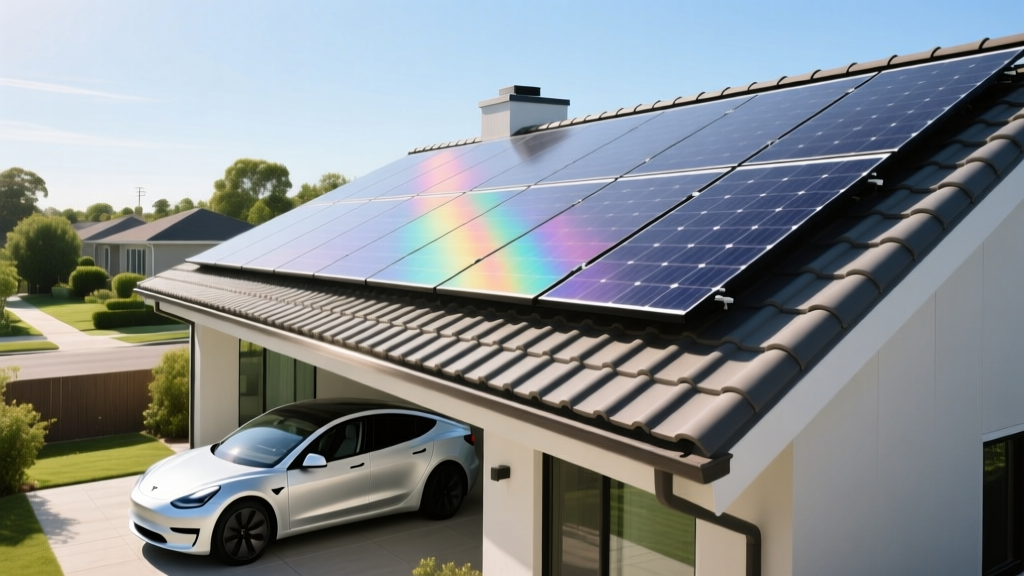
Unlike traditional solar installations where panels bolt onto existing shingles, the Tesla Solar Roof replaces your entire roof with a mix of active solar tiles and inactive (dummy) glass tiles. The active tiles contain photovoltaic cells that generate DC electricity, which an integrated inverter converts to AC for home use and EV charging. The inactive tiles match the active ones visually but produce no power — Tesla uses these on roof faces that get poor sun exposure to maintain a uniform look.
The product is essentially two purchases bundled into one: a premium roof replacement and a solar energy system. This dual nature is the single biggest factor driving the Tesla tile roof cost above conventional solar, and it's also the reason the product makes sense for some homeowners and very little sense for others.
Tesla Tile Roof Cost: 2026 Pricing Breakdown
Tesla prices the Solar Roof per square foot of total roof area, and the cost varies based on roof complexity (number of stories, pitch, penetrations like vents and skylights), the ratio of active to inactive tiles, and your location. Here's what the numbers look like for typical US homes in 2026:
| Home Size | Roof Area (sq ft) | System Size (kW) | Est. Installed Cost | Cost per Watt |
|---|---|---|---|---|
| Small (1,200 sq ft home) | ~1,500 | ~6 kW | $52,000 – $62,000 | $8.67 – $10.33 |
| Medium (2,000 sq ft home) | ~2,200 | ~10 kW | $68,000 – $85,000 | $6.80 – $8.50 |
| Large (3,000 sq ft home) | ~3,200 | ~15 kW | $95,000 – $125,000 | $6.33 – $8.33 |
These figures include the tiles, inactive glass tiles, underlayment, inverter(s), removal of the old roof, installation labor, and permitting. They do not include a Powerwall battery, which adds roughly $12,000–$16,000 per unit installed in 2026.
How the Federal Solar Tax Credit Reduces Your Cost
The Solar Roof qualifies for the federal Residential Clean Energy Credit (IRC §25D), which provides a 30% tax credit on the total installed cost — including the roofing portion — through 2032. This is a critical advantage: unlike the §30D EV tax credit, the solar credit has no income cap and no MSRP cap. However, you must have sufficient federal tax liability to claim it (it's non-refundable), and you should confirm eligibility with a tax professional.
| Home Size | Gross Cost | 30% Credit | Net Cost |
|---|---|---|---|
| Small (~6 kW) | $57,000 | –$17,100 | ~$39,900 |
| Medium (~10 kW) | $76,500 | –$22,950 | ~$53,550 |
| Large (~15 kW) | $110,000 | –$33,000 | ~$77,000 |
For context on current IRS rules and qualifying property, see the IRS Residential Clean Energy Credit page.
Energy Production and EV Charging Math
The real question for EV owners is whether the Tesla tile roof cost pays for itself through electricity savings — specifically, how much solar energy you'll generate and how that translates to EV charging.
A 10 kW Tesla Solar Roof in a moderately sunny US location (think mid-Atlantic, Midwest) produces roughly 12,000–14,500 kWh per year. In sunnier regions (Southwest, Southern California), that same system can produce 15,000–17,000 kWh annually. In cloudier climates (Pacific Northwest, New England), expect closer to 9,500–11,500 kWh.
What That Means for EV Charging
Let's put those production numbers in EV terms. The average American drives about 37 miles per day, and a modern EV like the Tesla Model Y consumes roughly 28 kWh per 100 miles (or about 0.28 kWh/mile). That means daily driving requires approximately 10.4 kWh, or about 3,800 kWh per year.
Even a modest 6 kW Solar Roof producing 8,000 kWh/year generates more than double the energy needed to power one EV's daily commute. A 10 kW system producing 13,000 kWh/year could realistically cover two EVs plus a meaningful portion of household electricity use.
Tesla Solar Roof vs. Conventional Solar Panels
The Tesla tile roof cost only makes sense when compared head-to-head with the alternative: conventional rack-mounted solar panels on a standard roof. Here's how the two paths compare for a typical 2,000 sq ft home needing a 10 kW system:
| Factor | Tesla Solar Roof | Conventional Panels |
|---|---|---|
| Total installed cost | $68,000 – $85,000 | $25,000 – $35,000 |
| New roof included? | Yes (full replacement) | No (mounts on existing) |
| Cost if roof also needs replacing | $68,000 – $85,000 (bundled) | $25,000 – $35,000 solar + $12,000 – $20,000 roof = $37,000 – $55,000 |
| Energy production (same kW) | Comparable (slightly lower efficiency per tile) | Comparable (slightly higher panel efficiency) |
| Aesthetics | Sleek, integrated look | Visible panels on roof |
| Installation timeline | 1–3 weeks (full tear-off) | 1–3 days |
| Warranty (tiles/product) | 25 years | 25 years (typical) |
| Warranty (power output) | 25 years | 25 years (typical) |
The math becomes clearer when your existing roof is near end-of-life. If you'd spend $15,000 on a new asphalt shingle roof anyway, the incremental cost of the Solar Roof over "new roof + conventional panels" shrinks to roughly $13,000–$30,000 — a premium you're paying for aesthetics and integration. If your roof is relatively new (under 10 years old), the Tesla tile roof cost is very hard to justify on financial grounds alone.
Powerwall, Time-of-Use, and Overnight EV Charging
Solar panels produce energy during the day, but most EV owners charge at night. Without battery storage, your solar energy flows to the grid during peak sun hours (often at low utility buyback rates) and you repurchase it from the grid at night (often at higher rates). This is where the Tesla Powerwall changes the equation.
Each Powerwall 3 (2026 model) stores 13.5 kWh usable and can discharge at up to 11.5 kW continuously. For EV charging, that means one Powerwall can deliver roughly 13.5 kWh of stored solar to your car overnight — enough for about 48 miles of range in a Model Y or about 55 miles in a more efficient sedan like the Hyundai Ioniq 6.
If you drive more than that daily, you'll either need multiple Powerwalls (each adding $12,000–$16,000 installed) or you'll draw from the grid for the remainder. For most single-EV households with moderate commutes, one Powerwall bridges the gap between daytime solar production and overnight charging adequately.
Time-of-use (TOU) optimization: In states with TOU utility rates (California, parts of the Northeast), a Powerwall lets you store cheap midday solar and discharge it during expensive evening peak hours — potentially saving $500–$1,500/year beyond simple solar self-consumption. This economic benefit partially offsets the battery's upfront cost.
Who Should (and Shouldn't) Consider the Tesla Solar Roof
- Your existing roof needs full replacement within the next 1–2 years
- You plan to stay in the home 10+ years (allowing payback)
- You value aesthetics highly and are willing to pay a premium for an integrated look
- You live in a state with strong net metering or high electricity rates ($0.20+/kWh)
- You're also installing a Powerwall and have TOU utility rates
- Your roof is in good condition with 10+ years of remaining life
- You're primarily motivated by ROI — conventional panels deliver the same kWh at far lower cost
- You may move within 5–7 years (you likely won't recoup the premium in home value)
- Your roof is complex (many angles, dormers, skylights), which drives up the tile cost significantly
Tesla Solar Roof Warranty and Longevity
Tesla backs the Solar Roof with a 25-year warranty covering the tiles (product warranty), power output (performance warranty, guaranteeing at least 95% of nameplate output at year 5 with no more than 0.5% annual degradation thereafter), and weatherization (the roof's ability to keep water out). The inverter carries a 12.5-year warranty.
For comparison, a conventional asphalt shingle roof typically lasts 20–25 years, so the Solar Roof's product warranty aligns with a standard roof lifecycle. If you're replacing a roof that was going to need replacement anyway, the warranty coverage effectively means your next roof comes with built-in energy production.
One practical note: because the Solar Roof is a proprietary system, repairs and modifications must go through Tesla or a Tesla-certified installer. If you're in a region with limited Tesla service coverage, this can mean longer wait times for repairs compared to a conventional roof serviced by any local roofer.
State and Local Incentives That Further Reduce Cost
Beyond the 30% federal credit, many states offer additional solar incentives that apply to the Tesla Solar Roof:
- State tax credits: Some states offer their own credits (e.g., South Carolina offers up to $3,500; check your state's energy office for current programs)
- SREC income: In states like New Jersey, Massachusetts, and Maryland, you earn Solar Renewable Energy Certificates for every MWh your system produces, which you can sell for $50–$300+ each
- Property tax exemptions: Many states exempt the added home value of solar from property tax reassessment
- Sales tax exemptions: Several states exempt solar equipment from sales tax, saving 5–10% on the equipment portion
- Utility rebates: Some utilities offer upfront rebates or performance-based incentives for solar installations
These vary enormously by jurisdiction and change frequently. Check the DSIRE database (maintained by NC Clean Energy Technology Center) for a state-by-state breakdown of current incentives.
Frequently Asked Questions
How long does Tesla Solar Roof installation take?
The physical installation typically takes 5–10 business days for an average home, but the full process — from initial design consultation to permitting to final utility interconnection approval — often spans 2–6 months. Complex roofs, HOA approvals, and local permitting backlogs can extend this timeline. This is significantly longer than conventional solar panel installation, which often completes in 1–3 days on-site.
Can I charge my EV directly from the Tesla Solar Roof?
Yes, but with a caveat. During daylight hours, your Solar Roof generates electricity that flows to your home's electrical panel. If your EV charger (like a Tesla Wall Connector) is drawing power at the same time, that energy is effectively coming from your solar tiles. However, you can't "direct wire" the roof to the charger — it all flows through your home's panel and inverter system. For overnight charging, you'll need a Powerwall to store daytime solar production.
What happens to the Solar Roof if I need roof repairs after a storm?
Tesla's 25-year product warranty covers tile defects and weatherization failures. For storm damage (hail, fallen trees), your homeowner's insurance typically covers repairs, similar to a conventional roof. However, because the tiles are proprietary, repairs must be done by Tesla or a certified installer. Tesla rates the tiles for Class 3 hail resistance (ANSI FM 4473), which covers hail up to 1.75 inches — adequate for most regions but below the Class 4 rating some insurers discount for.
Does the Tesla Solar Roof increase my home's resale value?
Studies from Lawrence Berkeley National Laboratory and Zillow suggest solar installations add roughly 3–4% to home resale value on average. The Solar Roof's aesthetic advantage may push this slightly higher for design-conscious buyers, but the premium you paid over conventional panels is unlikely to be fully recouped at sale. If you install the system 10+ years before selling, the energy savings during ownership will likely outweigh any unrecovered premium.
Is the Tesla Solar Roof worth it compared to just buying a cheaper EV and using conventional solar?
Financially, the most efficient path for most EV owners is conventional rack-mounted solar panels ($25,000–$35,000 for 10 kW) combined with any EV that fits their needs. The $30,000–$50,000 premium of the Solar Roof over conventional panels could instead fund the price difference between a base-model EV and a fully loaded trim, or cover 7–10 years of public DC fast charging. The Solar Roof is a premium lifestyle and design product that also generates electricity — not the most cost-effective way to power an EV.