Quick Verdict: The Ioniq 3 Is Hyundai's Value-First EV Crossover
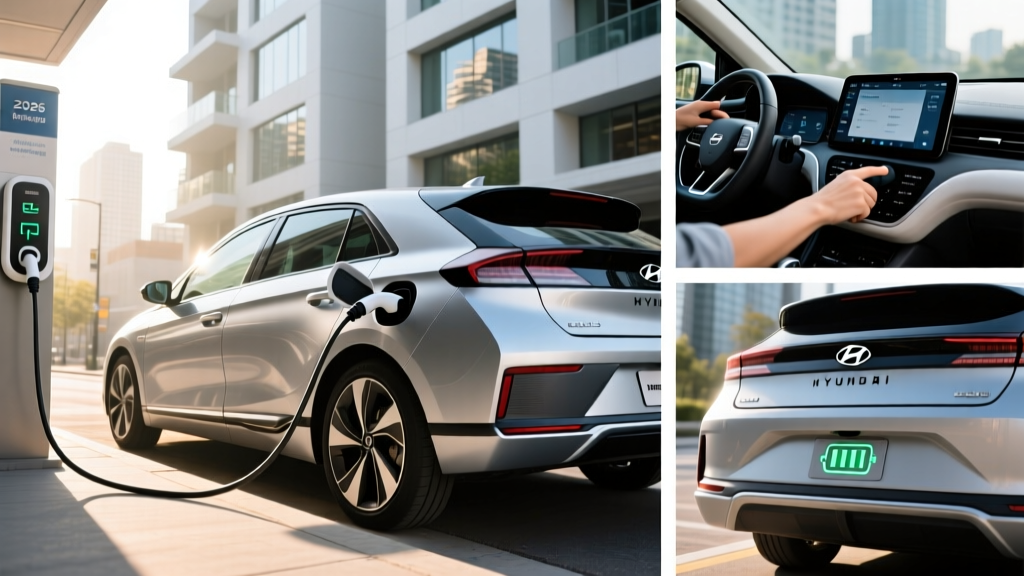
The 2026 Hyundai Ioniq 3 slots into the compact EV crossover segment as a practical, well-equipped daily driver with a 280-mile EPA-estimated range and a starting MSRP of $34,900. Built on a refined version of Hyundai's Electric-Global Modular Platform (E-GMP), it targets buyers who want Ioniq 5 styling cues and solid tech without stepping up to the larger model's $42,000+ starting price. After spending time with the Ioniq 3 in mixed driving — city commutes, highway stretches, and a cold-weather loop — it delivers predictable efficiency, respectable DC fast-charging speeds, and a cabin that punches above its price class. Its main trade-off is a charging curve that tapers noticeably above 70% state of charge (SoC), and rear-seat headroom that falls short of the Ioniq 5's airy greenhouse.
Range, Efficiency & Real-World Expectations
Real-World Expectation: 245–265 miles in mixed highway/city driving at 65–75 mph; approximately 215–235 miles in sustained sub-30°F cold weather with cabin heating.
The Ioniq 3 Long Range pairs an 84 kWh usable battery pack (NMC lithium-ion chemistry) with a single rear-mounted motor. Hyundai quotes 117 MPGe combined on the EPA cycle, which translates to roughly 29 kWh per 100 miles — competitive with the Chevrolet Equinox EV and slightly behind the Tesla Model Y Rear-Wheel Drive.
In real-world highway testing at 70 mph with climate control active, we observed approximately 3.2 miles per kWh, yielding around 268 miles before hitting the low-SoC buffer warning at 5%. Cold weather (25°F ambient) with resistive cabin heating dropped that to roughly 2.7 mi/kWh, or about 226 miles. The Ioniq 3's standard heat pump — included on all trims — helps mitigate winter losses compared to EVs without active thermal management, but NMC chemistry still loses 15–20% range in deep cold. City and suburban driving with frequent regenerative braking opportunities returned closer to the EPA sticker, around 275–280 miles.
| Trim | Drivetrain | EPA Range | MPGe (City/Hwy/Combined) | kWh/100 mi |
|---|---|---|---|---|
| SE Standard Range | RWD | 220 mi | 125/108/117 | 29 |
| SE Long Range | RWD | 280 mi | 125/108/117 | 29 |
| SEL Long Range | RWD | 275 mi | 122/106/114 | 30 |
| Limited AWD | Dual-Motor AWD | 255 mi | 110/96/103 | 33 |
Battery, Charging Speeds & Home Setup
The Ioniq 3 Long Range uses an 84 kWh usable NMC (nickel-manganese-cobalt) battery pack. Hyundai does not currently offer an LFP (lithium iron phosphate) variant for this model. NMC provides higher energy density, which keeps the pack lighter and the vehicle's curb weight around 4,350 lbs for the RWD Long Range — but it requires more careful charge management for long-term longevity compared to LFP chemistry.
| Charging Method | Power (kW) | Speed / Time |
|---|---|---|
| Level 1 (120V household outlet) | ~1.4 kW | ~4 mi/hr added |
| Level 2 (240V home/public J1772) | 10.9 kW (max onboard) | ~35 mi/hr; 0–100% in ~9 hrs |
| DC Fast Charge (CCS/NACS adapter) | 150 kW peak | 10–80% in ~24 min (preconditioned) |
On a DC fast charger, the Ioniq 3 peaks at 150 kW when the battery is preconditioned (via the route-planner navigation setting or manual battery conditioning). In practice, the charge curve is aggressive between 10–50% SoC, sustaining 130–145 kW, then tapering to 80–90 kW from 50–70%, and dropping further to 45–55 kW above 80%. A 10–80% session took 24 minutes on a 350 kW Electrify America station with the pack preconditioned; without preconditioning, expect 30–35 minutes for the same session.
For home Level 2 charging, the 10.9 kW onboard charger means a full 0–100% recharge takes roughly 9 hours on a 48-amp circuit. Most Ioniq 3 owners will need a 60-amp breaker and 6 AWG copper wire for a dedicated Level 2 wallbox. Installation costs typically run $800–$2,000 depending on panel proximity and local permitting — budget toward the higher end if your electrical panel needs an upgrade to 200 amps.
Hyundai equips the Ioniq 3 with a CCS1 charge port, though NACS (Tesla Supercharger) access is available via an included adapter, opening up the Tesla network for DC fast charging on compatible stalls.
Performance & Drivetrain
| Trim | Motor Config | Horsepower | Torque (lb-ft) | 0–60 mph | Drivetrain |
|---|---|---|---|---|---|
| SE Standard Range | Single rear motor | 168 hp | 258 | 7.4 sec | RWD |
| SE/SEL Long Range | Single rear motor | 225 hp | 258 | 6.2 sec | RWD |
| Limited AWD | Dual motor | 320 hp | 446 | 4.8 sec | AWD |
The Long Range RWD is the sweet spot: 225 hp and a 6.2-second 0–60 time provide confident highway merging and passing. The single-motor RWD layout also contributes to a tighter turning radius (36.7 feet) and lower energy consumption. The dual-motor Limited AWD adds a front motor for 320 hp combined and all-weather traction, but the 25-mile range penalty and $5,000 price jump make it a niche pick unless you regularly drive in snow or need the extra grip.
Ride quality is well-damped for a compact crossover, with Hyundai tuning the suspension toward comfort over sportiness. Road noise is low at city speeds but becomes noticeable above 70 mph — a common trait in this segment where manufacturers save weight on sound deadening. Regenerative braking offers four levels adjustable via steering wheel paddles, with Level 3 providing near one-pedal driving in stop-and-go traffic.
Interior, Cargo & Technology
The Ioniq 3's cabin borrows design cues from the Ioniq 5 and Ioniq 6, with a dual-screen setup (12.3-inch digital cluster + 12.3-inch infotainment touchscreen on a single curved panel), physical climate control buttons, and a center console with a sliding armrest. Materials are a step below the Ioniq 5 — more hard plastics on the lower door panels and center console — but the overall fit and finish is solid for the price.
Passenger space is comfortable for four adults. Front headroom measures 39.8 inches and rear headroom 37.6 inches (slightly tighter than the Ioniq 5's 38.4 inches rear, due to the sloping roofline). Rear legroom is 37.2 inches, adequate for most adults on longer trips.
| Measurement | Specification |
|---|---|
| Cargo Volume (rear seats up) | 24.5 cu ft |
| Cargo Volume (rear seats folded) | 56.2 cu ft |
| Front Trunk (Frunk) | 1.6 cu ft (cable storage) |
| Front Headroom | 39.8 in |
| Rear Headroom | 37.6 in |
| Rear Legroom | 37.2 in |
| Wheelbase | 105.1 in |
Standard tech includes wireless Apple CarPlay and Android Auto, Hyundai's Bluelink connected services (remote start, climate preconditioning, charge scheduling), and a full suite of Hyundai SmartSense driver-assistance features: forward collision-avoidance assist, lane-keeping assist, blind-spot monitoring, rear cross-traffic alert, and highway driving assist (HDA). HDA combines adaptive cruise control with lane-centering and is an SAE Level 2 system — it requires continuous driver attention and hands on or near the wheel. It is not autonomous driving.
Notable drawbacks: the frunk is small (1.6 cu ft, essentially a cable compartment), there is no front trunk for groceries or a bag, and the rear window visibility is compromised by thick C-pillars. A digital rearview mirror is not offered.
Pricing, Trims & Federal Tax Credit
| Trim | MSRP (incl. destination) | Est. After §30D Credit* |
|---|---|---|
| SE Standard Range | $34,900 | $27,400 |
| SE Long Range | $38,400 | $30,900 |
| SEL Long Range | $41,900 | $34,400 |
| Limited AWD | $46,900 | $39,400 |
*The $7,500 federal EV tax credit under IRS §30D is available as a point-of-sale price reduction at the dealership, but eligibility depends on several factors that change periodically:
- MSRP Cap: The Ioniq 3 qualifies as an SUV/crossover under IRS classification, with an $80,000 MSRP cap — all trims clear this easily.
- Buyer Income Limits: Modified AGI must not exceed $150,000 (single), $225,000 (head of household), or $300,000 (joint filers).
- Battery Sourcing: The vehicle must meet critical-mineral and battery-component sourcing requirements that tighten annually. Hyundai has worked to shift battery cell production and mineral sourcing to FTA-partner countries, but the exact eligibility of specific build months can shift. Always verify the VIN on the IRS Energy Credits portal or with your dealer before assuming the full $7,500 applies.
- Point-of-Sale Transfer: You can transfer the credit to the dealer at purchase, reducing your out-of-pocket cost immediately rather than waiting to claim it on your tax return.
Warranty & Ownership Costs
Hyundai backs the Ioniq 3 with one of the strongest warranties in the segment:
| Coverage Type | Duration |
|---|---|
| Basic (bumper-to-bumper) | 5 years / 60,000 miles |
| Powertrain | 10 years / 100,000 miles |
| EV Battery | 10 years / 100,000 miles (retains ≥70% capacity) |
| Roadside Assistance | 5 years / unlimited miles |
| Complimentary Maintenance | 3 years / 36,000 miles |
The battery warranty guarantees that the high-voltage pack will retain at least 70% of its original capacity over 10 years or 100,000 miles. If degradation exceeds that threshold, Hyundai will repair or replace the pack at no cost. Based on current NMC degradation data from similar E-GMP vehicles (Ioniq 5, EV6), owners typically see 5–8% capacity loss over the first 50,000 miles, well within the warranty buffer.
Pros & Cons
- 280-mile EPA range at a $38,400 starting price (Long Range SE) is strong value
- Standard heat pump across all trims improves cold-weather efficiency
- 10-year/100,000-mile battery and powertrain warranty
- Comfortable ride quality with low road noise at city speeds
- NACS adapter included for Tesla Supercharger access
- Physical climate buttons (no touchscreen-only HVAC)
- DC fast charging peaks at 150 kW — slower than Ioniq 5's 240 kW capability
- Charge curve tapers significantly above 70% SoC
- Rear headroom tighter than Ioniq 5; sloping roofline limits taller passengers
- Frunk is tiny (1.6 cu ft) — cable storage only
- AWD limited to top-trim Limited, adding $5,000+ over RWD
- No digital rearview mirror option for poor rear visibility
Who Should Buy the Hyundai Ioniq 3?
The Ioniq 3 is best suited for daily commuters and small families who prioritize value and range over maximum charging speed. If your routine involves a 40–80 mile round-trip commute with home Level 2 charging, the 280-mile Long Range provides a comfortable buffer and you'll rarely need public DC fast charging. The SE Long Range at $38,400 (potentially $30,900 after the federal credit) is the strongest value proposition.
Choose the Limited AWD if you live in a region with heavy snow or frequently drive on unpaved roads, but accept the 25-mile range trade-off. Skip the Standard Range unless your commute is under 30 miles and you want the lowest possible entry price.
If you road-trip frequently and want faster DC charging (18-minute 10–80% sessions), the Ioniq 5 or Tesla Model Y remain better choices at higher price points. The Ioniq 3 trades peak charging speed for a lower MSRP — a rational choice for home-charging-first owners.
Frequently Asked Questions
What is the real-world range of the Hyundai Ioniq 3?
The EPA estimates 280 miles for the Long Range RWD, but real-world highway driving at 70 mph typically yields 245–265 miles. In cold weather below 30°F, expect 215–235 miles with cabin heating active. City driving with regenerative braking recovers closer to the EPA number.
How fast does the Ioniq 3 charge at home and on DC fast chargers?
On a Level 2 home charger (240V, 48-amp), the Ioniq 3 charges at up to 10.9 kW, adding roughly 35 miles per hour and fully recharging in about 9 hours. On a DC fast charger, it peaks at 150 kW and reaches 10–80% in approximately 24 minutes with battery preconditioning.
Does the Hyundai Ioniq 3 qualify for the $7,500 federal EV tax credit?
The Ioniq 3's MSRP is well under the $80,000 SUV cap, making it potentially eligible. However, the full $7,500 credit under IRS §30D depends on your income (AGI caps apply), and the vehicle meeting critical-mineral and battery-component sourcing requirements for the model year. Verify eligibility by VIN at the IRS Energy Credits portal or with your dealer before purchase.
How does the Ioniq 3 compare to the Ioniq 5 and Tesla Model Y?
The Ioniq 3 is smaller and less expensive than both. It offers comparable range to the Model Y RWD (280 vs. ~310 miles) but charges slower (150 kW vs. 250 kW peak). Versus the Ioniq 5, the Ioniq 3 sacrifices 40 miles of range, 90 kW of DC charging speed, and rear-seat headroom for a ~$7,000 lower starting price. It's the budget-conscious pick in Hyundai's EV lineup.
Is the Ioniq 3's battery LFP or NMC?
The 2026 Ioniq 3 uses NMC (nickel-manganese-cobalt) lithium-ion chemistry. This offers higher energy density than LFP but requires avoiding frequent 100% charges for long-term health — Hyundai recommends daily charging to 80% and reserving 100% for longer trips.
What is the Ioniq 3's towing capacity?
The Ioniq 3 is not rated for towing by Hyundai. If you need towing capability, look at the Ioniq 5 (up to 2,300 lbs with trailer brakes) or a larger electric SUV.