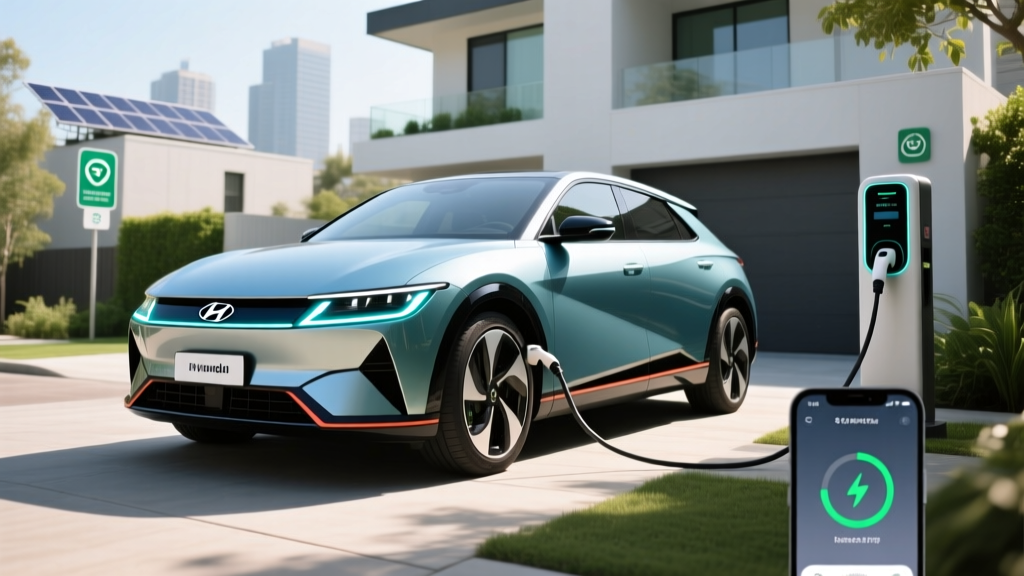
The Hyundai Ioniq 5 has been one of the most compelling electric crossovers since its debut, and the 2025 model year brings a meaningful refresh: the shift to NACS (Tesla Supercharger) compatibility, updated infotainment, and a new XRT trim aimed at the outdoorsy buyer. But for many shoppers, the most pressing question isn't about horsepower or styling — it's about 2025 Hyundai Ioniq 5 incentives and whether this EV qualifies for the federal tax credit, and how much you'll actually pay after stacking every available rebate.
This review covers the full ownership picture: real-world range, charging speed, tax-credit eligibility under current IRS §30D rules, and how the Ioniq 5 stacks up against the Tesla Model Y, Ford Mustang Mach-E, and Kia EV6. All figures reflect the 2025 model year as sold in the US market.
2025 Hyundai Ioniq 5: Core Specs at a Glance
| Spec | SE / SEL RWD | Limited RWD | SE / SEL AWD | Limited AWD | XRT AWD |
|---|---|---|---|---|---|
| EPA Range | 318 mi | 318 mi | 290 mi | 290 mi | 259 mi |
| Battery (usable) | 84.0 kWh, NMC (Nickel Manganese Cobalt) | ||||
| Horsepower | 168 hp (RWD) | 320 hp (Dual-Motor AWD) | |||
| 0-60 mph | ~7.0 sec | ~4.5 sec | |||
| Max DC Fast Charge | 240 kW peak (800V architecture) | ||||
| 10-80% DCFC Time | ~18 minutes (optimal conditions) | ||||
| Level 2 Home Charge | 10.9 kW (~30 mi/hr) | ||||
| MPGe (combined) | 132 MPGe | 110 MPGe | 98 MPGe | ||
| Base MSRP | $42,600 | $50,200 | $46,700 | $53,850 | $54,100 |
Sources: fueleconomy.gov, Hyundai Motor America. MSRP excludes destination charge (~$1,495).
Real-World Range: What the EPA Sticker Doesn't Tell You
The Ioniq 5's 84.0 kWh usable battery uses NMC (Nickel Manganese Cobalt) chemistry, which offers higher energy density than LFP (Lithium Iron Phosphate) cells but is more sensitive to sustained high-state-of-charge storage. Hyundai includes a buffer above and below the displayed 0-100% to protect long-term battery health.
Efficiency in mixed driving lands around 27-30 kWh/100 mi for the RWD and 32-36 kWh/100 mi for the AWD, depending on temperature and driving style. The heat pump (standard on all trims) helps mitigate cold-weather losses compared to EVs without active thermal management, but physics is physics — any EV loses 15-30% of range in deep cold.
Charging Speed: 800V Architecture Still Pays Off
The Ioniq 5's 800-volt electrical architecture remains one of its strongest advantages in this segment. Here's the full charging picture:
| Charging Level | Power | Speed (Approx.) | Use Case |
|---|---|---|---|
| Level 1 (120V household) | ~1.4 kW | ~4 mi/hr | Emergency / overnight trickle |
| Level 2 (240V home) | 10.9 kW | ~30 mi/hr | Daily home charging; 0-100% in ~8.5 hrs |
| DC Fast Charge (peak) | 240 kW | 10-80% in ~18 min | Road trips; requires 350 kW-class station |
| DC Fast Charge (typical 150 kW station) | ~150 kW sustained | 10-80% in ~25 min | Most common public fast-charger experience |
Charging curve reality check: The Ioniq 5 peaks near 240 kW only between roughly 10-55% state of charge. Above 60%, the rate tapers significantly — by 80% you're typically seeing 60-80 kW, and above 90% it drops further. This is normal for NMC batteries and is why we quote 10-80% times rather than 0-100%.
For the 2025 model year, Hyundai added the native NACS (Tesla Supercharger) port on new production, replacing the CCS1 connector used on 2022-2024 models. This opens access to Tesla's Supercharger network without an adapter — a major practical advantage for road-trip charging. Owners of earlier CCS-equipped Ioniq 5s can use a Hyundai-provided NACS adapter at Superchargers.
At home on a Level 2 charger (a 48-amp hardwired unit on a 60-amp circuit), the Ioniq 5 adds roughly 30 miles of range per hour of charging. A full overnight session easily replenishes a day's worth of driving for nearly all commuters.
2025 Hyundai Ioniq 5 Incentives & Tax Credit Eligibility
This is where the purchase decision often gets decided. Under the current IRS §30D Clean Vehicle Credit, the 2025 Ioniq 5 may qualify for up to $7,500 in federal tax credits — but eligibility depends on several factors that buyers must verify before signing.
- MSRP cap: Vehicle MSRP must not exceed $80,000 for SUVs/trucks/vans. All 2025 Ioniq 5 trims clear this — even the Limited AWD at ~$55,300 with destination.
- Buyer income cap: Adjusted gross income must not exceed $150,000 (single), $225,000 (head of household), or $300,000 (joint filers).
- Battery component sourcing: A percentage of battery components must be manufactured or assembled in North America, and critical minerals must meet sourcing thresholds. These thresholds increase annually. Hyundai has shifted some Ioniq 5 production to the US (Savannah, Georgia plant), improving eligibility — but confirm with your dealer for the specific VIN.
- Point-of-sale transfer: As of 2024, eligible buyers can transfer the credit to the dealer at purchase, receiving the $7,500 as an immediate price reduction rather than waiting to claim it on their tax return. This requires the dealer to be registered with the IRS Energy Credits Online portal.
| Trim | MSRP + Destination | Est. Price After $7,500 Credit | Notes |
|---|---|---|---|
| SE RWD | $44,095 | ~$36,595 | Best value for range |
| SEL RWD | $47,095 | ~$39,595 | Added comfort features |
| Limited RWD | $51,695 | ~$44,195 | Premium interior, HUD, V2L |
| SE AWD | $48,195 | ~$40,695 | Performance + all-weather |
| Limited AWD | $55,345 | ~$47,845 | Fully loaded flagship |
| XRT AWD | $55,595 | ~$48,095 | Off-road styling, 259 mi range |
Critical caveat: Battery sourcing rules tighten each year. A VIN that qualifies in early 2025 may have different eligibility status later if supply chains shift. Always verify credit eligibility for your specific vehicle through the dealer and, if needed, a tax professional. Some states also offer additional rebates (California's CVRP, Colorado's state credit, etc.) — check your state's energy office for current programs.
Performance, Interior & Tech
The dual-motor AWD Ioniq 5 delivers 320 horsepower and a 4.5-second 0-60 mph time — genuinely quick for a family crossover. The RWD model's 168 hp and ~7.0-second sprint is adequate for commuting but won't excite. All trims use a single-speed reduction gear with smooth, linear power delivery.
Inside, the Ioniq 5's flat floor (thanks to the dedicated E-GMP platform) creates genuinely impressive interior space:
- Rear legroom: 39.4 inches — competitive with midsize SUVs
- Cargo behind rear seats: 27.2 cu ft
- Cargo with rear seats folded: 59.3 cu ft
- Frunk (front trunk):strong> 0.85 cu ft (RWD) / 0.42 cu ft (AWD) — enough for charging cables
The 2025 refresh updates the infotainment to Hyundai's latest ccNC software with a 12.3-inch center display, wireless Apple CarPlay and Android Auto, and improved voice recognition. The dual-motor models include a Vehicle-to-Load (V2L) feature, which can power external devices (laptops, camping gear, even small appliances) at up to 3.6 kW through an adapter plugged into the charge port or an interior outlet.
Driver-assist tech includes Hyundai's Highway Driving Assist 2 (HDA2), which combines adaptive cruise control with lane-centering on divided highways. This is an SAE Level 2 system — the driver must remain attentive with hands on or near the wheel at all times. It is not autonomous driving.
Pros, Cons & Verdict
- Best-in-class DC fast charging (240 kW, 18 min 10-80%)
- NACS native port on 2025 models — direct Tesla Supercharger access
- Spacious flat-floor interior with class-leading rear legroom
- Strong federal tax credit eligibility (verify by VIN)
- V2L capability for camping and emergency power
- Competitive 318-mile EPA range (RWD)
- RWD model underpowered at 168 hp
- Frunk is small compared to some competitors
- XRT trim sacrifices significant range (259 mi) for styling
- Real-world highway range 15-20% below EPA sticker
- Rear wiper absent on earlier builds (addressed on some 2025 units)
- Insurance costs can run 15-25% higher than gas equivalents
How It Compares: Ioniq 5 vs. Key Rivals
The Ioniq 5 competes in the most crowded EV crossover segment. Here's how it stacks up on the metrics that matter:
- vs. Tesla Model Y Long Range: The Model Y offers slightly more EPA range (~320 mi), a larger Supercharger network advantage (though this gap is closing with NACS adoption), and stronger software/OTA updates. The Ioniq 5 counters with a more comfortable ride, better interior materials, and a less polarizing design.
- vs. Kia EV6: The EV6 shares the E-GMP platform and 800V architecture, so charging speeds are nearly identical. The EV6's styling is sportier; the Ioniq 5 offers more rear headroom and a more upright, practical cargo area.
- vs. Ford Mustang Mach-E: The Mach-E Extended Range AWD is competitive on range (~312 mi EPA) but charges slower on DCFC (~150 kW peak vs. Ioniq 5's 240 kW). The Mach-E's driving dynamics are slightly more engaging, but the Ioniq 5 wins on charging speed and interior space.
- Choose the Ioniq 5 if: You prioritize fast DC charging for road trips, want a spacious crossover with V2L capability, qualify for the §30D credit, and prefer a comfortable daily driver over a sporty one.
- Look elsewhere if: You need maximum cargo volume (consider a Model Y or three-row EV), you want hands-free highway driving (GM Super Cruise or Ford BlueCruise), or you're a budget-first buyer who might find a used EV or PHEV more practical.
- Best trim pick: The SEL RWD at ~$47,095 (before credit) offers the best blend of range, features, and value. Add AWD only if you regularly face snow or need the performance boost.
Battery Warranty & Long-Term Ownership
Hyundai backs the Ioniq 5's battery with a 10-year / 100,000-mile warranty (whichever comes first), covering defects and capacity loss below 70% of original capacity. The powertrain carries the same 10-year/100,000-mile coverage. The limited vehicle warranty is 5 years / 60,000 miles.
NMC batteries in the Ioniq 5 are projected to retain roughly 85-90% of original capacity after 100,000 miles based on industry degradation data for thermally managed 800V systems. Best practices for longevity include:
- Set daily charge limit to 80% (use 100% only for road trips)
- Avoid frequent DC fast charging when Level 2 is available
- Don't store the vehicle at very high or very low SoC for extended periods
- Use preconditioning when navigating to a fast charger (the Ioniq 5 does this automatically when a DCFC station is set as the navigation destination)
Frequently Asked Questions
Does the 2025 Hyundai Ioniq 5 qualify for the $7,500 federal tax credit?
It can, depending on your income, the vehicle's VIN-specific battery sourcing compliance, and MSRP. All Ioniq 5 trims are under the $80,000 SUV MSRP cap. Your AGI must be under $150K (single) / $300K (joint). Confirm eligibility with your dealer for the specific VIN before purchase, and consult a tax professional for your situation. The credit can be transferred to the dealer at point of sale for an immediate price reduction.
What is the real-world range of the 2025 Ioniq 5?
The RWD model's 318-mile EPA rating translates to roughly 260-280 miles in real-world highway driving in moderate temperatures, and 210-240 miles in cold weather (below 30°F). The AWD models rated at 290 miles EPA typically deliver 235-255 miles on the highway.
How fast does the Ioniq 5 charge at home and on the road?
At home on a Level 2 (240V, 48-amp) charger, the Ioniq 5 charges at 10.9 kW, adding about 30 miles of range per hour. On a 350 kW-class DC fast charger, it peaks at 240 kW and can go from 10-80% in approximately 18 minutes under optimal conditions. At more common 150 kW public stations, expect 10-80% in about 25 minutes.
Is the 2025 Ioniq 5 worth buying over the Tesla Model Y or Kia EV6?
The Ioniq 5 is worth strong consideration if you value ride comfort, interior quality, V2L capability, and best-in-class DC charging speed. The Model Y wins on software and total cargo space; the EV6 is a close sibling with sportier styling but less rear headroom. Test-drive all three — the Ioniq 5's comfort advantage is immediately apparent on longer drives.
What are the biggest drawbacks of the Ioniq 5?
The RWD model's 168 hp feels sluggish for the price. The frunk is tiny. The XRT trim's aggressive tires and suspension drop range to 259 miles EPA. And as with all EVs, real-world highway range falls notably short of the EPA sticker, especially in cold weather. Insurance premiums also tend to run higher than comparable gas crossovers.
Does the 2025 Ioniq 5 have a NACS or CCS charging port?
New 2025 Ioniq 5 models come with the native NACS (Tesla) charging port, granting direct access to Tesla Superchargers and other NACS-equipped networks. If you own a 2022-2024 model with CCS1, Hyundai provides a NACS adapter for Supercharger access.