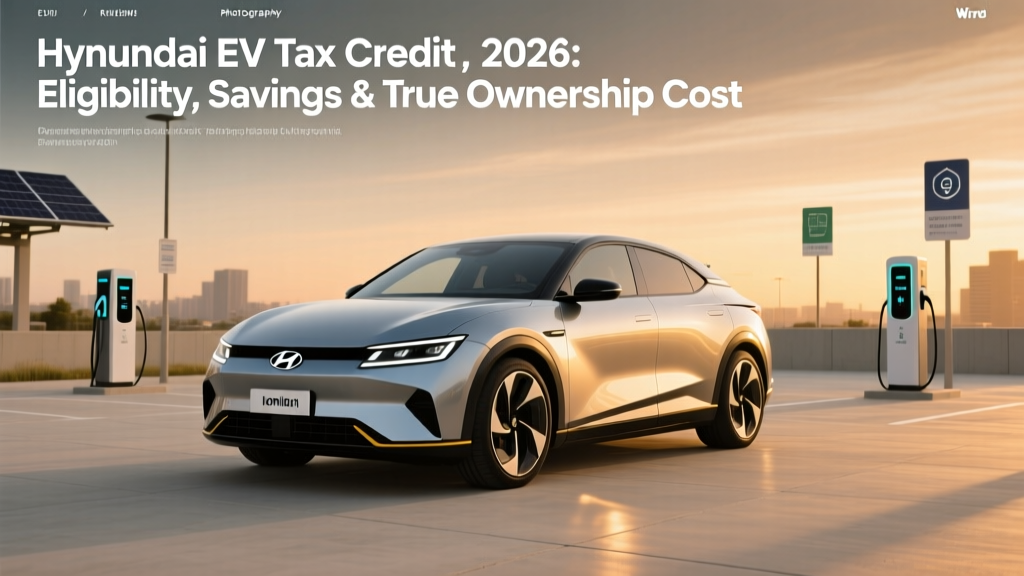
Hyundai's electric lineup — the Ioniq 5, Ioniq 6, and Kona Electric — represents some of the most compelling EVs on the market in 2026. But the sticker price is only the beginning of the ownership equation. Between shifting federal tax credit rules, state incentives, home charging economics, and higher-than-average insurance premiums, the real cost to own a Hyundai EV requires careful math.
This guide breaks down exactly what you'll pay — and save — over five years of Hyundai EV ownership, with a focus on the Hyundai EV tax credit landscape under IRS §30D rules as they stand in 2026.
Which Hyundai EVs Qualify for the Federal Tax Credit in 2026?
The federal Clean Vehicle Credit under IRS §30D offers up to $7,500 for qualifying new EVs. However, eligibility hinges on a web of requirements that change as battery supply chains shift. Here's the 2026 checklist:
§30D Federal Tax Credit Eligibility Requirements (2026)
- MSRP Caps: Vans, SUVs, and pickups must be under $80,000; sedans and other body styles under $55,000
- Buyer Income Limits: Modified AGI cannot exceed $300,000 (joint filers), $225,000 (head of household), or $150,000 (individual)
- North American Assembly: Vehicle must undergo final assembly in North America (all current US-market Hyundai EVs now qualify since the Metaplant Georgia facility came online)
- Battery Component Sourcing: A percentage of battery components must be manufactured or assembled in North America — the threshold increases annually
- Critical Minerals: A percentage of critical minerals must be sourced from the US or a free-trade-agreement country — this threshold also escalates yearly
- Point-of-Sale Transfer: As of 2024, buyers can transfer the credit to the dealer at purchase, reducing the upfront price rather than waiting for tax filing
Key Hyundai models and 2026 credit status:
| Model | Body Class | MSRP Range | Assembly | Estimated Credit |
|---|---|---|---|---|
| Ioniq 5 (SE/SEL/Limited) | SUV | $42,600 – $58,200 | Georgia, USA | Up to $7,500* |
| Ioniq 6 (SE/SEL/Limited) | Sedan | $38,650 – $52,250 | Georgia, USA | Up to $7,500* |
| Kona Electric (SE/SEL/Limited) | SUV | $33,550 – $42,050 | Georgia, USA | Up to $7,500* |
*Credit amount depends on meeting both the critical-minerals and battery-component thresholds. The Ioniq 6 sedan faces the $55,000 MSRP cap (sedan classification), meaning Limited trims may exceed the threshold. SUV-classified Ioniq 5 and Kona Electric have the higher $80,000 cap. Always verify current eligibility at fueleconomy.gov before purchasing, as sourcing rules evolve quarterly.
5-Year Total Cost of Ownership: Hyundai EV vs. Gas Equivalent
To understand whether a Hyundai EV saves money long-term, we need to compare it against a realistic gas-powered alternative. We'll use the Hyundai Ioniq 5 SEL AWD ($47,200 MSRP before incentives) versus the Hyundai Tucson SEL AWD ($33,500 MSRP, 28 MPG combined) over 5 years and 75,000 miles.
| Cost Category | Ioniq 5 SEL AWD (EV) | Tucson SEL AWD (Gas) | 5-Year Difference |
|---|---|---|---|
| Purchase Price (after $7,500 credit) | $39,700 | $33,500 | +$6,200 |
| Fuel / Electricity (75k mi) | $4,125 | $9,375 | –$5,250 |
| Maintenance | $1,800 | $3,750 | –$1,950 |
| Insurance (5 years) | $11,250 | $8,500 | +$2,750 |
| Depreciation (est.) | $18,500 | $13,200 | +$5,300 |
| Total 5-Year Cost | $75,375 | $68,325 | +$7,050 |
Assumptions: Electricity at $0.16/kWh national average (home charging), gas at $3.50/gallon, Ioniq 5 efficiency at 3.0 mi/kWh (114 MPGe combined per EPA data), 15,000 miles/year. Insurance based on national EV average premiums. Depreciation estimates based on current EV resale trends.
The EV still costs roughly $7,000 more over five years in this scenario, primarily due to steeper depreciation and higher insurance. However, this gap narrows significantly — or reverses — if you have access to cheaper electricity (solar, off-peak rates under $0.10/kWh), qualify for additional state incentives, or if gas prices rise above $4.00/gallon.
Charging vs. Gas: The Real Cost-Per-Mile Math
The single largest ongoing savings with a Hyundai EV comes at the fuel pump — or rather, the charger. But the math varies enormously depending on how and where you charge.
| Charging Scenario | Cost/kWh | Cost/Mile (Ioniq 5) | vs. Gas (28 MPG @ $3.50/gal) |
|---|---|---|---|
| Home Level 2 (national avg) | $0.16 | $0.053 | Save $0.072/mi |
| Home Level 2 (off-peak/utility rate) | $0.09 | $0.030 | Save $0.095/mi |
| Home solar (amortized) | $0.05 | $0.017 | Save $0.108/mi |
| Public DC fast charging (EA/EVgo avg) | $0.42 | $0.140 | Cost $0.015/mi MORE |
| Tesla Supercharger (NACS, avg) | $0.30 | $0.100 | Save $0.025/mi |
At 15,000 miles per year on home charging at $0.16/kWh, the Ioniq 5 costs roughly $800/year in electricity versus $1,875/year for gas in the Tucson. That's a $1,075 annual fuel savings.
However, if you rely exclusively on public DC fast charging at $0.42/kWh, you'd spend $2,100/year — actually more than the gas Tucson. This is why home charging access is the single most important economic factor in EV ownership. Without it, the fuel savings disappear entirely.
The Ioniq 5 supports NACS connectivity natively in 2026, granting access to Tesla's Supercharger network (over 25,000 stalls) in addition to Electrify America and other CCS networks. The Ioniq 5's 800V architecture allows peak DC charging at 240 kW, reaching 10-80% in approximately 18 minutes under ideal conditions — though real-world charging curves taper significantly above 80%, so plan stops accordingly.
Maintenance Savings: Where EVs Quietly Win
EVs eliminate the most common recurring maintenance costs associated with internal combustion engines. Here's how the Hyundai Ioniq 5 stacks up against a gas crossover over 75,000 miles:
| Maintenance Item | EV (Ioniq 5) | Gas (Tucson) | EV Savings |
|---|---|---|---|
| Oil changes (every 7,500 mi) | $0 | $700 | $700 |
| Transmission fluid | $0 | $250 | $250 |
| Brake pads (regen extends life) | $200 (1 set) | $800 (2-3 sets) | $600 |
| Engine air filter | $0 | $150 | $150 |
| Spark plugs | $0 | $300 | $300 |
| Coolant flush | $150 | $250 | $100 |
| Cabin air filter + wipers + tires | $1,250 | $1,300 | $50 |
| Total (75k miles) | $1,600 | $3,750 | $2,150 |
Regenerative braking is the hidden hero here. The Ioniq 5's one-pedal driving mode (i-Pedal) recovers kinetic energy and drastically reduces brake pad wear — many EV owners report original brake pads lasting 80,000+ miles. Hyundai's 5-year/60,000-mile basic warranty and 10-year/100,000-mile powertrain warranty (which covers the battery system) further reduce ownership risk.
One cost that is higher on EVs: tires. The Ioniq 5 AWD weighs approximately 4,600 lbs and delivers instant torque, accelerating tire wear. Budget for a tire rotation every 7,500 miles and expect replacement at 35,000–45,000 miles rather than the 55,000+ miles typical on lighter gas crossovers.
The Insurance Reality: Why EVs Cost More to Insure
This is where the savings narrative hits a wall. EV insurance premiums run 15–30% higher than equivalent gas vehicles, and Hyundai EVs are no exception.
Why EV insurance costs more:
- Higher repair costs: Battery pack damage in a collision often requires full replacement ($15,000–$20,000 for an 84 kWh pack), and insurers factor this into premiums
- Specialized labor: High-voltage system repairs require certified technicians, limiting shop options and raising labor rates
- Higher vehicle values: Even after the tax credit, the insured value of the EV is typically higher than a comparable gas model
- Total-loss threshold: Insurers are more likely to declare an EV a total loss after battery-area damage, driving up claim costs
Based on 2026 national averages, expect to pay approximately $2,200–$2,500/year to insure an Ioniq 5 SEL AWD versus $1,600–$1,800/year for a Tucson SEL AWD. That's an extra $3,000–$3,500 over five years.
Mitigation strategies: Shop quotes from insurers with dedicated EV programs (GEICO, Progressive, and Tesla Insurance all offer competitive EV rates in many states). Bundling home and auto, maintaining a clean record, and selecting higher deductibles can close the gap. Some states offer EV insurance discounts — check with your state's insurance commissioner.
EV Depreciation: The Biggest Unknown in Ownership Cost
Depreciation remains the most volatile and consequential cost factor for EVs. As of 2026, EVs generally depreciate faster than comparable gas vehicles, driven by several factors:
- Price wars: Tesla's aggressive price cuts since 2023 reset used-EV values downward across the entire market, including Hyundai models
- Rapid tech improvement: Newer EVs offer more range and faster charging, making 2-3 year old models feel dated
- Battery health uncertainty: Used buyers discount for potential battery degradation, even though Hyundai's 84 kWh NMC packs typically retain 90%+ capacity after 5 years
- Tax credit effect: The $7,500 point-of-sale credit effectively lowers the "real" purchase price, meaning depreciation is calculated from a lower baseline than MSRP suggests
Estimated 5-year depreciation (75,000 miles):
- Hyundai Ioniq 5 SEL AWD: ~45-50% of after-credit purchase price (roughly $18,500–$20,000)
- Hyundai Tucson SEL AWD (gas): ~35-40% of purchase price (roughly $12,000–$13,500)
The gap is narrowing. As EV adoption matures and the used-EV market grows, depreciation curves are stabilizing. Hyundai's 10-year/100,000-mile battery warranty also transfers to second owners (albeit reduced to 5 years/60,000 miles for the original new-vehicle coverage terms), which supports resale confidence.
State, Local, and Utility Incentives Beyond the Federal Credit
Important: State and local incentives vary dramatically by jurisdiction and change frequently. The figures below represent common examples as of 2026 but may not apply to your specific location. Always verify current programs through your state's energy office, utility provider, and the Alternative Fuels Data Center before making purchase decisions.
Beyond the federal §30D credit, many Hyundai EV buyers can stack additional savings:
| Incentive Type | Examples | Typical Value |
|---|---|---|
| State purchase rebates | CA (CVRP), CO, MA, NY, NJ | $1,000 – $7,500 |
| Utility rebates (purchase) | PG&E, SCE, ConEdison, Xcel Energy | $500 – $1,500 |
| Home charger rebates | Various utility programs | $250 – $1,000 |
| HOV lane access | CA, CO, FL, GA, MD, NJ, NY, VA | Time savings (priceless in traffic) |
| Reduced registration fees | Varies — some states charge MORE for EVs | –$50 to +$200/year |
| Time-of-use charging rates | Most major utilities | $0.06–$0.10/kWh off-peak |
In a best-case scenario — say, a Colorado buyer stacking the $7,500 federal credit, the $5,000 Colorado state tax credit, a $500 Xcel Energy rebate, and a $500 home charger incentive — the effective discount on an Ioniq 5 could reach $13,500, fundamentally changing the ownership cost equation.
However, note that some states (Ohio, Alabama, Arkansas, and others) impose higher annual registration fees on EVs to compensate for lost gas tax revenue, adding $100–$200/year. Factor this into your state-specific math.
Hyundai EV Tax Credit: Frequently Asked Questions
Can I get the Hyundai EV tax credit if I lease instead of buy?
Not directly under §30D, which applies only to purchases. However, leased Hyundai EVs may qualify for the separate §45W Commercial Clean Vehicle Credit, which the leasing company can claim and pass along as a reduced lease payment. This "lease loophole" has no MSRP caps, income limits, or battery-sourcing requirements, making it a viable path for buyers who exceed income thresholds or want models that don't meet §30D sourcing rules. Confirm with your dealer whether the lease rate reflects the passed-through credit.
Does the Hyundai Ioniq 5 qualify for the full $7,500 credit in 2026?
As of early 2026, the Ioniq 5 assembled at Hyundai's Metaplant Georgia facility qualifies for at least the partial credit ($3,750) by meeting the battery-component requirement. Whether it earns the full $7,500 depends on the critical-minerals sourcing threshold for the current tax year, which escalates annually. Hyundai has been progressively shifting supply chains to FTA-partner countries. Check the latest status at fueleconomy.gov before signing paperwork, as eligibility can change with model-year production batches.
How much does it really cost to own a Hyundai Ioniq 5 over 5 years?
Based on our analysis above, approximately $75,000–$78,000 total over 5 years / 75,000 miles when including purchase (after federal credit), electricity, insurance, maintenance, and depreciation. This is roughly $5,000–$8,000 more than a comparable gas Tucson over the same period, primarily due to depreciation and insurance premiums. However, with favorable electricity rates, stacked state incentives, and lower gas prices reversing, the EV can reach parity or come out ahead. Your mileage — literally — will vary.
Is the Hyundai EV battery warranty transferable to a second owner?
Hyundai's 10-year/100,000-mile battery warranty applies to the original owner. For subsequent owners, coverage reduces to 5 years/60,000 miles from the original purchase date. This still provides meaningful protection but is worth factoring into used-EV purchases or resale expectations.
What happens if my income exceeds the tax credit limit?
The §30D credit phases out completely above the modified AGI caps ($300,000 joint, $225,000 head of household, $150,000 individual). If you exceed these limits, the lease pathway (§45W) becomes your primary option for capturing a federal incentive, as it carries no income restrictions. Consult a tax professional to determine your exact eligibility based on your filing status and projected income for the delivery year.
Bottom Line: Is a Hyundai EV Worth the Total Cost?
The Hyundai Ioniq 5, Ioniq 6, and Kona Electric offer excellent efficiency, fast 800V charging, and strong build quality. The 2026 Hyundai EV tax credit — when you qualify — meaningfully reduces the purchase price. But the full ownership picture requires honest accounting: higher insurance, faster depreciation, and the critical dependency on affordable home charging.
Buy a Hyundai EV if: You can charge at home at under $0.16/kWh, qualify for the federal credit (and ideally stack state incentives), drive 12,000+ miles per year to maximize fuel savings, and plan to keep the vehicle 5+ years to ride out the depreciation curve.
Consider a Hyundai hybrid (Tucson Hybrid or PHEV) instead if: You lack reliable home charging, exceed the income caps, plan to sell within 3 years, or live in a state with no additional EV incentives and higher registration fees.
The numbers don't lie — but they do vary. Run your own scenario with your local electricity rate, insurance quote, and state incentives before signing.