If you have been browsing dealer lots or scrolling Cadillac's configurator, the appeal of a Cadillac EV lease is obvious: lower monthly payments than buying, access to the latest battery tech without long-term depreciation risk, and a luxury electric experience without the six-figure commitment. But lease math is different from purchase math, and the incentives that make electric vehicles affordable work differently when you lease versus buy.
This guide breaks down the real numbers behind leasing a 2026 Cadillac Lyriq or the newly expanded 2026 Cadillac Optiq, including the federal tax credit mechanics, 5-year total cost of ownership, charging versus gas savings, and the insurance realities that catch many first-time EV lessees off guard.
The 2026 Cadillac EV Lineup: What You Can Actually Lease
For the 2026 model year, Cadillac offers two fully electric vehicles available for lease in the United States. The midsize Lyriq crossover continues as the volume seller, while the compact Optiq (introduced for 2025 and expanded for 2026) slots below it as a more accessible entry point.
| Spec | 2026 Lyriq (RWD Luxury) | 2026 Optiq (Luxury) |
|---|---|---|
| Base MSRP | $58,590 | $52,990 |
| EPA Range | 314 miles | 303 miles |
| Battery (usable) | 102 kWh, NMC | 85 kWh, NMC |
| Horsepower | 340 hp | 295 hp |
| 0–60 mph | 6.0 sec | 6.3 sec |
| Peak DC Fast Charge | 190 kW | 150 kW |
| 10–80% DC Charge | ~30 min | ~27 min |
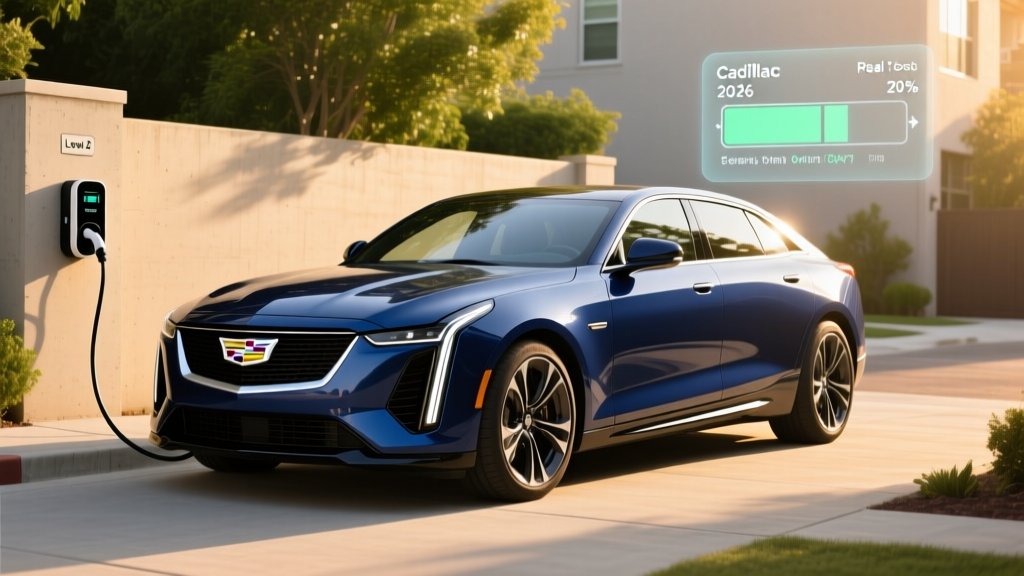
| Level 2 Charge Rate | 19.2 kW (AC) | 11.5 kW (AC) |
| MPGe (combined) | 89 MPGe | 92 MPGe |
| Drivetrain | RWD (AWD avail.) | AWD |
| Battery Warranty | 8 yr / 100,000 mi | 8 yr / 100,000 mi |
Federal Tax Credit: How §30D Works on a Cadillac EV Lease
The federal EV tax credit under IRS §30D is one of the most misunderstood incentives in the market. For 2026, the credit offers up to $7,500, but eligibility depends on a stack of requirements that must all be met simultaneously.
- MSRP Cap: SUVs must have an MSRP at or below $80,000. The 2026 Lyriq and Optiq both qualify at their base and mid trims. Fully loaded Sport trims may push past this threshold — verify the exact window-sticker price.
- Income Limits: Modified adjusted gross income (MAGI) must not exceed $300,000 (joint filers), $225,000 (head of household), or $150,000 (single filers). The lesser of your current-year or prior-year MAGI is used.
- Battery Sourcing: The battery must contain a minimum percentage of critical minerals sourced from the U.S. or a free-trade-agreement partner, AND a minimum percentage of battery components must be manufactured or assembled in North America. These thresholds increase annually. Cadillac's Ultium platform (built in Tennessee and Michigan) has generally met these requirements, but eligibility can vary by build date and supply-chain shifts.
- Point-of-Sale Transfer: As of 2024, you can transfer the credit to the dealer at the point of sale, effectively reducing your down payment or capitalized cost by up to $7,500. This applies to both purchases and leases, though on a lease, the credit is technically claimed by the lessor (GM Financial) and typically passed through as a cap-cost reduction.
- One Credit Per Vehicle: The credit is claimed once per VIN. If you buy out the lease later, you cannot claim the credit again.
Lease-specific nuance: When you lease a Cadillac EV, GM Financial is the legal owner of the vehicle. The lessor claims the §30D credit and, in competitive lease markets, passes the full $7,500 to you as a capitalized cost reduction. This is why Cadillac EV leases can appear significantly cheaper than purchase payments — but always verify on the lease disclosure that the credit is actually being applied to your cap cost, not absorbed by the lessor.
5-Year Total Cost of Ownership: Leasing vs. Buying a Cadillac Lyriq
To understand whether a Cadillac EV lease makes financial sense, we modeled a 5-year ownership horizon for the 2026 Lyriq RWD Luxury. The lease scenario assumes two consecutive 36-month leases (6 years total, but we prorate to 5 years for comparison). The purchase scenario assumes financing at 6.5% APR for 72 months with a 10% down payment.
| Cost Category | Lease (2×36 mo) | Purchase (Financed) |
|---|---|---|
| Vehicle Payments (incl. tax credit applied) | $34,200 | $46,800 |
| Charging (12,000 mi/yr) | $4,320 | $4,320 |
| Insurance (avg.) | $14,400 | $14,400 |
| Maintenance & Repairs | $1,800 | $2,100 |
| Depreciation / Resale Offset | $0 (returned) | –$18,500 (resale value) |
| Disposition / End-of-Lease Fees | $990 | $0 |
| Net 5-Year Cost | $55,710 | $49,120 |
The purchase scenario wins on pure net cost over 5 years primarily because of the equity you retain in the vehicle. However, the lease scenario offers lower monthly cash outflow (roughly $570/month vs. $780/month for the financed purchase) and shields you from EV depreciation risk — which, as we discuss below, remains a genuine concern.
Charging vs. Gas: The Real Per-Mile Cost for a Cadillac EV
One of the strongest arguments for leasing a Cadillac EV is the fuel-cost advantage over a comparable gas-powered luxury SUV like the Cadillac XT5 or BMW X3. But the savings depend heavily on how and where you charge.
| Scenario | Cost per Mile | Annual Cost (12k mi) |
|---|---|---|
| Home Level 2 charging ($0.14/kWh avg.) | $0.044 | $528 |
| Public DC fast charging ($0.40/kWh avg.) | $0.126 | $1,512 |
| Blended (80% home / 20% public) | $0.060 | $720 |
| Gas SUV at 24 MPG, $3.40/gal | $0.142 | $1,704 |
| Gas SUV at 20 MPG, $3.40/gal | $0.170 | $2,040 |
At the Lyriq's combined efficiency of roughly 3.15 miles per kWh (derived from its 89 MPGe EPA rating, per fueleconomy.gov), home charging at the national average residential rate of $0.14/kWh delivers fuel at about 4.4 cents per mile. Even with a blended mix of home and public charging, you will spend roughly $720 per year on electricity compared to $1,700–$2,000 for a gas-powered competitor.
Over a 36-month lease, that translates to approximately $2,160 in home-charging fuel costs versus $5,100–$6,120 for gas — a savings of $2,940 to $3,960 over the lease term. This gap widens further if your utility offers time-of-use rates or EV-specific charging plans that drop off-peak electricity to $0.08–$0.10/kWh.
Maintenance Savings: Where EVs Quietly Win
EVs eliminate the maintenance items that plague internal-combustion luxury vehicles. The Lyriq and Optiq have no engine oil, no transmission fluid, no spark plugs, no timing belts, and no exhaust system. Regenerative braking significantly reduces brake-pad wear — many EV owners report original brake pads lasting 80,000+ miles.
| Service Item | Lyriq (EV) | Gas SUV (XT5) |
|---|---|---|
| Oil Changes | $0 | $600–$900 |
| Brake Pads (front) | $0 (regen extends life) | $400–$600 |
| Transmission Fluid | $0 | $200–$300 |
| Coolant / Filters | $150 | $350–$500 |
| Tire Rotation & Replacement | $1,200 (heavier EV wears tires faster) | $1,000 |
| Cabin Air Filter / Wipers / Misc. | $450 | $450 |
| Total (5 years) | $1,800 | $2,950–$3,750 |
The net maintenance savings of roughly $1,150–$1,950 over 5 years is meaningful but not transformative. The real value is convenience: fewer service visits, no waiting for oil changes, and no surprise powertrain repairs. For a lease, this matters less since you return the vehicle before major wear items typically need replacement — but you still avoid the routine service costs.
One caveat: EVs are heavier (the Lyriq weighs approximately 5,600 lbs), and that extra mass accelerates tire wear. Budget for at least one set of replacement tires during a 5-year ownership period, and expect to pay a premium for EV-optimized tires with low rolling resistance and noise foam.
Insurance: The Cost That Catches EV Lessees Off Guard
Insurance premiums for electric vehicles remain higher than for comparable gas vehicles, and this is where the Cadillac EV ownership story gets less rosy. According to industry data, EV insurance premiums run 15–25% higher than equivalent ICE models, driven by several factors:
- Higher repair costs: EV battery packs and specialized electronics are expensive to replace after collision damage. Body shops need EV-specific training and equipment.
- Higher vehicle values: The Lyriq's $58,590+ MSRP places it in a premium insurance tier regardless of powertrain.
- Parts availability: Cadillac EV parts, particularly Ultium battery modules and power electronics, can have longer lead times, extending rental-car costs for insurers.
- Limited claims history: Insurers are still building actuarial data on EV-specific repair patterns, leading to conservative (higher) pricing.
For a 2026 Lyriq, expect annual insurance premiums in the range of $2,400–$3,200 depending on your state, driving record, age, and coverage level. That compares to roughly $2,000–$2,600 for a gas-powered XT5. Over a 36-month lease, the insurance premium difference adds roughly $1,200–$1,800 in additional cost.
Tip: Before signing a lease, run quotes with your current insurer and at least two competitors. Some carriers offer EV-specific discounts (up to 10%) for vehicles with advanced ADAS features like Cadillac's Super Cruise, which is available on the Lyriq and Optiq.
Depreciation and Resale: Why Leasing Reduces Your Risk
Electric vehicle depreciation has been one of the most volatile segments of the used-car market over the past three years. Several factors have compressed EV resale values:
- Price wars: Tesla's aggressive price cuts in 2023–2024 cascaded across the entire EV market, pulling down used values for every brand.
- Rapid tech advancement: Newer EVs offer more range, faster charging, and NACS compatibility, making 2–3-year-old models feel dated.
- Battery health uncertainty: Used-EV buyers remain cautious about long-term battery degradation, even though data from fleet telematics studies shows modern NMC and LFP packs retaining 90%+ capacity after 100,000 miles.
- Tax credit resets: When a new buyer can claim $7,500 on a new EV, the used market must discount accordingly to remain competitive.
For the Lyriq specifically, 3-year depreciation has tracked at approximately 45–52% of original MSRP, compared to 35–40% for a gas-powered XT5 over the same period. This means a $58,590 Lyriq might command roughly $28,000–$32,000 on the used market after 36 months and 36,000 miles.
This is precisely why leasing makes strategic sense for a Cadillac EV: you transfer the depreciation risk to GM Financial. If EV values continue to soften, you walk away at lease-end with no exposure. If they stabilize or recover, you have the option to purchase at the predetermined residual value.
Should You Lease or Buy a Cadillac EV? The Decision Framework
Choose a Cadillac EV lease if:
- You want the lowest monthly payment and can benefit from the $7,500 credit passed through as a cap-cost reduction.
- You drive fewer than 12,000–15,000 miles per year (lease mileage caps typically sit at 10k/12k/15k).
- You want to hedge against EV depreciation risk and rapidly shifting battery technology.
- You plan to upgrade to the next generation of Cadillac EVs (expected Celestiq-derived models, updated Super Cruise) within 3 years.
- You have reliable home Level 2 charging and won't depend heavily on expensive public DC fast charging.
Choose to buy a Cadillac EV if:
- You drive more than 15,000 miles per year (lease overage penalties of $0.20–$0.30/mile add up fast).
- You plan to keep the vehicle 5+ years, where the purchase's equity advantage overtakes the lease's lower monthly cost.
- You qualify for the full $7,500 federal credit and can apply it at point of sale to reduce your financed amount.
- You want to modify the vehicle (window tint, wheels, wraps) without worrying about lease-return condition requirements.
- You live in a state with strong EV purchase incentives that stack on top of the federal credit (e.g., Colorado's additional $5,000).
Frequently Asked Questions
How much does it really cost to own a Cadillac EV over 5 years?
Based on our modeling, a leased 2026 Lyriq costs approximately $55,700 over 5 years (two consecutive 36-month leases, prorated), while a financed purchase costs roughly $49,100 net of resale value. The purchase wins on total cost because of retained equity, but the lease offers lower monthly payments (~$570 vs. ~$780) and zero depreciation risk. Both scenarios assume the $7,500 federal credit is applied, 12,000 miles driven annually, and a blended home/public charging mix.
Do I qualify for the $7,500 federal tax credit on a Cadillac EV lease?
Qualification depends on three factors: your income (MAGI under $300k joint / $150k single), the vehicle's MSRP (under $80,000 for SUVs), and battery-component/critical-mineral sourcing rules that tighten annually. On a lease, the lessor (GM Financial) technically claims the credit and typically passes it through as a cap-cost reduction. Verify this explicitly in your lease agreement — it is not automatic. Check current rules at irs.gov before signing.
How much do I save on fuel and maintenance by leasing a Cadillac Lyriq?
With primarily home charging at $0.14/kWh, you will spend roughly $528 per year on electricity versus $1,700–$2,040 for a comparable gas SUV — saving $1,172–$1,512 annually. Maintenance savings add another $230–$390 per year. Combined, expect to save approximately $1,400–$1,900 per year, or $4,200–$5,700 over a 36-month lease term.
Are Cadillac EVs more expensive to insure than gas models?
Yes, typically 15–25% more. A 2026 Lyriq will likely cost $2,400–$3,200 per year to insure, compared to $2,000–$2,600 for a gas XT5. Higher repair costs, expensive battery components, and limited claims data drive the premium. Get quotes from multiple insurers before signing a lease, and ask about EV or ADAS discounts.
How well do Cadillac EVs hold their value?
The Lyriq has seen 3-year depreciation of approximately 45–52%, worse than the 35–40% typical for gas luxury SUVs. EV resale values have been pressured by new-vehicle price cuts, rapid technology updates, and buyer caution around used battery health. This depreciation gap is a primary reason leasing is attractive: you return the vehicle at lease-end and absorb none of the resale-value risk.
Can I charge a Cadillac Lyriq at Tesla Superchargers?
Yes. Starting with the 2025 model year, Cadillac EVs are equipped with the NACS (North American Charging Standard) port, granting native access to Tesla's Supercharger network — over 20,000 stalls nationwide — without an adapter. This is a significant practical advantage over CCS-only vehicles and makes road-trip charging substantially more convenient and reliable.
What happens if I exceed my lease mileage on a Cadillac EV?
GM Financial typically charges $0.20–$0.25 per mile over your contracted limit at lease-end. On a 10,000-mile-per-year lease, driving 15,000 miles annually would result in 15,000 excess miles and a charge of $3,000–$3,750. If you anticipate high mileage, either negotiate a 15,000-mile lease upfront (which raises the monthly payment modestly) or purchase the vehicle instead.