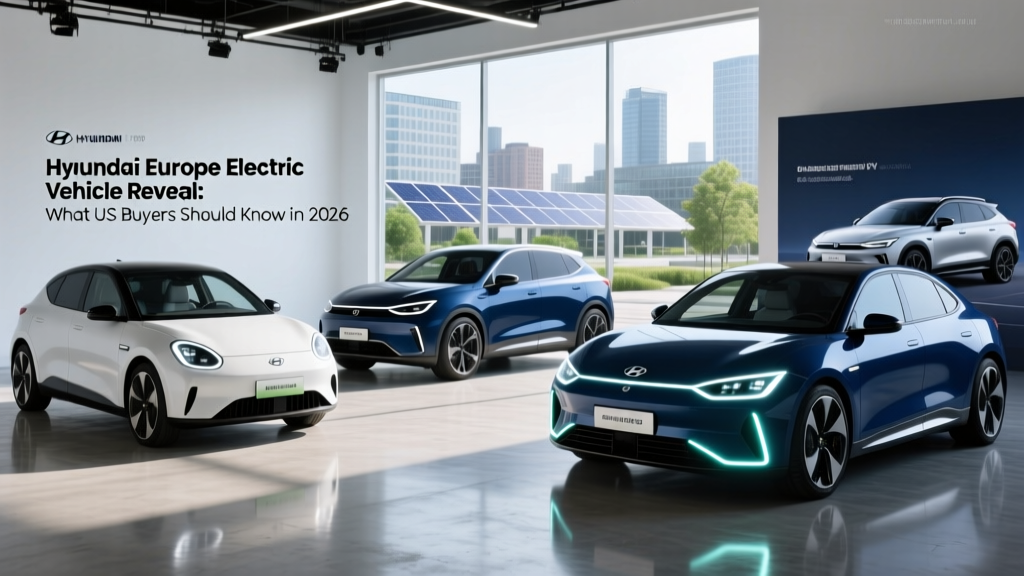
The short answer: Hyundai's recent European electric vehicle reveals—including the refreshed Ioniq 5, the new Inster (sold as the Casper Electric in some markets), and the upcoming Ioniq 2 compact—introduce upgraded battery chemistries, faster charging architectures, and lower starting prices. For US buyers, the key takeaway is that European-spec models often preview what arrives stateside 6-12 months later, but with different pricing, EPA range ratings, and federal tax credit eligibility. If you're shopping a Hyundai EV in 2026, the Ioniq 5 (EPA 310 miles, from $42,500) and Ioniq 6 (EPA 361 miles, from $38,650) remain the US-available lineup, with the Ioniq 2 expected to arrive as a 2027 model at roughly $30,000 before incentives.
What Hyundai's European EV Reveals Mean for American Shoppers
Hyundai has used the European market as a testing ground for its next-generation electric vehicles. The 2025-2026 European reveals include several models and updates that signal where the brand is heading globally. The Inster, a subcompact EV with up to 221 miles of WLTP range (roughly 185-195 miles EPA-equivalent) and a starting price under €25,000 in Europe, represents Hyundai's push into affordable urban EVs. The Ioniq 2, officially announced for Europe in late 2025, is a compact hatchback targeting the VW ID.2 segment with a projected 280-mile WLTP range and a price point around €24,000.
For US buyers, these reveals matter because they preview the technology—specifically battery chemistry shifts toward LFP (lithium iron phosphate) for lower-cost models, updated E-GMP platform refinements, and next-generation infotainment—that will filter into American-market vehicles. However, European WLTP range figures run 10-15% higher than EPA estimates, European pricing doesn't translate directly to US MSRP, and federal §30D tax credit eligibility depends on battery sourcing and final assembly location, not European availability.
Current US Hyundai EV Lineup: Exact Specs and Pricing
Before speculating about incoming models, here's what you can actually buy from Hyundai in the US right now, with verified EPA data and current pricing.
| Model | EPA Range | Battery (kWh) | Chemistry | Peak DC Charge | 10-80% Time | 0-60 mph | Starting MSRP |
|---|---|---|---|---|---|---|---|
| Ioniq 5 SE Std Range | 245 mi | 63.0 (usable) | NMC | 150 kW | ~22 min | 7.4 sec | $42,500 |
| Ioniq 5 SE/SEL/Limited (Long Range RWD) | 310 mi | 84.0 (usable) | NMC | 238 kW | ~18 min | 7.2 sec | $47,250 |
| Ioniq 5 Limited AWD | 290 mi | 84.0 (usable) | NMC | 238 kW | ~18 min | 4.5 sec | $54,600 |
| Ioniq 6 SE (Long Range RWD) | 361 mi | 77.4 (usable) | NMC | 233 kW | ~18 min | 6.8 sec | $38,650 |
| Ioniq 6 SEL/Limited AWD | 316 mi | 77.4 (usable) | NMC | 233 kW | ~18 min | 5.1 sec | $44,100 |
| Ioniq 5 N (Performance) | 221 mi | 84.0 (usable) | NMC | 238 kW | ~18 min | 3.25 sec | $67,500 |
Real-world range reality: The Ioniq 5 Long Range RWD carries a 310-mile EPA sticker. In mixed driving at 70°F, expect 275-290 miles. On sustained highway runs at 75+ mph, plan for 240-260 miles. In freezing weather (below 32°F) without preconditioning, range can drop to 200-230 miles. The Ioniq 6's aerodynamic sedan shape holds up better at highway speeds—expect ~300 miles real-world highway from its 361-mile EPA rating.
EV vs Gas vs Hybrid: Real Cost Comparison
The question most shoppers ask is whether a Hyundai EV actually saves money compared to a gas-powered Tucson or a Tucson Hybrid. Let's run the numbers over a 5-year, 75,000-mile ownership period using national averages.
| Cost Category | Ioniq 5 SEL (EV) | Tucson Hybrid SEL | Tucson Gas SEL |
|---|---|---|---|
| Base MSRP | $47,250 | $34,235 | $31,250 |
| Federal Tax Credit (§30D) | Up to $7,500* | $0 | $0 |
| Effective Purchase Price | ~$39,750 | $34,235 | $31,250 |
| 5-Year Fuel/Energy Cost | $3,900 (home charging, $0.14/kWh) | $7,350 (38 MPG, $3.50/gal) | $9,600 (28 MPG, $3.50/gal) |
| 5-Year Maintenance | ~$1,200 | ~$3,400 | ~$3,800 |
| 5-Year Insurance (avg) | ~$9,500 | ~$7,800 | ~$7,500 |
| 5-Year Total Cost | ~$54,350 | ~$52,785 | ~$52,150 |
*Federal §30D tax credit eligibility for the Ioniq 5 depends on battery component sourcing and critical mineral requirements, which have tightened significantly for 2026. Hyundai's US-built Ioniq 5 (produced at the Metaplant in Georgia) qualifies for the full $7,500 credit for buyers meeting income caps ($150K single / $300K joint) and purchasing at or below the $55,000 SUV MSRP cap. The credit can now be transferred at the point of sale, reducing your purchase price directly. Always verify current eligibility at irs.gov before purchasing.
The EV doesn't always win on pure economics over 5 years—insurance premiums for EVs run 15-25% higher than gas equivalents, and the upfront price gap only partially closes with the tax credit. Where the EV pulls ahead is at 7-10 years, as maintenance savings compound (no oil changes, no transmission fluid, significantly less brake wear due to regenerative braking) and fuel savings grow if gas prices rise. If you drive more than 15,000 miles annually, the EV breaks even faster.
What First-Time EV Buyers Must Know Before Choosing Hyundai
If you're coming from a gas car, several practical realities shape the ownership experience. These aren't dealbreakers, but they require planning.
Home Charging Is Non-Negotiable for Most Owners
Roughly 80-85% of EV charging happens at home. Without access to Level 2 home charging (a 240V circuit, typically 32-48 amps delivering 7.7-11.5 kW), EV ownership becomes significantly less convenient. A professional Level 2 installation runs $800-$2,500 depending on your electrical panel capacity and the distance from panel to parking spot. If your home has a 200-amp panel and your parking spot is near the electrical room, expect the lower end. If you need a panel upgrade to 200A, add $1,500-$3,000.
Without home charging, you'll rely on public DC fast charging and Level 2 destination chargers. This works in dense urban areas with robust charging infrastructure but becomes a burden in suburban and rural settings. Check the Alternative Fuels Data Center map for charging density in your area before committing.
Charging Speed: Peak kW vs. Sustained Reality
Hyundai's E-GMP platform supports peak charging rates of 238 kW (Ioniq 5 Long Range) on a 350 kW DC fast charger. But peak rate is not sustained rate. Here's what actually happens during a charging session:
- 10-40% SoC: The car pulls near-peak power (~200-238 kW), adding roughly 3-4 miles of range per minute
- 40-60% SoC: Charge rate tapers to ~150-175 kW as battery management protects cell health
- 60-80% SoC: Further taper to ~80-120 kW
- 80-100% SoC: Dramatic slowdown to ~20-40 kW—this is why we measure 10-80% times, not 0-100%
The 10-80% time of ~18 minutes is achievable on a properly rated 350 kW charger (like Electrify America's latest stations). On a 150 kW charger—still common at many public stations—that 10-80% session stretches to 28-35 minutes. Preconditioning the battery (which the Ioniq 5 does automatically when you navigate to a charger) is essential for hitting peak rates in cold weather.
Cold Weather Range Loss Is Real and Measurable
Hyundai's battery thermal management system is among the better implementations in the industry, but physics still applies. In sustained sub-freezing temperatures (20-32°F), expect 20-30% range reduction. Below 20°F, that loss can reach 35-40% on short trips where the cabin heater cycles frequently without the benefit of a heat pump pre-warming cycle. The Ioniq 5 includes a heat pump on all trims, which mitigates this loss compared to resistance heaters, but doesn't eliminate it.
If you live in the northern US and regularly drive in temperatures below freezing, budget your real-world winter range at roughly 65-70% of the EPA sticker. A 310-mile Ioniq 5 becomes a ~210-mile car in January in Minnesota.
Federal Tax Credit Eligibility: Current §30D Rules for 2026
The §30D clean vehicle credit remains available but with strict requirements that have narrowed eligibility significantly since the Inflation Reduction Act's implementation. Here's what determines whether you qualify:
- Income caps: Modified AGI must not exceed $150,000 (single filers), $225,000 (head of household), or $300,000 (married filing jointly)
- MSRP caps: Vehicle MSRP must not exceed $55,000 for sedans (Ioniq 6) or $80,000 for SUVs/trucks/vans (Ioniq 5)
- Battery component sourcing: Increasing percentage of battery components must be manufactured or assembled in North America (escalating thresholds through 2029)
- Critical minerals: Increasing percentage of critical minerals must be sourced from the US or FTA partners
- Final assembly: Vehicle must undergo final assembly in North America
- Point-of-sale transfer: As of 2024, buyers can transfer the credit to the dealer at purchase, reducing the sale price immediately rather than waiting to claim it on taxes
- One credit per vehicle VIN, one credit per buyer per year
The US-built Ioniq 5 (Georgia assembly) has generally qualified for the full credit, but battery sourcing requirements tighten annually. Verify the specific VIN's eligibility through the IRS portal at fueleconomy.gov before signing paperwork, as component sourcing can change mid-model-year.
Common Misconceptions About Hyundai EVs—Addressed with Data
| Myth | Fact |
|---|---|
| "EV batteries need replacing every 5-7 years" | Hyundai's EV battery warranty covers 10 years/100,000 miles with a capacity retention threshold of 70%. Real-world degradation data from high-mileage Ioniq 5 owners shows approximately 8-12% capacity loss at 100,000 miles, meaning a 310-mile car becomes a ~275-mile car—a modest reduction, not a catastrophic failure. |
| "The European range numbers mean the US car will get that range" | WLTP (European) testing produces figures 10-15% higher than EPA testing. The European Ioniq 5's 315-mile WLTP rating translates to roughly the 310-mile EPA rating we see in the US. Always look at EPA numbers for US-market vehicles. |
| "EVs are always cheaper to own than gas cars" | Not universally. Higher insurance premiums (15-25% more), higher upfront purchase prices, and potential home charging installation costs mean EVs break even at 5-7 years for moderate-mileage drivers. High-mileage drivers (15K+/year) break even faster; low-mileage drivers (under 8K/year) may never recoup the premium. |
| "I can charge from 0-100% in 18 minutes" | The 18-minute figure applies to 10-80% only. Charging from 80-100% adds another 25-35 minutes due to the charge curve taper. For road trips, plan to charge from 10-80% and drive on, rather than waiting for a full charge. |
| "European models are identical to US models" | European Hyundais often have different standard equipment, different battery suppliers, and different pricing structures. Features standard in Europe may be optional or unavailable in the US, and vice versa. Always check US-spec sheets. |
Decision Framework: Which Hyundai Electrified Vehicle Fits Your Situation?
Choose the Ioniq 5 if: You want a crossover with strong charging speed (238 kW peak, 18-min 10-80%), 310 miles of EPA range, V2L capability for powering devices, and you qualify for the §30D credit. Best for families needing cargo space and road-trip capability.
Choose the Ioniq 6 if: You prioritize maximum range (361 miles EPA) and efficiency (140 MPGe combined) in a sedan form factor, and you're willing to sacrifice some cargo volume and rear headroom. Best for commuters and long-distance drivers who don't need SUV utility.
Choose a Tucson Hybrid if: You lack reliable home charging access, regularly drive in areas with sparse DC fast charging infrastructure, or your budget doesn't accommodate the EV's higher purchase price even after tax credits. The Tucson Hybrid's 38 MPG combined and $34,235 starting price make it a pragmatic choice without charging dependency.
Wait for the Ioniq 2 (expected 2027) if: You want an affordable compact EV under $30,000 for urban commuting, don't need more than 200 miles of range, and can delay your purchase. European pricing suggests a US MSRP around $28,000-$32,000, potentially qualifying for both the §30D new-vehicle credit and state incentives.
Consider the Tucson PHEV if: You want 33 miles of electric-only range for daily commuting (covering most round-trip commutes under 30 miles) with a gas engine for longer trips. Total range exceeds 400 miles, and you avoid range anxiety entirely. Starting at $38,725, it's a bridge option for households not ready to go fully electric.
Real Ownership Costs: What the Brochures Don't Emphasize
Beyond the spec sheet, several cost factors shape the actual ownership experience:
Public charging costs more than home charging—significantly. While home charging at $0.14/kWh costs roughly $0.04 per mile in the Ioniq 5, DC fast charging at Electrify America or EVgo averages $0.35-$0.48/kWh, pushing per-mile cost to $0.10-$0.14—still below gasoline but not the dramatic savings of home charging. If you'll rely primarily on public charging, your fuel cost advantage over a hybrid shrinks considerably.
Tire wear accelerates on EVs. The Ioniq 5's weight (~4,600 lbs for Long Range AWD) and instant torque wear through tires 15-25% faster than equivalent gas crossovers. Budget $200-$400 extra per tire replacement cycle versus a Tucson, and expect replacements at 30,000-40,000 miles rather than 45,000-55,000 miles.
Insurance premiums are higher. EV insurance costs 15-25% more than gas equivalents due to higher repair costs (specialized body shops, battery replacement risk, sensor recalibration after collisions). Get quotes from your insurer before purchasing—the premium difference can be $300-$600 annually.
Depreciation has been volatile. EV resale values dropped significantly in 2023-2024 due to price wars and rapid model updates. Hyundai EVs have held value better than some competitors, but expect 45-55% depreciation over 5 years—comparable to mainstream gas crossovers but worse than Toyota hybrids, which benefit from strong demand and proven longevity.
Frequently Asked Questions
Will Hyundai's European EV models (Inster, Ioniq 2) be sold in the US?
The Inster is unlikely to reach the US market—Hyundai has indicated it's designed for European and Asian urban markets where smaller vehicles are more practical. The Ioniq 2 is more likely for US sale, potentially as a 2027 model, but Hyundai has not confirmed US availability. If it arrives, expect a starting price around $28,000-$32,000 with an EPA range of approximately 230-260 miles.
Does the Ioniq 5 qualify for the full $7,500 federal tax credit in 2026?
The US-built Ioniq 5 (Georgia Metaplant) has qualified for the full credit for eligible buyers. However, §30D battery sourcing requirements tighten annually, and mid-model-year supply chain changes can affect eligibility. Always verify through the IRS portal at fueleconomy.gov using the specific VIN before purchase. Income caps ($150K single / $300K joint) and MSRP caps ($80K for SUVs) also apply.
How does Hyundai's EV reliability compare to Tesla and other brands?
Hyundai's E-GMP platform has proven reliable in early data. The Ioniq 5 has not been subject to large-scale recalls for battery or powertrain issues. Consumer Reports rates Hyundai's EV reliability as average to above-average for the segment. The 10-year/100,000-mile battery and powertrain warranty is among the longest in the industry, matching or exceeding most competitors.
What happens if I need a battery replacement out of warranty?
Full battery pack replacement for the Ioniq 5 currently costs $12,000-$18,000 depending on the pack size and labor. However, individual module replacement (if only a few cells degrade) can cost $2,000-$5,000. Given that real-world data shows only 8-12% degradation at 100,000 miles, most owners will never need a full replacement during typical ownership periods.
Can I use Tesla Superchargers with a Hyundai EV?
As of 2026, Hyundai has not adopted the NACS (Tesla) connector for its US vehicles. The Ioniq 5 and Ioniq 6 use CCS1 connectors. However, Hyundai has announced plans to transition to NACS on new models beginning in 2025-2026 for future vehicles. Current Ioniq owners can access Tesla Superchargers only through a CCS-to-NACS adapter, which Hyundai has indicated it will provide or make available. Check with your dealer for adapter availability and Supercharger network compatibility.
Is Hyundai's highway driver assist (HDA2) comparable to Tesla Autopilot?
Hyundai's Highway Driving Assist 2 (HDA2) is a Level 2 driver-assistance system per SAE classification. It provides adaptive cruise control with lane centering and lane-change assist on highways. It requires continuous driver supervision—hands on or near the wheel, eyes on the road. It is not self-driving and does not approach the capability of Level 4 autonomous systems like Waymo. HDA2 performs competently for highway cruising but is generally considered a step behind Tesla's Autopilot and GM's Super Cruise in smoothness and lane-change confidence.