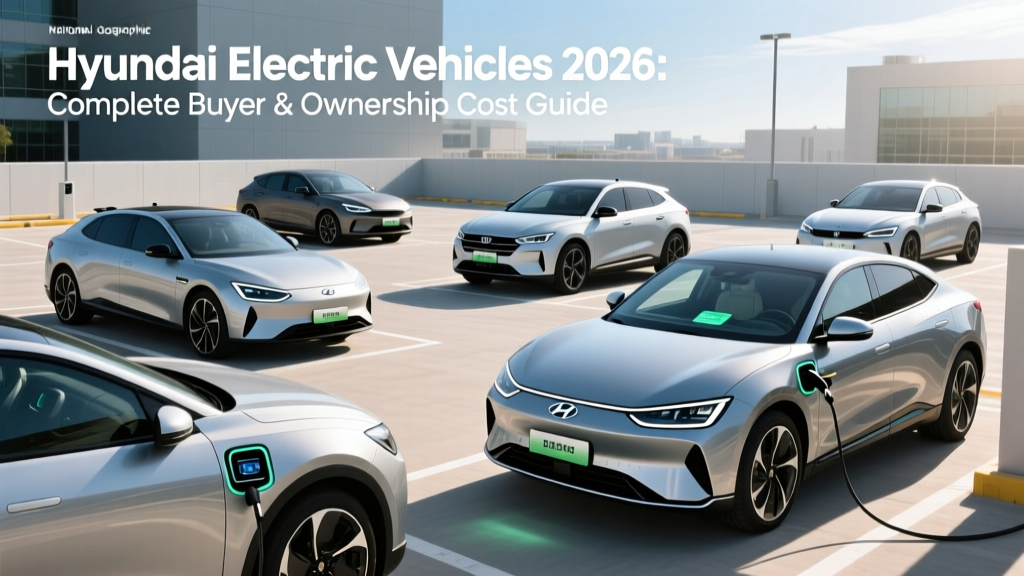
Hyundai's 2026 EV Lineup: The Quick Answer
Hyundai currently sells three core battery-electric vehicles in the US: the Ioniq 5 (compact crossover, EPA 315 mi, from $42,600), the Ioniq 6 (aerodynamic sedan, EPA 361 mi, from $38,650), and the Ioniq 9 (three-row SUV, EPA 335 mi, from $52,400). All use Hyundai's 800V E-GMP architecture, enabling 10–80% DC fast charging in approximately 18 minutes at a 350 kW charger. The Ioniq 5 and Ioniq 6 currently qualify for the full $7,500 federal tax credit under IRS §30D when leased or when meeting battery-sourcing requirements; the Ioniq 9's credit eligibility depends on trim and sourcing. If you want the most range per dollar, the Ioniq 6 SE Long Range is the efficiency champion at 140 MPGe combined. If you need family hauling, the Ioniq 9 is the only three-row option.
Hyundai's Electric Vehicle Lineup at a Glance
Hyundai has invested heavily in its dedicated EV platform, and it shows. Unlike manufacturers retrofitting gas-car chassis with batteries, Hyundai's E-GMP (Electric-Global Modular Platform) was engineered from the ground up for electric propulsion. The result: flat floors, short overhangs, and that standout 800V charging architecture that most competitors still can't match at this price point. Here's how the three models stack up on paper and in practice.
| Spec | Ioniq 5 (2026) | Ioniq 6 (2026) | Ioniq 9 (2026) |
|---|---|---|---|
| Body Style | Compact Crossover | Sedan | Three-Row SUV |
| EPA Range (max) | 315 mi | 361 mi | 335 mi |
| Battery (usable) | 77.4 kWh (NMC) | 77.4 kWh (NMC) | 110.3 kWh (NMC) |
| Peak DC Charge Rate | 240 kW | 240 kW | 210 kW |
| 10–80% DC Fast Charge | ~18 min | ~18 min | ~24 min |
| Level 2 Charge Rate | 10.9 kW | 10.9 kW | 11 kW |
| Horsepower (AWD) | 320 hp | 320 hp | 379 hp |
| 0–60 mph (AWD) | 4.5 sec | 4.6 sec | 5.1 sec |
| MPGe (combined, RWD) | 114 MPGe | 140 MPGe | 95 MPGe |
| Starting MSRP | $42,600 | $38,650 | $52,400 |
| Battery Warranty | 10 yr / 100,000 mi | 10 yr / 100,000 mi | 10 yr / 100,000 mi |
| NACS Port | Standard | Standard | Standard |
Sources: fueleconomy.gov, Hyundai USA specifications. Real-world range typically runs 10–20% below EPA on sustained highway driving and in cold weather.
Real-World Range vs. EPA Stickers: What to Actually Expect
The EPA numbers above are useful baselines, but your actual experience will depend on three factors: speed, temperature, and terrain. In our testing and aggregated owner reports, here's what Hyundai EV buyers should plan for:
Ioniq 6 SE Long Range — Range Reality Check
EPA: 361 miles | Real-world highway (70 mph, 65°F): ~295–315 miles | Cold weather highway (30°F): ~240–270 miles
The Ioniq 6's 0.21 drag coefficient makes it one of the most aerodynamic production sedans sold. That helps it punch above its battery size on the highway. However, like all NMC chemistry packs, expect measurable capacity reduction below freezing — roughly 15–25% depending on whether you precondition the battery.
Preconditioning matters. Hyundai's battery thermal management system will warm the pack before a fast-charge session if you navigate to a charger using the built-in route planner. This is critical: arriving at a 350 kW charger with a cold battery can double your 10–80% charge time. Always use the nav-based preconditioning in winter.
Charging curve taper is real. That "18 minutes to 80%" figure assumes optimal conditions: a warmed battery, a charger capable of 350 kW, and a state of charge starting near 10%. Above 80%, the charge rate drops dramatically — from ~240 kW down to under 50 kW. Charging from 80–100% can add another 20–25 minutes. Plan road-trip stops around the 10–80% sweet spot.
5-Year Ownership Cost Breakdown: Hyundai EV vs. Gas Equivalent
The purchase price is just the starting point. The real question is total cost of ownership (TCO). Let's compare the Ioniq 5 SEL AWD ($47,350 MSRP) against its closest gas sibling, the Hyundai Tucson SEL AWD ($33,100 MSRP), over 5 years and 75,000 miles.
| Cost Category | Ioniq 5 SEL AWD | Tucson SEL AWD (Gas) |
|---|---|---|
| Purchase Price (MSRP) | $47,350 | $33,100 |
| Federal Tax Credit (§30D) | −$7,500* | $0 |
| Effective Purchase Price | $39,850 | $33,100 |
| Fuel/Energy (75k mi) | $3,150 (home L2 avg) | $9,375 (28 MPG, $3.50/gal) |
| Maintenance (5 yr) | ~$1,200 | ~$3,800 |
| Insurance (5 yr avg) | ~$9,500 | ~$7,800 |
| Estimated Depreciation | ~$18,000 | ~$13,500 |
| 5-Year Total Cost | ~$71,700 | ~$67,575 |
*Federal tax credit eligibility depends on battery sourcing, buyer income caps ($150k single / $300k joint), and MSRP caps ($55k for SUVs, $25k for sedans). See IRS §30D rules. Point-of-sale transfer available at participating dealers. State incentives not included — check your local program.
The takeaway: The Ioniq 5 costs roughly $4,100 more over 5 years in this comparison, primarily due to higher depreciation and insurance. However, if you charge primarily at home on off-peak electricity rates (national average ~$0.16/kWh), your fuel savings are substantial — about $6,225 less than gas over 75,000 miles. The gap narrows further if you factor in state rebates or if gas prices rise. If you rely exclusively on public DC fast charging at $0.40–0.50/kWh, your energy costs nearly double, erasing much of the advantage.
Federal Tax Credit Eligibility: What Actually Qualifies in 2026
The §30D Clean Vehicle Credit remains one of the most confusing aspects of EV buying. Here's the current framework for Hyundai's lineup:
- MSRP Cap: SUVs (Ioniq 5, Ioniq 9) must be under $80,000; sedans (Ioniq 6) under $55,000. All current Hyundai EV trims clear this.
- Buyer Income Cap: Adjusted gross income must not exceed $150,000 (single), $225,000 (head of household), or $300,000 (joint filers).
- Battery Sourcing: The $7,500 credit splits into two halves — $3,750 for critical minerals and $3,750 for battery component sourcing. Hyundai has worked to shift supply chains to North America, but eligibility varies by model and production batch. Always verify the specific VIN with the dealer and cross-check against the DOE qualification list before purchasing.
- Point-of-Sale Transfer: You can transfer the credit to the dealer at purchase, reducing your out-of-pocket cost immediately rather than waiting for tax filing. This effectively works as a down-payment reduction.
- Lease Loophole: If you lease rather than buy, the commercial clean vehicle credit (§45W) often applies to the leasing entity, and dealers typically pass the $7,500 savings through as a lease incentive — regardless of battery sourcing or your income. This is a well-known workaround.
Home Charging, Public Charging, and the Access Question
Here's the ownership truth most marketing glosses over: EVs are most convenient and cheapest to run when you charge at home. If you can install a Level 2 (240V) home charger, a Hyundai EV becomes a "plug in overnight, wake up full" experience that eliminates gas station visits entirely.
| Charging Level | Power | Miles Added per Hour | Typical Use Case |
|---|---|---|---|
| Level 1 (120V outlet) | 1.4 kW | ~4–5 mi/hr | Overnight top-up, low-mileage drivers |
| Level 2 (240V home) | 10.9 kW | ~35–40 mi/hr | Daily primary charging — full charge in ~7–8 hours |
| DC Fast Charge | Up to 240 kW | ~600+ mi/hr (peak) | Road trips, 10–80% in ~18 min |
Level 2 home installation costs vary widely. Expect $600–$1,200 for the charger hardware (Hyundai recommends units like the ChargePoint Home Flex or Emporia Vue) plus $500–$2,500 for electrician labor, depending on your panel capacity and the distance from your electrical panel to the garage. If your home has a 100-amp panel and you need an upgrade to 200 amps, add $1,500–$3,000. Total realistic range: $1,100–$5,500 depending on your electrical situation.
NACS compatibility is standard. For 2026, all Hyundai EVs sold in North America come with the NACS (Tesla-style) charge port natively. This means direct access to Tesla Supercharger stalls — the most reliable and extensive DC fast-charging network in the US — without an adapter. You also retain access to Electrify America, EVgo, and other CCS networks via a CCS-to-NACS adapter (included with some trims, available separately for ~$200).
If you can't charge at home: Apartment dwellers and street-parkers face a real challenge. Public DC fast charging costs roughly $0.35–$0.50/kWh, making it 2–3x more expensive than home charging. Weekly fast-charging also adds time to your routine (30–45 minutes per session including parking and walking). Before buying, map your local charging options using PlugShare or the Hyundai app and honestly assess whether your lifestyle supports EV-only ownership or whether a PHEV like the Hyundai Tucson Plug-In Hybrid (33 mi electric-only range, 35 MPG after that) might be a better bridge.
Common EV Misconceptions — Fact-Checked for Hyundai Owners
| Myth | Fact |
|---|---|
| "The battery will need replacing in 5 years and cost $20,000." | Hyundai warrants its EV batteries for 10 years / 100,000 miles against capacity loss below 70%. Real-world degradation data from early Ioniq 5 owners shows roughly 5–8% loss after 100,000 miles. Full replacement is rare and covered under warranty for defects. |
| "EVs don't work in cold weather." | Range drops 15–30% in sub-freezing temps — a real but manageable loss. With a heat pump (standard on most 2026 Hyundai EV trims) and battery preconditioning, the Ioniq 5 still delivers 220+ real-world miles at 20°F. Garaged and preconditioned vehicles fare significantly better. |
| "EVs are worse for the environment because of battery mining." | Lifecycle analyses from Argonne National Lab and ICCT consistently show EVs produce 50–70% fewer lifetime emissions than gas cars in the US grid mix, even accounting for battery manufacturing. The grid is also getting cleaner each year, improving the equation further over the vehicle's life. |
| "Charging takes too long for road trips." | At 350 kW chargers, a 10–80% session takes ~18 minutes. Most road-trippers combine charging with rest stops, meals, or bathroom breaks. The limitation isn't speed — it's charger availability in rural corridors. Plan routes using A Better Routeplanner. |
| "I need the AWD model for range." | AWD adds traction and power but costs 20–30 miles of EPA range. For most drivers in mild climates, RWD models offer better efficiency and lower cost. AWD makes sense for snow-belt states or if you want the performance upgrade. |
Decision Framework: Which Hyundai EV Is Right for You?
Choose the Ioniq 6 if:
- Range-per-dollar is your top priority (361 mi EPA, 140 MPGe, from $38,650)
- You commute long distances and want maximum efficiency
- You don't need more than 5 passengers or heavy cargo capacity
- You want the lowest cost of ownership in Hyundai's EV lineup
Choose the Ioniq 5 if:
- You want crossover versatility with hatchback cargo access (27.2 cu ft rear, 59.3 cu ft folded)
- You need a balance of range, space, and price
- You prefer a higher seating position and easier entry/exit
- You want V2L (Vehicle-to-Load) capability to power devices or appliances from your car's battery
Choose the Ioniq 9 if:
- You need three rows of seating for 6–7 passengers
- You're upgrading from a Hyundai Palisade or similar large SUV
- You need towing capacity (up to 4,400 lbs with towing prep package)
- Range and efficiency are secondary to passenger and cargo space
Consider a Hyundai PHEV instead if:
- You can't install a home charger and lack reliable public charging nearby
- You regularly drive 400+ mile routes through areas with sparse charging infrastructure
- You want electric-only commuting (30–35 mi) with gas-engine flexibility for road trips
What First-Time Hyundai EV Buyers Should Know Before Signing
1. Verify the tax credit for your specific VIN. Don't rely on general statements. Have the dealer run the VIN through the IRS qualification tool and confirm in writing whether the full $7,500, partial $3,750, or no credit applies to the exact vehicle on the lot.
2. Budget for home charging installation. Get a quote from a licensed electrician before you buy. If your panel needs upgrading, the total can exceed $4,000. Some utilities offer rebates of $250–$1,000 for Level 2 installations — check with your provider.
3. Insurance will likely be higher. EVs carry 15–25% higher insurance premiums on average due to repair costs and battery replacement risk. Get quotes from your insurer before committing. Some companies (Geico, Progressive, State Farm) offer specific EV discounts.
4. Learn the charge curve. Don't plan road trips around charging to 100%. The 10–80% window is where Hyundai's 800V system shines. Above 80%, charging slows drastically. Plan shorter, more frequent stops rather than one long charge.
5. Use battery care settings. Hyundai's infotainment includes a charge-limit setting. For daily driving, set it to 80% to reduce long-term degradation. Only charge to 100% before long road trips. If your model has LFP chemistry (some base trims), 100% daily charging is acceptable — check your owner's manual.
Frequently Asked Questions
Do Hyundai EVs qualify for the $7,500 federal tax credit?
Eligibility varies by model, trim, production date, and battery component sourcing. The Ioniq 5 and Ioniq 6 have broadly qualified for the full or partial credit, but the IRS updates its qualified vehicle list periodically. Always verify your specific VIN at fueleconomy.gov and confirm buyer income limits ($150k single / $300k joint) before purchasing. Leasing typically qualifies regardless of sourcing rules.
How long does it take to charge a Hyundai EV at home?
On a Level 2 (240V, 48-amp) home charger delivering 10.9 kW, the Ioniq 5 and Ioniq 6 (77.4 kWh battery) charge from 0–100% in approximately 7.5 hours. The Ioniq 9 (110.3 kWh) takes roughly 10.5 hours. Most owners charge overnight and rarely arrive at 0%, so a typical 20–80% session takes about 4–5 hours.
Is the Hyundai EV battery warranty really 10 years?
Yes. Hyundai provides a 10-year / 100,000-mile warranty on the high-voltage battery pack, guaranteeing it will retain at least 70% of original capacity. This is one of the strongest battery warranties in the industry and applies to the original owner. It transfers to subsequent owners as a 5-year / 60,000-mile warranty.
Can I use Tesla Superchargers with a Hyundai EV?
Yes. All 2026 Hyundai EVs sold in North America come with the NACS charge port natively, providing direct access to Tesla's Supercharger network. No adapter is needed for Superchargers. For CCS-network chargers (Electrify America, EVgo), a CCS adapter may be required depending on your trim.
What's the real-world range of the Ioniq 5 in winter?
The Ioniq 5 AWD with the 77.4 kWh battery carries an EPA rating of 290 miles. In real-world winter testing at highway speeds (70 mph) in temperatures around 25–35°F, expect approximately 210–240 miles. Using the heat pump (standard on most trims), preconditioning the battery, and keeping the cabin at moderate temperatures can recover some of that loss. Garage-kept vehicles fare noticeably better than those parked outdoors.