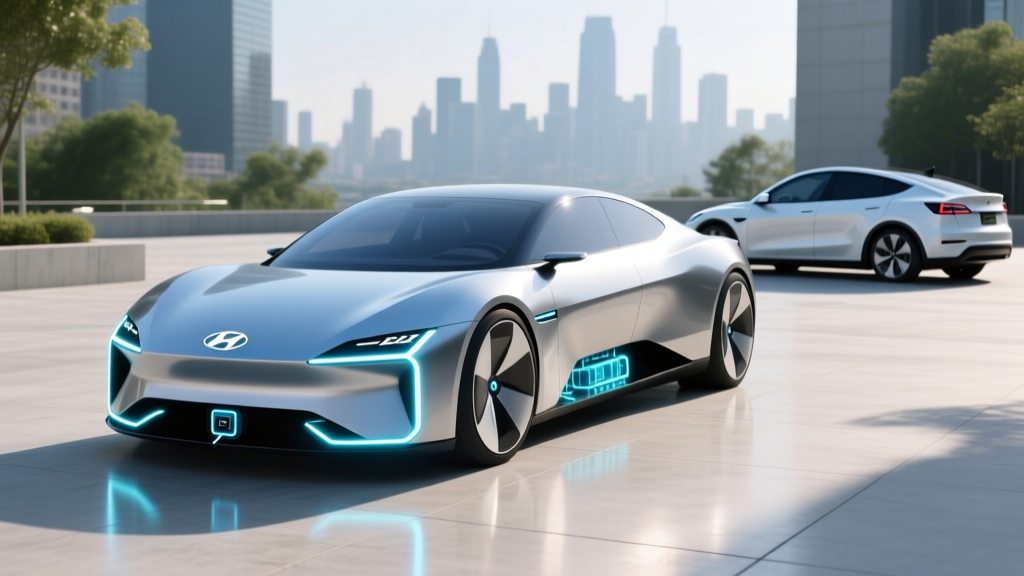
If you've been following Hyundai's electric car concepts — from the striking 45 Concept to the Prophecy sedan and the Seven SUV — you're probably wondering which of these visions actually made it to the showroom floor and whether they're worth buying today. The short answer: Hyundai has translated nearly every major concept into a production EV built on its E-GMP (Electric Global Modular Platform). The Ioniq 5 (from the 45 Concept), Ioniq 6 (from the Prophecy), and the three-row Ioniq 9 (previewed by the Seven Concept) are all available or arriving for the 2026 model year with 800V architecture, up to 361 miles of EPA range, and DC fast charging that peaks at 240 kW. Below, we break down exactly what each production model delivers, how ownership costs compare to gas equivalents, and whether Hyundai's concept-to-reality pipeline actually serves buyers.
Hyundai's Concept-to-Production Pipeline: What Actually Shipped
Hyundai has been unusually disciplined about turning auto-show concepts into production vehicles that retain the original design intent and engineering promises. Here's how the major Hyundai electric car concepts mapped to real vehicles:
| Concept | Debuted | Production Model | On Sale | Key Feature Carried Over |
|---|---|---|---|---|
| 45 Concept | 2019 (Frankfurt) | Ioniq 5 | 2022–present | Angular pixel design, flat floor, V2L |
| Prophecy | 2020 (digital) | Ioniq 6 | 2023–present | Streamliner aero, 0.21 Cd drag coefficient |
| Seven Concept | 2021 (LA Auto Show) | Ioniq 9 | 2025–present | Three-row lounge interior, flat floor |
| Concept N | 2023 | Ioniq 5 N | 2024–present | Track-capable performance EV, 641 hp |
| INITIUM (H2) | 2024 | Next-gen Nexo (FCEV) | Expected ~2026 | Hydrogen fuel cell SUV (not BEV) |
The pattern is clear: Hyundai uses concepts to preview production design language and platform capabilities roughly 2–3 years before launch. Unlike some manufacturers whose concepts are pure fantasy, Hyundai's E-GMP platform underpins all of these, meaning shared 800V electrical architecture, battery options, and charging hardware.
Production Specs: Ioniq 5, 6, and 9 Compared
Here's what the production Hyundai EVs actually deliver for the 2026 model year, based on EPA data at fueleconomy.gov and Hyundai's official specifications:
| Spec | 2026 Ioniq 5 (Long Range RWD) | 2026 Ioniq 6 (SEL Long Range) | 2026 Ioniq 9 (Long Range RWD) |
|---|---|---|---|
| EPA Range | 303 mi | 361 mi | ~330 mi (est.) |
| Battery (usable) | 77.4 kWh (NMC) | 77.4 kWh (NMC) | 110.3 kWh (NMC) |
| Max DC Fast Charge | ~240 kW | ~240 kW | ~240 kW |
| 10–80% DC Charge | ~18 min | ~18 min | ~24 min |
| Level 2 Rate | 10.9 kW | 10.9 kW | 10.9 kW |
| Horsepower | 225 hp | 225 hp | 215 hp |
| 0–60 mph | 7.0 sec | 7.3 sec | ~8.2 sec |
| MPGe (combined) | 114 MPGe | 140 MPGe | ~95 MPGe (est.) |
| Starting MSRP | ~$44,000 | ~$42,500 | ~$56,000 |
| Battery/Powertrain Warranty | 10 yr / 100,000 mi | 10 yr / 100,000 mi | 10 yr / 100,000 mi |
EV vs. Gas: The Cost Comparison Buyers Need
Hyundai's EVs compete directly with its own gas-powered models and popular crossovers from other brands. Here's how a 2026 Ioniq 5 stacks up against a comparably equipped Hyundai Tucson (gas) over five years and 75,000 miles of driving:
| Cost Category | 2026 Ioniq 5 SEL (EV) | 2026 Tucson SEL (Gas AWD) |
|---|---|---|
| Purchase Price (MSRP) | $47,250 | $33,500 |
| Est. Federal Tax Credit (§30D) | Up to $7,500* | $0 |
| Effective Purchase Price | ~$39,750 | $33,500 |
| Fuel/Energy (5 yr, 75k mi) | ~$3,400 (home L2) | ~$8,200 |
| Maintenance (5 yr) | ~$1,200 | ~$3,100 |
| Insurance (5 yr est.) | ~$8,500 | ~$6,800 |
| 5-Year Total Cost | ~$52,850 | ~$51,600 |
*Federal §30D credit eligibility depends on your modified adjusted gross income, the vehicle's MSRP (must be under $55,000 for sedans, $80,000 for SUVs/vans), battery component and critical mineral sourcing requirements, and point-of-sale transfer rules. Always verify current eligibility at IRS.gov or with a tax professional before purchasing.
The numbers show a near-parity scenario: the Ioniq 5 costs slightly more over five years primarily because of higher insurance premiums (EVs typically carry 15–25% higher insurance rates due to repair costs and parts pricing). Where the EV wins decisively is fuel and maintenance — home charging at the national average of $0.16/kWh yields roughly $0.045/mile in energy cost versus $0.11/mile for gas at $3.50/gallon and 28 MPG combined. If you have access to workplace or free charging, the EV's cost advantage widens substantially.
Real-World Ownership: What First-Time Hyundai EV Buyers Should Know
Hyundai's E-GMP platform is one of the most capable in the industry for daily ownership, but there are practical realities that spec sheets don't always reveal:
Charging Speed Is Genuinely Best-in-Class
Hyundai's 800V architecture allows DC fast charging at up to 240 kW on compatible chargers. That's not just a peak number — the charging curve holds above 150 kW from roughly 10% to 55% SoC before tapering. A 10–80% session takes approximately 18 minutes at a 350 kW Electrify America or Ionity station. This is meaningfully faster than most competitors still on 400V platforms (which peak around 150 kW and take 28–35 minutes for the same session). The catch: you need to find a charger capable of delivering 250+ kW. Many public stations are still 50–150 kW, where the advantage shrinks.
Home Charging Is Where Ownership Succeeds or Fails
If you can install a Level 2 home charger (240V, 48A circuit delivering 10.9 kW), a fully depleted Ioniq 5 recharges in about 7 hours — overnight is always enough. Installation costs typically run $800–$2,500 depending on panel capacity, conduit run length, and local permit fees. If your home has a 100A electrical panel that's already near capacity, you may need a panel upgrade ($1,500–$3,000 additional). Without home charging, relying entirely on public DC fast charging increases your per-mile energy cost by 2–3x and adds weekly time overhead.
The NACS Transition Matters
Starting with the 2025 model year, Hyundai began equipping new EVs with the NACS (North American Charging Standard) port, enabling direct access to Tesla's Supercharger network without an adapter. If you're buying a 2026 model, confirm the connector — NACS-equipped vehicles unlock roughly 17,000+ additional fast-charging stalls nationwide. Vehicles with CCS1 ports (earlier model years) require a CCS-to-NACS adapter for Supercharger access.
Cold Weather Performance
Hyundai's battery thermal management system includes a heat pump (standard on most 2026 trims) and battery preconditioning. When you set a DC fast charger as your navigation destination, the car warms the battery to optimal charging temperature, which can shave 5–8 minutes off your charging session in cold conditions. Without preconditioning, a 32°F charging session can peak at only 120–150 kW instead of 240 kW.
Common Misconceptions About Hyundai's Production EVs
| Myth | Fact |
|---|---|
| "Concept cars never make it to production looking the same." | The Ioniq 5 retained over 90% of the 45 Concept's design language, including the pixel LED lighting and parametric surface details. The Ioniq 6's streamliner silhouette closely mirrors the Prophecy. |
| "Hyundai EVs don't qualify for the federal tax credit." | Several Hyundai Ioniq models assembled at the Hyundai Motor Group Metaplant America in Georgia qualify for the §30D credit, subject to income and MSRP caps. Verify sourcing requirements at IRS.gov before purchase. |
| "The battery will need replacing in a few years." | Hyundai warranties the high-voltage battery for 10 years/100,000 miles against capacity loss below 70%. Real-world degradation data from early Ioniq 5 owners shows roughly 5–8% loss over the first 60,000 miles — well within warranty thresholds. |
| "Fast charging degrades the battery quickly." | Hyundai's battery management system limits sustained high-C-rate charging and uses active liquid cooling. Occasional DC fast charging (2–3 times per week) shows negligible additional degradation versus L2-only charging in fleet data. |
| "The Ioniq 9 is just a bigger Ioniq 5." | The Ioniq 9 uses a significantly larger 110.3 kWh battery, a longer wheelbase (123.2 in vs. 118.1 in), and is engineered for three-row family use with a different suspension tune and towing capacity (up to 4,000 lbs). |
Decision Framework: Which Hyundai EV Fits Your Situation
Choose the Ioniq 5 if: You want a versatile crossover with strong charging speed, decent range (303 mi), V2L capability for powering devices, and you primarily drive 1–2 passengers. It's the best all-rounder and the closest production realization of a concept car's original vision.
Choose the Ioniq 6 if: Maximum range and efficiency are your top priorities. The 361-mile EPA rating and 140 MPGe combined make it the most efficient Hyundai EV. The trade-off is less cargo space (12.3 cu ft trunk) and a lower roofline that limits rear headroom for taller passengers.
Choose the Ioniq 9 if: You need three rows of seating and family-hauler capability. The ~330-mile range and 110.3 kWh battery provide confidence for road trips, and the larger battery means less frequent charging stops. Expect higher insurance costs and a $56,000+ starting price.
Choose the Ioniq 5 N if: You want track-capable performance (641 hp with N Grin Boost, 0–60 in ~3.4 sec) and don't mind sacrificing range (~221 mi EPA) and ride comfort for driving engagement. This is a niche vehicle, not a daily-driver optimization.
Wait if: You cannot install a home Level 2 charger and live in an area with sparse public charging infrastructure. Hyundai's EVs are excellent, but EV ownership without reliable home charging remains inconvenient regardless of the brand. Consider a Hyundai Tucson Hybrid (38 MPG combined, no plug needed) as a bridge solution.
Frequently Asked Questions
Will Hyundai release more concept-based EVs after the Ioniq 9?
Hyundai has announced plans to expand its EV lineup through 2030, and future concepts will likely preview smaller, more affordable models. The INITIUM concept previews a next-generation hydrogen fuel cell SUV (FCEV), not a battery EV. Any future production models will be labeled as announced/preliminary until official specs and pricing are confirmed.
Do Hyundai EVs hold their resale value compared to gas Hyundais?
EV depreciation has been steeper than gas vehicles in recent years due to rapid technology advancement, price cuts from competitors, and shifting incentive landscapes. Expect a Hyundai Ioniq 5 to retain roughly 45–55% of its value after three years, compared to 55–65% for a gas Tucson. The gap is narrowing as the used EV market matures, but upfront depreciation remains a real ownership cost.
Can I use a Hyundai Ioniq to power my home during an outage?
Hyundai's E-GMP vehicles support V2L (Vehicle-to-Load) through an adapter that plugs into the charging port or uses a dedicated interior outlet, delivering up to 3.6 kW — enough to run essential appliances like a refrigerator, lights, and a laptop for several days. Full V2H (Vehicle-to-Home) bidirectional charging, which can feed power back through your electrical panel, requires compatible home equipment and is not yet widely supported on Hyundai models as of 2026.
Is Hyundai's driver-assist system actually self-driving?
No. Hyundai's Highway Driving Assist 2 (HDA2) and the available Highway Driving Assist with lane-change support are SAE Level 2 systems — they provide adaptive cruise control and lane-centering, but the driver must remain fully engaged with hands on or near the wheel and eyes on the road. This is fundamentally different from Level 4 robotaxi services like Waymo. Hyundai does not currently offer a hands-off, eyes-off system for consumer vehicles.