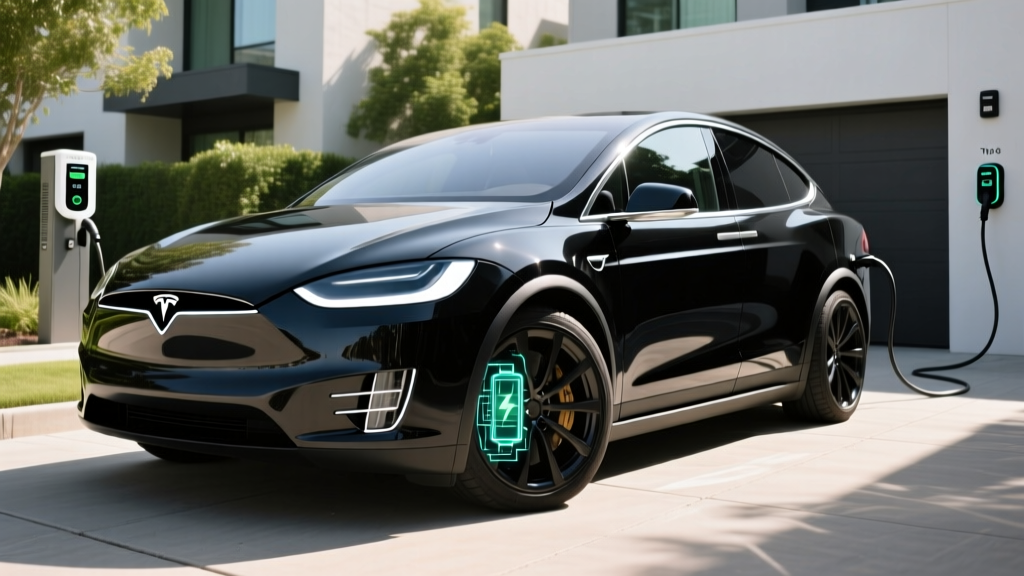
The Tesla Model X has always occupied a strange space: a three-row electric SUV with falcon-wing doors, supercar acceleration, and a price tag to match. For 2025 and into the 2026 model year, Tesla equipped the Model X with its Hardware 4 (HW4) Autopilot computer and updated sensor suite, sharpening the driver-assistance capabilities that have defined the brand. But beyond the silicon, the Model X remains a 100 kWh NMC-powered family hauler with legitimate road-trip credentials and access to the largest fast-charging network in North America.
We've spent significant time with the HW4-equipped Model X across highway, city, and cold-weather driving to answer the questions that matter: what's the real range, how fast does it actually charge, and does the HW4 upgrade justify the $80,000+ entry price? Here's the full breakdown.
2026 Tesla Model X Core Specifications
| Specification | Long Range (Dual Motor) | Plaid (Tri Motor) |
|---|---|---|
| EPA Range | 335 miles | 326 miles |
| Battery (usable) | ~100 kWh, NMC | ~100 kWh, NMC |
| Drivetrain | Dual Motor AWD | Tri Motor AWD |
| Horsepower | 670 hp | 1,020 hp |
| 0-60 mph | 3.8 seconds | 2.5 seconds |
| Top Speed | 155 mph | 163 mph |
| Peak DC Charge Rate | 250 kW | 250 kW |
| 10-80% DC Charge | ~30 minutes | ~30 minutes |
| Level 2 Charge Rate | 11.5 kW (~34 mi/hr) | 11.5 kW (~34 mi/hr) |
| MPGe (combined) | 102 MPGe | 98 MPGe |
| Efficiency | 33 kWh/100 mi | 34 kWh/100 mi |
| Seating | 5, 6, or 7 passengers | 5 or 6 passengers |
| Cargo (behind 3rd row) | 15.0 cu ft | 15.0 cu ft |
| Cargo (max, seats folded) | 85.1 cu ft | 85.1 cu ft |
| Towing Capacity | 5,000 lbs | 5,000 lbs |
| Autopilot Hardware | HW4 | HW4 |
| Base MSRP | $79,990 | $94,990 |
| Battery Warranty | 8 yr / 150,000 mi | 8 yr / 150,000 mi |
Real-World Range: EPA Sticker vs. What You'll Actually Get
Real-World Expectation: Plan for 270–300 miles on highway road trips at 70-75 mph. In mixed city/highway driving in mild weather, 300–320 miles is achievable. In cold weather (below 32°F), expect a 20–30% reduction — meaning 230–260 miles is realistic for winter road trips. Preconditioning the battery while plugged in recovers some of this loss.
The Model X's 100 kWh NMC (nickel manganese cobalt) battery pack is one of the largest in any consumer EV sold in the US. That capacity gives it a genuine advantage for long-distance travel, but physics still applies. The Model X is a heavy vehicle — roughly 5,100 lbs for the Long Range — and its SUV aerodynamics create more drag at highway speeds than a sedan like the Model S.
According to fueleconomy.gov, the Long Range Model X achieves 102 MPGe combined, which translates to about 33 kWh per 100 miles. On a flat, 65-mph cruise in 65°F weather with climate control on low, we've seen energy consumption dip to around 30 kWh/100 mi — which would theoretically stretch range past 330 miles. But load the cabin with passengers, push to 75+ mph, climb elevation, or drop the temperature below freezing, and 36-38 kWh/100 mi is common.
The Plaid variant's tri-motor setup and stickier tires extract a small efficiency penalty: 326 miles EPA and roughly 5–10 fewer real-world miles than the Long Range in equivalent conditions.
Charging Speed: DC Fast Charging and Home Level 2
| Charging Level | Power (kW) | Speed (miles/hr added) | Notes |
|---|---|---|---|
| Level 1 (120V household) | ~1.4 kW | ~3-4 mi/hr | Emergency/trickle only |
| Level 2 (240V, 48A Wall Connector) | 11.5 kW | ~34 mi/hr | Full charge in ~9 hours |
| Level 2 (240V, 32A mobile connector) | 7.7 kW | ~23 mi/hr | Common NEMA 14-50 setup |
| DC Fast (Tesla Supercharger V3) | Peak 250 kW | Up to ~175 mi in 15 min | 10-80% in ~30 min |
| DC Fast (CCS adapter, EA/others) | Peak ~150-170 kW | Varies by station | CCS adapter required for non-Tesla networks |
The Model X peaks at 250 kW on Tesla's V3 Superchargers, but as with all EVs, that peak is not sustained across the full charging session. The charge curve is aggressive between 10% and roughly 45% state of charge, where you'll see 200-250 kW. From 45-65%, the rate tapers to around 150 kW. Above 80%, it drops significantly — to 50-70 kW — as the battery management system protects cell longevity.
A typical 10-80% session takes approximately 30 minutes at a V3 Supercharger. That's competitive but no longer class-leading; vehicles built on 800V architectures like the Hyundai Ioniq 5 and Kia EV9 can complete the same session in 18-20 minutes. Tesla's advantage is network density and reliability, not raw charge speed.
For home charging, Tesla's Gen 3 Wall Connector at 48 amps delivers 11.5 kW, adding roughly 34 miles of range per hour. An overnight charge from 20% to 80% (about 60 kWh) takes roughly 5.5 hours — easily manageable with a standard overnight plug-in routine. Installation of a Wall Connector typically requires a 60A circuit; expect $800-$2,000 for professional installation depending on panel proximity and local permitting, per Tesla's installation guidance.
Preconditioning matters. If you navigate to a Supercharger using the car's built-in navigation, the Model X will automatically warm or cool the battery to optimal charging temperature before you arrive. Skipping this step — for example, by driving to a charger without setting it as a navigation destination — can add 5-10 minutes to your session, especially in cold weather.
Performance and Driving Dynamics
The Long Range Model X's 670 horsepower and 3.8-second 0-60 mph time already place it in sports-car territory. The Plaid's 1,020 hp and 2.5-second sprint are genuinely absurd for a three-row SUV — it will outrun most vehicles on the road from a stoplight while carrying six passengers and their luggage.
But straight-line speed isn't the whole story. The Model X's air suspension provides adjustable ride height and a comfortable, compliant ride on highway. Steering is precise if somewhat numb. The dual- and tri-motor setups provide instant torque-vectoring AWD that excels in rain and light snow. The 5,100-lb curb weight is noticeable in corners — this is a grand tourer, not a canyon carver.
Regenerative braking offers strong one-pedal driving capability. The Model X does not have adjustable regen levels like some competitors; Tesla uses a single, aggressive regen setting that most owners adapt to quickly but that can surprise first-time EV drivers.
HW4 Autopilot: What the Hardware 4 Upgrade Actually Changes
The HW4 computer, which Tesla began integrating into the Model X in 2023-2024, represents a significant upgrade over the previous HW3 system. Key improvements include:
- Higher-resolution cameras: HW4 uses cameras with roughly double the resolution of HW3, improving object detection at distance and in challenging lighting conditions.
- Improved processing power: The new silicon processes camera feeds faster with lower latency, which Tesla says allows the FSD (Supervised) neural network to react more quickly to complex scenarios.
- Removed ultrasonic sensors: Tesla eliminated ultrasonic parking sensors in favor of a camera-only "Tesla Vision" approach. In practice, parking proximity detection works well in most conditions but can struggle with thin objects like trailer hitches or narrow poles in heavy rain.
Standard Autopilot (included with every Model X) provides adaptive cruise control and lane-centering on highways. FSD (Supervised), available as a $8,000 one-time purchase or $99/month subscription as of early 2026, adds city-street navigation, automatic stop-sign and traffic-light handling, and lane changes on navigation routes. FSD has improved substantially but still requires vigilant supervision — it can misjudge construction zones, unprotected left turns, and complex intersections.
Compared to GM's Super Cruise (which offers true hands-free driving on pre-mapped highways) or Ford's BlueCruise, Tesla's FSD covers more road types but demands more driver attention. The trade-off is breadth vs. relaxation.
Interior, Cargo, and Practicality
The Model X's cabin is minimalist and tech-forward, dominated by a 17-inch center touchscreen that controls virtually every vehicle function. A second 8-inch screen serves rear-seat passengers for climate and entertainment. The yoke-style steering wheel remains polarizing; a conventional round wheel is available as a no-cost option and is recommended for most buyers.
Seating configurations include 5-seat (two rows), 6-seat (captain's chairs in the second row with a center aisle), and 7-seat (bench second row). The 6-seat layout offers the best balance of comfort and third-row access.
Cargo space: 15.0 cubic feet behind the third row is tight for a vehicle this size — comparable to a compact crossover. Fold the third row and you get 42.5 cu ft; fold both rear rows and the Model X opens up to 85.1 cu ft. The front trunk (frunk) adds a modest 6.0 cu ft — enough for a charging cable bag and a small soft cooler, but the Model X's frunk is notably smaller than competitors like the Rivian R1S.
Legroom: 41.2 inches in the front row, 38.4 inches in the second row, and 32.7 inches in the third row. That third row is best suited for children on longer trips; adults will find it cramped beyond short drives.
The falcon-wing rear doors are the Model X's signature feature. They open vertically with articulated hinges, providing excellent overhead clearance for loading car seats and accessing the third row in tight parking spaces. However, they operate more slowly than conventional doors, can struggle in very low garages (though sensors adjust the opening arc), and add mechanical complexity that has historically been a reliability concern.
Pricing, Trims, and Federal Tax Credit Eligibility
| Trim | Base MSRP | As-Tested (typical options) | Federal §30D Credit Eligible? |
|---|---|---|---|
| Long Range (Dual Motor) | $79,990 | $85,000–$92,000 | No — exceeds MSRP cap |
| Plaid (Tri Motor) | $94,990 | $100,000–$110,000 | No — exceeds MSRP cap |
The IRS §30D federal tax credit offers up to $7,500 for qualifying new EVs, but the Model X does not qualify. The credit imposes an MSRP cap of $80,000 for SUVs, and while the Long Range Model X's base MSRP sits just under that threshold at $79,990, the mandatory destination and order fee pushes it over the limit. Additionally, buyers must meet income caps ($300,000 joint / $150,000 single modified adjusted gross income) and the vehicle must meet battery critical-mineral and component sourcing requirements.
Popular options that increase the as-tested price include:
- FSD (Supervised): $8,000 or $99/month
- 22-inch wheels: $4,500 (reduces range to ~311 miles)
- Premium interior colors: $1,500–$2,500
- 6-seat or 7-seat layout: $6,500 (6-seat)
At the state level, some jurisdictions offer additional incentives that are not subject to the federal MSRP cap — check your state's energy office or AFDC's state law database for local programs.
Ownership Costs: Warranty, Efficiency, and Long-Term Value
Tesla covers the Model X battery and drive unit with an 8-year / 150,000-mile warranty (whichever comes first), with a minimum 70% capacity retention guarantee. The vehicle limited warranty is 4 years / 50,000 miles. These terms are competitive within the luxury EV segment, though Hyundai/Kia's 10-year / 100,000-mile battery warranty remains the industry benchmark.
The NMC battery chemistry in the Model X offers high energy density but is more sensitive to sustained high states of charge than LFP (lithium iron phosphate) chemistry. Tesla recommends daily charging to 80-90% for routine use and saving 100% charges for road trips. Long-term degradation data from Tesla's fleet suggests approximately 10-12% capacity loss at 150,000 miles — meaning a 335-mile Model X might deliver around 295-300 miles of range at that point.
Charging cost at home (at the US average of $0.16/kWh) works out to approximately $5.28 for every 100 miles driven. Compare that to a gas SUV averaging 22 MPG at $3.50/gallon: $15.91 per 100 miles. Over 15,000 annual miles, the Model X saves roughly $1,600 per year in fuel costs versus a comparable gasoline SUV.
Insurance premiums for the Model X are notably high — typically $3,000-$4,500 per year depending on location, driving record, and coverage level. Tesla offers its own insurance product in many states that uses real-time driving data to set premiums, which can be cheaper for safe drivers but more expensive for those with aggressive braking or cornering habits.
Pros, Cons, and Who Should Buy the HW4 Model X
Pros
- 335-mile EPA range — one of the longest of any 3-row EV
- Access to Tesla Supercharger network (17,000+ stalls in North America)
- HW4 Autopilot hardware with best-in-class camera resolution
- Supercar acceleration even in base Long Range trim
- Falcon-wing doors provide excellent car-seat and 3rd-row access
- Over-the-air updates continuously add features
- Strong resale value relative to luxury EV competitors
Cons
- $80,000+ price with no federal tax credit eligibility
- 250 kW peak charge rate trails 800V competitors (Ioniq 5, EV9, Lucid)
- Third-row legroom tight for adults
- Falcon-wing doors are slow and add mechanical complexity
- High insurance premiums ($3,000-$4,500/year typical)
- Yoke steering is polarizing; camera-only parking has blind spots
- Minimal physical button controls — everything goes through the screen
Who This EV Suits Best
- Tech-forward families who need three rows occasionally, value Tesla's Supercharger network for road trips, and want the latest driver-assist hardware.
- High-mileage commuters (60+ miles/day round trip) who benefit from the large battery and low per-mile electricity cost versus a gas SUV.
- Existing Tesla owners upgrading from a Model 3 or Model Y who want more space without leaving the ecosystem.
Consider alternatives if: you need a genuinely usable third row for adults (look at the Rivian R1S or Kia EV9), you want the fastest possible DC charging (Hyundai Ioniq 9, Lucid Gravity), or your budget is firm below $70,000.
Frequently Asked Questions
What is the real-world range of the HW4 Tesla Model X?
Expect 270-300 miles on highway road trips at 70-75 mph in moderate weather. In mixed city driving, 300-320 miles is realistic. In cold weather below freezing, plan for 230-260 miles. The EPA sticker says 335 miles (Long Range), but real-world conditions — speed, temperature, elevation, and HVAC load — always reduce that figure.
How fast does the Model X charge at home and on the road?
At home on a 240V / 48A Tesla Wall Connector, the Model X charges at 11.5 kW, adding about 34 miles per hour — a full overnight session easily replenishes daily driving. On DC fast chargers, it peaks at 250 kW at Tesla V3 Superchargers, with a 10-80% session taking approximately 30 minutes. The charge curve tapers significantly above 80% to protect battery health.
Does the Tesla Model X qualify for the federal EV tax credit?
No. While the Long Range base MSRP of $79,990 appears to sit under the $80,000 SUV cap, mandatory fees push the total above the limit. The Plaid at $94,990 exceeds it outright. Additionally, the §30D credit has buyer income caps and battery-sourcing requirements. Check IRS.gov for current rules, as they are subject to legislative change.
Is the HW4 Tesla Model X worth buying versus the Rivian R1S or Kia EV9?
It depends on your priorities. The Model X wins on range (335 vs. ~316 miles for the R1S Dual-Motor, ~280 for the EV9), Supercharger network access, and acceleration. The Rivian R1S offers a more usable third row, better off-road capability, and a more conventional design. The Kia EV9 starts $25,000+ lower, qualifies for the federal tax credit, and charges faster on 800V architecture, but gives up range and performance. If the Tesla ecosystem and range are paramount, the Model X delivers; if third-row practicality and value matter more, shop the R1S and EV9.
What's the biggest difference HW4 makes over the older HW3 Model X?
HW4's higher-resolution cameras and faster processor improve FSD (Supervised) performance — better detection of small objects, more confident lane changes, and faster reaction to sudden stops. For standard Autopilot (cruise + lane center), the difference is less dramatic. If you don't plan to use FSD, HW4 is a nice-to-have rather than a dealbreaker.
How long will the Model X battery last?
Tesla warranties the battery for 8 years or 150,000 miles with at least 70% capacity retention. Fleet data suggests the NMC pack loses roughly 10-12% capacity by 150,000 miles, with degradation slowing significantly after the first 30,000 miles. Avoiding routine 100% charges, minimizing DC fast charging when Level 2 is available, and preconditioning in cold weather all help maximize longevity. Out-of-warranty battery replacement currently costs approximately $20,000-$25,000.