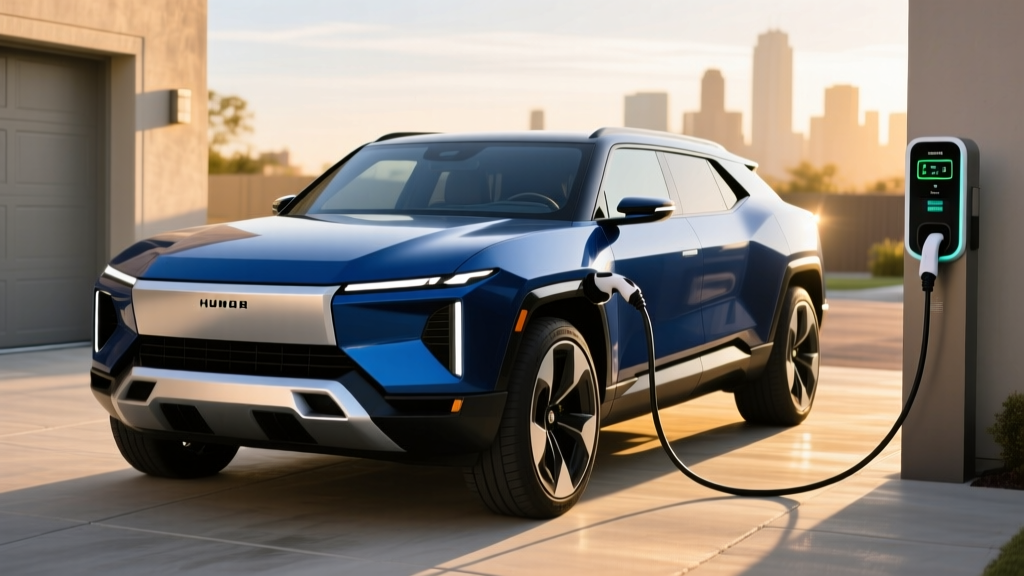
The GMC Hummer EV is a 9,000-pound electric supertruck that commands attention with its 1,000-horsepower Watts to Freedom launch mode and crab-walk capability. But when you spot a Hummer EV lease special at your local GMC dealer, the real question isn't whether it's impressive — it's whether the math works. Between the massive battery, premium insurance costs, and evolving federal tax credit rules, leasing a Hummer EV requires a careful look at the numbers beneath the marketing.
This guide dissects the full 5-year ownership picture for the 2026 GMC Hummer EV Pickup and SUV, including lease-specific tax credit nuances, real-world charging costs, and the depreciation trends that make leasing this particular EV more attractive than buying outright.
2026 Hummer EV: The Specs That Drive the Cost
Before calculating ownership costs, you need the baseline numbers. The 2026 GMC Hummer EV continues with GM's Ultium platform and dual-motor (2X) and tri-motor (3X) configurations. These aren't efficiency-focused commuters — they're performance machines that happen to run on electrons.
| Spec | 2X (Dual Motor) | 3X (Tri Motor) |
|---|---|---|
| Horsepower | 625 hp | 830 hp (up to 1,000 hp w/ WTF mode) |
| 0-60 mph | ~4.5 sec | ~3.0 sec |
| Battery (usable) | ~212 kWh (NMC) | ~212 kWh (NMC) |
| EPA Range | 350 mi | 329 mi |
| Max DC Fast Charge | 350 kW (peak) | 350 kW (peak) |
| 10-80% DC Fast Charge | ~34 min | ~34 min |
| Level 2 Charge Rate | 11.5 kW | 11.5 kW |
| Efficiency (MPGe) | 47 MPGe | 43 MPGe |
| Base MSRP (Pickup) | $99,995 | $107,995 |
| Battery/Powertrain Warranty | 8 yr / 100,000 mi | |
Hummer EV Lease Specials: How the Tax Credit Works on a Lease
This is where lease shoppers need to pay close attention. Under IRS §30D, the federal EV tax credit of up to $7,500 has strict rules for purchases — but leases operate under a different section of the tax code (§45W, the commercial clean vehicle credit). Here's the critical distinction:
When you buy: The Hummer EV Pickup with an MSRP above $80,000 does not qualify for the §30D consumer tax credit. The IRS caps eligible pickup trucks at an $80,000 MSRP. Every 2026 Hummer EV trim exceeds this threshold, meaning buyers get $0 in federal purchase credits.
When you lease: The leasing company (the legal owner) can claim the §45W commercial clean vehicle credit — up to $7,500 for vehicles over 14,000 lbs GVWR. Many lessors pass this savings through as a "lease cash" reduction, effectively lowering your capitalized cost. However, this is not guaranteed by law — it depends on the lessor's policy. GMC Financial Services and major banks have historically passed through lease credits on the Hummer EV, but always confirm with your dealer before signing.
- Vehicle MSRP cap: $80,000 for pickups/SUVs; $55,000 for sedans
- Buyer AGI cap: $150K single / $225K head of household / $300K joint
- Battery components must meet North American manufacturing thresholds (phasing in annually)
- Critical minerals must meet sourcing requirements from the US or FTA partners
- Point-of-sale transfer available at purchase — reduces purchase price immediately
- Hummer EV exceeds the $80K MSRP cap — not eligible under §30D for buyers
The bottom line on Hummer EV lease specials: if a dealer advertises a lease with the $7,500 "lease cash" applied, your effective monthly payment drops significantly — often by $100–$130/month over a 36-month term. Always verify that the advertised special actually includes this pass-through.
5-Year Total Cost of Ownership: Hummer EV vs. Gas Truck Baseline
Let's model what owning a Hummer EV actually costs over five years and 75,000 miles, compared against a comparable gas-powered heavy-duty pickup (we'll use the GMC Sierra 2500HD Denali at ~$75,000 MSRP and 15 MPG combined as the baseline).
| Category | Hummer EV 2X (Lease Scenario) | Gas Truck (Sierra 2500HD) |
|---|---|---|
| Acquisition (Down + Payments or Purchase) | $42,000 (36-mo lease residual buyout est.) | $75,000 (purchase) |
| Fuel / Charging | $5,625 (home L2 at $0.14/kWh) | $18,750 ($3.75/gal, 15 MPG) |
| Maintenance | $2,200 | $6,800 |
| Insurance (5 yr cumulative) | $18,500 | $11,000 |
| Depreciation / Resale Offset | -$22,000 (est. resale) | -$35,000 (est. resale) |
| Federal Tax Credit Applied | -$7,500 (lease pass-through) | $0 |
| Net 5-Year Cost | ~$38,825 | ~$76,550 |
Several assumptions drive these numbers. Charging cost assumes 80% home Level 2 at $0.14/kWh (national average for residential electricity in 2026) and 20% public DC fast charging at $0.40/kWh. The Hummer EV's 212 kWh battery and roughly 1.5 kWh/mile real-world consumption means each mile costs about $0.075 on home power — versus $0.25/mile for the gas truck. That's a fuel savings of roughly $13,125 over five years.
But insurance erodes a big chunk of that advantage, as we'll detail below.
Charging Cost vs. Gas: The Per-Mile Reality
The Hummer EV is the least efficient electric vehicle on the road by a wide margin. Its EPA-rated 47 MPGe (2X) translates to roughly 45 kWh per 100 miles — or about 1.5 kWh per mile in mixed driving. On the highway at 75 mph, expect consumption closer to 1.8–2.0 kWh per mile.
| Scenario | Hummer EV | Sierra 2500HD Gas |
|---|---|---|
| Home L2 ($0.14/kWh) | $0.070/mi | — |
| Public DCFC ($0.40/kWh) | $0.200/mi | — |
| Blended avg (80/20) | $0.096/mi | — |
| Gasoline ($3.75/gal, 15 MPG) | — | $0.250/mi |
| Savings per mile | $0.154/mi savings for EV | |
Over 15,000 miles per year, that's $2,310 in annual fuel savings when charging primarily at home. If you rely heavily on public DC fast charging — say, apartment living without home charger access — the savings narrow to roughly $750/year. This is why home Level 2 charging is essentially a prerequisite for making the Hummer EV's economics work.
A full 212 kWh charge at home costs roughly $29.68. That same range (350 EPA miles, ~270 real-world miles) in the gas truck costs about $67.50 at 15 MPG and $3.75/gallon. The savings are real, but they require the discipline of home charging.
Maintenance Savings: Fewer Parts, Real Dollars
The Hummer EV eliminates the most expensive recurring maintenance items on a heavy-duty gas truck. No engine oil, no transmission fluid, no spark plugs, no exhaust system, and minimal brake wear thanks to aggressive regenerative braking (the Hummer EV offers one-pedal driving modes that can recover up to 0.3g of deceleration).
| Service Item | Hummer EV | Gas HD Truck |
|---|---|---|
| Oil Changes | $0 | $1,500 (every 5K mi) |
| Brake Pads/Rotors | $400 (regen extends life) | $2,200 |
| Transmission Service | $0 | $600 |
| Coolant/Fluids | $200 | $500 |
| Tires (heavy vehicle wear) | $1,600 | $1,400 |
| Cabin Filter / Wipers / Misc. | $400 | $400 |
| Total | ~$2,600 | ~$6,600 |
Note the tire line: the Hummer EV's 9,000-lb curb weight and instant torque chew through tires faster than a gas truck. Budget for premium all-terrain rubber at roughly $400 per corner. That said, the overall maintenance savings still average $4,000 over five years.
Insurance Cost Reality: The Hummer EV Premium
Here's where the Hummer EV stings. Insurance for this vehicle runs 40–70% higher than a comparable gas truck, and there are concrete reasons why:
- Repair costs: The Hummer EV's Ultium battery pack, tri-motor drivetrain (on 3X), and specialized body panels are expensive to replace after a collision. Fewer body shops are certified for high-voltage EV repairs.
- Vehicle value: At $100K–$140K MSRP, comprehensive and collision premiums scale with replacement cost.
- Performance risk: 830+ horsepower and a 3-second 0-60 time place the Hummer EV in a supercar-risk category for actuaries.
- Weight: At 9,000+ lbs, the Hummer EV causes more damage to other vehicles in multi-car accidents, increasing liability exposure.
Expect annual premiums of $3,200–$4,200 depending on your state, driving record, and coverage level — compared to $1,800–$2,500 for a Sierra 2500HD Denali. Over five years, that's an additional $7,500 in insurance costs that partially offsets your fuel and maintenance savings.
Shop quotes from EV-friendly insurers (GEICO, Progressive, and State Farm have improved their EV rating models) before signing a lease. Some insurers now offer discounts for vehicles with advanced ADAS features like GM's Super Cruise, which is standard on the Hummer EV 3X.
Depreciation and Resale: Why Leasing the Hummer EV Makes Sense
The Hummer EV has experienced steeper-than-average depreciation since its launch. Early adopter premiums, production ramp-up, and the natural cooling of hype around ultra-expensive EVs have pushed 3-year residual values to roughly 45–52% of MSRP — compared to 55–65% for mainstream EVs and 50–60% for gas heavy-duty trucks.
For a $110,000 Hummer EV 2X, that means a 3-year resale value around $50,000–$57,000. If you bought outright, you'd absorb $53,000–$60,000 in depreciation. This is exactly why Hummer EV lease specials are structurally attractive: you transfer the depreciation risk to the lessor.
A typical 36-month Hummer EV lease at 10,000 miles/year might carry a residual of 52%, meaning you're only paying for ~$52,800 in depreciation plus rent charges (the lease equivalent of interest). If the lessor applies the $7,500 lease cash, your effective depreciation drops to ~$45,300 over three years.
The risk of buying a Hummer EV and watching its value erode further as battery technology advances (solid-state, cheaper LFP competitors) is real. Leasing insulates you from that uncertainty.
State, Local, and Utility Incentives
Beyond the federal landscape, many states, municipalities, and electric utilities offer additional rebates and incentives for EV purchases and leases. These change frequently and are jurisdiction-specific, so always verify current availability with official sources.
- California: CVRP rebates (income-dependent) and utility TOU charging rates
- Colorado: State EV tax credit up to $5,000 (purchase) — check lease applicability
- New York: Drive Clean Rebate up to $2,000 (MSRP caps may exclude Hummer EV)
- Utility rebates: Many utilities offer $250–$1,000 for home Level 2 charger installation or off-peak charging credits
- HOV lane access: Several states grant EVs carpool lane privileges regardless of occupancy
Important caveat: many state rebates carry MSRP caps similar to the federal program. A $100,000+ Hummer EV may be excluded from programs targeting mainstream EV adoption. Always confirm eligibility before counting on state incentives in your cost calculations.
Is a Hummer EV Lease Special Worth It? The Decision Framework
- You have home Level 2 charging (or can install a 48-amp/11.5 kW charger on a 60A circuit)
- The lease special includes the $7,500 lease cash pass-through
- You want to avoid long-term depreciation risk on a $100K+ EV
- You drive 10,000–15,000 miles/year (within standard lease limits)
- You value the performance, presence, and Super Cruise capability
- You lack reliable home charging and would rely on public DCFC (erodes savings)
- Insurance quotes in your area exceed $4,500/year
- You regularly tow heavy loads (range drops 40–50% under max tow)
- You want maximum efficiency — a Rivian R1T or Ford F-150 Lightning delivers similar capability at better MPGe
Frequently Asked Questions
How much does it really cost to own a Hummer EV over 5 years?
In a lease scenario with the $7,500 lease cash applied and primarily home charging, expect a net 5-year cost of roughly $38,000–$42,000 including payments, energy, insurance, maintenance, and depreciation offset. Buying outright pushes that figure higher due to steeper depreciation absorption and no federal purchase credit eligibility (the Hummer EV exceeds the $80,000 MSRP cap under §30D).
Do I qualify for the federal EV tax credit on a Hummer EV?
If you're purchasing, no — the Hummer EV's MSRP exceeds the $80,000 cap for pickups and SUVs under IRS §30D. If you're leasing, the lessor may claim the §45W commercial credit and pass the savings through as a cap cost reduction. This is lessor-dependent, not guaranteed. Confirm with your dealer that the lease cash is applied before signing. (IRS.gov)
How much do I save on fuel and maintenance with the Hummer EV?
Fuel savings average $2,300/year (at 15,000 miles and 80% home charging at $0.14/kWh) versus a 15-MPG gas heavy-duty truck. Maintenance savings average $800/year thanks to eliminated oil changes, reduced brake wear from regenerative braking, and fewer mechanical systems. Combined, that's roughly $15,500 in savings over five years — before accounting for higher insurance costs.
Are Hummer EVs more expensive to insure?
Yes, significantly. Expect $3,200–$4,200 annually compared to $1,800–$2,500 for a gas heavy-duty truck. The premium is driven by the vehicle's high replacement cost, expensive EV-specific collision repairs, 830+ hp performance profile, and 9,000-lb weight. Always get insurance quotes before committing to a lease.
How well does the Hummer EV hold its value?
The Hummer EV depreciates faster than mainstream EVs and gas trucks, with 3-year residuals estimated at 45–52% of MSRP. A $110,000 2X model may be worth $50,000–$57,000 after three years. This steep depreciation curve is exactly why leasing is the financially preferred path — you shift the residual risk to the lessor and can walk away or upgrade at term end.
Can I charge the Hummer EV at home on a standard outlet?
Technically yes, on a 120V Level 1 outlet — but at roughly 1.2 kW, you'd add only about 3–4 miles of range per hour. Charging the full 212 kWh battery would take over a week. A 240V Level 2 home charger at 11.5 kW (requiring a dedicated 60-amp circuit) adds ~25 miles per hour and can fully replenish overnight. Professional installation for Level 2 typically costs $800–$2,500 depending on your electrical panel capacity.
What happens if the Hummer EV battery degrades?
GM warranties the Ultium battery for 8 years or 100,000 miles against defects and excessive capacity loss (typically defined as dropping below 60–70% of original capacity). The Hummer EV's NMC chemistry will naturally lose 10–15% capacity over 8–10 years of normal use. For a lease, battery degradation is the lessor's concern, not yours — another reason leasing this vehicle makes practical sense.