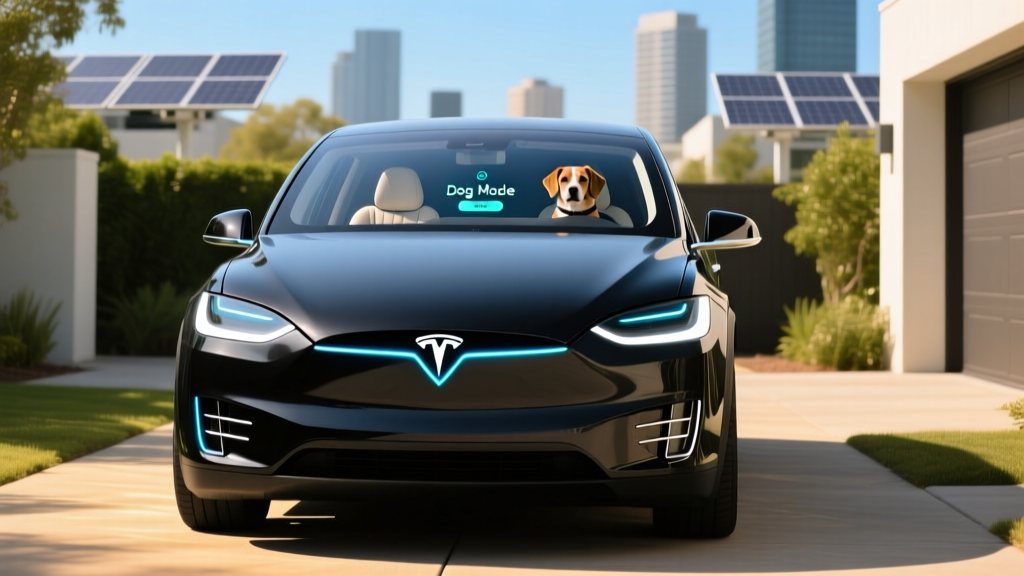
If you share your life with a dog, few EV features matter as much on a hot day as Tesla's Dog Mode. It keeps the cabin climate-controlled while you step out, displays a message on the touchscreen so passersby know your pet is safe, and sends alerts to your phone if something goes wrong. Below, we walk through exactly how to turn on Dog Mode in a Tesla, what it actually does, and pair that with a full 2026 Tesla Model Y profile so you know the vehicle behind the feature.
How to Turn on Dog Mode in a Tesla (Step-by-Step)
Dog Mode is available on all current Tesla models (Model 3, Model Y, Model S, Model X) running recent software. Here is the exact sequence:
- Park the vehicle. Dog Mode only activates when the car is in Park.
- Tap the fan icon at the bottom of the touchscreen to open climate controls.
- Select "Dog" from the three mode tabs at the top of the climate panel (the other two are "Keep" and "Camp").
- Set your target temperature using the up/down arrows. Tesla defaults to 70°F, which is comfortable for most breeds.
- Exit the vehicle. The touchscreen will display: "My owner will be back soon. Don't worry! The A/C is on and it's [XX]°F inside."
You can also activate Dog Mode remotely through the Tesla mobile app: open the app, tap Climate, then swipe to the Dog tab and confirm. This is useful if you've already walked away and realize you forgot to set it.
- Maintains your set cabin temperature using the HVAC system and high-voltage battery.
- Displays the reassuring message on the exterior-facing touchscreen.
- Locks the touchscreen so passengers or pets cannot accidentally change settings.
- Sends a push notification to your phone if the battery drops below 20% State of Charge (SoC), warning you to return.
- Disables Sentry Mode recording to conserve energy (Sentry Mode is a separate feature).
Energy Use: What Dog Mode Costs Your Battery
Dog Mode draws from the traction battery — not a separate auxiliary system — so understanding the energy cost is practical, not theoretical. In moderate weather (65–80°F ambient), the HVAC system in Dog Mode consumes roughly 200–400 watts on average. That translates to approximately 0.2–0.4 kWh per hour of runtime.
On a 2026 Model Y Long Range with its ~75 kWh usable battery, you could theoretically run Dog Mode for well over 100 hours before depletion. In extreme heat (100°F+), consumption can spike to 800–1,000 watts during initial cooldown, settling lower once the cabin reaches the target temperature. In freezing weather with the heat pump active, expect 300–600 watts sustained.
Practical takeaway: For a 30-minute grocery run in summer heat, Dog Mode will use roughly 0.15–0.25 kWh — effectively negligible against a 75 kWh pack. The 20% SoC alert provides a wide safety margin.
2026 Tesla Model Y: Range, Battery, and Real-World Expectations
The 2026 Tesla Model Y (refreshed "Juniper" generation) remains the best-selling EV in the U.S. and the most likely vehicle where new owners first encounter Dog Mode. Here is what you need to know about its energy platform.
| Spec | Long Range AWD | Performance AWD |
|---|---|---|
| EPA Range | 320 miles | 298 miles |
| Battery (usable) | ~75 kWh, NMC | ~75 kWh, NMC |
| Drivetrain | Dual-Motor AWD | Dual-Motor AWD |
| Horsepower | 384 hp | 456 hp |
| 0–60 mph | 4.8 sec | 3.5 sec |
| Efficiency | 122 MPGe / 28 kWh/100mi | 111 MPGe / 30 kWh/100mi |
| Max DC Fast Charge | 250 kW | 250 kW |
| 10–80% DC Time | ~25 min | ~25 min |
| Level 2 Home Rate | 11.5 kW (~44 mi/hr) | 11.5 kW (~44 mi/hr) |
| Cargo (rear seats up) | 30.2 cu ft | 30.2 cu ft |
| Cargo (seats folded) | 72.0 cu ft | 72.0 cu ft |
| Rear Legroom | 40.5 in | 40.5 in |
| Base MSRP | $44,990 | $51,490 |
Charging Speed: DC Fast and Home Level 2
The 2026 Model Y uses Tesla's NACS (North American Charging Standard) connector natively and accesses the Supercharger network — currently the most reliable DC fast-charging infrastructure in the U.S.
| Charging Level | Power | Speed | Notes |
|---|---|---|---|
| Level 1 (120V outlet) | ~1.4 kW | ~4–5 mi/hr | Emergency/trickle only |
| Level 2 (240V home) | 11.5 kW | ~44 mi/hr | Full charge overnight (~8 hrs) |
| DC Fast (Supercharger V3) | Peak 250 kW | 10–80% in ~25 min | Tapers above 60% SoC |
| DC Fast (Supercharger V4) | Up to 250 kW | Similar to V3 | Newer stalls, CCS adapter not needed |
Charging-curve reality: The 250 kW peak only holds between roughly 10–35% SoC. From 35–60%, expect ~150–170 kW. Above 80%, the rate drops sharply to protect the NMC battery — often below 50 kW. This is why Tesla and most EV analysts recommend charging to 80% on road trips and moving on rather than waiting for a full top-off.
For home charging, a Tesla Wall Connector on a 60-amp circuit delivers the full 11.5 kW (48 amps continuous). Installation typically runs $500–$1,500 if your electrical panel has capacity; a panel upgrade can add $1,500–$3,000.
Pricing, Trims, and Federal Tax Credit Eligibility
| Trim | MSRP | Est. After §30D Credit | Credit Eligible? |
|---|---|---|---|
| Long Range AWD | $44,990 | ~$37,490 | Yes (if buyer qualifies) |
| Performance AWD | $51,490 | ~$43,990 | Yes (if buyer qualifies) |
The federal EV tax credit under IRS §30D offers up to $7,500, but eligibility depends on multiple requirements that change periodically:
- MSRP cap: SUVs/vans/pickups must be under $80,000. The Model Y qualifies.
- Buyer income cap: Modified AGI must not exceed $150,000 (single), $225,000 (head of household), or $300,000 (joint).
- Battery sourcing: A percentage of critical minerals and battery components must be sourced from the U.S. or free-trade-agreement countries. Tesla has worked to meet these thresholds, but exact eligibility shifts as supply chains evolve.
- Point-of-sale transfer: As of 2024, buyers can transfer the credit to the dealer at purchase, reducing the upfront price rather than waiting for a tax refund.
Always verify current eligibility on the IRS website or with a tax professional before purchasing. Rules are subject to legislative change.
Standout Tech and Notable Drawbacks
Beyond Dog Mode, the 2026 Model Y brings a suite of technology that sets it apart from rivals like the Hyundai Ioniq 5, Ford Mustang Mach-E, and Volkswagen ID.4:
Standout features:
- 15.4-inch touchscreen with refreshed Juniper UI, faster processor, and ventilated front seats standard on all trims.
- Ambient lighting and power-folding second row — new for the Juniper refresh.
- Autopilot (standard): SAE Level 2 driver assistance including adaptive cruise, lane centering, and automatic emergency braking. The driver must remain engaged at all times.
- FSD (Supervised): Optional $8,000 upgrade adding automatic lane changes, intersection handling, and parking assist — still Level 2, still requires active supervision.
- Over-the-air updates continuously add features and refinements.
- Supercharger network access — over 6,000 U.S. stalls with industry-leading uptime.
Notable drawbacks:
- No physical stalks: Turn signals are now steering-wheel buttons (Juniper refresh), which draws polarized reviews from owners.
- Rear visibility: The sloping roofline limits the rear view; the digital mirror camera helps but isn't a full replacement.
- Ride firmness: Improved over pre-2025 models but still firmer than the Ioniq 5 or ID.4 on rough pavement.
- No Apple CarPlay/Android Auto: Tesla's native infotainment is capable but closed; no smartphone projection.
Who the 2026 Model Y Suits Best
- Families and pet owners: 72 cu ft cargo, Dog Mode, Camp Mode, and excellent rear-seat space make this a top pick.
- Commuters with home charging: 320 EPA miles and 11.5 kW Level 2 means you charge overnight and rarely visit a public charger.
- Road trippers: Supercharger network coverage is unmatched; 25-minute 10–80% stops keep travel time reasonable.
- You want a softer, more cushioned ride (try the Ioniq 5).
- You need Apple CarPlay or prefer physical buttons.
- You frequently tow — the Model Y's 3,500-lb tow rating is adequate for light trailers but not boats or campers.
Warranty Coverage
Tesla provides the following warranty for the 2026 Model Y:
- Basic vehicle: 4 years / 50,000 miles
- Battery and drive unit: 8 years / 120,000 miles (Long Range & Performance), with a minimum 70% capacity retention guarantee over the warranty period.
The 8-year battery warranty is competitive with the industry standard. Tesla's NMC chemistry typically shows 5–8% degradation over the first 50,000 miles, then flattens into a slow decline — most owners report 90%+ State of Health at 100,000 miles based on fleet data.
Frequently Asked Questions
Can Dog Mode drain the Tesla battery completely?
No. Tesla sends a push notification to your phone when the battery drops below 20% SoC while Dog Mode is active. At that point, you still have roughly 60+ miles of range (on a Long Range model) to return. In practice, Dog Mode uses so little energy (~0.2–0.4 kWh/hr in moderate weather) that reaching the 20% threshold during a typical errand is extremely unlikely.
Does Dog Mode work in extreme heat or cold?
Yes. The Model Y's heat pump (standard since 2021) makes climate control efficient in both directions. In 100°F+ heat, expect higher initial energy draw as the system cools the cabin, but it stabilizes. In freezing weather, the heat pump warms the cabin efficiently. Dog Mode maintains your set temperature regardless of outside conditions.
How does Dog Mode differ from Keep and Camp Mode?
All three maintain cabin temperature, but they differ in behavior: Dog Mode displays the pet-safety message on the touchscreen and locks controls. Keep Mode maintains temperature but shows no message — useful for quick stops where no pet is present. Camp Mode maintains temperature, keeps USB ports and the touchscreen active for entertainment, and is designed for sleeping in the vehicle overnight.
Does the 2026 Model Y qualify for the $7,500 federal tax credit?
The Model Y qualifies on the vehicle side (under the $80,000 SUV MSRP cap, assembled in the U.S.). However, buyer-side eligibility depends on your income, the battery's critical-mineral and component sourcing (which can shift), and current IRS rules. Verify at IRS.gov before purchasing.
Is the 2026 Model Y worth buying over the Hyundai Ioniq 5 or Ford Mach-E?
The Model Y wins on charging infrastructure (Supercharger access), real-world efficiency (28 kWh/100mi), software ecosystem, and cargo volume. The Ioniq 5 offers a more comfortable ride, 800V architecture for faster peak charging on compatible CCS stations, and Apple CarPlay. The Mach-E provides a more traditional driving feel and BlueCruise hands-free driving on mapped highways. For pet owners specifically, Dog Mode is a Tesla-exclusive feature that neither competitor matches.