If you've just slid into the driver's seat of a Tesla Model 3 for the first time, you might be looking around for something familiar: a key, an ignition slot, a start button. There isn't one. The Model 3 does away with every traditional startup ritual, and once you understand the logic behind it, you'll wonder why every car doesn't work this way. This guide walks you through exactly how to start a Tesla Model 3, then dives deep into the 2026 model's range, charging, battery, pricing, and tax-credit picture so you know what you're signing up for.
How to Start a Tesla Model 3: Step-by-Step
Starting a Tesla Model 3 is less of an event and more of a state transition. The car is always "on" in the sense that its electronics are managing the battery, thermal system, and connectivity. What you're really doing is authorizing the vehicle to drive. Here's the sequence:
- Approach with your key. The Model 3 recognizes your phone key (via Bluetooth), key card, or key fob. The door handles present themselves automatically with phone key.
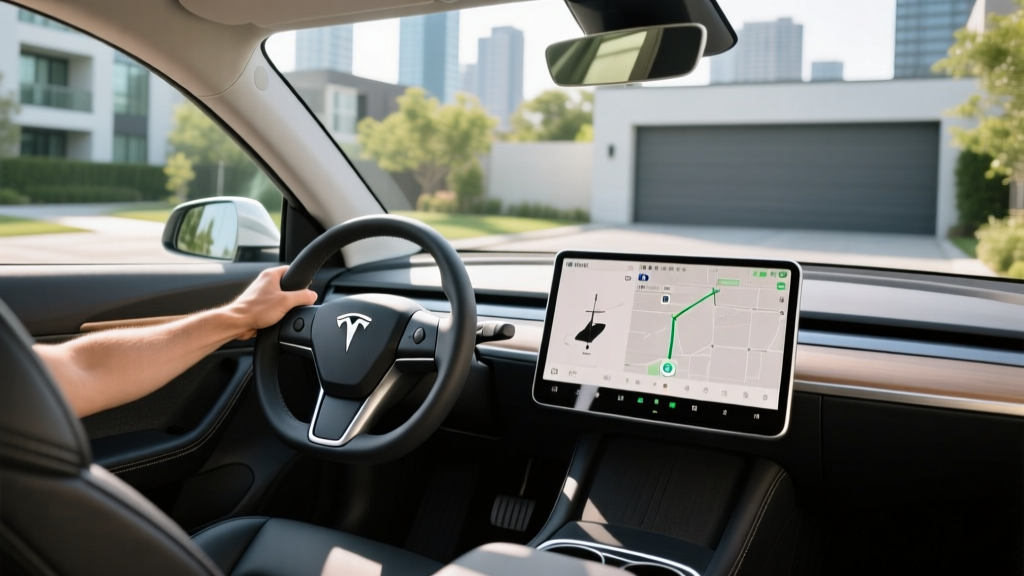
- Sit in the driver's seat. The seat occupancy sensor detects you. With a valid key present, the center touchscreen powers up and displays the instrument cluster (speedometer, battery level, gear selector).
- Press the brake pedal. This is the closest thing to a "start" action. The car enables the drive system — you'll see the green "READY" indicator on the touchscreen (or it simply becomes responsive).
- Select a gear. Use the stalk on the right side of the steering column. Push down for Drive, push up for Reverse, press the end of the stalk for Park. (On the refreshed "Highland" Model 3, gear selection moved to the touchscreen with backup buttons on the overhead console.)
- Drive. Release the brake, press the accelerator. There is no engine noise — just the faint hum of the electric motor.
To turn it off: Simply shift into Park, exit the vehicle, and walk away. The car powers down its drive systems, locks the doors, and enters sleep mode automatically. You can also tap Controls → Safety → Power Off on the touchscreen if you're sitting inside and want to shut down the electronics (useful if you're parked and waiting).
2026 Tesla Model 3: Quick Spec Overview
| Specification | RWD (Base) | Long Range AWD | Performance AWD |
|---|---|---|---|
| EPA Range | 363 miles | 346 miles | 315 miles |
| Battery (Usable) | ~60 kWh (LFP) | ~75 kWh (NMC) | ~75 kWh (NMC) |
| Drivetrain | Rear-Wheel Drive | Dual-Motor AWD | Dual-Motor AWD |
| Horsepower | 271 hp | 346 hp | 510 hp |
| 0–60 mph | 5.8 sec | 4.2 sec | 2.9 sec |
| MPGe (Combined) | 132 MPGe | 121 MPGe | 111 MPGe |
| Efficiency | 25 kWh/100 mi | 28 kWh/100 mi | 30 kWh/100 mi |
| Peak DC Fast Charge | 170 kW | 250 kW | 250 kW |
| 10–80% DCFC Time | ~25 min | ~20 min | ~20 min |
| Base MSRP (2026) | $38,990 | $45,990 | $52,990 |
Source: EPA / fueleconomy.gov
Real-World Range: What to Actually Expect
Tesla's efficiency advantage is well-documented. The RWD Model 3 achieves 25 kWh per 100 miles — meaning it extracts more miles from each kilowatt-hour than almost any competitor. Part of this comes from the car's low drag coefficient (~0.219 Cd), Tesla's heat pump (standard on all trims, critical for cold-weather range preservation), and the rear permanent-magnet reluctance motor's efficiency characteristics.
The LFP (lithium iron phosphate) battery in the RWD model has a lower energy density than the NMC (nickel manganese cobalt) packs in Long Range and Performance trims. That's why the RWD has a smaller ~60 kWh usable pack but still achieves strong range — the car is lighter and more efficient. The trade-off: LFP chemistry handles cold slightly worse than NMC, so winter range loss can be more pronounced on the base model.
Charging Speed: Home, Destination, and DC Fast
Charging is where Tesla's integrated ecosystem still holds an edge. The Supercharger network remains the most reliable public DC fast-charging option in the US, and the Model 3 is optimized for it.
| Charging Level | Power / Rate | Miles Added per Hour | Best Use Case |
|---|---|---|---|
| Level 1 (120V household) | ~1.4 kW | 3–5 mi/hr | Emergency / trickle top-up |
| Level 2 (240V home, 48A) | ~11.5 kW | ~37 mi/hr | Daily home charging (overnight full charge) |
| DC Fast (RWD peak) | 170 kW | ~200+ mi in 15 min | Road trips via Supercharger |
| DC Fast (LR/Perf peak) | 250 kW | ~175 mi in 15 min | Road trips, V3/V4 Superchargers |
Important charging-curve reality: The 250 kW peak on Long Range and Performance trims is just that — a peak, sustained only between roughly 10–30% State of Charge (SoC). Above 50%, charge rate tapers significantly, and above 80% it drops to under 40 kW. This is standard lithium-ion behavior to protect cell health. Tesla's navigation system automatically preconditions the battery when you route to a Supercharger, warming it to optimal temperature for the fastest possible charge curve upon arrival.
The RWD model's 170 kW peak is lower, but LFP chemistry can tolerate charging to 100% regularly without accelerated degradation — a meaningful ownership advantage. Tesla actually recommends charging LFP packs to 100% at least weekly for accurate battery management system (BMS) calibration. For NMC packs (Long Range, Performance), daily charging to 80% is recommended, reserving 100% for road trips.
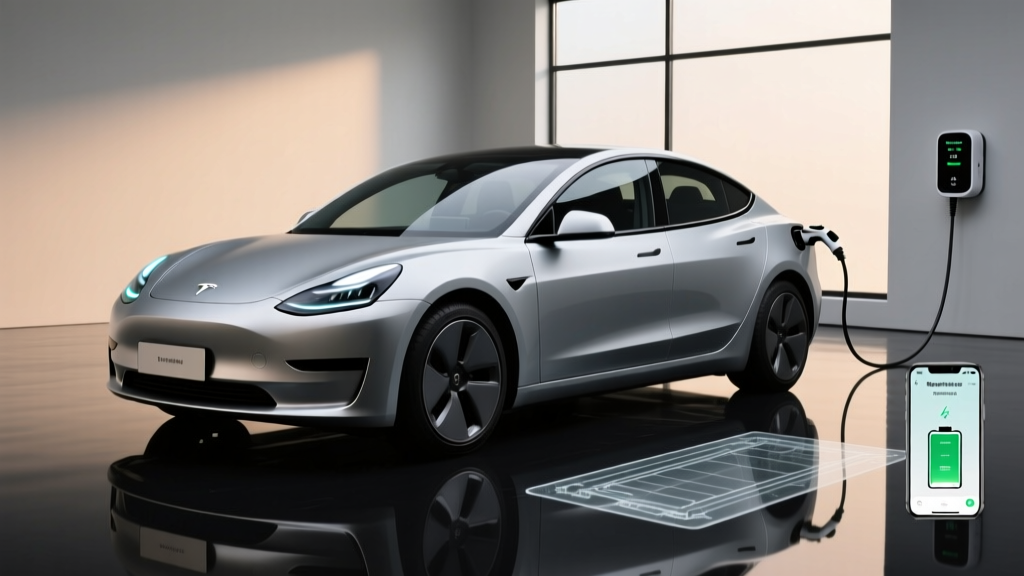
For home Level 2 charging, a Tesla Wall Connector on a 60-amp circuit delivers up to 11.5 kW (48 amps continuous). This adds roughly 37 miles of range per hour — more than enough to fully replenish any Model 3 overnight. Expect $500–$1,500 for a professional Wall Connector installation depending on your electrical panel proximity and local permit requirements. If your panel is maxed out, a service upgrade to 200A can add $1,500–$3,000.
Performance and Driving Dynamics
Even the base RWD Model 3 delivers 271 horsepower and a 5.8-second 0–60 mph time — quicker than most gas-powered sport sedans. The single rear motor provides satisfying acceleration with a slight weight bias over the drive axle, giving confident traction in dry conditions.
The Long Range AWD adds a front induction motor for 346 combined horsepower and a 4.2-second sprint to 60 mph. All-wheel drive improves wet-weather and light-snow traction substantially. The Performance model pushes 510 hp with track-tuned suspension, larger brakes, and a 2.9-second 0–60 — territory previously reserved from supercars.
The "Highland" refresh (introduced for the 2024 model year and continuing through 2026) improved ride quality noticeably. Acoustic glass, revised dampers, and additional sound deadening make this a significantly quieter and more comfortable car than pre-2024 Model 3s. The ventilated front seats and ambient lighting further close the gap with luxury competitors.
Pricing, Trims, and Federal Tax Credit Eligibility
| Trim | Base MSRP | Est. §30D Credit | Effective Price* |
|---|---|---|---|
| RWD | $38,990 | Up to $7,500 | ~$31,490 |
| Long Range AWD | $45,990 | Up to $7,500 | ~$38,490 |
| Performance AWD | $52,990 | Up to $7,500 | ~$45,490 |
*Effective price assumes full credit eligibility. Your actual credit depends on individual tax liability and IRS sourcing rules. Destination fee ($1,390) not included.
The federal EV tax credit under IRS §30D can reduce the effective price by up to $7,500, but eligibility is not automatic. Here's what determines whether you qualify:
- MSRP cap: Sedans (including the Model 3) must have an MSRP at or below $55,000. All three trims currently qualify.
- Buyer income limits: Modified adjusted gross income (MAGI) must not exceed $150,000 (single), $225,000 (head of household), or $300,000 (married filing jointly).
- Battery sourcing: The credit is split into two halves — $3,750 for meeting critical-minerals requirements and $3,750 for meeting battery-component sourcing requirements. Tesla has worked to onshore supply chains, and the Model 3 has historically qualified for the full $7,500, but sourcing rules tighten annually. Verify current-year eligibility on the IRS website before purchasing.
- Point-of-sale transfer: As of 2024, you can transfer the credit to the dealer at purchase, receiving the discount upfront rather than waiting to claim it on your tax return. Tesla applies this at checkout if you qualify.
Pro tip: The credit is non-refundable if claimed on your tax return — meaning it can only reduce your tax liability to zero, not generate a refund. The point-of-sale transfer bypasses this limitation, making it the preferred option for most buyers.
Interior, Cargo, and Technology
The Model 3's interior remains polarizing: minimalist by design, with nearly every function routed through the 15.4-inch center touchscreen. There is no instrument cluster, no physical speedometer, and no traditional stalk for turn signals on the Highland refresh (they're now buttons on the steering wheel — an adjustment period is guaranteed).
Passenger space:
- Front legroom: 42.7 inches
- Rear legroom: 35.2 inches
- Front headroom: 40.3 inches
- Rear headroom: 37.8 inches
Cargo volume: 23 cubic feet in the trunk, plus a small front trunk (frunk) for charging cables and small items. The rear seats fold 60/40 for longer cargo. The trunk opening is a conventional sedan lid, not a hatchback — this limits practicality versus the Model Y's liftgate.
Tech highlights:
- Tesla's infotainment remains the industry benchmark for responsiveness — navigation, media, and vehicle controls are instantaneous.
- Over-the-air (OTA) updates add features continuously; recent updates have improved adaptive cruise behavior and added new visualization elements.
- Standard Autopilot includes Traffic-Aware Cruise Control and Autosteer (lane centering). Full Self-Driving (Supervised) is a $8,000 option or $99/month subscription — but remains SAE Level 2, requiring constant driver supervision.
- Sentry Mode (360° camera surveillance while parked), Dog Mode (climate maintenance for pets), and Camping Mode are uniquely useful Tesla features.
Pros and Cons: Honest Assessment
✅ Pros
- Class-leading efficiency (25 kWh/100 mi on RWD)
- Access to Tesla Supercharger network — still the most reliable DC fast-charging ecosystem
- Strong real-world range across all trims (300+ mi mixed)
- OTA updates keep the car improving post-purchase
- LFP battery on RWD can charge to 100% daily without degradation concerns
- Excellent safety ratings (IIHS Top Safety Pick+)
- Low running costs — electricity at $0.13/kWh means ~$3.25 per 100 miles on RWD
❌ Cons
- Turn-signal buttons on steering wheel (Highland) require adjustment
- No physical instrument cluster — all info on center screen
- Rear seat is tighter than midsize competitors (Camry, Accord)
- Sedan trunk (not hatchback) limits cargo versatility vs. Model Y
- Ride quality improved but still firm over sharp impacts
- Repair costs after collision can be high; insurance premiums above average
- NACS connector standard — CCS vehicles need an adapter for Superchargers (but Model 3 is native)
Who Should Buy the 2026 Tesla Model 3?
Choose the Model 3 if:
- You want the most efficient, longest-range electric sedan under $50,000
- You road-trip regularly and value Supercharger network access
- You prefer minimalist interiors and tech-forward design
- You have home Level 2 charging (or can install it)
- You want a daily driver that also delivers sports-sedan acceleration
Look elsewhere if:
- You need hatchback cargo space → consider the Model Y or Hyundai Ioniq 5
- You prefer physical buttons and a traditional instrument cluster → Hyundai Ioniq 6 or BMW i4
- You need more rear-seat room for tall passengers → BMW i5 or Mercedes EQE
- You tow anything → the Model 3 is not rated for towing
Battery Warranty and Longevity
Tesla covers the Model 3 battery and drive unit for 8 years / 100,000 miles (RWD) or 8 years / 120,000 miles (Long Range and Performance), whichever comes first. The warranty guarantees the battery will retain at least 70% of its original capacity during the coverage period.
Real-world degradation data from Tesla's fleet suggests most Model 3 packs retain approximately 85–90% capacity after 100,000 miles. LFP packs in the RWD model tend to degrade slightly slower in terms of cycle life but may show more calendar aging variance. The key longevity practices: avoid leaving the car at very high or very low SoC for extended periods, use the scheduled departure feature to minimize time at 100%, and let the car precondition before fast charging.
Out-of-warranty battery replacement for a Model 3 currently runs $12,000–$16,000 including labor, though this figure has been declining as Tesla's refurbishment program scales and cell costs drop industry-wide.
Frequently Asked Questions
Do I need a key to start a Tesla Model 3?
You need one of three authentication methods: a phone key (your smartphone via Bluetooth), an RFID key card, or an optional key fob. The car must detect a valid key to enter drive mode. Without one, the touchscreen will display "No Key Detected" and the vehicle will not shift into Drive or Reverse.
Can I remote-start a Tesla Model 3?
Not in the traditional sense — there's no engine to start. However, you can remotely activate climate control (preconditioning) via the Tesla app. This warms or cools the cabin and battery before you enter the car, which is especially useful in extreme weather for preserving range.
What happens if the 12V battery dies?
The Model 3 uses a 12V lithium-ion auxiliary battery to power electronics (door handles, touchscreen, computers). If it depletes, you won't be able to unlock or start the car normally. Tesla provides external 12V jump-start access points (under the front bumper tow-eye cover) to restore power. The main high-voltage traction battery is separate and rarely depletes unexpectedly thanks to DC-DC converter charging of the 12V system.
How much does it cost to charge a Model 3 at home?
At the US average residential electricity rate of ~$0.16/kWh (2026), fully charging the RWD Model 3's 60 kWh battery costs approximately $9.60 — yielding 363 miles of EPA range. That's roughly $0.026 per mile, compared to $0.12–$0.15 per mile for a comparable gas sedan at $3.50/gallon and 30 MPG.
Does the 2026 Model 3 qualify for the full $7,500 federal tax credit?
The Model 3 has historically qualified for the full $7,500 under §30D, but eligibility depends on current-year battery-sourcing and critical-minerals requirements, your income, and the vehicle's MSRP. All three trims fall under the $55,000 sedan MSRP cap. Check IRS.gov and Tesla's checkout page for real-time credit confirmation before purchasing.
Is the Model 3 worth it vs. the Hyundai Ioniq 6 or BMW i4?
The Model 3 wins on efficiency, Supercharger access, and OTA software. The Ioniq 6 offers a more conventional interior with physical controls, 800V ultra-fast charging (10–80% in ~18 min on 350 kW chargers), and a hatchback-like aesthetic. The BMW i4 delivers superior build quality, a real instrument display, and a more premium cabin but at a higher price point. For most buyers prioritizing range-per-dollar and road-trip charging infrastructure, the Model 3 remains the default recommendation.
How do I know the Model 3 is actually "on" and ready to drive?
Once you're authenticated and press the brake pedal, the touchscreen displays the drive interface with your speed, gear selection, and battery information. There is no engine noise or vibration. If the touchscreen shows your speedometer and gear indicator, the car is ready to drive. Shift into D or R using the stalk (or touchscreen on Highland models) and go.
Sources: EPA / fueleconomy.gov, IRS §30D Clean Vehicle Credits, Tesla Model 3 Specifications