Why Tesla's Reverse Gear Confuses New EV Drivers
If you've just transitioned from a traditional automatic transmission to a Tesla, one of the first questions you'll ask is: how to put a Tesla in reverse? Unlike gas-powered cars with a column shifter or console-mounted PRNDL lever, Tesla vehicles use a minimalist drive-stalk system (or, in the newest models, a touchscreen-only interface) that can feel unintuitive at first. This guide walks you through every method for engaging reverse across the current Tesla lineup — and then delivers the full ownership picture: real-world range, charging speeds, battery chemistry, pricing, and federal tax credit eligibility for 2026.
Whether you're sitting in a freshly delivered Model 3 Highland or evaluating a Model Y for your family, understanding the drive controls is just the beginning. Let's get into the mechanics, then the data that actually matters for your purchase decision.
Step-by-Step: How to Put a Tesla in Reverse
Method 1: The Drive Stalk (Model S, Model X, and Pre-2025 Model 3/Y)
For most Tesla vehicles on the road, reverse is engaged via the drive stalk on the right side of the steering column:
- Ensure the vehicle is fully stopped and your foot is on the brake pedal.
- Push the stalk up (toward the dashboard) and hold for one second.
- The instrument panel will display a large "R", confirming reverse is engaged.
- Release the brake gently — the car will begin creeping backward, or press the accelerator to move.
To shift back to Drive, pull the stalk down (toward you) and hold for one second. To enter Park, press the button on the end of the stalk.
Method 2: Touchscreen Controls (2025+ Model 3 Highland Refresh & Newer Vehicles)
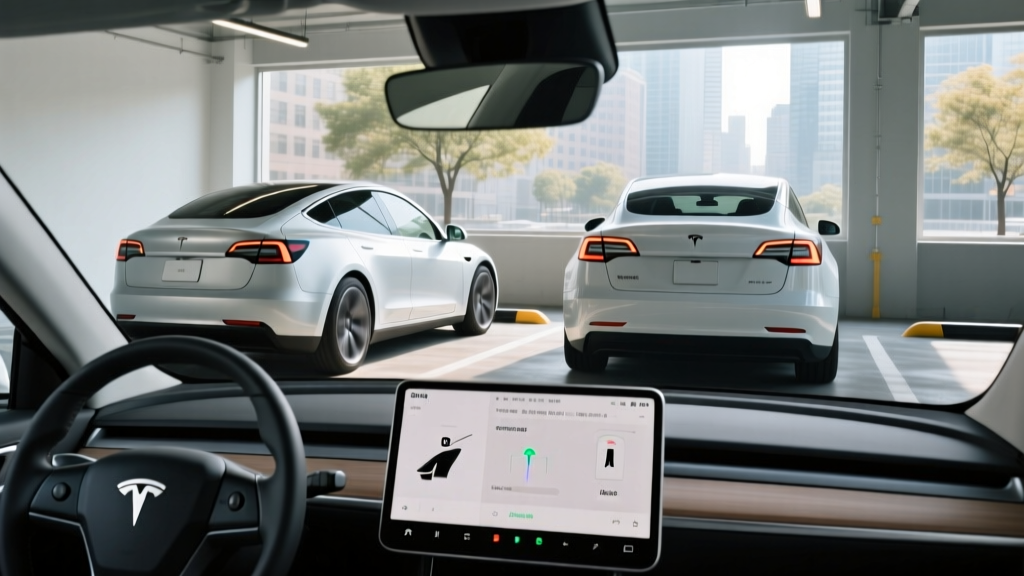
Tesla has been eliminating the physical drive stalk in newer model-year refreshes. In vehicles without a stalk, you shift using the touchscreen slider:
- With your foot on the brake, look at the bottom-left corner of the touchscreen.
- A gear selector slider will appear showing P | R | N | D.
- Slide the control to "R" to engage reverse.
- The backup camera feed will appear automatically on the main display.
Tesla also offers an Auto Shift feature (when enabled in Controls > Driving) that attempts to predict your intended direction based on obstacles and steering angle. When you buckle in and press the brake, the car may automatically select Reverse if it detects you're facing a wall or garage door. This is not infallible — always verify the gear indicator before releasing the brake.
Method 3: Tesla Mobile App (Remote Summon / Smart Summon)
If you're using Smart Summon (available with Enhanced Autopilot or FSD Supervised) to pull your Tesla out of a tight parking spot, the app handles forward and reverse direction automatically based on your phone's location relative to the vehicle. You do not manually select reverse in this scenario — the car navigates at low speed under your supervision.
2026 Tesla Model Lineup: Full Spec Breakdown
Knowing how to shift into reverse is day-one knowledge. What matters for years of ownership is the data below. Here's how the current 2026 Tesla lineup stacks up on the metrics that drive real buyer decisions.
| Spec | Model 3 (RWD) | Model 3 Long Range AWD | Model Y Long Range AWD | Model S (Dual Motor) | Model X (Dual Motor) |
|---|---|---|---|---|---|
| EPA Range | 363 mi | 341 mi | 320 mi | 402 mi | 335 mi |
| Battery (usable) | ~60 kWh (LFP) | ~82 kWh (NMC) | ~82 kWh (NMC) | ~100 kWh (NMC) | ~100 kWh (NMC) |
| Drivetrain | RWD, Single Motor | AWD, Dual Motor | AWD, Dual Motor | AWD, Dual Motor | AWD, Dual Motor |
| Horsepower | 271 hp | 346 hp | 384 hp | 670 hp | 670 hp |
| 0–60 mph | 5.8 sec | 4.2 sec | 4.8 sec | 3.1 sec | 3.8 sec |
| Max DC Fast Charge | 170 kW | 250 kW | 250 kW | 250 kW | 250 kW |
| 10–80% DC Time | ~25 min | ~28 min | ~27 min | ~30 min | ~32 min |
| Level 2 Home Rate | 11.5 kW (~44 mi/hr) | 11.5 kW (~44 mi/hr) | 11.5 kW (~40 mi/hr) | 11.5 kW (~41 mi/hr) | 11.5 kW (~36 mi/hr) |
| Efficiency (MPGe) | 132 MPGe | 125 MPGe | 122 MPGe | 120 MPGe | 102 MPGe |
| Cargo Volume | 23 cu ft | 23 cu ft | 76 cu ft (rear seats folded) | 28 cu ft | 88 cu ft (rear seats folded) |
| Base MSRP | $38,990 | $45,990 | $47,990 | $79,990 | $84,990 |
Sources: fueleconomy.gov (EPA data), Tesla.com official specifications.
Real-World Range: What the EPA Sticker Doesn't Tell You
EPA estimates are a starting point, not a guarantee. Here's what to expect in actual driving:
- Highway (70+ mph): Expect 10–15% less than EPA. A Model 3 LR rated at 341 mi may deliver ~290 mi at sustained highway speeds.
- Cold weather (below 32°F): Range loss of 20–30% is typical due to battery resistance and cabin heating. The same Model 3 LR might yield ~240 mi in January in Minnesota.
- City / stop-and-go: Regenerative braking helps you meet or even slightly exceed EPA estimates in urban driving.
- Towing (Model Y/X): Towing at max capacity (3,500 lb for Model Y) can cut range by 40–50%.
Tesla's thermal management system is among the best in the industry — the heat pump (standard across the lineup) significantly reduces cold-weather cabin-heating energy draw compared to resistive heaters. But physics is physics: cold batteries are less efficient, and highway-speed aerodynamic drag is the enemy of range in any EV.
LFP vs. NMC: Which Battery Chemistry Is in Your Tesla?
The base Model 3 RWD uses a lithium iron phosphate (LFP) battery, while Long Range, Performance, Model S, and Model X variants use nickel manganese cobalt (NMC) chemistry.
| Factor | LFP (Model 3 RWD) | NMC (Long Range / S / X) |
|---|---|---|
| Energy Density | Lower (heavier pack for same kWh) | Higher (more range per kg) |
| Cycle Life | ~3,000+ cycles | ~1,000–2,000 cycles |
| Recommended Daily SoC | 100% (charge to full regularly) | 80% (charge to 100% only for trips) |
| Cold-Weather Performance | More range loss in cold | Better cold-weather output |
| Cost | Lower (no cobalt/nickel) | Higher |
The practical takeaway: if you charge at home nightly and commute under 60 miles, the LFP Model 3 RWD is the longevity champion. If you need maximum range for road trips or live in a cold climate, the NMC Long Range variants are the better fit.
Charging Speed Deep Dive: DC Fast, Level 2, and the Charge Curve
Charging speed is arguably the single most important ownership variable after range. Here's what each Tesla can do across charging levels — and why peak kW numbers don't tell the full story.
| Charging Level | Power (kW) | Miles Added Per Hour | Notes |
|---|---|---|---|
| Level 1 (120V outlet) | ~1.4 kW | 3–5 mi/hr | Emergency/trickle only; adds ~40 mi overnight |
| Level 2 (240V home) | 11.5 kW | 36–44 mi/hr | Full charge in 8–10 hours; ideal for daily use |
| DC Fast Charge (V3 Supercharger) | Up to 250 kW | ~1,000+ mi/hr (peak) | 10–80% in ~25–32 min depending on model |
| DC Fast Charge (V4 Supercharger) | Up to 350 kW* | Higher peak rate | *Vehicle must support >250 kW intake; current Teslas cap at 250 kW |
The Charging Curve Reality
Tesla advertises "up to 250 kW" on V3 Superchargers — but that's a peak rate, not a sustained rate. In practice:
- 10–30% SoC: The battery accepts peak power (200–250 kW depending on model and battery temp).
- 30–60% SoC: Rate tapers gradually to ~150 kW.
- 60–80% SoC: Further taper to ~80–100 kW.
- Above 80%: Sharp drop to <50 kW. Charging from 80–100% can take as long as 10–80%.
Pro tip: Always precondition your battery before arriving at a Supercharger. Navigate to the charger using the car's built-in navigation — Tesla will automatically warm the battery to optimal temperature, which can shave 5–8 minutes off your 10–80% session in cold weather.
Home Charging Setup Cost
A Level 2 home installation using a Tesla Wall Connector ($475 for the unit) on a 60-amp circuit typically costs $500–$1,500 for electrician labor, depending on panel proximity. If your home requires a panel upgrade from 100A to 200A service, add $1,500–$3,000. Always get a quote from a licensed electrician before budgeting.
Pricing, Tax Credits, and Total Cost of Ownership
Sticker price is only part of the equation. The federal EV tax credit under IRS §30D can reduce your effective cost significantly — but eligibility depends on multiple factors that change frequently.
| Model / Trim | Base MSRP | §30D Credit (Max) | Effective Price* |
|---|---|---|---|
| Model 3 RWD | $38,990 | Up to $7,500 | ~$31,490 |
| Model 3 Long Range AWD | $45,990 | Up to $7,500 | ~$38,490 |
| Model Y Long Range AWD | $47,990 | Up to $7,500 | ~$40,490 |
| Model S Dual Motor | $79,990 | $0 (exceeds MSRP cap) | $79,990 |
| Model X Dual Motor | $84,990 | $0 (exceeds MSRP cap) | $84,990 |
*Effective price assumes full §30D eligibility. Actual credit depends on your specific situation.
§30D Federal Tax Credit Eligibility Checklist
- Buyer income cap: Modified AGI must not exceed $150,000 (single), $225,000 (head of household), or $300,000 (joint filers).
- Vehicle MSRP cap: Sedans (Model 3) must be under $55,000; SUVs/trucks (Model Y) under $80,000. Model S and Model X exceed these caps and do not qualify.
- Battery sourcing rules: A percentage of critical minerals and battery components must be sourced from the U.S. or free-trade-agreement partners. Tesla's U.S.-built vehicles generally meet these thresholds, but specific eligibility can shift based on supply-chain changes. Verify at irs.gov.
- Point-of-sale transfer: As of 2024, you can transfer the credit to the dealer at purchase, reducing your out-of-pocket cost immediately rather than waiting for tax filing.
- One credit per vehicle: The credit applies once per VIN; it does not stack with the used-EV credit (§25E).
Important: Tax credit rules are subject to legislative changes. Consult a tax professional and verify current eligibility on IRS.gov before purchasing.
Tech, Safety, and Driver Assistance
Every 2026 Tesla ships with a 15.4-inch center touchscreen (Model 3/Y) or 17-inch (Model S/X), over-the-air software updates, and the Tesla mobile app for remote preconditioning, charging monitoring, and Sentry Mode access.
Autopilot and FSD (Supervised)
Basic Autopilot (included) provides adaptive cruise control and lane-keeping assist on highways. Enhanced Autopilot ($6,000 add-on) adds Navigate on Autopilot, Auto Lane Change, Autopark, and Smart Summon. FSD (Supervised) ($8,000 or $99/month) attempts to handle city streets, traffic lights, and stop signs — but remains a Level 2 system requiring constant driver supervision.
FSD (Supervised) does not make the vehicle autonomous. It cannot handle all road conditions, construction zones, severe weather, or unmapped areas. You are legally responsible for the vehicle at all times. NHTSA continues to investigate Autopilot/FSD-involved incidents. See nhtsa.gov for current safety data.
Safety Ratings
The Model 3 and Model Y have earned IIHS Top Safety Pick+ ratings and 5-star NHTSA overall scores. The Model S and Model X carry 5-star NHTSA ratings as well. Tesla's low center of gravity (battery pack under the floor) contributes to exceptional rollover resistance.
Who Should Buy a Tesla in 2026?
✅ Best For
- Daily commuters with home charging — the Model 3 RWD at ~$31,500 after credit is one of the cheapest ways to commute on electrons.
- Families needing cargo space — Model Y offers 76 cu ft with seats folded and access to the Supercharger network for road trips.
- Tech-forward buyers who value OTA updates, app integration, and the Supercharger ecosystem.
- High-mileage drivers — electricity at ~$0.13/kWh home charging costs roughly $0.04/mile vs. $0.12–0.15/mile for gas.
❌ Think Twice If
- You can't charge at home. Public DC fast charging costs $0.30–0.50/kWh, erasing much of the fuel savings.
- You need a physical button interface. Nearly all controls (climate, mirrors, glovebox, shifting in newer models) are touchscreen-only.
- You tow frequently. Model Y's 3,500-lb capacity is adequate for small trailers but range drops precipitously.
- You want a traditional dealership experience. Tesla sells direct — no haggling, but no local service center in every market.
Tesla vs. Key Competitors: Is It Worth It?
| Vehicle | EPA Range | Max DC kW | Base MSRP | Tax Credit |
|---|---|---|---|---|
| Tesla Model 3 LR AWD | 341 mi | 250 kW | $45,990 | Up to $7,500 |
| Hyundai Ioniq 6 SE | 361 mi | 240 kW | $42,700 | Up to $7,500 |
| BMW i4 eDrive40 | 307 mi | 205 kW | $57,900 | $0 (MSRP cap) |
| Tesla Model Y LR AWD | 320 mi | 250 kW | $47,990 | Up to $7,500 |
| Hyundai Ioniq 5 SEL AWD | 290 mi | 240 kW | $49,200 | Up to $7,500 |
| Ford Mustang Mach-E Premium | 320 mi | 150 kW | $48,995 | Up to $7,500 |
The Tesla advantage in 2026 remains the Supercharger network — now open to NACS-equipped competitors, but still the most reliable and widespread DC fast-charging ecosystem. The Hyundai Ioniq 6 offers slightly more EPA range in the sedan segment, while the Ioniq 5 and Mach-E compete closely with the Model Y on price and features. Tesla's edge is software integration, charging speed, and total cost of ownership.
Warranty Coverage
- Basic Vehicle: 4 years / 50,000 miles
- Battery & Drive Unit (Model 3 RWD): 8 years / 100,000 miles
- Battery & Drive Unit (Model 3 LR, Model Y, S, X): 8 years / 120,000 miles (Long Range) or 150,000 miles (Model S/X)
- Capacity retention threshold: Tesla warrants that the battery will retain at least 70% of its original capacity during the warranty period.
Real-world degradation data from fleet analyses suggests Tesla NMC packs lose approximately 5–8% capacity in the first 50,000 miles, then degrade very slowly. LFP packs tend to show even less degradation but can have greater variance in state-of-charge estimation accuracy.
Frequently Asked Questions
Can I put a Tesla in reverse while it's moving forward?
No. Tesla's software prevents shifting into Reverse at any speed above a crawl (~3 mph). The vehicle must be fully stopped with your foot on the brake before Reverse will engage. Attempting to shift at speed will trigger a warning on the touchscreen.
What happens if the touchscreen dies — can I still shift into reverse?
In vehicles with a physical drive stalk (Model S, Model X, and pre-refresh Model 3/Y), the stalk operates independently of the touchscreen and will still function. In stalkless models, Tesla includes a redundant physical button set on the overhead console or center console for Park and gear selection in the event of a display failure. Consult your owner's manual for the exact location.
Does the Model 3 RWD (LFP battery) charge slower than Long Range?
Yes. The LFP-equipped Model 3 RWD peaks at approximately 170 kW on DC fast chargers, compared to 250 kW for the NMC Long Range. Expect a 10–80% session in about 25 minutes for RWD vs. 28 minutes for LR — the difference is smaller than the peak kW numbers suggest because the LFP pack's smaller capacity means less total energy to add.
Is it cheaper to charge a Tesla at home or at a Supercharger?
Home charging is dramatically cheaper. At a national average of $0.14/kWh, filling a 60 kWh Model 3 battery costs about $8.40. The same fill at a Supercharger ($0.30–0.45/kWh) costs $18–$27. Over a year of 12,000 miles, home charging saves roughly $800–$1,200 vs. exclusive Supercharger use.
Does the Tesla Model Y qualify for the full $7,500 tax credit in 2026?
The Model Y Long Range AWD at $47,990 falls under the $80,000 SUV MSRP cap and generally qualifies, provided the buyer meets income limits and the vehicle's battery sourcing satisfies current §30D requirements. Always verify on fueleconomy.gov and irs.gov at the time of purchase, as rules can change.
How do I know which Tesla has the drive stalk vs. touchscreen-only shifting?
As of the 2025 model year refresh, the updated Model 3 (Highland) eliminated the stalk in most markets. The Model Y received a similar refresh for 2026. Model S and Model X retain the physical stalk as of the current generation. When shopping, check the specific model year and build — Tesla sometimes phases features gradually across factories.