Tesla's vehicles are heavy, torque-rich electric machines that place unique demands on their tires. Between the instant torque delivery, the added mass of a 75–100 kWh battery pack, and the regenerative braking forces, Tesla tires wear differently — and maintaining correct tire pressure is one of the most impactful things you can do for range, safety, and tire longevity. If you've pulled up to a gas station air pump wondering how to put air in Tesla tires, this guide covers the exact procedure, the correct PSI for every current Tesla model, and the EV-specific nuances that generic tire guides miss.
Why Tire Pressure Matters More on a Tesla Than a Gas Car
Internal combustion vehicles are heavy, but EVs are heavier. A 2026 Tesla Model Y Long Range AWD tips the scales at roughly 4,400 lbs, and the Model S Plaid exceeds 4,700 lbs. That mass, combined with instant electric torque at zero RPM, accelerates tire wear significantly if pressures are off by even 2–3 PSI.
Under-inflated tires on a Tesla create three compounding problems:
- Range loss: Rolling resistance increases roughly 0.3% for every 1 PSI drop below spec. On a Model 3 Long Range with an EPA-estimated 341 miles, that can mean 5–10 miles of lost range from chronic under-inflation.
- Accelerated wear: Tesla's torque delivery concentrates wear on the outer shoulders of under-inflated tires. Owners commonly report needing replacements at 20,000–25,000 miles when pressures aren't maintained, versus 35,000+ miles with proper inflation.
- TPMS alerts: Tesla's Tire Pressure Monitoring System is sensitive. A 3+ PSI deviation from spec (or a rapid drop from temperature change) triggers a dashboard warning that persists until corrected and, on some model years, requires a manual TPMS reset via the touchscreen.
Correct Tesla Tire Pressure by Model (2024–2026)
Tesla recommends different pressures depending on the model, wheel size, and load. The definitive source is always the tire information placard on the driver's side B-pillar (the door jamb sticker), not the max pressure printed on the tire sidewall. Here are the baseline cold-tire pressures for current-production Teslas:
| Model | Wheel Size | Front PSI (cold) | Rear PSI (cold) | Notes |
|---|---|---|---|---|
| Model 3 (2024+ Highland) | 18" / 19" | 42 | 42 | Performance trim: 42/42 |
| Model Y (2025+ Juniper) | 19" / 20" / 21" | 42 | 42 | Loaded/towing: see door placard |
| Model S (2024–2026) | 19" / 21" | 38–42 | 38–42 | Varies by wheel; Plaid may differ |
| Model X (2024–2026) | 20" / 22" | 42–45 | 42–45 | Higher due to mass; check placard |
Step-by-Step: How to Put Air in Tesla Tires
The physical process of adding air to a Tesla tire is identical to any passenger car — Tesla uses standard Schrader valves. The differences lie in the target pressure (higher than most gas cars), the TPMS behavior, and the Tesla-specific post-fill steps.
What You'll Need
- A reliable tire pressure gauge (digital preferred — Tesla's spec tolerances are tight)
- Access to an air compressor: gas station pump, portable 12V inflator, or home garage compressor
- Your Tesla's door-jamb placard PSI spec (or the table above as a starting reference)
The Procedure
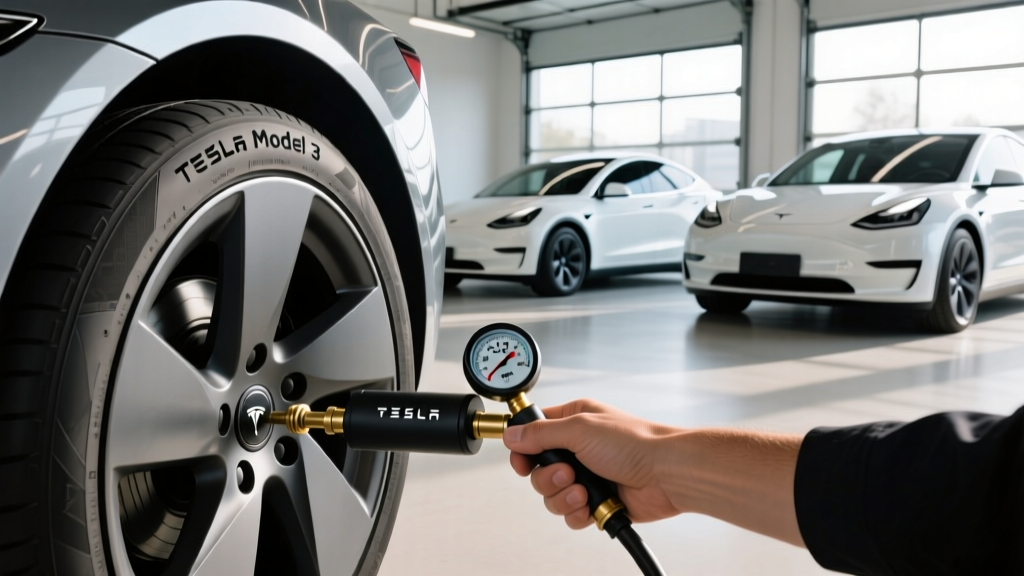
- Check cold pressure first. Before driving (or after 3+ hours parked), remove the valve stem cap and press your gauge firmly onto the Schrader valve. Note the reading for each tire.
- Compare to spec. Reference the door-jamb placard. If a tire is below spec, it needs air. If it's above cold spec, you can bleed a small amount by pressing the valve stem pin briefly.
- Attach the air chuck. Press the air pump nozzle firmly onto the valve stem. You should hear a brief hiss that stops when the seal is good. If using a gas station pump with a built-in gauge, be aware these are often inaccurate by 2–4 PSI — verify with your own gauge after.
- Fill in short bursts. Add air in 3–5 second bursts, checking your gauge between each. Tesla's recommended pressures (38–45 PSI) are higher than many gas cars (32–35 PSI), so expect to add more than you might assume.
- Verify final pressure. Once within 1 PSI of target, disconnect and do a final gauge check. Tolerance of ±1 PSI is acceptable; ±2 PSI or more should be corrected.
- Replace valve stem caps. These keep moisture and debris out of the Schrader valve. Tesla's OEM caps are plastic — if you've lost one, replace it to prevent slow leaks.
- Reset TPMS if needed. On most 2024+ Teslas, the TPMS auto-recalibrates after driving a few miles at corrected pressure. On some older firmware versions, navigate to Controls → Service → Tire Pressure Monitor → Reset on the touchscreen. Drive for 5–10 minutes above 25 mph for the system to relearn.
Cold Weather, Altitude, and EV-Specific Pressure Dynamics
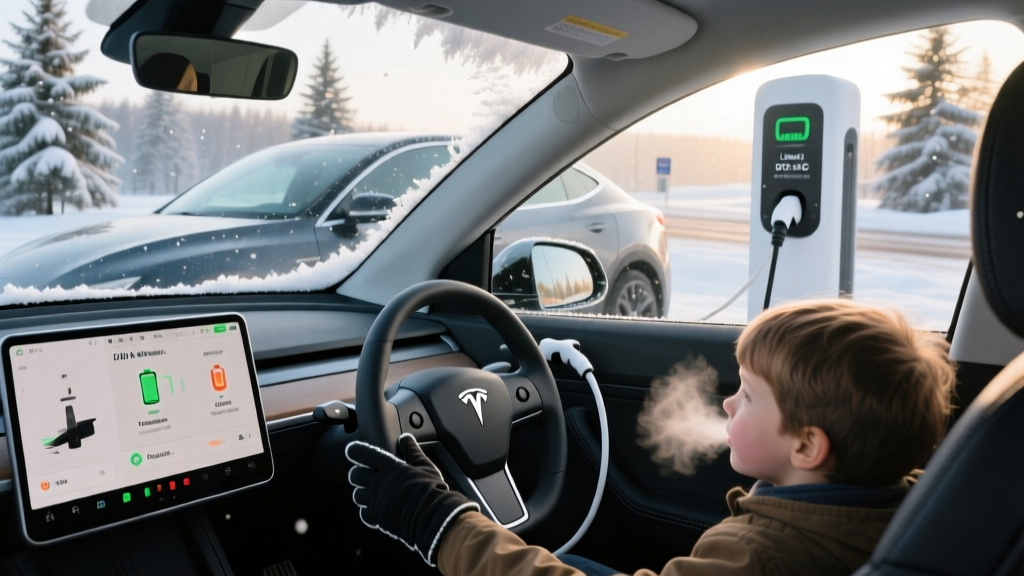
Tesla owners in cold climates encounter a recurring scenario: the TPMS warning lights up on the first frosty morning of the season. This is physics, not a leak.
For every 10°F drop in ambient temperature, tire pressure decreases approximately 1 PSI. A Model 3 set to 42 PSI on a 75°F September afternoon will read roughly 37–38 PSI on a 25°F January morning — enough to trigger Tesla's TPMS alert threshold. The fix is simple: add air to cold spec during seasonal transitions, and check pressures monthly in winter.
Altitude changes affect gauge readings (atmospheric pressure shifts), but the actual pressure inside the tire relative to atmosphere remains stable. If you drive from sea level to 7,000 feet elevation, your gauge may read 2–3 PSI higher, but the tire is correctly inflated. Trust the cold-pressure reading taken at your home altitude.
Tesla Tire Wear: Why EVs Eat Tires Faster
Tesla vehicles wear tires 20–30% faster than comparable-weight gas cars, and the reasons are rooted in EV physics:
- Instant torque: Electric motors deliver peak torque at 0 RPM. Every acceleration from a stop applies maximum rotational force to the contact patch, especially on dual-motor AWD models.
- Vehicle mass: The battery pack adds 800–1,200 lbs over an equivalent ICE vehicle. More mass means more friction force during cornering and braking.
- Regenerative braking: Aggressive regen settings create deceleration forces that load the tire's leading edge, contributing to irregular wear patterns.
- Low-rolling-resistance compounds: OEM EV tires (like the Michelin Pilot Sport EV or Hankook iON evo) use specialized rubber compounds optimized for efficiency, which can trade some treadwear longevity for lower rolling resistance.
Correct tire pressure is your primary defense. Rotating tires every 6,250 miles (Tesla's recommendation) is the second. Many Tesla owners find that switching to a high-treadwear EV-specific tire at first replacement — such as the Michelin CrossClimate 2 or Pirelli P Zero Elect — extends service life while maintaining acceptable efficiency.
Portable Inflators and Tesla's Tire Repair Kit
Tesla does not include a spare tire in any current model. Instead, the vehicle ships with a tire repair kit (sealant + 12V compressor) stored in the trunk sub-floor or frunk, depending on the model. This kit is designed for temporary puncture sealing to reach a service center — it is not a substitute for proper inflation maintenance.
Many Tesla owners invest in a dedicated portable inflator for the garage or trunk. Key specs to look for:
- Max output pressure: At least 50 PSI (to comfortably reach Tesla's 42+ PSI spec)
- Power source: 12V via the cigarette-lighter socket (15A fuse — most Tesla 12V sockets support this) or battery-powered
- Auto-shutoff: Set your target PSI and the unit stops automatically — prevents overfilling
- Fill rate: Look for units that can fill a tire from 35 to 42 PSI in under 2 minutes
Popular choices among Tesla owners include the Viair 85P (12V, reliable, accurate gauge) and the Xiaomi Portable Electric Air Compressor 2 (battery-powered, compact, USB-C rechargeable). Both handle Tesla's higher target pressures without strain.
When to Seek Tesla Service for Tire Issues
While adding air is a straightforward owner task, certain tire situations require Tesla Service or a qualified tire shop:
- Persistent TPMS warnings after confirming correct cold pressure and resetting — may indicate a faulty TPMS sensor or slow leak at the bead/valve
- Uneven wear patterns (inner-edge or outer-edge cupping) — suggests alignment issues, which Tesla Service can address with factory-spec alignment equipment
- Tire replacement: Tesla recommends EV-rated tires with acoustic foam liners (marked "EV" or with specific OEM part numbers). Aftermarket tires without foam liners increase cabin road noise noticeably
- Wheel/tire balancing: Vibration at highway speeds (65–80 mph) often indicates a balance issue. Tesla's road-force balancing equipment is available at Service Centers
Tesla's mobile service can handle tire rotations and some replacements at your home or workplace, though availability varies by region. For warranty-related tire issues (e.g., premature wear on a vehicle under its New Vehicle Limited Warranty), scheduling through the Tesla app is the fastest path.
Frequently Asked Questions
Can I use any gas station air pump on a Tesla?
Yes. Tesla uses standard Schrader valves identical to those on gas cars. Any air pump with a compatible chuck will work. Just verify pressure with your own accurate gauge afterward — public pump gauges are notoriously unreliable, often off by 2–5 PSI.
Why does my Tesla TPMS keep warning me even after I add air?
Two common causes: (1) You filled the tires while they were warm/hot, so the pressure drops below threshold once they cool overnight. Always set pressures to cold spec. (2) The TPMS needs a reset cycle. Drive at 25+ mph for 5–10 minutes, or use Controls → Service → Tire Pressure Monitor → Reset on the touchscreen.
What happens if I overinflate my Tesla tires?
Over-inflation by 3–5 PSI reduces the contact patch, leading to center-tread wear and a harsher ride. Over-inflation by 8+ PSI risks reduced wet-weather grip and, in extreme cases, impact damage from potholes. Tesla's spec is a balance of range, comfort, and wear — stick within ±1 PSI of the door-placard number.
Do Tesla tires need nitrogen instead of regular air?
Nitrogen is not required and provides minimal real-world benefit for passenger EVs. The theoretical advantage (slower pressure loss, no moisture) is marginal — regular compressed air is 78% nitrogen already. Tesla does not specify nitrogen. Use dry compressed air and check pressures monthly.
How often should I check Tesla tire pressure?
Monthly, at minimum, and before any long road trip. Check more frequently during seasonal temperature transitions (fall and spring). Tesla's TPMS will alert you to significant drops, but it may not catch gradual 1–2 PSI losses that cumulatively affect range and wear.
Does tire pressure affect my Tesla's range?
Yes. Under-inflation increases rolling resistance, which directly reduces efficiency. Testing by EV owners and publications consistently shows 2–5 miles of range difference between correctly inflated and 4-PSI-under tires on a full charge. Over a year of driving, that's meaningful energy cost.