Why the Tesla Model Y Still Dominates the EV Market
The Tesla Model Y remains the benchmark compact electric SUV for buyers who want a proven charging network, strong efficiency, and a straightforward online ordering process. Unlike legacy automakers that still route EV purchases through dealerships, Tesla sells directly — meaning you configure, order, and schedule delivery entirely from tesla.com or the Tesla app. This guide walks you through exactly how to order a Tesla Model Y in 2026, what each trim costs after federal incentives, and the real-world range and charging numbers you should expect before clicking "Order."
2026 Tesla Model Y Quick Specs at a Glance
| Specification | Long Range RWD | Long Range AWD | Performance AWD |
|---|---|---|---|
| EPA Range | 320 mi | 308 mi | 285 mi |
| Battery (usable) | ~75 kWh (LFP) | ~75 kWh (NMC) | ~75 kWh (NMC) |
| Drivetrain | Rear-Wheel Drive | Dual-Motor AWD | Dual-Motor AWD |
| Horsepower | 346 hp | 384 hp | 456 hp |
| 0-60 mph | 5.8 sec | 4.8 sec | 3.5 sec |
| Peak DC Fast Charge | 170 kW | 250 kW | 250 kW |
| 10-80% DCFC Time | ~28 min | ~22 min | ~22 min |
| Level 2 Home Charge | 11.5 kW (~44 mi/hr) | 11.5 kW (~44 mi/hr) | 11.5 kW (~44 mi/hr) |
| EPA Efficiency | 129 MPGe / 26 kWh/100mi | 122 MPGe / 28 kWh/100mi | 115 MPGe / 30 kWh/100mi |
| Base MSRP | $44,990 | $47,990 | $52,490 |
| Battery Warranty | 8 yr / 120,000 mi | 8 yr / 120,000 mi | 8 yr / 120,000 mi |
Sources: fueleconomy.gov, Tesla official specifications. Figures reflect 2026 model-year data.
Step-by-Step: How to Order a Tesla Online
Tesla's direct-to-consumer model eliminates dealership negotiation, but it also means there's no salesperson walking you through options. Here's the exact process:
- Visit tesla.com/modely/design — This is the configurator. You select your trim (Long Range RWD, Long Range AWD, or Performance), paint color, wheel size, and interior.
- Choose your trim carefully. The Long Range RWD uses a lithium iron phosphate (LFP) battery, which Tesla recommends charging to 100% regularly. The AWD and Performance trims use nickel-manganese-cobalt (NMC) chemistry, which degrades faster at sustained 100% state of charge — daily charging to 80% is recommended.
- Select exterior and interior. Pearl White Multi-Coat is the only no-cost paint. Solid Black, Deep Blue Metallic, Ultra Red, and Quicksilver each add $1,000–$2,500 depending on color. The 20" Helix wheels add $2,000 and reduce EPA range by roughly 5%.
- Add Autopilot or FSD (Supervised). Basic Autopilot (traffic-aware cruise + autosteer) is included. Full Self-Driving (Supervised) adds $8,000 or $99/month. Note: FSD is SAE Level 2 — you must remain attentive with hands on the wheel at all times. It is not autonomous driving.
- Place your $250 order fee. This is non-refundable. Tesla will then assign an estimated delivery window (typically 2–6 weeks depending on your region and configuration).
- Complete financing or cash payment. You can arrange third-party financing, use Tesla's in-house financing, or pay in full. Trade-in value can be estimated in the app.
- Schedule delivery. Most deliveries occur at a local Tesla Service Center or via contactless drop-off. You'll complete a brief walkthrough and sign paperwork digitally.
Real-World Range: What to Actually Expect
The Long Range RWD carries an EPA-estimated 320 miles. In real-world highway driving at 70-75 mph with climate control on, expect approximately 265–285 miles. In cold weather (below 32°F), range can drop to 210–240 miles due to battery heating demands and cabin HVAC load. The heat pump on the 2026 Model Y mitigates some cold-weather loss, but physics still wins — plan charging stops around 200 miles of usable range in winter road-trip conditions.
City driving with frequent regenerative braking opportunities can actually exceed the EPA estimate on LFP-equipped RWD models, with some owners reporting 330+ miles in mild-weather stop-and-go commuting. The key variable is speed: efficiency drops sharply above 65 mph due to aerodynamic drag, which scales with the square of velocity.
Charging Speed: DC Fast, Home Level 2, and the Supercharger Network
| Charging Level | Power | Miles Added per Hour | Use Case |
|---|---|---|---|
| Level 1 (120V outlet) | ~1.4 kW | ~5 mi/hr | Emergency / trickle top-off |
| Level 2 (240V, 48A) | 11.5 kW | ~44 mi/hr | Daily home charging (overnight) |
| Tesla Supercharger V3 | Up to 250 kW | ~180 mi in 15 min | Road trips |
| Tesla Supercharger V4 | Up to 350 kW (future) | TBD | Rolling out in select locations |
Critical nuance on DC fast charging: The 250 kW peak rate on Long Range AWD and Performance models is not sustained for the full session. The charge curve peaks around 250 kW between 10–30% state of charge, then tapers progressively. By 60% SoC, you'll see roughly 150 kW; by 80%, it drops to around 60 kW. This is why the 10-80% time of ~22 minutes is the meaningful metric, not the peak kW number.
The LFP-equipped Long Range RWD peaks at a lower 170 kW, making it slightly slower on road trips. If you take frequent long highway drives, the AWD trim's faster charging curve saves roughly 6 minutes per stop.
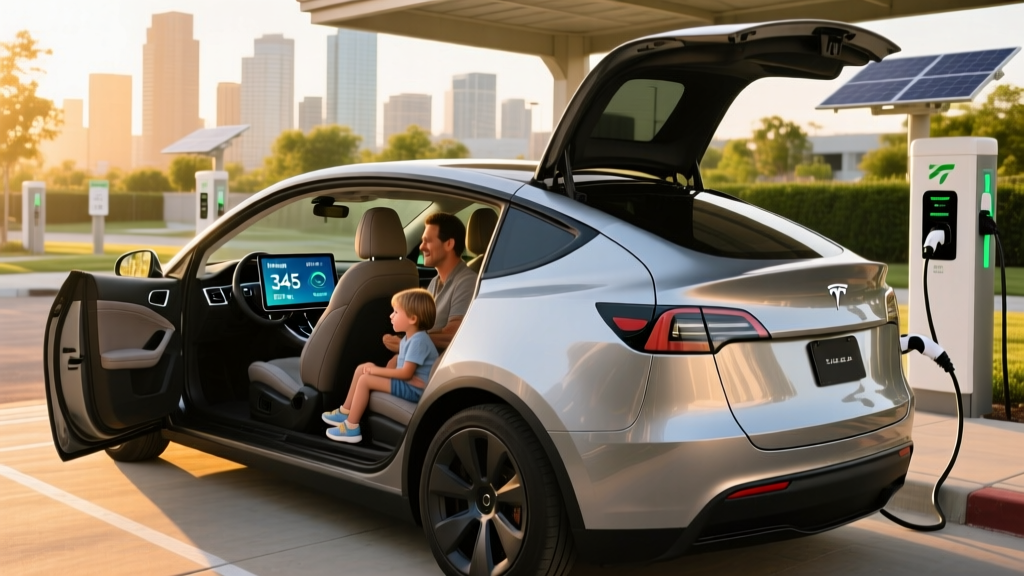
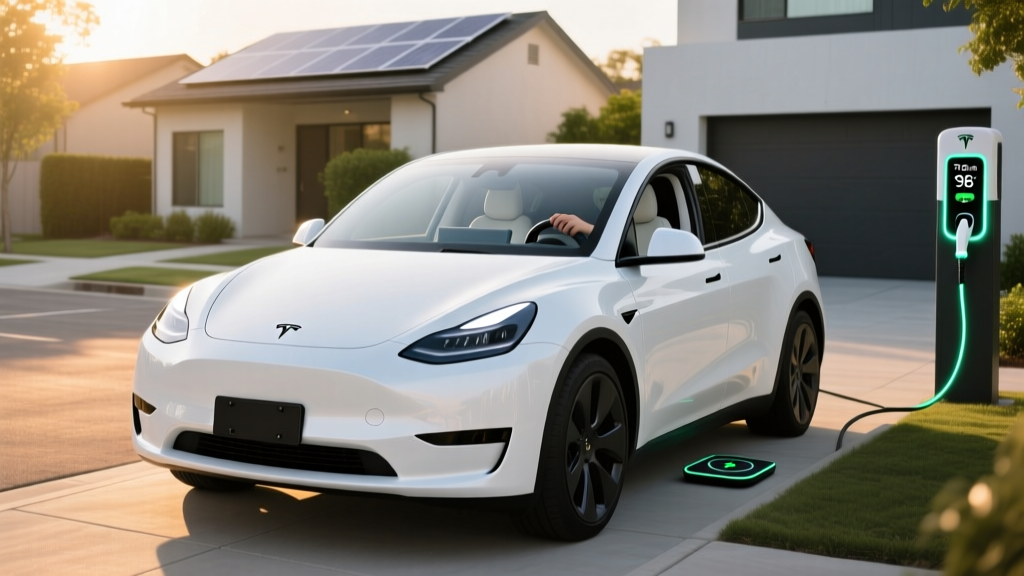
Home charging setup: Tesla's Wall Connector ($420) on a 60-amp circuit delivers the full 11.5 kW (48 amps continuous). A typical 200-amp home electrical panel can accommodate this without an upgrade. Expect installation costs of $600–$1,800 from a licensed electrician, depending on run length and whether a sub-panel is needed. Always defer to a licensed electrician for final electrical specifications.
Pricing Breakdown: MSRP, Options, and Federal Tax Credit
| Trim | Base MSRP | Destination Fee | Est. As-Tested* | §30D Credit Eligibility |
|---|---|---|---|---|
| Long Range RWD | $44,990 | $1,390 | $46,380 | Up to $7,500 (subject to sourcing/income) |
| Long Range AWD | $47,990 | $1,390 | $49,380 | Up to $7,500 (subject to sourcing/income) |
| Performance AWD | $52,490 | $1,390 | $53,880 | Up to $7,500 (subject to sourcing/income) |
*As-tested reflects base + destination. Adding paint, wheels, or FSD increases the price substantially.
Federal Tax Credit Eligibility (§30D) — Key Rules for 2026
- MSRP cap: SUVs must have an MSRP at or below $80,000. All Model Y trims qualify.
- Buyer income cap: Modified AGI must not exceed $150,000 (single), $225,000 (head of household), or $300,000 (joint filers).
- Battery sourcing: A percentage of critical minerals and battery components must be sourced from the U.S. or free-trade-agreement countries. The exact percentage threshold increases annually. Tesla's U.S.-manufactured batteries generally meet current requirements, but verify at purchase — rules can shift.
- Point-of-sale transfer: Since 2024, buyers can transfer the credit to the dealer (Tesla) at purchase, reducing the purchase price directly rather than waiting for a tax refund. This effectively functions as a down-payment reduction.
- Verification: Always confirm eligibility on IRS.gov or with a tax professional before relying on the credit in your budget.
If you qualify for the full $7,500 and use the point-of-sale transfer, the Long Range RWD effectively drops to ~$38,880 — making it one of the most value-competitive electric SUVs on the market.
Interior, Cargo, and Daily Livability
The 2026 Model Y interior continues Tesla's minimalist approach: a single 15.4" touchscreen handles infotainment, climate, and vehicle settings. There is no instrument cluster — speed and navigation appear on the upper-left corner of the center screen.
Cargo space: 30.2 cubic feet behind the second row, expanding to 72.1 cubic feet with seats folded. The front trunk (frunk) adds 4.1 cubic feet — useful for charging cables and groceries. Total cargo capacity trails the Hyundai Ioniq 5 (with its sliding rear seats) but exceeds the Ford Mustang Mach-E.
Passenger dimensions: Front legroom measures 41.8 inches; rear legroom is 38.4 inches. The rear seat comfortably fits two adults on longer trips, though the center position is narrow. The panoramic glass roof creates an airy feel but adds solar heat gain in summer — a sunshade (sold separately by Tesla for ~$150) is strongly recommended in hot climates.
Standout tech: Tesla's infotainment system remains the most responsive in the industry, with native Spotify, Netflix/YouTube (while parked), and over-the-air updates that regularly add features. The Tesla app provides remote preconditioning, charging management, Sentry Mode camera access, and location tracking.
Driver Assistance: Autopilot and FSD (Supervised)
Both Tesla Autopilot and Full Self-Driving (Supervised) are SAE Level 2 driver-assistance systems. This means the driver must remain fully engaged, monitor the road, and keep hands on the steering wheel at all times. Tesla's cabin camera monitors driver attention. These systems do not make the vehicle autonomous. Only Level 4 services (like Waymo robotaxis operating in defined geofenced areas) remove the driver from the loop.
Basic Autopilot includes traffic-aware cruise control and autosteer (lane centering). It handles highway driving competently but requires regular steering-wheel torque input. FSD (Supervised) adds automatic lane changes, navigate-on-autopilot (highway exit-to-exit), traffic light/stop sign recognition, and enhanced parking features. Real-world performance varies significantly by region and road complexity — it excels on well-marked divided highways but can struggle with construction zones, faded lane markings, and complex urban intersections.
Pros, Cons, and Who Should Buy
- Access to the Tesla Supercharger network — the most reliable and extensive DC fast-charging network in North America
- Best-in-class efficiency (26 kWh/100mi on RWD) means lower charging costs per mile
- Over-the-air updates continuously improve the vehicle post-purchase
- LFP battery on RWD trim can be charged to 100% daily without degradation concerns
- Strong resale value relative to non-Tesla EVs
- Competitive pricing after $7,500 federal credit
- No physical controls — all climate, wiper, and mirror adjustments require the touchscreen
- Rear visibility is compromised by the sloping roofline; no rear wiper
- FSD (Supervised) costs $8,000 and does not deliver autonomous driving capability
- Ride quality is firm, especially on 20" wheels — rough pavement is noticeable
- Insurance premiums are higher than comparable non-Tesla SUVs (budget 20-40% more)
- Service center wait times can be long in high-population areas
Who the Model Y Suits Best
Commuters: The Long Range RWD is ideal. 320 EPA miles means most commuters charge once per week at home. LFP chemistry tolerates daily 100% charging, so you always start with a full battery.
Families: The AWD trim offers all-weather confidence and adequate rear-seat space for two child seats. Cargo room handles strollers and groceries easily, though larger families should cross-shop the three-row Tesla Model X or Kia EV9.
Road trippers: Tesla's Supercharger network is the decisive advantage. Route planning is built into the navigation system, which preconditions the battery automatically before arrival at a charger. Expect 20-25 minute stops every 180-200 highway miles.
Towing: The Model Y is rated for 3,500 lbs of towing capacity. Adequate for a small utility trailer or a pair of jet skis, but not suitable for boat or camper towing — look to the Ford F-150 Lightning or Rivian R1T for heavier loads.
Model Y vs. Key Competitors: Is It Still the Best Buy?
The Model Y's primary competitors in the compact electric SUV segment include the Hyundai Ioniq 5, Ford Mustang Mach-E, and Chevrolet Equinox EV. Here's how they compare on the metrics that matter most:
Hyundai Ioniq 5 (Long Range AWD): EPA 290 miles, 320 hp, peak 350 kW DC charging (10-80% in ~18 minutes on capable chargers). The Ioniq 5 charges faster than the Model Y at compatible 350 kW stations and offers a more conventional interior with physical buttons. However, it lacks access to the Tesla Supercharger network without an adapter, and real-world Supercharger compatibility with non-Tesla adapters remains inconsistent at some stalls.
Ford Mustang Mach-E (Extended Range AWD): EPA 290 miles, 365 hp, peak 150 kW DC charging. The Mach-E offers a more traditional driving feel and strong handling, but its slower charging speed (10-80% in ~34 minutes) is a significant road-trip disadvantage.
The verdict: If Supercharger access and software integration are your priorities, the Model Y remains the default choice. If you value faster peak charging, physical controls, and a more conventional cabin, the Ioniq 5 is a compelling alternative — especially now that NACS adapters are widely available for non-Tesla EVs accessing Superchargers.
Frequently Asked Questions
What is the real-world range of the 2026 Tesla Model Y?
EPA estimates range from 285 to 320 miles depending on trim. Real-world highway driving at 70-75 mph typically yields 265-285 miles in mild weather and 210-240 miles in freezing conditions. City driving with regenerative braking can exceed EPA estimates, particularly on the LFP-equipped RWD model.
How fast does the Model Y charge at home and on the road?
At home on a Level 2 Wall Connector (11.5 kW), the Model Y adds approximately 44 miles of range per hour — a full overnight session easily replenishes a day's driving. On Tesla Superchargers, Long Range AWD and Performance models peak at 250 kW, achieving a 10-80% charge in roughly 22 minutes. The RWD model peaks at 170 kW with a 10-80% time of approximately 28 minutes.
How much does a Tesla Model Y cost after the federal tax credit?
If you qualify for the full $7,500 §30D credit and use the point-of-sale transfer, the Long Range RWD effectively costs around $38,880 including destination. The Long Range AWD drops to roughly $41,880. Eligibility depends on buyer income (AGI caps apply), the vehicle's MSRP (all trims are under the $80,000 SUV cap), and battery component/critical mineral sourcing requirements. Always verify on IRS.gov.
Does the 2026 Model Y qualify for the $7,500 federal EV tax credit?
All Model Y trims meet the $80,000 MSRP cap for SUVs. The vehicle is assembled in the U.S., and Tesla's battery sourcing has generally satisfied annual critical-mineral and component thresholds. However, buyer income must fall within §30D limits ($150K single / $300K joint), and sourcing rules can change. Confirm your specific eligibility before finalizing your order.
Is the Tesla Model Y worth buying vs. competitors in 2026?
The Model Y's strongest advantages are Supercharger network access, efficiency, and software. Its weaknesses are the touchscreen-only interface, firm ride, and higher insurance costs. If you road-trip frequently and value the most reliable charging infrastructure, it's the segment leader. If you prefer physical controls and faster peak charging on third-party networks, the Hyundai Ioniq 5 is a strong alternative.
What are the biggest drawbacks of owning a Model Y?
The most common owner complaints center on the lack of physical controls (mirror and wiper adjustments require screen taps), absence of a rear wiper, firm suspension on rough roads, and Tesla service center wait times in major metro areas. Insurance costs also tend to run 20-40% higher than comparable non-Tesla compact SUVs.
How long does it take to get a Tesla Model Y after ordering?
Delivery windows in 2026 typically range from 2 to 6 weeks after placing your $250 order fee, depending on your region, selected configuration, and current production allocation. Popular configurations (white exterior, Long Range AWD) tend to deliver faster than less common combinations.