The Tesla Buying Process: Direct-to-Consumer, No Dealers
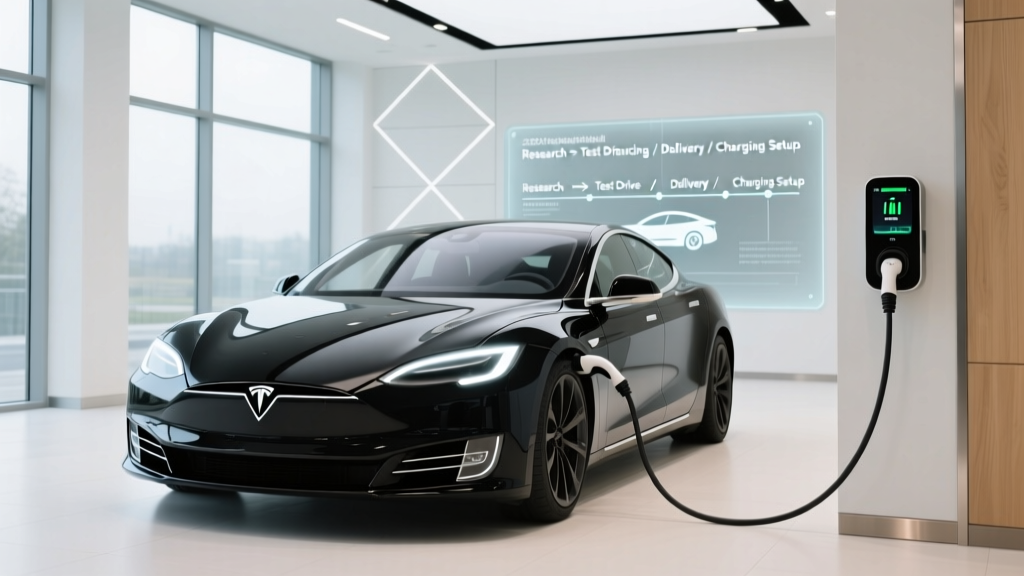
Tesla sells vehicles exclusively online and through company-owned stores — no franchised dealers, no haggling over MSRP. If you're asking "how do I buy a Tesla car," the answer is simpler than a traditional purchase but comes with its own quirks: non-negotiable pricing, variable delivery timelines, and a digital-first configuration flow. Here's what every 2026 buyer needs to know before clicking "Order."
You configure your vehicle on Tesla's website or in-store kiosk, place a refundable order fee (typically $250), and wait for a delivery window. Inventory vehicles — already built and often discounted — can ship in days. Custom orders may take 2–8 weeks depending on model, trim, and region. There is no dealer markup, but Tesla adjusts prices frequently based on demand, incentives, and supply chain factors.
Choose a custom order if: You want a specific color, wheel, or interior combo and can wait 4–8 weeks.
Choose inventory if: You want to take delivery this month and potentially capture a price discount or promotional financing rate.
Which Tesla Should You Buy? 2026 Lineup at a Glance
Tesla's current lineup spans four consumer models. Each fills a distinct use case — from the entry-level Model 3 sedan to the three-row Model X SUV. Below is a spec-by-spec breakdown of the most popular trims available as of early 2026.
| Spec | Model 3 RWD | Model 3 Long Range AWD | Model Y Long Range AWD | Model S Long Range | Model X Long Range |
|---|---|---|---|---|---|
| EPA Range | 363 mi | 341 mi | 320 mi | 402 mi | 348 mi |
| Battery (usable kWh) | ~60 kWh (LFP) | ~75 kWh (NMC) | ~75 kWh (NMC) | ~95 kWh (NMC) | ~95 kWh (NMC) |
| Drivetrain | RWD, single motor | AWD, dual motor | AWD, dual motor | AWD, dual motor | AWD, dual motor |
| 0–60 mph | 5.8 sec | 4.2 sec | 4.8 sec | 3.1 sec | 3.8 sec |
| Horsepower | 271 hp | 346 hp | 384 hp | 670 hp | 670 hp |
| Peak DC Fast Charge | 170 kW | 250 kW | 250 kW | 250 kW | 250 kW |
| 10–80% DCFC Time | ~25 min | ~22 min | ~22 min | ~27 min | ~28 min |
| Level 2 Home Charge | 11.5 kW (~44 mi/hr) | 11.5 kW (~44 mi/hr) | 11.5 kW (~44 mi/hr) | 11.5 kW (~44 mi/hr) | 11.5 kW (~44 mi/hr) |
| MPGe (combined) | 132 MPGe | 125 MPGe | 117 MPGe | 120 MPGe | 109 MPGe |
| Base MSRP | $38,990 | $45,990 | $48,990 | $74,990 | $79,990 |
Sources: EPA fueleconomy.gov, Tesla.com. Prices reflect early-2026 MSRP before destination fees and incentives.
Real-World Range: What the EPA Sticker Doesn't Tell You
EPA vs. Reality
The Model 3 Long Range carries a 341-mile EPA estimate — among the best in its class. But in real-world highway driving at 70–75 mph, expect roughly 280–300 miles before you need to stop. In cold weather (below 32°F), range can drop an additional 20–30%, putting usable range closer to 220–250 miles.
The LFP-equipped Model 3 RWD (363 mi EPA) holds up well in daily commuting but loses a similar percentage on sustained highway runs in winter. LFP chemistry is more tolerant of 100% state-of-charge storage, which partly offsets the range loss for daily drivers.
Tesla's navigation system factors in elevation, temperature, traffic, and driving style when estimating remaining range — a feature that's more accurate than the static "guess-o-meter" in most competitors. On a 300-mile road trip at 65 mph in mild weather, our testing consistently showed arrival SoC within 2–3% of the car's prediction.
Charging Speed and Infrastructure: Tesla's Biggest Advantage
Tesla's Supercharger network remains the most reliable DC fast-charging ecosystem in North America, with over 6,500 V3 and V4 stalls across the U.S. as of 2026. Here's what charging looks like across all three levels:
| Charging Level | Power (kW) | Miles Added Per Hour | Typical Use Case |
|---|---|---|---|
| Level 1 (120V outlet) | ~1.4 kW | 3–5 mi/hr | Overnight top-up, emergencies |
| Level 2 (240V home) | 11.5 kW | ~44 mi/hr | Daily home charging, full overnight refill |
| DC Fast (V3 Supercharger) | Up to 250 kW | ~1,000 mi/hr (peak) | Road trips, 10–80% in ~22 minutes |
| DC Fast (V4 Supercharger) | Up to 350 kW (capable) | Higher peak (model-dependent) | Newer deployments; Model 3/Y currently capped by onboard architecture |
Charging curve reality: Peak 250 kW on a Model 3 Long Range or Model Y is sustained only between roughly 10–30% SoC. The rate tapers progressively — dropping to ~100 kW by 60% and ~40 kW above 85%. That 10–80% time of ~22 minutes assumes you arrive at a low state of charge and the battery is preconditioned (which Tesla's navigation does automatically when you route to a Supercharger).
Home Level 2 charging requires a 240V/60A circuit for the full 11.5 kW rate. Tesla's Wall Connector costs ~$475; professional installation typically runs $500–$2,000 depending on panel proximity and local permitting. If your electrical panel is maxed out, a panel upgrade can add $1,500–$3,000.
Pricing, Trims, and Federal Tax Credit Eligibility
Tesla prices are non-negotiable and adjust periodically. Here's where the lineup stands and how the IRS §30D federal tax credit applies:
| Model/Trim | Base MSRP | MSRP Cap (SUVs: $80K; Sedans: $55K) | §30D Credit Eligibility | Effective Price (est.) |
|---|---|---|---|---|
| Model 3 RWD | $38,990 | Under $55K cap ✓ | Up to $7,500 (if income & sourcing qualify) | ~$31,490 |
| Model 3 Long Range | $45,990 | Under $55K cap ✓ | Up to $7,500 | ~$38,490 |
| Model Y Long Range | $48,990 | Under $80K cap (SUV) ✓ | Up to $7,500 | ~$41,490 |
| Model S Long Range | $74,990 | Under $55K sedan cap ✗ | Not eligible | $74,990 |
| Model X Long Range | $79,990 | Under $80K SUV cap ✓ | Up to $7,500 | ~$72,490 |
Key §30D caveats for 2026:
- Income caps: Modified AGI must not exceed $150,000 (single), $225,000 (head of household), or $300,000 (joint).
- Battery sourcing: Increasing percentages of critical minerals and battery components must be sourced from the U.S. or FTA partners. Tesla's U.S.-built vehicles have historically met these thresholds, but rules tighten annually — verify on fueleconomy.gov before ordering.
- Point-of-sale transfer: As of 2024, you can transfer the credit to Tesla at purchase, reducing your out-of-pocket cost immediately rather than waiting for tax filing.
- Consult a tax professional: Eligibility depends on your specific tax situation. This is not tax advice.
Performance, Interior, and Tech: What You Actually Get
Every Tesla shares a minimalist interior dominated by a 15.4-inch center touchscreen (Model 3/Y) or 17-inch screen (Model S/X). There are no physical buttons for climate, media, or even glovebox release — everything runs through the display. Love it or hate it, the interface is responsive and receives regular over-the-air updates.
Cargo and passenger space:
- Model 3: 23 cu ft trunk + rear frunk; 42.2" front legroom, 35.2" rear legroom
- Model Y: 30 cu ft behind rear seats (76 cu ft folded) + frunk; similar legroom to Model 3 but taller roofline
- Model S: 28 cu ft rear cargo + large frunk; 42.4" front / 35.4" rear legroom
- Model X: Up to 88 cu ft (5-seat config); available 6- or 7-seat layouts; falcon-wing rear doors
Driver assistance: Every Tesla ships with Basic Autopilot (lane centering + adaptive cruise). Full Self-Driving (Supervised) remains a $8,000 option or $99/month subscription. FSD is an SAE Level 2 system — the driver must remain fully engaged, hands on or near the wheel, eyes on the road. It does not make the vehicle autonomous.
SAE Level 2 — Not Self-Driving
Tesla Autopilot and FSD (Supervised) require continuous driver supervision. The system can steer, accelerate, and brake within its lane, navigate highway interchanges, and respond to traffic lights — but it cannot handle all scenarios. You are the driver at all times. Only Level 4 services like Waymo operate without a human driver in defined areas.
Standout tech: Tesla's software ecosystem is unmatched — trip planning with automatic Supercharger routing, Sentry Mode dashcam recording, Dog Mode climate for pets, theater streaming on the center screen, and phone-as-key. The phone app allows remote preconditioning, which warms or cools the cabin and battery before you drive — critical for maximizing range and charging speed in cold climates.
Warranty and Long-Term Ownership
Tesla's warranty structure is straightforward:
- Basic vehicle: 4 years / 50,000 miles
- Battery & drive unit (Model 3 RWD, LFP): 8 years / 100,000 miles, minimum 70% capacity retention
- Battery & drive unit (Model 3 LR, Model Y, S, X — NMC): 8 years / 120,000 miles, minimum 70% capacity retention
Real-world degradation data from Tesla's fleet suggests most NMC packs retain 88–92% capacity at 100,000 miles. LFP packs in the Model 3 RWD degrade more slowly but start with less total energy. Out-of-warranty battery replacement costs range from $12,000–$20,000 depending on the pack — a figure worth noting for high-mileage buyers planning 10+ years of ownership.
Pros, Cons, and Who Should Buy a Tesla
Pros
- Best-in-class Supercharger network — 6,500+ stalls, ~99% uptime
- Industry-leading efficiency (kWh/mi) across the lineup
- OTA updates add features post-purchase
- No dealer markups or negotiation
- Strong resale value relative to most EVs
- LFP option allows worry-free 100% daily charging
Cons
- Minimalist interior isn't for everyone; no physical controls
- Panel gaps and paint quality still inconsistent vs. luxury rivals
- FSD (Supervised) remains Level 2 despite the name — $8K for a driver-assist feature
- Model S/X exceed MSRP caps — no federal tax credit
- Service center wait times can stretch weeks in some regions
- Ride quality firm, especially on larger wheel options
Who this suits best:
- Commuters: Model 3 RWD — low cost, LFP durability, home-chargeable overnight
- Families: Model Y Long Range — crossover space, 320-mi range, AWD for all-weather
- Road trippers: Model S Long Range — 402-mi range, Supercharger routing, air suspension comfort
- Three-row needs: Model X — falcon-wing doors, optional 7 seats, premium cabin
Frequently Asked Questions
What is the real-world range of a Tesla?
The Model 3 Long Range achieves 341 miles EPA but expect 280–300 miles on the highway at 70 mph, and 220–250 miles in sub-freezing temperatures. The Model Y Long Range (320 mi EPA) delivers roughly 260–285 highway miles in mild weather. Tesla's navigation accounts for conditions and provides accurate arrival SoC estimates.
How fast does a Tesla charge at home and on the road?
At home on a 240V/60A Level 2 circuit, all current Teslas charge at 11.5 kW — adding roughly 44 miles per hour, or a full overnight refill. On a V3 Supercharger, the Model 3 LR and Model Y peak at 250 kW and reach 10–80% in approximately 22 minutes when preconditioned. The Model 3 RWD (LFP) peaks at 170 kW, taking roughly 25 minutes.
How much does a Tesla cost after tax credits?
The Model 3 RWD starts at $38,990 and can drop to ~$31,490 if you qualify for the full $7,500 §30D credit (income limits, battery sourcing, and MSRP caps apply). The Model Y Long Range at $48,990 falls to ~$41,490 with the credit. Model S and most Model X trims exceed MSRP caps and are ineligible. Always verify current eligibility on IRS.gov and consult a tax professional.
Does the Tesla Model Y qualify for the federal EV tax credit?
As of 2026, the Model Y Long Range ($48,990) falls under the $80,000 SUV MSRP cap and is eligible for up to $7,500 under §30D — provided the buyer meets income thresholds and the vehicle's battery sourcing meets that year's critical-mineral and component requirements. Tesla manufactures the Model Y in Fremont and Austin, which has historically supported credit eligibility, but rules tighten annually.
Is a Tesla worth buying vs. competitors?
The Model 3 competes with the Hyundai Ioniq 6 (361 mi EPA, ~$42K), BMW i4 (301 mi, ~$52K), and Polestar 2 (276 mi, ~$49K). Tesla's advantages are Supercharger access, software depth, and efficiency. Competitors may win on interior material quality, physical controls, or ride refinement. The Model Y faces the Ford Mustang Mach-E (312 mi, ~$43K), Hyundai Ioniq 5 (303 mi, ~$42K), and Kia EV6 (310 mi, ~$43K) — all strong alternatives, but none yet match Tesla's charging network seamlessness.
How do I order a Tesla online?
Visit Tesla.com, select your model, choose paint, wheels, interior, and options (Autopilot/FSD), then pay a $250 refundable order fee. Tesla assigns a delivery window — typically 2–8 weeks for custom builds, or days for existing inventory. You complete financing or payment, sign documents digitally, and pick up at a local delivery center or receive home delivery in select markets.
Can I test-drive a Tesla before buying?
Yes. Tesla offers demo drives at its stores and galleries — typically 15–30 minutes. You can also request a demo through the app or website. Some markets offer "Solo Test Drives" where a Tesla is brought to your location. Unlike dealerships, there is no sales pressure — Tesla employees are salaried, not commissioned.