The Quick Answer: Building vs. Buying an EV
If you're searching for how to build an electric car, you likely fall into one of two camps: (1) you want a DIY EV conversion of a classic or donor vehicle, or (2) you're wondering whether assembling an EV from a kit or scratch is cheaper than buying a factory model like the 2026 Chevrolet Equinox EV ($33,400 MSRP, 315-mile EPA range) or Tesla Model 3 ($38,990, 341 miles).
The reality: A competent home EV conversion typically costs $10,000 to $35,000 in parts alone (on top of the donor car), yields 60 to 150 miles of range, and requires hundreds of hours of fabrication, wiring, and safety engineering. A factory-built EV with a 250+ mile EPA range, 8-year battery warranty, DC fast charging, and full crash-test certification starts under $35,000 after the federal §30D tax credit. For most buyers, building is a passion project — not a cost-saving shortcut.
What "Building an Electric Car" Actually Means
There are three realistic paths when people talk about building an EV at home, and they differ enormously in cost, complexity, and roadworthiness:
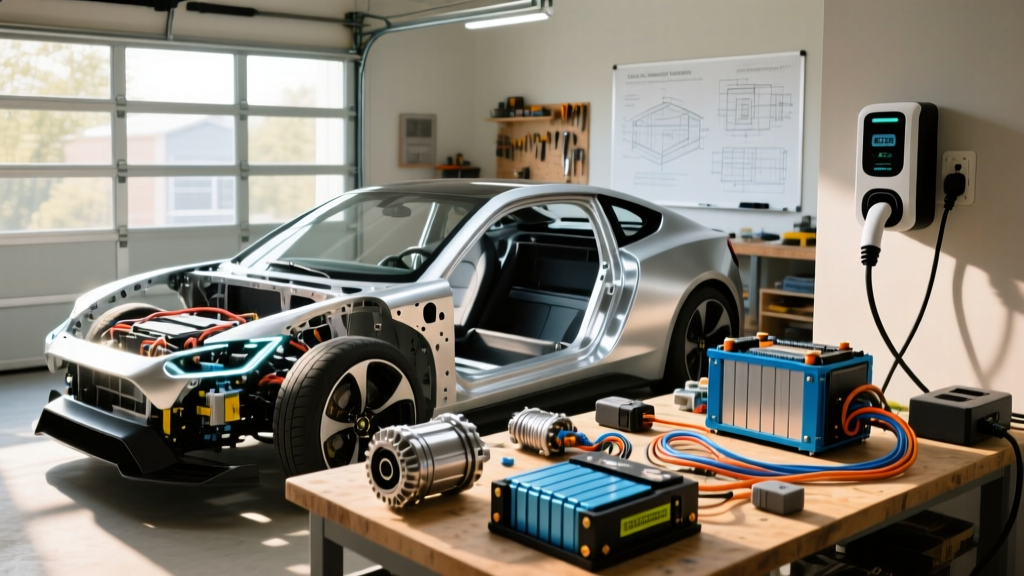
- EV conversion kit on a donor car: You take a lightweight, simple vehicle (commonly a VW Beetle, Porsche 944, Mazda Miata, or old pickup), strip the gas engine, fuel system, and exhaust, and install an electric motor, motor controller, and battery pack. Companies like Electric GT and Stealth EV sell partial kits.
- Scratch-built or kit car (e.g., Factory Five, Exomotive) with EV drivetrain: You build a chassis from a kit and integrate EV components. This demands advanced fabrication and electrical skills.
- University/hobby-scale (go-karts, neighborhood EVs): Low-speed vehicles (LSVs) under 25 mph are much simpler but not highway-legal in most states.
For a highway-capable, street-legal passenger car, path #1 (conversion) is the most common — and still a serious engineering undertaking.
Real Cost Breakdown: DIY EV Conversion vs. Factory EV
Below is a realistic 2026 cost comparison. Conversion costs are based on common build logs from the EV conversion community (e.g., Open Inverter Forum, DIY Electric Car); factory EV prices reflect current MSRP before incentives.
| Cost Category | DIY EV Conversion | 2026 Chevy Equinox EV LT | 2026 Tesla Model 3 RWD |
|---|---|---|---|
| Donor vehicle / base MSRP | $2,000–$8,000 | $33,400 | $38,990 |
| Battery pack (usable kWh) | $4,000–$15,000 (20–50 kWh, typically salvaged Tesla/Nissan modules) | Included (85 kWh usable, NMC) | Included (~57.5 kWh usable, LFP) |
| Motor + controller | $2,500–$6,000 (NetGain Hyper9, Cascadia Motion, etc.) | Included | Included |
| Charger, BMS, DC-DC, wiring | $1,500–$4,000 | Included | Included |
| Fabrication / machining | $1,000–$5,000 (or hundreds of your own hours) | N/A | N/A |
| Registration, inspection, insurance | $500–$2,000 (varies heavily by state) | ~$1,200/yr avg | ~$1,500/yr avg |
| Federal §30D tax credit | $0 (not eligible — not a certified manufacturer vehicle) | Up to $7,500 (subject to MSRP, income, sourcing rules per IRS §30D) | $0 (Tesla no longer qualifies under current critical-mineral rules) |
| Total realistic cost | $11,500–$40,000+ | ~$25,900–$33,400 | $38,990 |
| EPA-verified range | None (no EPA testing) — expect 60–150 mi real-world | 315 mi (real-world highway ~260–280 mi) | 341 mi (real-world highway ~280–300 mi) |
| DC fast charging | Rarely — most conversions are Level 2 AC only | 150 kW peak, 10–80% in ~30 min | 170 kW peak, 10–80% in ~25 min |
| Warranty | None (your risk) | 8 yr / 100,000 mi battery | 8 yr / 120,000 mi battery |
| Crash safety | Unverified — donor car's structure only | NHTSA 5-star, IIHS Top Safety Pick | NHTSA 5-star, IIHS Top Safety Pick+ |
Range, Charging, and the kWh Problem in Conversions
The single biggest compromise in a DIY EV build is energy capacity versus weight and space. A factory EV like the Equinox uses a tightly packaged 85 kWh NMC battery in a dedicated skateboard platform. In a conversion, you're typically shoehorning salvaged modules (e.g., Tesla Model S packs, Nissan Leaf stacks, or Chevrolet Bolt modules) into a trunk, bed, or tunnel not designed for them.
Here's the math that matters:
- Battery cost per kWh (2026 market): Salvaged modules run roughly $100–$180/kWh; new LiFePO4 (LFP) prismatic cells are around $130–$200/kWh at small quantities.
- Weight penalty: LFP cells are heavier than NMC. A 40 kWh LFP pack can weigh 700–900 lbs, significantly affecting a lightweight donor car's handling and efficiency.
- Efficiency: A well-built conversion typically achieves 250–350 Wh/mile (compare to the Model 3 RWD at ~240 Wh/mile or the Equinox EV at ~300 Wh/mile on the EPA cycle).
- Realistic range: A 30 kWh usable pack at 300 Wh/mile = ~100 miles. Cold weather (below 32°F) can knock that down 20–30% if your pack lacks active thermal management — which most conversions do.
- Charging: Most conversions top out at 3.3–7.2 kW AC Level 2 (adding ~12–25 miles per hour of charging). DC fast charging requires a CHAdeMO or CCS inlet, compatible high-voltage contactors, and BMS communication — a $2,000+ add-on that's rarely worth it on a small pack.
If your daily commute is under 40 miles round-trip and you have Level 2 charging at home, a conversion's limited range may be fine. If you need highway road-trip capability, a factory EV is the only realistic answer.
EV Conversion vs. Gas Car vs. Hybrid: Which Saves More?
Let's compare the long-term economics assuming 12,000 miles/year, national-average electricity at $0.17/kWh, and gasoline at $3.30/gallon (2026 EIA averages).
| Metric | DIY EV Conversion (30 kWh, 300 Wh/mi) | 2026 Toyota Corolla Hybrid (gas) | 2026 Chevy Equinox EV |
|---|---|---|---|
| Fuel/energy cost per mile | $0.051 | $0.066 (52 MPG combined) | $0.051 |
| Annual fuel/energy cost | $612 | $792 | $612 |
| Maintenance (annual avg) | Low ($150–$300) but you're the mechanic | $600–$900 | $300–$500 |
| Insurance (annual avg) | $800–$1,500 (specialty/salvage title) | $1,100 | $1,200 |
| 5-year fuel + maintenance | $3,810–$5,310 | $6,960–$8,460 | $4,560–$5,560 |
The conversion doesn't save money versus a modern factory EV once you account for build cost, no tax credit, and potentially higher insurance on a modified-title vehicle. The factory EV wins on range, safety, charging speed, warranty, and resale value. The hybrid (like the Corolla Hybrid at ~$23,500 MSRP) is the cheapest path to low operating costs if you lack reliable home charging access — a factor many would-be EV builders overlook.
Legal, Safety, and Registration Gotchas
Before you order a motor controller, understand the regulatory landscape. EV conversions face real hurdles:
- Title and registration: Most states require a "specially constructed vehicle" (SPCNS) or rebuilt-title inspection. California's SB100 program offers limited smog-exempt registration slots for conversions — but they're allocated annually and competitive.
- Safety inspections: High-voltage systems (typically 96V–400V in conversions) must be properly fused, isolated, and shielded. A fault can be lethal. The NHTSA doesn't certify conversions — you are the manufacturer, and you assume liability.
- Airbags and crash systems: Most conversions disable or cannot retain factory airbags and crumple-zone engineering. This is a genuine safety trade-off versus any modern production EV.
- Insurance: Many mainstream insurers won't write full coverage on a converted EV. Specialty insurers (Hagerty, Grundy) may, but at a premium and often with agreed-value limits.
- No federal tax credit: The §30D credit applies only to new vehicles from certified manufacturers with documented battery sourcing. A home build qualifies for $0. See current rules at irs.gov.
Common Myths About Building Your Own EV
| Myth | Fact |
|---|---|
| "I can build an EV for under $5,000." | Only for a low-speed neighborhood vehicle (golf cart class, <25 mph) with lead-acid or tiny LFP packs. Highway-capable builds start around $11,000+ in parts. |
| "Conversions get 200+ miles of range." | Extremely rare. That requires 60+ kWh of batteries — $8,000–$12,000 in cells alone, plus 1,000+ lbs of weight most donor cars can't handle. |
| "It's cheaper than buying a used Nissan Leaf." | A 2022–2024 Leaf S (149 mi EPA) sells for $12,000–$18,000 used, with a factory battery warranty, CHAdeMO DC charging, and full safety systems. Hard to beat on cost. |
| "Any mechanic can do it." | EV conversions require high-voltage electrical knowledge, fabrication, CAN-bus integration, and BMS programming. Most general mechanics won't touch them. |
| "It'll be self-driving with an open-source autopilot." | No. Consumer driver-assist is SAE Level 2 (driver must remain engaged). Home-built autonomous systems are not road-legal and carry extreme liability. |
Decision Framework: Should You Build or Buy?
Build an EV conversion IF:
- You have a specific classic or sentimental donor car you want to preserve and electrify (e.g., '70s VW Bus, old Porsche 911).
- You have advanced fabrication, welding, and high-voltage electrical skills — or a trusted shop that does.
- Your use case is local driving under 60 miles/day with reliable home Level 2 charging.
- You value the project experience and uniqueness over warranty, safety ratings, and resale value.
- Budget is not the primary driver — you'll likely spend more than a used factory EV.
Buy a factory EV IF:
- You need 250+ miles of EPA-verified range and DC fast charging for road trips.
- You want crash-test certification (NHTSA/IIHS), airbags, and modern ADAS (automatic emergency braking, blind-spot monitoring).
- You want the federal §30D tax credit (up to $7,500, subject to MSRP caps, buyer income limits, and battery-sourcing rules).
- You need financing — banks and credit unions rarely finance conversions.
- You want an 8-year/100,000-mile battery warranty and dealer service network.
Consider a hybrid (HEV or PHEV) IF:
- You lack reliable home or workplace charging access.
- You live in a region with extreme cold (below 0°F) where EV range loss is significant.
- Your budget is under $25,000 and you want low operating costs now — the Corolla Hybrid or Toyota Prius (up to 57 MPG combined per fueleconomy.gov) is hard to beat.
Frequently Asked Questions
How long does an EV conversion take?
For a skilled hobbyist working weekends: 300–800 hours. For a professional shop: 4–12 weeks. First-time builders often take 12–18 months and commonly abandon projects mid-build.
What battery chemistry is best for a conversion?
Salvaged Tesla NMC modules offer the best energy density (~160–180 Wh/kg at the pack level) but require careful BMS integration. LFP prismatic cells (e.g., EVE, CATL) are safer, tolerate 100% state-of-charge better, and last longer (3,000+ cycles), but are heavier — a problem in light donor cars.
Can I use a Tesla motor in my conversion?
Yes, but it's complex. Tesla's drive units use proprietary CAN protocols. Adapters like the Open Inverter project and Cascadia Motion controllers have made Tesla Large and Small Drive Units more accessible, but integration still requires significant electrical and software skill.
Is a DIY EV conversion street-legal in my state?
It depends. Most states have a specially-constructed-vehicle process requiring brake, light, and VIN inspections. A few states (notably California via SB100) have specific pathways. Check your state DMV's SPCNS or kit-car regulations before starting. Expect the process to take weeks to months.
Can I add DC fast charging to a conversion?
Technically yes, but it's expensive and rare. You need a CCS or CHAdeMO inlet, a compatible high-power onboard charger or external DC interface, high-voltage contactors rated for 500A+ peak, and a BMS that can communicate with the charger protocol. Budget $2,500–$5,000 additional — often not worth it on packs under 40 kWh.
What's the cheapest legitimate way into EV ownership?
A used 2019–2023 Nissan Leaf S (149 mi EPA) or Chevrolet Bolt EV (259 mi EPA) can be found for $12,000–$18,000, and the federal used-EV credit (§25E) can knock up to $4,000 off for qualified buyers purchasing from a dealer for $25,000 or less. This is almost always cheaper and safer than a conversion.