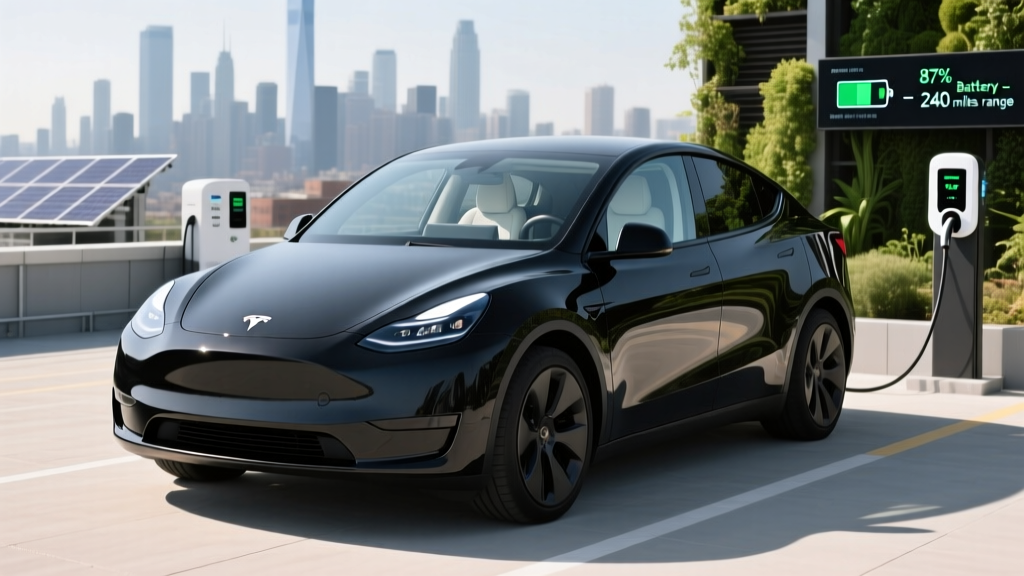
If you've spent any time researching electric vehicles, you've likely typed "how reliable is a Tesla" into a search bar. It's one of the most common questions in the EV space, and for good reason: Tesla sells more vehicles than any other EV brand in the U.S., yet its build-quality reputation and repair logistics generate fierce debate. Rather than rehash anecdotes, this review examines the 2026 Tesla Model Y — the company's highest-volume seller — through hard data on battery longevity, charging infrastructure, real-world range, repair frequency, and total ownership cost.
The short answer? Tesla's powertrain and battery reliability are strong, often exceeding 90% capacity retention past 100,000 miles. The reliability concerns center on interior fit-and-finish, suspension components, and the brand's reliance on mobile service rather than a traditional dealer network. Let's unpack what that actually means for your wallet and your daily driving.
2026 Tesla Model Y: Core Specifications at a Glance
| Spec | Long Range AWD | Performance AWD |
|---|---|---|
| EPA Range | 320 miles | 290 miles |
| Battery (usable) | ~75 kWh (NMC) | ~75 kWh (NMC) |
| Drivetrain | Dual-Motor AWD | Dual-Motor AWD |
| Horsepower | 384 hp | 456 hp |
| 0–60 mph | 4.8 sec | 3.5 sec |
| Peak DC Fast Charge | 250 kW | 250 kW |
| 10–80% DC Charge Time | ~25 min | ~25 min |
| Level 2 Home Charge (11.5 kW) | ~44 mi/hr | ~44 mi/hr |
| MPGe (combined) | 122 MPGe | 111 MPGe |
| Efficiency (kWh/100 mi) | 28 kWh/100 mi | 30 kWh/100 mi |
| Cargo Volume (rear seats up) | 30.2 cu ft | 30.2 cu ft |
| Cargo Volume (rear seats folded) | 72.1 cu ft | 72.1 cu ft |
| Rear Legroom | 37.6 in | 37.6 in |
| Base MSRP | $44,990 | $51,490 |
| Battery Warranty | 8 yr / 120,000 mi | 8 yr / 120,000 mi |
All 2026 Model Y trims use nickel-manganese-cobalt (NMC) battery chemistry. NMC provides higher energy density than LFP (lithium iron phosphate), which translates to more range in a lighter pack — but Tesla recommends daily charging to 80% for NMC longevity, reserving 100% charges for road trips. If you want an LFP option (which tolerates daily 100% charges better), you'll need to look at the base RWD variant, which Tesla has offered intermittently with an LFP pack sourced from CATL. Always confirm chemistry at purchase, as Tesla has shifted suppliers mid-year in the past.
Real-World Range: What the EPA Sticker Doesn't Tell You
Real-World Highway (70–75 mph, mild weather): ~265–285 miles
Real-World Highway (below 30°F): ~210–245 miles
Mixed City/Suburban Commute: ~290–310 miles
The Model Y's 320-mile EPA rating is a useful baseline, but fueleconomy.gov data and independent testing consistently show that highway driving at sustained speeds above 70 mph reduces effective range by 10–17%. EVs are most efficient at lower speeds where regenerative braking recaptures energy; on the interstate, aerodynamic drag dominates and there's little regen opportunity.
Cold weather compounds the loss. Lithium-ion batteries experience increased internal resistance in freezing temperatures, and the cabin heater draws heavily from the pack. Tesla's standard heat pump — which scavenges waste heat from the drivetrain — helps significantly compared to resistive heating, but you should still budget 20–30% range reduction in sub-freezing conditions. On a winter road trip from Denver to Grand Junction, expect closer to 220 usable miles before needing to charge, not 320.
For daily commuting under 60 miles round-trip, the Model Y's range is more than adequate regardless of season. Range becomes a planning factor primarily on road trips exceeding 200 miles and in extreme cold.
Charging Speed and Infrastructure: Tesla's Real Advantage
Charging speed is where Tesla ownership diverges most sharply from the rest of the EV market. The Model Y supports a peak DC fast-charge rate of 250 kW on V3 Superchargers, achieving a 10–80% charge in approximately 25 minutes under ideal conditions (warm battery, low state of charge at plug-in).
| Charging Level | Power (kW) | Miles Added per Hour | Typical Use Case |
|---|---|---|---|
| Level 1 (120V household) | ~1.4 kW | ~3–5 mi/hr | Emergency / overnight trickle |
| Level 2 (240V, 48A Wall Connector) | 11.5 kW | ~44 mi/hr | Daily home charging |
| DC Fast Charge (V3 Supercharger) | Up to 250 kW | ~1,000 mi/hr (peak) | Road trips, ~25 min 10–80% |
| DC Fast Charge (V4 Supercharger) | Up to 250 kW | ~1,000 mi/hr (peak) | Same speed, updated pedestal design |
Understanding kW vs. kWh: kW (kilowatts) measures power — how fast energy flows into the battery, like water pressure from a hose. kWh (kilowatt-hours) measures energy capacity — how much the battery holds, like the size of the tank. The Model Y's ~75 kWh battery charged at 250 kW (peak) will fill quickly, but that peak rate isn't sustained for the entire session. The charge curve tapers significantly above 80% state of charge to protect battery health, which is why 10–80% is the standard benchmark.
As of early 2026, Tesla operates over 6,500 Supercharger stations and 60,000+ individual stalls in North America, according to Tesla's Supercharger page. With the NACS connector now adopted by Ford, GM, Rivian, Hyundai, and others, Supercharger access has broadened — but Tesla owners still enjoy the most seamless plug-and-charge experience in the industry. No app fumbling, no payment-card swiping at the pedestal; the car authenticates and bills your Tesla account automatically.
For home charging, Tesla's Wall Connector ($420) on a 60-amp circuit delivers 48 amps / 11.5 kW, adding roughly 44 miles of range per hour of charging. A typical overnight session (8–10 hours) fully replenishes the pack from any daily driving. Installation costs vary widely: expect $500–$1,500 if your electrical panel has capacity, or $2,000–$4,000+ if a panel upgrade to 200 amps is needed. Always get a quote from a licensed electrician before committing.
Battery Reliability and Degradation: What the Data Shows
This is the heart of the "how reliable is a Tesla" question. Battery degradation — the gradual loss of usable capacity over time and charge cycles — is the single largest long-cost variable in EV ownership.
Tesla's own 2024 Impact Report (the most recent comprehensive dataset published) showed that Model 3 and Model Y batteries retain approximately 85% of their original capacity after 200,000 miles. Independent data from fleet operators and owner surveys tracked by outlets like Recurrent Auto corroborate this: most Model Y owners report 90–93% capacity retention at 50,000 miles and 85–88% at 100,000 miles.
The Model Y's battery and drive unit warranty provides coverage for 8 years or 120,000 miles (whichever comes first), with a capacity-retention threshold of 70%. If your battery drops below 70% of its original capacity within that window, Tesla will repair or replace it at no cost. In practice, very few owners hit this threshold under normal use — it would require a defective module or extreme abuse.
Practical tips for maximizing battery longevity:
- Set your daily charge limit to 80% (the car's software makes this easy).
- Avoid leaving the car at 100% state of charge for extended periods.
- Use DC fast charging for road trips, but rely on Level 2 home charging for daily use — frequent Supercharging slightly accelerates degradation over years.
- In cold weather, use the car's scheduled departure feature to precondition the battery while plugged in, reducing stress on the cells.
Full battery replacement outside of warranty currently costs between $12,000 and $16,000 at Tesla Service Centers, depending on the pack variant. However, given the degradation data, most owners will sell or trade the vehicle long before a replacement is needed.
Build Quality, Software, and Service: The Nuanced Picture
Tesla's powertrain reliability is well-documented, but the brand's historical weak points are build quality and service logistics. Panel gaps, paint imperfections, and interior trim alignment have improved markedly since the Fremont factory's early days, and the Shanghai- and Austin-built Model Y vehicles (which supply the U.S. market) show tighter tolerances in recent model years. That said, J.D. Power's 2025 Initial Quality Study still places Tesla below the industry average, driven largely by cosmetic complaints and infotainment glitches rather than mechanical failures.
The service model is where Tesla diverges from traditional automakers. There are no dealerships. Instead, Tesla operates a network of company-owned Service Centers supplemented by Mobile Service vans that come to your home or workplace. In major metro areas, service appointments are typically available within 1–2 weeks. In rural regions, however, the nearest Service Center may be hours away, and mobile service availability can be sparse. This is a genuine consideration if you live outside a top-50 metro area.
On the software side, Tesla's over-the-air (OTA) update system is best-in-class. The car receives regular feature additions, efficiency tweaks, and UI improvements without a service visit. The 15.4-inch center touchscreen handles all vehicle controls — there are no physical buttons for climate, mirrors, or glovebox. Some buyers love the minimalism; others find it distracting while driving. The new Model Y "Juniper" refresh (introduced in 2025) added ambient lighting, ventilated rear seats, a rear-seat touchscreen, and a power-folding second row — meaningful quality-of-life upgrades over the pre-refresh model.
Pricing, Tax Credits, and Total Cost of Ownership
| Trim | Base MSRP | Est. After §30D Credit* | Destination Fee |
|---|---|---|---|
| Long Range AWD | $44,990 | $37,490 | $1,390 |
| Performance AWD | $51,490 | $43,990 | $1,390 |
*Federal tax credit (§30D) caveats: The full $7,500 credit requires meeting IRS eligibility rules that include buyer income caps ($150,000 single / $300,000 joint MAGI), vehicle MSRP caps ($55,000 for sedans, $80,000 for SUVs/vans — the Model Y qualifies under the SUV threshold), and battery component/critical mineral sourcing requirements that phase in more strictly each year. As of 2026, the critical-minerals and battery-component sourcing rules are stringent, and credit amounts can split into $3,750 (minerals only) or $7,500 (both requirements met). The credit is available as a point-of-sale transfer to the dealer, reducing your out-of-pocket cost at purchase. Always verify current-year eligibility with a tax professional before relying on the credit in your budget.
Beyond the purchase price, the Model Y's total cost of ownership (TCO) is where the math gets compelling. Electricity costs roughly $0.13–$0.17 per kWh nationally (varying by utility), meaning a full 75 kWh charge costs about $10–$13 at home. That's roughly $0.04–$0.05 per mile — compared to $0.12–$0.16 per mile for a 25-MPG gas crossover at $3.50/gallon. Over 15,000 miles per year, the fuel savings alone are approximately $1,200–$1,600 annually.
Maintenance costs are also substantially lower: no oil changes, no spark plugs, no transmission fluid, and regenerative braking extends pad life dramatically. Tesla recommends cabin air filter replacement every 2–3 years and a brake fluid check every 2 years. Annual maintenance typically runs $200–$400, versus $800–$1,200 for a comparable gas-powered SUV.
The offsetting costs: EV insurance premiums run 15–25% higher than equivalent gas vehicles (the Model Y's average annual premium is roughly $2,200–$2,800 depending on your state and driving record), and tire wear can be accelerated by the vehicle's weight and instant torque. Budget for a tire replacement every 30,000–40,000 miles at $800–$1,400 for a set of four.
Autopilot and FSD: What "Self-Driving" Actually Means
Tesla Autopilot and FSD (Supervised) are driver-assistance systems, not autonomous driving. The driver must remain fully engaged — hands on or near the wheel, eyes on the road — at all times. Only Level 4 systems (like Waymo's robotaxi) operate without a human driver.
Tesla's Autopilot comes standard on every Model Y and provides adaptive cruise control and lane-centering on highways. It's competent and well-calibrated for its intended use. Full Self-Driving (Supervised), an $8,000 add-on (or $99/month subscription as of 2026), extends capability to city streets, traffic-light recognition, and automatic stop-sign handling.
- It does not make the car autonomous. You are the driver and are legally responsible for all vehicle actions.
- It does not handle all scenarios gracefully — construction zones, faded lane markings, and unusual intersections still require immediate takeover.
- It is not approved for hands-off or eyes-off driving anywhere in the U.S. as of 2026.
Whether FSD is "worth it" is intensely personal. As a driver-assist system for long highway commutes, it reduces fatigue meaningfully. As a path to full autonomy, it remains unproven. Most Model Y buyers are better served by the included Autopilot and putting the $8,000 toward a home charging setup or simply pocketing the savings.
Model Y vs. the Competition: Where It Wins and Loses
The Model Y's most direct competitors in 2026 include the Hyundai Ioniq 5, Ford Mustang Mach-E, and Chevrolet Equinox EV. Here's how the key trade-offs break down:
- Supercharger network access (most reliable DC fast-charging in North America)
- Best-in-class software and OTA updates
- Strongest real-world efficiency (28 kWh/100 mi) in the segment
- Extensive cargo space (72.1 cu ft with seats folded)
- Strong resale value relative to other EVs
- Below-average build quality scores (J.D. Power)
- No physical buttons — all controls via touchscreen
- Service Center coverage is thin outside major metros
- FSD is expensive and still requires full driver engagement
- Ride quality is firm; road noise is noticeable at highway speed
The Ioniq 5 offers faster peak charging (up to 350 kW on 800V architecture), a more conventional interior with physical controls, and a slightly softer ride — but its public charging experience depends on Electrify America or other third-party networks, which remain less reliable than Superchargers. The Mach-E offers a more engaging driving feel and Ford's dealer network for service, but its efficiency and range trail the Model Y. The Equinox EV undercuts the Model Y on price by $8,000+ but offers notably less range and a less refined driving experience.
Who Should Buy the 2026 Tesla Model Y?
- You take regular road trips and want the most reliable DC fast-charging network available.
- You can install Level 2 home charging and want a "fill up at home" daily routine.
- You value software-forward features, OTA updates, and a minimal interior.
- You need versatile cargo space for family gear, pets, or weekend trips.
- You live in a rural area far from a Tesla Service Center and need dealer-based service.
- You prefer physical buttons and a traditional cockpit layout.
- Your budget is under $35,000 — consider the Equinox EV or a used Model 3 instead.
- You want the smoothest ride quality — test-drive the Ioniq 5 or BMW iX for comparison.
Frequently Asked Questions
What is the real-world range of the 2026 Tesla Model Y?
The EPA rates the Long Range AWD at 320 miles. In real-world highway driving at 70–75 mph in mild weather, expect 265–285 miles. In freezing temperatures, that drops to approximately 210–245 miles. City and suburban driving with regenerative braking returns closer to the EPA number, around 290–310 miles.
How fast does the Model Y charge at home and on the road?
At home on a Level 2 Wall Connector (11.5 kW / 48 amps), the Model Y adds roughly 44 miles of range per hour — a full overnight charge covers any daily driving. On a V3 Supercharger (250 kW peak DC), it charges from 10–80% in approximately 25 minutes. Charging slows significantly above 80% to protect the battery, so plan to unplug at 80% on road trips unless you need the full pack.
How much does the Model Y cost after federal tax credits?
The Long Range AWD starts at $44,990. If you qualify for the full $7,500 §30D federal tax credit (subject to income caps of $150K single / $300K joint, MSRP caps, and battery-sourcing requirements), the effective price drops to approximately $37,490 before destination fees. The credit can be transferred at point of sale. Verify your eligibility with a tax professional and check current IRS guidelines before budgeting around it.
Is the Model Y worth buying over competitors like the Ioniq 5 or Mach-E?
It depends on your priorities. If charging reliability, software, efficiency, and cargo space top your list, the Model Y is the strongest choice. If you prefer physical controls, a softer ride, faster peak charging speeds (Ioniq 5 at 350 kW), or a traditional dealer service network (Mach-E), the alternatives have merit. Test-drive all three before deciding.
What are the biggest pros and cons of owning a Tesla Model Y?
Pros: Supercharger network, industry-leading efficiency and software, spacious cargo area, low running costs, strong safety ratings (IIHS Top Safety Pick+). Cons: Build-quality inconsistencies, touchscreen-only controls, limited service-center reach in rural areas, above-average insurance premiums, firm ride quality.
Does the 2026 Model Y qualify for the federal EV tax credit?
The Model Y qualifies under the §30D SUV MSRP cap of $80,000, and both the Long Range and Performance trims fall well below that threshold. However, the full $7,500 credit also depends on your income, the battery's critical-mineral sourcing, and battery-component manufacturing origin — all of which are subject to annual tightening under current law. Confirm eligibility on irs.gov or with your tax advisor at time of purchase.
How reliable is a Tesla compared to gas cars over 100,000 miles?
Tesla's electric powertrain has far fewer moving parts than an internal combustion engine — no timing belts, no oil pump, no exhaust system, no multi-speed transmission. This translates to fewer mechanical failure points. Battery data shows ~85–88% capacity retention at 100,000 miles for the Model Y. The reliability gap versus gas cars is mostly cosmetic and service-logistical, not mechanical. Over a 10-year ownership period, the Model Y's total maintenance and fuel costs are typically $8,000–$12,000 lower than a comparable gas SUV, even accounting for higher insurance and potential out-of-warranty repairs.