The Short Answer: How Much to Charge an Electric Car
Charging an electric car at home on a standard utility rate costs between $0.12 and $0.18 per kWh in most U.S. regions as of early 2026. For a typical 75 kWh battery (like the Tesla Model Y Long Range or Hyundai Ioniq 5), a full 0–100% charge runs $9 to $14 at home. Public DC fast charging is significantly more expensive — typically $0.30 to $0.55 per kWh, making a full charge $23 to $41. For context, fueling a comparable gas car averaging 28 MPG combined at $3.20/gallon costs roughly $0.114 per mile, while home-charged EV driving costs $0.035 to $0.05 per mile depending on vehicle efficiency.
The exact cost depends on your electricity rate, battery size, charging method, and how you drive. Below, we break down every scenario with real numbers.
Home Charging Costs: Level 1 and Level 2 Compared
Home charging is where the majority of EV owners do 80–90% of their charging, and it's also where the economics overwhelmingly favor electrification. Your cost per mile hinges on two variables: your local electricity rate (measured in cents per kWh) and your vehicle's efficiency (measured in kWh per 100 miles or miles per kWh).
Level 1 charging uses a standard 120V household outlet and delivers roughly 1.0 to 1.4 kW of power. That translates to about 3–5 miles of range per hour of charging — adequate for drivers who cover under 30 miles daily and can plug in overnight. The electricity cost is identical to Level 2; the difference is speed, not price per kWh.
Level 2 charging requires a 240V circuit (the same voltage as an electric dryer) and a dedicated EVSE (Electric Vehicle Supply Equipment). Most home Level 2 chargers deliver 7.2 kW to 11.5 kW, adding 25–45 miles of range per hour. A full charge for a 75 kWh battery takes 7–10 hours — perfectly suited for overnight replenishment.
| Electricity Rate ($/kWh) | Full Charge Cost | Cost Per Mile (3.5 mi/kWh) | Typical Region |
|---|---|---|---|
| $0.10 | $7.50 | $0.029 | WA, ID, LA (low-rate states) |
| $0.14 | $10.50 | $0.040 | National average (residential) |
| $0.18 | $13.50 | $0.051 | Northeast, parts of CA |
| $0.28 | $21.00 | $0.080 | CA peak TOU rates, HI |
| $0.35 | $26.25 | $0.100 | San Diego (SDG&E peak), some HI tiers |
The national average residential electricity rate sits around $0.165/kWh according to the U.S. Energy Information Administration (EIA). At that rate, a driver covering 12,000 miles per year in a vehicle averaging 3.5 miles per kWh (roughly 28.5 kWh/100mi, typical of a mid-size crossover like the Ford Mustang Mach-E or Volkswagen ID.4) would spend approximately $566 per year on home charging.
Time-of-Use (TOU) rates matter enormously. Many utilities offer off-peak rates 40–60% cheaper than peak rates. If your utility offers $0.08/kWh overnight (10 PM–6 AM) versus $0.25 during peak evening hours, scheduling your EV to charge overnight can cut your annual charging cost from $700+ to under $300. Check with your local utility for EV-specific rate plans — many now offer them.
Public DC Fast Charging: Convenience at a Premium
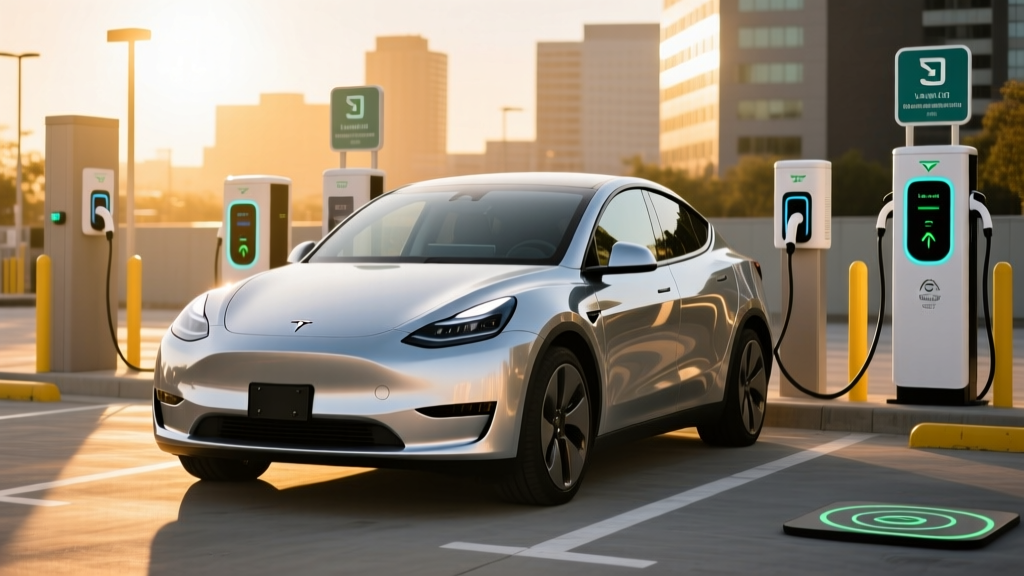
DC fast charging (Level 3) is the road-trip backbone of EV ownership. Networks like Tesla Supercharger, Electrify America, EVgo, and ChargePoint offer peak charge rates from 50 kW to 350 kW, capable of adding 100–250 miles of range in 15–30 minutes depending on the vehicle and charger.
But this convenience carries a significant cost premium. As of early 2026, typical DC fast-charging pricing breaks down as follows:
| Network | Typical $/kWh | Idle Fee | Membership Discount |
|---|---|---|---|
| Tesla Supercharger (V3/V4) | $0.25–$0.40 | $1.00/min after full | None (Tesla vehicles); some open to NACS adapters |
| Electrify America | $0.31–$0.48 | $0.40/min after grace | Pass+ plan: $4/mo for ~25% discount |
| EVgo | $0.29–$0.43 | Varies by station | Plus plan available |
| ChargePoint (DC stations) | $0.30–$0.55 | Varies | None standard |
For a 75 kWh battery charged from 10% to 80% (roughly 52.5 kWh added) at $0.38/kWh — a realistic mid-range figure — you're paying about $20 per session. If you rely exclusively on DC fast charging and consume 3,500 kWh annually (12,000 miles at 3.5 mi/kWh), your annual fuel cost jumps to $1,330 — still cheaper than gas in most cases, but the savings gap narrows considerably.
Real-world charging curve reality check: A vehicle that advertises "peak 250 kW" charging does not sustain that rate for the entire session. Most EVs hit peak rate only between 10–30% State of Charge (SoC), then taper progressively. A Hyundai Ioniq 5 (84 kWh battery, NMC chemistry) might peak at 240 kW but average roughly 150 kW across a 10–80% session, completing it in about 18 minutes. Above 80%, charging slows dramatically to protect battery health — which is why road-trippers typically charge to 80% and move on rather than waiting for a full top-off.
EV Charging Cost vs. Gas: The Head-to-Head Numbers
The most common question from prospective EV buyers is whether charging is actually cheaper than gasoline. The answer is almost always yes for home charging, sometimes yes for public fast charging, and heavily dependent on your local electricity and gas prices.
| Vehicle Type | Efficiency | Energy Cost | Annual Cost | Cost Per Mile |
|---|---|---|---|---|
| EV — Home Level 2 ($0.14/kWh avg) | 28 kWh/100mi (3.57 mi/kWh) | $0.14/kWh | $470 | $0.039 |
| EV — Home TOU off-peak ($0.09/kWh) | 28 kWh/100mi | $0.09/kWh | $302 | $0.025 |
| EV — Public DC fast only ($0.38/kWh) | 28 kWh/100mi | $0.38/kWh | $1,277 | $0.106 |
| PHEV — Blended (30 mi EV + gas) | 38 MPG gas / 95 MPGe elec | $3.20/gal + $0.14/kWh | $680 | $0.057 |
| Gas car — 28 MPG combined | 28 MPG | $3.20/gal | $1,371 | $0.114 |
| Gas car — 22 MPG (truck/SUV) | 22 MPG | $3.20/gal | $1,745 | $0.145 |
The data is clear: home-charged EVs save $800 to $1,100 per year compared to a comparable gas vehicle. Even exclusive DC fast charging roughly breaks even with gasoline. The break-even electricity rate — where home charging costs the same per mile as a 28 MPG gas car at $3.20/gallon — is approximately $0.32/kWh. Very few residential rates exceed that threshold.
For the most accurate comparisons tailored to your zip code, the EPA's fuel economy site (fueleconomy.gov) lists kWh/100mi ratings for every certified EV, which you can multiply by your local rate to calculate your personalized cost.
Total Ownership Cost: Beyond the Charger
Charging cost is just one line item. A complete EV ownership analysis must account for purchase price, incentives, maintenance, insurance, and depreciation.
Purchase Price and Federal Tax Credit
The federal IRS §30D Clean Vehicle Credit offers up to $7,500 for qualifying new EVs, but eligibility is constrained by multiple requirements:
- MSRP caps: Vans, SUVs, and pickups must be under $80,000; sedans and other vehicles under $55,000.
- Buyer income limits: Modified AGI must not exceed $300,000 (joint), $225,000 (head of household), or $150,000 (single).
- Battery sourcing: Increasing percentages of critical minerals and battery components must be sourced from the U.S. or free-trade-agreement countries. This requirement tightens annually and has disqualified several models.
- Point-of-sale transfer: As of 2024, buyers can transfer the credit to the dealer for an immediate price reduction rather than waiting for a tax refund.
- Final assembly: Vehicle must undergo final assembly in North America.
Always verify a specific vehicle's eligibility on fueleconomy.gov's tax credit page before purchasing — the qualifying list changes as manufacturers adjust supply chains.
Maintenance Savings
EVs eliminate oil changes, spark plugs, timing belts, exhaust system repairs, and transmission fluid changes. Regenerative braking significantly extends brake pad life — many EV owners report original brake pads lasting 80,000–100,000+ miles. The U.S. Department of Energy estimates EV maintenance costs at roughly $0.061 per mile versus $0.101 per mile for gas vehicles — a savings of approximately $480 per year at 12,000 miles.
Insurance Reality
This is where EVs often cost more. EV insurance premiums run 15–25% higher than comparable gas vehicles on average, driven by higher repair costs (especially battery replacement after collisions) and elevated vehicle prices. For a $45,000 EV, expect annual premiums of $1,800–$2,400 depending on your state, driving record, and coverage level — roughly $200–$400 more per year than insuring a similarly priced gas car.
Tires
EVs are heavier (battery mass) and produce instant torque, which accelerates tire wear. Expect to replace tires every 25,000–40,000 miles rather than the 40,000–60,000 miles typical for gas cars. Budget an extra $150–$300 per year for tire replacement compared to a comparable ICE vehicle.
Battery Longevity and Warranty
Federal law mandates that EV batteries carry a warranty of at least 8 years/100,000 miles (10 years/150,000 miles in California and states adopting CARB standards). Most manufacturers warrant that the battery will retain 70–80% of original capacity during that period. Real-world degradation data from fleets and long-term owners shows most NMC batteries retain 85–92% capacity after 100,000 miles, while LFP (lithium iron phosphate) batteries — used in standard-range Tesla Model 3/Y and some other models — show even less degradation, often retaining 90–95% over the same distance.
Full battery replacement outside warranty currently runs $8,000–$18,000 depending on the vehicle and battery size, though this is rarely needed within the vehicle's practical lifespan.
Real-World Factors That Change Your Charging Cost
Sticker numbers don't tell the full story. Several real-world variables shift your actual cost per mile:
Climate and Temperature
Cold weather reduces EV range by 15–30% in freezing temperatures, primarily because the battery must expend energy on thermal management and cabin heating. A vehicle rated at 300 miles EPA range may deliver 210–255 miles in sustained 20°F weather. This means more frequent charging sessions and higher annual energy consumption. Vehicles equipped with a heat pump (standard on the Hyundai Ioniq 5, Tesla Model Y, and many 2025+ models) reduce this penalty to roughly 10–20% by efficiently extracting ambient heat rather than relying on resistive heating.
Driving Patterns and Efficiency
Highway driving at 75+ mph reduces efficiency by 10–20% compared to the EPA combined cycle, which blends city and highway. Stop-and-go city driving actually favors EVs thanks to regenerative braking. If your commute is predominantly highway, expect real-world consumption 15–20% higher than the EPA kWh/100mi figure.
Home Charging Access
This is the single biggest variable in EV economics. If you can install a Level 2 charger at home, EV ownership is almost always cheaper than gas. If you rely entirely on public charging — common for apartment dwellers and street-parkers — your fuel cost roughly doubles or triples, and the savings versus gas may disappear entirely depending on local public charging rates.
Level 2 home charger installation typically costs $500–$2,000 for the equipment and electrician labor if your electrical panel has capacity. If a panel upgrade (from 100A to 200A) is needed, add $1,500–$3,500. Some utilities and states offer rebates of $300–$1,000 for charger installation — check your local utility and the Alternative Fuels Data Center for current incentives.
Common Misconceptions About EV Charging Costs
| Myth | Fact |
|---|---|
| "Charging an EV is more expensive than gas." | Only if you rely exclusively on the most expensive public DC fast chargers. Home charging at average residential rates costs roughly one-third of gasoline per mile. The break-even point is approximately $0.32/kWh — above most U.S. residential rates. |
| "You need to charge to 100% every day." | Most EV batteries (especially NMC chemistry) are happiest between 20–80% SoC. Daily charging to 80% extends battery lifespan. Many vehicles let you set a charge limit. LFP batteries tolerate 100% daily charging better and Tesla recommends periodic full charges for LFP-equipped vehicles. |
| "Public charging is always unreliable." | Reliability varies significantly by network. Tesla Superchargers consistently report 99%+ uptime. Electrify America and EVgo have improved markedly since 2023, though individual station reliability still varies. Apps like PlugShare show real-time station status and user reviews. |
| "EV batteries need replacement every few years." | Modern EV batteries are designed to last the life of the vehicle. Data from high-mileage fleets shows 85–95% capacity retention at 100,000+ miles. The 8-year/100,000-mile federal warranty mandate provides additional protection. |
| "Solar panels are required to make EV charging affordable." | Home solar can further reduce charging cost to near zero, but even at standard grid rates of $0.14/kWh, EV charging is significantly cheaper than gasoline. Solar is an optimization, not a requirement. |
Decision Framework: Is an EV Right for Your Budget?
Use this if-then framework to evaluate your situation:
Choose a battery EV (BEV) if:
- You have access to home Level 2 charging (garage, driveway, or workplace)
- Your daily driving is under 200 miles round-trip
- You want to minimize per-mile fuel cost ($0.03–$0.05/mile at home)
- You qualify for the §30D tax credit (check income, MSRP, and sourcing rules)
- You accept higher insurance premiums in exchange for lower fuel/maintenance costs
Choose a plug-in hybrid (PHEV) if:
- You lack reliable home charging but want some electric driving (20–45 miles electric-only range)
- You frequently take road trips exceeding 300+ miles and don't want to plan around charging
- Your household has one vehicle that must serve all purposes
- You want EV-like commuting with gas-car flexibility for longer trips
Wait on an EV (or choose a hybrid) if:
- You park on the street with no charging access and your workplace doesn't offer charging
- Your local public DC fast-charging infrastructure is sparse (check PlugShare for your area)
- You live in an extremely cold climate and regularly drive 250+ miles between charging options
- Your budget cannot absorb the higher upfront cost even after tax credits
Frequently Asked Questions
How much does it cost to charge an EV at home per month?
At the national average residential rate of ~$0.165/kWh, a driver covering 1,000 miles per month in a vehicle rated at 28 kWh/100mi would use 280 kWh, costing approximately $46 per month. Drivers in low-rate states (Washington, Louisiana) may pay $25–$30/month; those in high-rate areas (California peak, Hawaii) may pay $70–$90/month.
Is it cheaper to charge an EV or fill up a gas car in 2026?
For home charging, EVs are cheaper in virtually every U.S. market. A gas car averaging 28 MPG at $3.20/gallon costs $0.114/mile. A home-charged EV averages $0.035–$0.05/mile. The gap narrows if you rely entirely on premium-priced public DC fast chargers, where costs can reach $0.10–$0.15/mile — roughly equal to gas.
Do I need to install a special charger at home?
You can charge on a standard 120V outlet (Level 1), but it adds only 3–5 miles of range per hour — adequate only for low-mileage drivers. A 240V Level 2 charger ($500–$2,000 installed) is strongly recommended for most EV owners, adding 25–45 miles per hour and fully replenishing a battery overnight. Always hire a licensed electrician and check whether your panel needs an upgrade.
Does fast charging damage the EV battery?
Occasional DC fast charging has minimal impact on battery health. However, exclusive reliance on high-power DC fast charging (150+ kW) over many years may accelerate degradation slightly compared to Level 2 charging. Modern thermal management systems actively protect the battery during fast charging. For daily use, Level 2 home charging is ideal; DC fast charging is designed for road trips and occasional top-ups.
What happens if I run out of charge on the road?
The same thing that happens if you run out of gas — you need roadside assistance. Most EVs provide extensive low-charge warnings, and navigation systems route through charging stations. AAA and other roadside services now offer mobile EV charging in many metro areas, providing enough charge (typically 10–20 miles of range) to reach the nearest station.
Are there free EV charging stations?
Yes, though they're becoming less common. Some workplaces, shopping centers, hotels, and municipalities offer complimentary Level 2 charging as an amenity. Apps like PlugShare and ChargeHub allow you to filter for free stations. However, free chargers are often slower (Level 2, not DC fast) and may have time limits or restricted access.