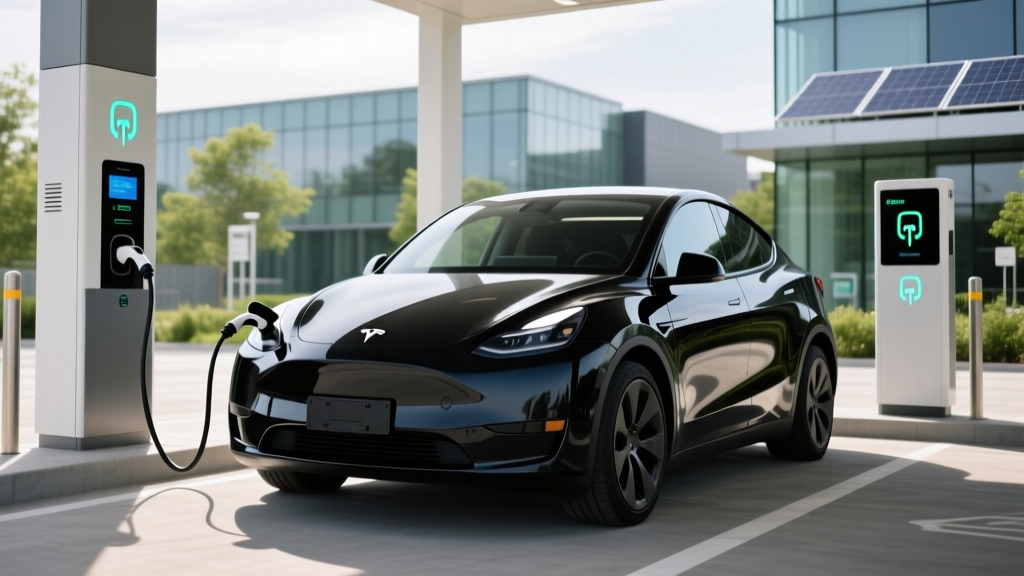
If you've typed "how long to charge Tesla" into your search bar, you're not alone — it's one of the most common questions prospective EV buyers ask. The answer depends entirely on which Tesla you own, where you're charging, and how much range you need to add. This guide focuses on the 2026 Tesla Model Y, the brand's best-selling crossover, and gives you exact charging times across every scenario — from a 120V wall outlet to a V4 Supercharger.
We'll also cover the Model Y's real-world range, battery chemistry differences between trims, tax credit eligibility under current IRS §30D rules, and how it stacks up against the Hyundai Ioniq 5 and Ford Mustang Mach-E. No marketing fluff — just the numbers you need to plan your ownership.
2026 Tesla Model Y: Core Specs at a Glance
Before we break down charging times, here are the essential specifications for the current Model Y lineup. Note that Tesla refreshed the Model Y (internally called "Juniper") for the 2025 model year, and those updates carry into 2026 with minor software and packaging adjustments.
| Specification | Long Range RWD | Long Range AWD | Performance AWD |
|---|---|---|---|
| EPA Range | 320 mi | 308 mi | 285 mi |
| Battery Capacity (usable) | ~75 kWh (LFP) | ~75 kWh (NMC) | ~75 kWh (NMC) |
| Max DC Fast Charge Rate | 250 kW | 250 kW | 250 kW |
| 10–80% DC Fast Charge Time | ~28 min | ~25 min | ~25 min |
| Level 2 Home Charge Rate | 11.5 kW (44 mi/hr) | 11.5 kW (44 mi/hr) | 11.5 kW (44 mi/hr) |
| 0–60 mph | 6.5 sec | 4.8 sec | 3.5 sec |
| Horsepower | 346 hp | 514 hp | 514 hp |
| Drivetrain | RWD | Dual-Motor AWD | Dual-Motor AWD |
| MPGe (combined) | 122 MPGe | 117 MPGe | 111 MPGe |
| Efficiency | 27 kWh/100 mi | 29 kWh/100 mi | 30 kWh/100 mi |
| Base MSRP | $44,990 | $47,990 | $52,490 |
Source: EPA fueleconomy.gov and Tesla official specifications. Real-world results may vary based on temperature, driving style, and terrain.
How Long to Charge a Tesla Model Y: Every Scenario
The question "how long to charge Tesla" has three distinct answers depending on your charging setup. Here's what to expect at each level, with the critical distinction between kW (the rate of power flow, like water pressure in a hose) and kWh (the total energy stored, like the size of the water tank).
DC Fast Charging (Supercharger & Third-Party Networks)
The 2026 Model Y supports a peak DC fast-charge rate of 250 kW on Tesla's V3 and V4 Superchargers. However — and this is critical — peak rate is not sustained rate. The charging curve tapers significantly as the battery fills:
- 10–30% SoC: Near-peak rate of ~240–250 kW
- 30–60% SoC: Sustains ~170–200 kW
- 60–80% SoC: Tapers to ~100–130 kW
- Above 80% SoC: Drops below 50 kW (charge at home for the last 20%)
This taper is why Tesla quotes a 10–80% time of approximately 25 minutes for the Long Range AWD and Performance trims. The LFP-equipped Long Range RWD takes slightly longer (~28 minutes) because LFP chemistry has a marginally different charge acceptance profile at high SoC.
Preconditioning matters. If you navigate to a Supercharger using the car's built-in navigation, the Model Y will automatically warm the battery to optimal temperature before you arrive. Skipping preconditioning in cold weather (below 40°F) can add 5–10 minutes to your charge time and reduce peak kW acceptance.
Level 2 Home Charging (240V)
This is where most Tesla owners do 90%+ of their charging. The Model Y's onboard charger accepts up to 11.5 kW on a 48-amp circuit (requiring a 60-amp breaker). Here's what that means in practical terms:
- Empty-to-full (0–100%): ~7–8 hours on an 11.5 kW Wall Connector
- Typical daily top-up (30–80%): ~3.5 hours
- Range added per hour: ~44 miles
If your home electrical panel can't support a 60-amp dedicated circuit, you can install a Wall Connector on a 40-amp breaker (32 amps, ~7.7 kW), which adds approximately 30 miles of range per hour — still more than enough for overnight charging.
Level 1 Trickle Charging (120V Standard Outlet)
Tesla includes a Mobile Connector with the vehicle. Plugged into a standard 120V household outlet at 12 amps, expect:
- Charge rate: ~1.4 kW
- Range added per hour: ~3–5 miles
- Full charge time: 50+ hours
Level 1 is viable only for low-mileage commuters (under 30 miles/day) or as a backup option. It is not a practical daily strategy for most owners.
| Charge Method | Power (kW) | Miles Added/Hour | 10–80% Time | 0–100% Time |
|---|---|---|---|---|
| Level 1 (120V Outlet) | ~1.4 kW | 3–5 mi | N/A (impractical) | ~50+ hours |
| Level 2 (48A Wall Connector) | 11.5 kW | ~44 mi | ~5 hours | ~7–8 hours |
| Level 2 (32A / 40A breaker) | 7.7 kW | ~30 mi | ~7 hours | ~10–11 hours |
| DC Fast (Tesla Supercharger V3/V4) | Peak 250 kW | ~1,000 mi/hr (peak) | ~25–28 min | N/A (taper above 80%) |
| DC Fast (CCS adapter, EA/others) | Peak 150–250 kW* | Varies | ~28–35 min | N/A |
*Non-Tesla DC chargers with CCS adapters may not sustain peak rates due to station limitations and protocol overhead. Tesla's NACS connector is native.
Real-World Range: What the EPA Sticker Doesn't Tell You
The EPA rates the 2026 Model Y Long Range AWD at 308 miles. But EPA testing uses a mixed city/highway cycle at moderate temperatures. Here's what to actually expect:
Real-World Range Expectations — Model Y Long Range AWD:
- City/suburban driving (55°F+): 290–310 mi (near or slightly above EPA)
- Highway at 70–75 mph (55°F+): 250–275 mi
- Highway in cold weather (below 32°F): 200–230 mi
- Highway at 80+ mph: 220–245 mi
Tesla's heat pump (standard on all 2026 Model Y trims) significantly reduces cold-weather cabin-heating energy draw compared to resistive heaters. Expect ~15–20% range loss in freezing temps, not the 30–40% loss seen in older EVs without heat pumps.
The LFP battery in the Long Range RWD is slightly heavier and less energy-dense than the NMC packs in the AWD trims, which is why the RWD model carries a higher EPA rating (320 mi) — it uses a slightly different testing calibration. Real-world differences between the two chemistries are minimal in daily driving.
Battery Chemistry: LFP vs NMC in the Model Y
Tesla uses two battery chemistries in the 2026 Model Y depending on trim:
| Factor | LFP (Long Range RWD) | NMC (Long Range AWD, Performance) |
|---|---|---|
| Energy Density | Lower (~160 Wh/kg cell-level) | Higher (~250 Wh/kg cell-level) |
| Cycle Life | 3,000+ cycles to 80% SoH | 1,500–2,000 cycles to 80% SoH |
| Recommended Daily Charge Limit | 100% (charge fully as often as you like) | 80% daily, 100% for road trips |
| Cold-Weather Performance | Slightly reduced charge acceptance when cold | Better cold-weather charge rates |
| Cobalt Content | Zero cobalt | Contains cobalt/nickel |
The practical takeaway: If you want a daily commuter you can charge to 100% every night without long-term degradation concerns, the LFP-equipped Long Range RWD is the pragmatic choice. If you need AWD traction or maximum acceleration, the NMC trims are the better fit — just follow Tesla's 80% daily charge recommendation.
Pricing, Trims, and Federal Tax Credit Eligibility
Here's where the purchase decision gets concrete. The 2026 Model Y starts at $44,990 for the Long Range RWD, but federal tax credit eligibility under IRS §30D is not guaranteed for every buyer or every trim.
| Trim | Base MSRP | §30D Credit Eligible? | Effective Price (with credit) |
|---|---|---|---|
| Long Range RWD | $44,990 | Yes — meets MSRP, income, and sourcing thresholds* | ~$37,490 |
| Long Range AWD | $47,990 | Yes* | ~$40,490 |
| Performance AWD | $52,490 | Yes* | ~$44,990 |
*All Model Y trims fall under the $80,000 MSRP cap for SUVs. Eligibility requires:
- Buyer AGI limits: $150,000 (single), $225,000 (head of household), $300,000 (joint)
- Battery sourcing: Tesla's North American battery supply chain currently satisfies critical-mineral and component requirements, but these thresholds tighten annually — verify at the point of sale
- Point-of-sale transfer: Since 2024, you can transfer the credit to the dealer at purchase, reducing your out-of-pocket cost immediately rather than waiting for tax filing
Important: Tax credit rules are subject to change. Always confirm current eligibility with your tax professional and check the IRS clean vehicle credits page before purchasing. Adding options (FSD, premium wheels, paint) can push MSRP higher but will not exceed the $80,000 SUV cap for the Model Y.
Interior, Cargo, Tech, and Driver Assistance
The Juniper-refreshed Model Y interior is a meaningful step up from pre-2025 models, with ventilated front seats, ambient lighting, a rear-seat touchscreen, and improved sound insulation.
Dimensions and Space
- Cargo (rear seats up): 30.2 cu ft
- Cargo (rear seats folded): 72.1 cu ft
- Front trunk (frunk): 4.1 cu ft
- Rear legroom: 41.6 inches
- Front headroom: 41.0 inches
The Model Y's cargo volume remains best-in-class for its segment, outpacing the Ioniq 5 (56.2 cu ft max) and Mach-E (59.7 cu ft max) with seats folded.
Tech and Driver Assistance
The 15.4-inch center touchscreen runs Tesla's latest software with native navigation, streaming, and vehicle controls. Notable features:
- Autopilot (standard): SAE Level 2 adaptive cruise + lane centering. This is a driver-assist system, not self-driving — you must keep hands on the wheel and eyes on the road.
- Full Self-Driving Supervised ($8,000 option): Adds automatic lane changes, traffic light/stop sign recognition, and city street navigation assist. Still SAE Level 2 — full driver engagement required at all times.
- Sentry Mode / Dashcam: Continuous 360° recording when parked or driving
- Over-the-air updates: Regular feature additions and performance improvements
Driver Assistance Limitation: Neither Autopilot nor FSD Supervised makes the Model Y a self-driving vehicle. Tesla's system is classified as SAE Level 2, meaning the human driver is responsible for all driving decisions and must remain attentive. Only Level 4 systems (like Waymo's driverless robotaxi) operate without a human driver in the loop.
Warranty, Ownership Costs, and Longevity
Tesla's warranty coverage is competitive but not class-leading:
- Basic vehicle warranty: 4 years / 50,000 miles
- Battery & drive unit warranty: 8 years / 120,000 miles (Long Range AWD, Performance)
- Battery & drive unit warranty: 8 years / 100,000 miles (Long Range RWD with LFP)
- Battery degradation threshold: Warranty covers replacement if capacity drops below 70% during the warranty period
Real-world battery degradation data from high-mileage Tesla owners shows most Model Y packs retain 90–93% capacity after 100,000 miles, with LFP packs showing marginally better longevity. A full battery replacement outside warranty currently costs approximately $12,000–$16,000 depending on the pack.
Insurance premiums for the Model Y are higher than average for the segment — expect $1,800–$2,800 annually depending on your profile and location. Get quotes before purchasing.
Tesla Model Y vs. Key Competitors
How does the Model Y's charging speed and overall package compare to its two main rivals?
| Spec | Tesla Model Y LR AWD | Hyundai Ioniq 5 Limited AWD | Ford Mustang Mach-E GT |
|---|---|---|---|
| EPA Range | 308 mi | 290 mi | 292 mi |
| Max DC Charge Rate | 250 kW | 350 kW (800V architecture) | 150 kW |
| 10–80% DC Charge Time | ~25 min | ~18 min | ~38 min |
| 0–60 mph | 4.8 sec | 5.1 sec | 3.5 sec |
| Base MSRP | $47,990 | $52,600 | $54,995 |
| NACS Native? | Yes | No (CCS; NACS adapter available) | No (CCS; NACS adapter available) |
Choose the Tesla Model Y if: You want access to the Supercharger network without adapters, prefer the most cargo space in the segment, and value over-the-air software updates.
Choose the Hyundai Ioniq 5 if: Fastest DC charging is your top priority (350 kW / 18-min 10–80%), and you prefer a more conventional interior layout with physical buttons.
Choose the Ford Mustang Mach-E GT if: You want the quickest acceleration (3.5 sec 0–60) and prefer Ford's dealer network for service, but can accept slower DC charging.
Pros and Cons: The Honest Summary
Pros
- Supercharger network — still the most reliable and widespread DC fast-charging ecosystem in the US
- Best-in-class cargo volume (72.1 cu ft max)
- Strong efficiency (117 MPGe combined for LR AWD)
- Competitive 25-min 10–80% fast-charge time
- LFP option for daily 100% charging without degradation worry
- Heat pump standard — better cold-weather range retention
- Point-of-sale tax credit transfer available
Cons
- 250 kW peak charge rate trails Ioniq 5's 350 kW (800V) system
- No Apple CarPlay or Android Auto — Tesla's proprietary infotainment only
- Above-average insurance premiums
- FSD Supervised is an $8,000 add-on that remains Level 2, not autonomous
- Limited service center locations compared to legacy automakers
- Minimal physical buttons — all climate/media controls via touchscreen
Who the 2026 Model Y Suits Best
The Model Y is the default recommendation for a specific buyer profile:
- Daily commuters (20–60 miles/day): Home Level 2 charging covers all daily needs; you'll rarely visit a Supercharger except on road trips.
- Families needing cargo space: 72+ cu ft with seats folded handles strollers, groceries, and road-trip luggage with room to spare.
- Road-trip enthusiasts: The Supercharger network makes long-distance travel the least stressful of any EV on the market — plan your route and the car handles the rest.
- Cold-climate buyers: The standard heat pump and AWD availability make the Model Y one of the better EVs for snowy, freezing winters.
Less ideal for: Buyers who prioritize the absolute fastest DC charging (look at 800V platforms like the Ioniq 5 or Kia EV6), those who need Apple CarPlay integration, or anyone without home charging access who would rely entirely on public infrastructure.
Frequently Asked Questions
How long does it take to charge a Tesla Model Y at a Supercharger?
Approximately 25–28 minutes from 10% to 80% State of Charge, depending on trim and battery temperature. Charging above 80% slows dramatically due to the charge curve taper — plan to unplug at 80% and charge the remainder at home for efficiency.
Can I charge a Tesla Model Y at home overnight?
Yes. A Tesla Wall Connector on a 48-amp circuit adds ~44 miles of range per hour, meaning a typical overnight session (8 hours) adds roughly 300+ miles — more than enough for any daily commute. Installation requires a licensed electrician and typically costs $500–$2,000 depending on your panel capacity and wiring distance.
Does the Tesla Model Y qualify for the $7,500 federal tax credit?
As of 2026, all Model Y trims qualify for the full $7,500 §30D federal tax credit for eligible buyers. You must meet income caps ($150K single / $300K joint), and the vehicle must meet battery-sourcing requirements — which Tesla currently satisfies. The credit can be transferred at the point of sale to reduce your purchase price directly.
Is it better to charge a Tesla to 80% or 100%?
It depends on your battery chemistry. NMC trims (Long Range AWD, Performance) should be charged to 80% daily and 100% only for road trips. LFP trims (Long Range RWD) can and should be charged to 100% regularly — Tesla recommends at least one full charge per week to keep the battery management system calibrated.
How much does it cost to charge a Tesla Model Y at home?
At the US average residential electricity rate of ~$0.16/kWh, a full charge of the ~75 kWh battery costs approximately $12. That translates to roughly $0.04 per mile — compared to ~$0.12–$0.15 per mile for a comparable gas-powered SUV at current fuel prices.
How long will the Tesla Model Y battery last?
Tesla warranties the battery for 8 years / 100,000–120,000 miles (depending on trim), guaranteeing at least 70% capacity retention. Real-world data from high-mileage owners suggests most packs retain 90%+ capacity at 100,000 miles. LFP chemistry shows slightly better long-term cycle life. Full replacement outside warranty costs $12,000–$16,000.