The Short Answer
How long does an electric car charge last? It depends on three things: battery capacity (measured in kWh), vehicle efficiency (miles per kWh), and how you drive. A typical 2026 EV with a 75–85 kWh battery delivers 250–320 EPA-rated miles on a full charge. In real-world highway driving at 70 mph, expect roughly 200–270 miles before needing to plug in. In freezing weather, that number can drop another 20–30%, meaning a 300-mile EPA sticker might yield just 210 miles on a cold winter road trip.
For daily commuting (30–40 miles round trip), most EVs need charging only once or twice a week on a Level 2 home charger. The "charge" itself — meaning the energy stored in the battery — doesn't degrade over time while parked; it depletes only as you drive or use cabin climate systems.
What "Charge Lasting" Actually Means: Range vs. Battery Longevity
When buyers ask how long an electric car charge lasts, they're usually asking two different questions:
- Per-charge range: How many miles can I drive before the battery is empty?
- Battery lifespan: How many years before the battery degrades and holds less charge?
Let's address both with hard numbers.
Per-Charge Range: EPA vs. Reality
The EPA range sticker on a new EV is tested under controlled conditions that include a mix of city and highway driving at moderate temperatures. It's a useful baseline, but real-world results vary significantly based on:
- Speed: Efficiency drops sharply above 65 mph due to aerodynamic drag. A car rated at 300 EPA miles may deliver only 240–260 miles at sustained 75–80 mph highway speeds.
- Temperature: Cold weather (below 32°F) reduces range by 20–40% because the battery chemistry is less efficient and cabin heating draws significant energy. EVs with heat pumps (standard on the Hyundai Ioniq 5, Tesla Model Y, and most 2026 models) mitigate this loss to roughly 15–25%.
- Terrain: Mountain driving with sustained climbs can cut range by 30% or more, though regenerative braking recovers some energy on descents.
- Payload and accessories: Roof cargo boxes, towing, and aggressive HVAC use all reduce range.
Real-World Range Expectations (2026 Models)
| Vehicle | Battery (kWh usable) | EPA Range | Real-World Highway (70 mph) | Cold Weather (20°F) |
|---|---|---|---|---|
| Tesla Model Y Long Range | 75 kWh (NMC) | 320 mi | ~270 mi | ~230 mi |
| Hyundai Ioniq 5 SEL | 77.4 kWh (NMC) | 305 mi | ~255 mi | ~215 mi |
| Chevrolet Equinox EV 3RS | 85 kWh (NMC) | 319 mi | ~265 mi | ~220 mi |
| Ford Mustang Mach-E Select | 75.7 kWh (LFP) | 250 mi | ~210 mi | ~175 mi |
| BMW iX xDrive50 | 105.2 kWh (NMC) | 324 mi | ~280 mi | ~240 mi |
Sources: fueleconomy.gov, manufacturer specifications. Cold-weather estimates based on independent testing by Recurrent Auto and AAA.
Battery Lifespan: How Many Years Before Degradation?
Modern EV batteries are engineered to last the life of the vehicle. Industry data from Recurrent Auto, which tracks over 15,000 EVs in real-world conditions, shows that the average EV battery retains 90–95% of its original capacity after 5 years and roughly 85–90% after 10 years / 150,000 miles.
Federal law mandates a minimum battery warranty of 8 years / 100,000 miles (10 years / 150,000 miles in CARB states like California). Most manufacturers warrant that the battery will retain at least 70% of its original capacity during that period. Some, like Hyundai, offer a 10-year/100,000-mile powertrain warranty.
Full battery replacement remains rare and expensive — typically $8,000–$20,000 depending on pack size — but is increasingly uncommon given improved thermal management systems in 2026 models.
EV vs. Gas Car: Range, Refueling Time, and Daily Practicality
Understanding how long a charge lasts only matters in context. Here's how EVs compare to conventional gas vehicles and hybrids across the metrics that affect your daily routine.
| Metric | Average Gas Car (2026) | Average EV (300-mi range) | Toyota RAV4 Hybrid |
|---|---|---|---|
| Total range per fill/charge | 350–450 mi | 250–320 mi (EPA) | 580 mi (14.5 gal × 40 MPG) |
| Real-world highway range | 300–400 mi | 210–270 mi | 500+ mi |
| Refuel/recharge time (full) | 3–5 minutes | 10–35 min (DC fast 10–80%) 7–11 hrs (Level 2 home) | 3–5 minutes |
| Cost per mile (fuel/energy) | $0.12–$0.16 (at $3.50/gal, 25 MPG) | $0.03–$0.05 (home charging, $0.14/kWh) $0.09–$0.14 (public DC fast) | $0.09 (at $3.50/gal, 40 MPG) |
| Weekly "refuel" stops (40-mi/day commute) | 1 gas station visit | 0 (charge at home overnight, 2–3× per week) | 1 gas station visit (every ~2 weeks) |
| Cold-weather range loss | Negligible (10–15%) | 20–40% | Negligible |
The key takeaway: EVs have less total range than gas cars, but most owners charge at home and never "refuel" during the week. The trade-off emerges on road trips longer than 200 miles, where DC fast-charging stops add 20–40 minutes to your journey.
Charging Times: How Long to Get Your Charge Back
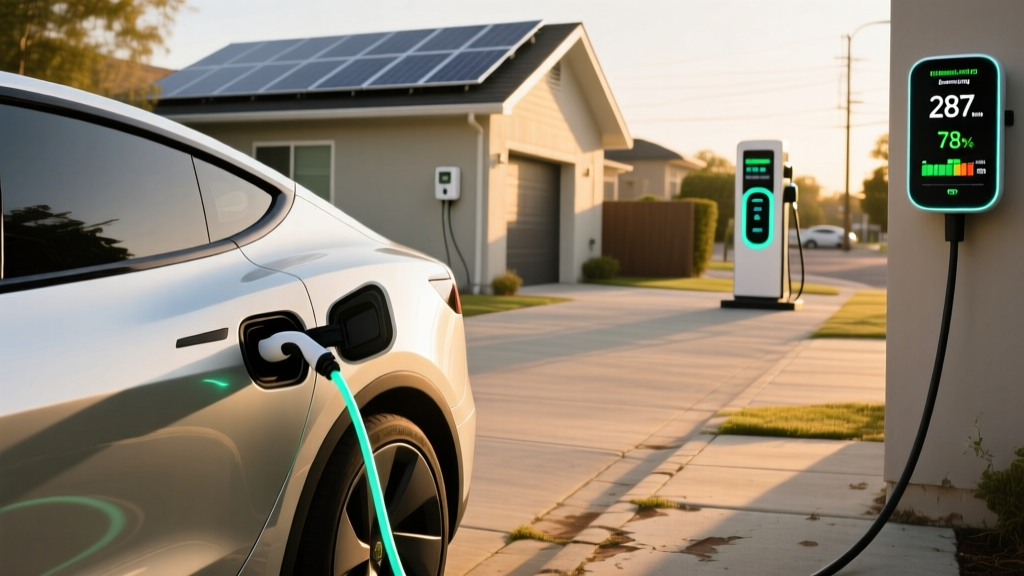
How long your charge "lasts" is only half the equation. The other half is how quickly you can replenish it. Here are the three charging levels available to 2026 EV owners:
| Level | Power (kW) | Miles Added per Hour | Typical Use Case | 10–80% Time (75 kWh battery) |
|---|---|---|---|---|
| Level 1 (120V household) | 1.0–1.4 kW | 3–5 mi/hr | Emergency/overnight top-up | ~45–50 hours |
| Level 2 (240V home/public) | 7.2–19.2 kW | 25–60 mi/hr | Daily home charging, workplace | ~4–8 hours |
| DC Fast Charge (public) | 50–350 kW | 150–1,000+ mi/hr (peak) | Road trips, highway corridors | ~15–35 minutes |
Critical nuance on DC fast charging: Peak kW ratings are not sustained. A vehicle that advertises "250 kW peak" may only sustain that rate between 10–30% State of Charge (SoC), then taper to 150 kW, then 80 kW, and finally under 40 kW above 80%. This is why manufacturers quote 10–80% times rather than 0–100%. Charging from 80–100% on a DC fast charger can take as long as the first 80% due to this taper. For battery health and time efficiency, most EV owners fast-charge only to 80% on road trips.
Connector Compatibility in 2026
The industry has largely standardized on NACS (North American Charging Standard) — Tesla's connector — which is now used by Ford, GM, Rivian, Hyundai, Kia, BMW, and most major automakers on 2026 models. CCS1 is still found on some older vehicles and Volkswagen ID.4 models. CHAdeMO is effectively discontinued for new vehicles. Adapters are available for cross-compatibility (e.g., CCS-to-NACS adapters from Lectron and A2Z).
Total Cost of Ownership: What You'll Actually Spend
How long a charge lasts directly impacts your wallet. Let's model a realistic 5-year ownership scenario comparing a 2026 Tesla Model Y Long Range, a Toyota Camry (gas), and a Toyota RAV4 Hybrid, assuming 15,000 miles/year and home charging access.
| Cost Category (5 Years / 75,000 mi) | 2026 Tesla Model Y LR ($44,990 MSRP) | 2026 Toyota Camry SE ($30,000 MSRP) | 2026 RAV4 Hybrid XLE ($34,000 MSRP) |
|---|---|---|---|
| Purchase price (after incentives) | ~$37,490 (est. $7,500 §30D credit) | $30,000 | $34,000 |
| Fuel/energy cost | $2,100 (home, $0.14/kWh, 3.5 mi/kWh) | $9,450 ($3.50/gal, 28 MPG avg) | $6,560 ($3.50/gal, 40 MPG) |
| Maintenance | ~$1,200 (tire rotation, cabin filter, wipers) | ~$3,500 (oil changes, brakes, filters) | ~$3,000 |
| Insurance (avg) | ~$11,500 ($2,300/yr) | ~$7,500 ($1,500/yr) | ~$8,000 ($1,600/yr) |
| Estimated 5-yr depreciation | ~$18,000 | ~$12,000 | ~$13,000 |
| Total 5-Year Cost | ~$70,290 | ~$62,450 | ~$64,560 |
Note: §30D federal tax credit eligibility depends on MSRP caps (under $55,000 for sedans, $80,000 for SUVs/trucks), buyer income limits ($150K single / $300K joint), and battery critical-mineral sourcing requirements. Check current rules at IRS.gov. Point-of-sale transfer is available from participating dealers.
The EV wins on fuel and maintenance but loses on insurance and depreciation in this scenario. The breakeven point vs. a gas car typically arrives around year 6–7 for high-mileage drivers, or sooner if electricity rates are low and gas prices rise.
Common Misconceptions About EV Charge and Range
| Myth | Fact |
|---|---|
| "EV batteries need replacing every few years like phone batteries." | EV batteries use sophisticated thermal management and are warrantied for 8–10 years. Real-world data shows ~90% capacity retention at 100K miles. |
| "You'll be stranded if you run out of charge." | EV navigation systems (Tesla, Hyundai, Ford) route through chargers and warn you well in advance. Roadside assistance and mobile charging services exist in most metro areas. |
| "Charging takes too long for road trips." | A 10–80% DC fast charge takes 15–30 minutes on 2026 vehicles — roughly the time for a restroom break and snack. Plan stops around 200-mile intervals. |
| "You need a special electrical panel to own an EV." | Most homes with a 200-amp panel can support a Level 2 (40–48 amp) charger. A panel upgrade ($1,500–$3,500) is needed only in older homes with 100-amp service. Always consult a licensed electrician. |
| "EVs are worse in cold weather." | Range drops 20–40% in extreme cold, but EVs start reliably (no cold-crank issues), and preconditioning while plugged in warms the battery and cabin before departure using grid power, not battery energy. |
| "Public charging is always broken." | Reliability varies by network. Tesla Superchargers consistently report 99%+ uptime. Electrify America and EVgo have improved to ~90–95% uptime in 2026, but CCS connector issues on older vehicles remain a friction point. |
Decision Framework: Is an EV Right for Your Driving Pattern?
Choose a Battery Electric Vehicle (BEV) if:
- You have access to home charging (garage, driveway, or dedicated parking spot with a 240V outlet).
- Your daily commute is under 80 miles round trip.
- You take road trips of 300+ miles fewer than 5 times per year (manageable with 1–2 DC fast-charge stops).
- You want to minimize maintenance costs and fuel spending.
- You qualify for the §30D tax credit, reducing effective purchase price by up to $7,500.
Choose a Plug-In Hybrid (PHEV) if:
- You lack reliable home or workplace charging access.
- Your commute is 25–40 miles (covered by PHEV electric-only range of 25–50 miles on models like the Toyota RAV4 Prime or Jeep Wrangler 4xe).
- You frequently drive 400+ mile road trips and don't want to plan charging stops.
- You live in an area with sparse DC fast-charging infrastructure.
Stick with a Hybrid (HEV) or Gas Car if:
- You live in an apartment with no charging access and no workplace charging.
- You regularly tow heavy loads (trailers, boats) exceeding 3,500 lbs, where EV range drops dramatically.
- You drive 300+ highway miles multiple times per week in extreme cold (below 10°F).
- Your budget is under $28,000 and you need the lowest possible upfront cost (used gas/HEV market).
First-Time EV Buyer Checklist: What to Know Before You Buy
- Audit your charging access. Can you install a Level 2 charger at home? Budget $500–$2,000 for the charger unit and $800–$2,500 for electrician installation (permit included). If your panel needs upgrading, add $1,500–$3,500.
- Map your real driving pattern. Track your actual weekly mileage for two weeks. Most Americans drive 30–40 miles/day — well within any 2026 EV's range.
- Check §30D eligibility before committing. Confirm the vehicle's MSRP is under the cap, your AGI is within limits, and the battery meets critical-mineral and component sourcing requirements. Use the IRS portal and verify with your tax professional.
- Test the charging network on your common routes. Download the PlugShare or A Better Routeplanner app and simulate a road trip you take regularly. Are there reliable DC fast chargers every 150–200 miles?
- Factor in insurance costs. EVs typically cost 15–30% more to insure than comparable gas cars due to higher repair costs and parts pricing. Get quotes before purchasing.
- Understand the charge curve. Don't plan road trips around peak kW numbers. Look at 10–80% charge times and average sustained kW — a car that sustains 180 kW average will outperform one that peaks at 250 kW but tapers quickly.
Frequently Asked Questions
Does an EV lose charge while parked?
Minimally. Modern EVs lose roughly 1–3% of State of Charge per week while parked (known as "vampire drain"), primarily from battery management systems and connected features. Over a two-week vacation, expect to return to your car with 95–98% of the charge you left it with. Disabling sentry mode, cabin overheat protection, and third-party app polling reduces this loss.
How long does it take to charge an EV at home overnight?
On a Level 2 home charger (typically 7.7–11.5 kW), a 75 kWh battery charges from 20% to 80% in approximately 5–7 hours — easily replenishing a day's driving overnight. Most EV owners plug in when they get home and wake up to a full battery every morning, eliminating gas station visits entirely.
Is it bad to charge an EV to 100% every day?
For NMC/NCA batteries (most EVs), daily charging to 100% accelerates degradation slightly. Most manufacturers recommend setting a daily charge limit of 80–90% and charging to 100% only before long trips. LFP batteries (found in the Tesla Model 3 RWD, Ford Mustang Mach-E Select) can be charged to 100% daily without significant degradation — in fact, LFP chemistry benefits from regular full charges for accurate SoC calibration.
What happens if I run out of charge on the road?
Unlike a gas car that can accept a fuel can, an empty EV requires a tow to the nearest charger or a mobile charging service. However, 2026 EV navigation systems proactively route through chargers and warn you 50+ miles before projected depletion. AAA and other roadside services now offer mobile DC charging in major metro areas. The best practice: treat 10% SoC as your "reserve" and plan stops before reaching it.
How much does it cost to charge an EV vs. filling a gas tank?
Home charging at the US average of $0.14/kWh costs roughly $10–$14 for a full charge (75–85 kWh battery), yielding 250–320 miles. That's equivalent to $3.20–$4.50 per "gallon." Public DC fast charging costs $0.30–$0.50/kWh, making a full charge $22–$42 — closer to gas-car fueling costs. The biggest savings come from home charging.
Do EV batteries degrade in hot climates?
Extreme heat (sustained 100°F+) accelerates battery degradation more than cold, but 2026 EVs use active liquid cooling to keep battery cells in the optimal 68–95°F range even in desert conditions. Data from Recurrent Auto shows only marginally higher degradation in Arizona vs. Oregon. Preconditioning and garage parking help further.
For official range and efficiency data, consult fueleconomy.gov. For current federal tax credit rules, visit IRS.gov §30D. Safety ratings available at NHTSA.gov and IIHS.org.