If you're researching a Tesla purchase in 2026, one question dominates the decision: how long does it take to charge a Tesla? The answer depends on which model you buy, the battery chemistry inside it, and whether you're topping up at a Supercharger or plugged in at home. Below, we break down every current Tesla model's charging profile, real-world range, pricing, and ownership economics so you know exactly what to expect before you sign the paperwork.
Tesla Charging Speeds Across the 2026 Lineup
Tesla's charging architecture varies significantly by model and battery pack. The key distinction is between kW (kilowatts), which measures charging power or speed, and kWh (kilowatt-hours), which measures the battery's total energy capacity. A higher kW rating means faster charging; a higher kWh capacity means more range.
| Spec | Model 3 RWD | Model 3 LR AWD | Model Y LR AWD | Model S LR | Model X LR | Cybertruck AWD |
|---|---|---|---|---|---|---|
| Battery (usable kWh) | 57.5 (LFP) | 75 (NMC) | 75 (NMC) | 95 (NMC) | 95 (NMC) | 123 (NMC) |
| EPA Range | 272 mi | 341 mi | 320 mi | 402 mi | 335 mi | 340 mi |
| Max DC Fast Charge | 170 kW | 250 kW | 250 kW | 250 kW | 250 kW | 350 kW (800V) |
| 10–80% DCFC Time | ~28 min | ~25 min | ~25 min | ~30 min | ~32 min | ~18 min |
| Level 2 Home Rate | 11.5 kW / 37 mi/hr | 11.5 kW / 44 mi/hr | 11.5 kW / 44 mi/hr | 11.5 kW / 52 mi/hr | 11.5 kW / 40 mi/hr | 11.5 kW / 44 mi/hr |
| Efficiency (MPGe) | 132 combined | 131 combined | 122 combined | 120 combined | 105 combined | 87 combined |
Sources: fueleconomy.gov, Tesla spec sheets.
Understanding Tesla's Charging Architecture
DC Fast Charging (Supercharger Network)
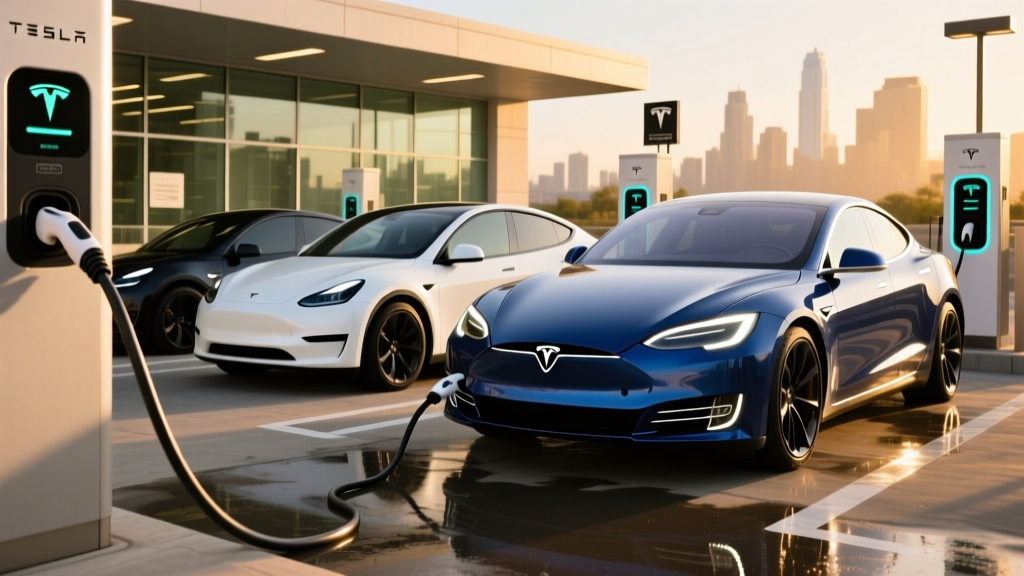
Tesla's Supercharger network remains the gold standard for public EV charging reliability. As of 2026, Tesla operates over 6,500 Supercharger stations in North America. Most V3 Superchargers deliver up to 250 kW, while newer V4 posts support up to 350 kW — currently accessible at full speed only by the Cybertruck's 800-voltage architecture.
Here's how the charge curve actually works: peak kW is only sustained between roughly 10–50% state of charge (SoC). Above 60%, the rate tapers to protect battery health. Above 80%, charging slows dramatically — going from 80% to 100% on DC fast charge can take as long as the 10–80% session. This is why Tesla (and every other automaker) quotes 10–80% times rather than 0–100%.
Preconditioning matters. When you navigate to a Supercharger using the Tesla's built-in navigation, the car automatically warms or cools the battery to the optimal temperature for fast charging. Arriving at a Supercharger without preconditioning — especially in cold weather — can add 10–15 minutes to your charging session as the battery limits charge rate until it reaches operating temperature.
Home Level 2 Charging
Most Tesla owners do the vast majority of their charging at home on a Level 2 (240V) circuit. Tesla's Wall Connector delivers up to 11.5 kW (48 amps) when connected to a 60-amp circuit. This adds roughly 37–52 miles of range per hour depending on the model's efficiency, meaning any Tesla can fully recharge overnight from near-empty.
A standard Level 1 (120V) outlet using Tesla's Mobile Connector adds only 3–5 miles of range per hour — adequate only for low-mileage commuters or as a backup option. If your daily drive is under 30 miles round-trip, Level 1 can technically suffice, but Level 2 is strongly recommended for battery health and convenience.
| Charging Level | Voltage | Max Power (kW) | Miles of Range/Hour | Best For |
|---|---|---|---|---|
| Level 1 (Mobile Connector) | 120V | 1.4–1.9 kW | 3–5 mi/hr | Emergency / low-mileage |
| Level 2 (Wall Connector) | 240V | 11.5 kW | 37–52 mi/hr | Daily home charging |
| DC Fast (V3 Supercharger) | 400V+ | 250 kW | ~1,000+ mi/hr (peak) | Road trips |
| DC Fast (V4 Supercharger) | 800V | 350 kW | ~1,300+ mi/hr (peak) | Cybertruck / future models |
LFP vs. NMC: How Battery Chemistry Affects Your Charging
Tesla uses two distinct battery chemistries across its 2026 lineup, and the choice has real implications for how you charge and how long your battery lasts:
| Factor | LFP (Lithium Iron Phosphate) | NMC (Nickel Manganese Cobalt) |
|---|---|---|
| Found In | Model 3 RWD | Model 3 LR, Model Y LR, Model S, Model X, Cybertruck |
| Energy Density | Lower (smaller packs, less range) | Higher (more range per kg) |
| Daily Charge Limit | 100% OK daily | 80% recommended daily |
| Cycle Life | 3,000+ cycles | 1,000–2,000 cycles |
| Cold-Weather Performance | More range loss in cold | Better cold-weather retention |
| Max DC Charge Speed | 170 kW | 250–350 kW |
What this means practically: If you buy a Model 3 RWD with LFP, Tesla recommends charging to 100% regularly — this helps the battery management system calibrate and actually prolongs pack life. With NMC models, you should set your daily charge limit to 80% and only charge to 100% before long road trips. LFP charges slower on DC fast chargers but offers superior long-term durability.
2026 Tesla Pricing, Trims, and Federal Tax Credit Eligibility
| Model / Trim | Base MSRP | Est. §30D Credit | Effective Price* | MSRP Cap OK? |
|---|---|---|---|---|
| Model 3 RWD | $38,990 | Up to $7,500 | ~$31,490 | ✓ Yes |
| Model 3 Long Range AWD | $45,990 | Up to $7,500 | ~$38,490 | ✓ Yes |
| Model Y Long Range AWD | $46,990 | Up to $7,500 | ~$39,490 | ✓ Yes |
| Model S Long Range | $79,990 | $0 (over MSRP cap) | $79,990 | ✗ No ($55K sedan cap) |
| Model X Long Range | $84,990 | $0 (over MSRP cap) | $84,990 | ✗ No ($80K SUV cap) |
| Cybertruck AWD | $79,990 | Up to $7,500 | ~$72,490 | ✓ Yes ($80K truck cap) |
*Effective price assumes full §30D credit eligibility. Actual credit depends on battery component sourcing, critical minerals requirements, and buyer income. Source: IRS §30D Clean Vehicle Credit.
- Income caps: Modified AGI ≤ $150,000 (single), $225,000 (head of household), $300,000 (joint)
- MSRP caps: ≤ $55,000 for sedans; ≤ $80,000 for SUVs, vans, and trucks
- Battery sourcing: Increasing percentages of battery components must be manufactured/assembled in North America, and critical minerals must be sourced from the U.S. or FTA partners — these thresholds tighten annually
- Point-of-sale transfer: Eligible buyers can apply the credit as an upfront discount at purchase rather than waiting to claim it on their tax return
- Final assembly: Vehicle must undergo final assembly in North America (all U.S.-built Teslas qualify)
Important: The Model S exceeds the $55,000 sedan MSRP cap and the Model X exceeds the $80,000 SUV cap, making both ineligible for the federal credit regardless of your income. The Model 3, Model Y, and Cybertruck remain eligible if you meet income and sourcing requirements. Always verify current eligibility at fueleconomy.gov before purchasing, as battery-sourcing rules shift periodically.
Performance, Efficiency, and Practicality by Model
Model 3 (RWD and Long Range AWD)
The refreshed Model 3 "Highland" continues into 2026 with a quieter cabin, improved suspension, and a rear touchscreen for passengers. The RWD variant delivers 272 miles EPA, 283 hp, and a 5.8-second 0–60 mph time. The Long Range AWD bumps output to 346 hp, 4.2-second 0–60, and 341 miles EPA. Cargo space is 23 cu ft (trunk + frunk combined), and rear legroom measures a tight 35.3 inches — adequate for adults on shorter trips but snug for tall passengers on long hauls. Efficiency leads the lineup at 132 MPGe combined (25 kWh/100mi) for the RWD.
Model Y (Long Range AWD)
The best-selling EV in America for good reason. The 2026 Model Y Long Range delivers 320 miles EPA, 384 hp, and a 4.8-second 0–60. Where it shines is practicality: 76 cu ft of cargo volume with rear seats folded (30 cu ft behind the second row) and 40.5 inches of rear legroom. Efficiency is 122 MPGe combined (28 kWh/100mi). The Juniper refresh brought a front light bar, ventilated front seats, and a slightly softer ride.
Model S and Model X (Long Range)
The flagship sedan and SUV continue with 402 and 335 miles EPA respectively, dual-motor AWD, and 670 hp in Long Range guise (0–60 in 3.1 seconds for the Model S). The Model S offers 28 cu ft of cargo with a usable frunk; the Model X provides 88 cu ft with seats folded and optional third row. Both remain ineligible for the federal tax credit due to MSRP caps, which limits their value proposition against newer competitors.
Cybertruck (AWD)
The Cybertruck's 800-volt architecture enables 350 kW peak DC charging at V4 Superchargers, making it the fastest-charging Tesla at roughly 18 minutes 10–80%. The dual-motor AWD delivers 600 hp, 3.9-second 0–60, and 340 miles EPA. The 6-foot bed with powered tonneau and 2,500-lb payload make it functional as a work truck, though its polarizing design and 87 MPGe efficiency (the least efficient Tesla) are trade-offs. At $79,990, it falls under the $80,000 truck MSRP cap and can qualify for the full $7,500 credit.
Driver Assistance, Tech, and Notable Drawbacks
All 2026 Teslas include basic Autopilot (adaptive cruise control, lane centering, automatic emergency braking). The optional FSD (Supervised) package ($8,000 one-time or $99/month) adds traffic light/stop sign recognition, autosteer on city streets, and automatic lane changes. FSD has improved substantially but still requires active supervision — expect occasional phantom braking, inconsistent lane selection in construction zones, and difficulty with unmapped roads.
The infotainment system runs on a central touchscreen (15.4" in Model 3/Y, 17" in Model S/X) with no Apple CarPlay or Android Auto — Tesla's proprietary system handles navigation, media, and vehicle controls. Over-the-air updates add features regularly, and the built-in dashcam and Sentry Mode are standout security features competitors still don't match.
- No Apple CarPlay / Android Auto — you're locked into Tesla's ecosystem
- Model 3 rear seat is tight for adults on long trips (35.3" legroom)
- FSD (Supervised) is not autonomous — driver liability remains with you
- Service center wait times in some metro areas can stretch to several weeks
- No physical instrument cluster — all info is on the center screen
- Insurance premiums run 15–30% higher than comparable gas vehicles in most states
Warranty Coverage and Battery Longevity
Tesla's warranty structure is straightforward:
- Basic vehicle warranty: 4 years / 50,000 miles (all models)
- Battery and drive unit warranty: 8 years / 100,000 miles (Model 3 RWD); 8 years / 120,000 miles (Model 3 LR, Model Y, Model S, Model X, Cybertruck)
- Capacity retention threshold: Tesla warrants that the battery will retain at least 70% of original capacity during the warranty period. If degradation drops below 70%, Tesla will repair or replace the pack.
In practice, Tesla battery degradation is modest. Data aggregated from fleet telemetry shows most NMC packs retain ~90% capacity at 100,000 miles, with the steepest degradation occurring in the first 20,000 miles (roughly 3–5%) before leveling off. LFP packs in the Model 3 RWD show similar or slightly better longevity curves, though they are more sensitive to extreme cold.
Out-of-warranty battery replacement costs range from $12,000–$16,000 for a Model 3/Y pack to $18,000–$22,000 for Model S/X — a figure worth factoring into long-term ownership plans if you intend to keep the vehicle past 150,000 miles.
Pros, Cons, and Verdict: Which Tesla Should You Buy?
Pros
- Supercharger network — most reliable DC fast-charging ecosystem in North America
- Industry-leading efficiency (kWh/100mi) across the lineup
- Over-the-air updates continuously add features
- Strong resale value relative to most EV competitors
- Model 3 and Model Y eligible for up to $7,500 federal tax credit
- Excellent cargo versatility (Model Y, Model X, Cybertruck)
- Class-leading charging speed on Cybertruck (800V / 350 kW)
Cons
- No Apple CarPlay or Android Auto
- Model S and Model X ineligible for federal tax credit (MSRP cap)
- Service center capacity still lags behind sales volume in some regions
- FSD costs $8,000 and still requires full driver attention
- Insurance costs significantly higher than gas equivalents
- LFP battery (Model 3 RWD) charges slower and loses more range in cold
- Minimal physical controls — everything goes through the touchscreen
Choose Your Tesla
- Choose Model 3 RWD if: You want the most affordable entry point, commute under 40 miles daily, and can charge at home. LFP longevity is a plus if you plan to keep it 8+ years.
- Choose Model 3 Long Range if: You take regular road trips, need AWD for snow, and want the best blend of range (341 mi), performance, and price with tax credit eligibility.
- Choose Model Y Long Range if: You need family-friendly cargo space, rear-seat comfort for kids or car seats, and the practicality of a crossover with 320 miles of range.
- Choose Cybertruck if: You need a truck bed, want the fastest Tesla charging speeds, and your budget supports a ~$72K effective price after the credit.
- Choose Model S/X if: You prioritize luxury and performance over value, don't need the federal credit, and want maximum range (Model S at 402 mi).
Frequently Asked Questions
How long does it take to charge a Tesla at a Supercharger?
At a V3 Supercharger (250 kW), most Tesla models charge from 10–80% in approximately 25–30 minutes. The Cybertruck, with its 800V architecture, can reach 80% in about 18 minutes at a V4 Supercharger delivering 350 kW. The Model 3 RWD with its LFP battery peaks at 170 kW, taking roughly 28 minutes for the same 10–80% session. Remember that charging slows significantly above 80% — plan to unplug at 80% on road trips for the best time efficiency.
How long does it take to charge a Tesla at home?
On a Level 2 home charger (Tesla Wall Connector at 11.5 kW), a full charge from near-empty takes 5–10 hours depending on the model's battery size. The Model 3 RWD (57.5 kWh) fully charges in about 5 hours; the Cybertruck (123 kWh) takes roughly 10.5 hours. Since most owners arrive home with 40–60% battery remaining, an overnight charge easily replenishes daily driving. On a standard 120V outlet (Level 1), expect 24–72 hours for a full charge — impractical as a primary charging method.
Does the Tesla Model Y qualify for the $7,500 federal tax credit?
The 2026 Model Y Long Range AWD at $46,990 MSRP falls under the $80,000 SUV/truck cap and is eligible for up to $7,500 under IRS §30D — provided you meet income limits (≤$300K joint, $150K single) and the vehicle's battery meets the current-year critical minerals and component sourcing thresholds. These sourcing requirements tighten annually, so verify eligibility at fueleconomy.gov at the time of purchase. The credit can be applied as a point-of-sale discount.
What is the real-world range of a Tesla on a highway road trip?
Expect 10–15% less than the EPA sticker at sustained 75 mph highway speeds, and 20–30% less in freezing temperatures due to cabin heating and battery thermal management demands. A Model Y Long Range rated at 320 miles EPA typically delivers 250–280 miles on a warm-weather highway trip and 220–250 miles in winter conditions. Using seat heaters instead of cabin heat and driving at 65–70 mph can recover 15–20 miles of range.
Is Tesla still worth buying versus competitors in 2026?
For most buyers, the Model 3 and Model Y remain the default EV recommendations — the Supercharger network, efficiency, and software integration are difficult to beat. However, the Hyundai Ioniq 5 and Kia EV6 now match Tesla on DC charging speed (and exceed it on 800V chargers), offer CarPlay, and provide comparable range. The Ford Mustang Mach-E and Chevrolet Equinox EV are strong Model Y alternatives if you prefer a traditional dealer service network. Tesla's advantage remains strongest for road-trippers who rely on the Supercharger network's reliability.
How much does home charging cost compared to gas?
At the U.S. average residential electricity rate of ~$0.16/kWh, charging a Model Y (75 kWh battery) from empty to full costs roughly $12 for 320 miles — about $0.038 per mile. A comparable gas SUV getting 25 MPG at $3.30/gallon costs $0.132 per mile. Over 15,000 miles per year, that's ~$570 in electricity vs. ~$1,980 in gas — a savings of roughly $1,400 annually. Public DC fast charging at $0.35–$0.48/kWh narrows this gap, which is why home charging access is the single biggest factor in EV ownership satisfaction.