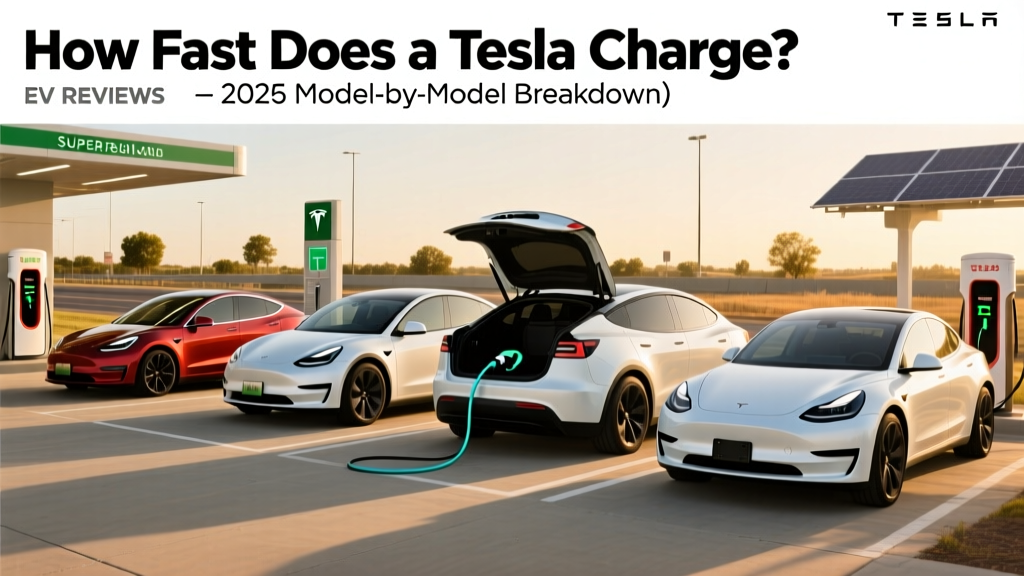
If you're researching an electric vehicle, one question dominates the decision: how fast does a Tesla charge? The answer depends heavily on which model you drive, which battery chemistry sits under the floor, and whether you're plugged into a V4 Supercharger, a third-party DC fast charger, or a home Level 2 wall connector. In this guide, we break down real charging speeds across the entire 2026 Tesla lineup — not just the marketing peak-kW number, but the sustained charge curve, the 10-80% stopwatch time, and the miles-per-hour you'll actually see at home.
Tesla's Charging Hardware: What Changed in 2026
Tesla's North American Charging Standard (NACS) connector is now the de facto EV plug in the United States, adopted by Ford, GM, Rivian, Hyundai, and dozens of other automakers. That means Tesla owners enjoy access not only to the Supercharger network (now exceeding 6,000 stalls in North America) but also priority integration at an expanding roster of third-party stations.
The rollout of V4 Supercharger cabinets — capable of delivering up to 350 kW to compatible vehicles — has accelerated through 2025 and 2026. However, not every Tesla can accept that full power envelope. The vehicle-side charge architecture (battery chemistry, thermal management, and onboard charge controller) determines the actual peak and sustained rate. Let's go model by model.
2026 Tesla Charging Speeds: Full Spec Table
| Spec | Model 3 LR | Model Y LR | Model S | Model X | Cybertruck AWD |
|---|---|---|---|---|---|
| Max DC Fast Charge | 250 kW | 250 kW | 250 kW | 250 kW | 250 kW (350 kW capable) |
| 10–80% Time (est.) | ~25 min | ~27 min | ~28 min | ~30 min | ~22 min (V4 stall) |
| Battery Usable (kWh) | ~75 kWh (NMC) | ~75 kWh (NMC) | ~95 kWh (NMC) | ~95 kWh (NMC) | ~123 kWh (NMC) |
| Level 2 Home Rate | 11.5 kW (44 mi/hr) | 11.5 kW (42 mi/hr) | 11.5 kW (40 mi/hr) | 11.5 kW (38 mi/hr) | 11.5 kW (37 mi/hr) |
| Level 1 (120V) Rate | ~1 kW (3-4 mi/hr) | ~1 kW (3-4 mi/hr) | ~1 kW (3 mi/hr) | ~1 kW (3 mi/hr) | ~1 kW (2-3 mi/hr) |
| EPA Range | 363 mi | 320 mi | 402 mi | 335 mi | 340 mi |
| Efficiency (MPGe) | 132 MPGe | 122 MPGe | 120 MPGe | 109 MPGe | 79 MPGe |
| EPA kWh/100 mi | 25 | 28 | 28 | 31 | 48 |
kW (kilowatts) measures power — how fast energy flows into the battery during charging. Think of it as the flow rate of a hose.
kWh (kilowatt-hours) measures energy capacity — how much total energy the battery stores. Think of it as the size of the bucket.
A 250 kW charger fills a 75 kWh battery faster than a 50 kW charger — but the battery size (kWh) determines how much total energy you need to put in.
How Fast Does a Tesla Charge on the Road? DC Fast-Charging Deep Dive
The headline number — 250 kW — applies across most of Tesla's 2026 fleet at V3 Superchargers. But peak kW is only part of the story. EV batteries follow a charge curve: power ramps up quickly from low state of charge (SoC), holds near peak through roughly 50-60% SoC, then tapers significantly above 80% to protect battery longevity.
Model 3 Long Range & Model Y Long Range
Both vehicles share Tesla's NMC (nickel manganese cobalt) battery pack at approximately 75 kWh usable. On a V3 Supercharger, you'll see the charge rate climb to 250 kW within the first few minutes (assuming you've preconditioned the battery via the in-car navigation routing). The rate holds above 200 kW through roughly 55% SoC, then drops to 100-120 kW by 70%, and falls below 50 kW past 85%.
Real-world 10-80% time: approximately 25 minutes for the Model 3, 27 minutes for the Model Y. The Model Y's slightly longer time reflects its heavier curb weight and marginally higher energy consumption, even with a similar pack.
Model S and Model X
The larger ~95 kWh NMC pack in the Model S and Model X means more total energy to replenish. While peak rate is the same 250 kW, the larger battery extends the 10-80% window to roughly 28-30 minutes. For road-trippers, the Model S's superior efficiency (28 kWh/100 mi vs. the Model X's 31) means each minute of charging buys slightly more miles of range.
Cybertruck All-Wheel Drive
The Cybertruck's ~123 kWh pack is the largest in Tesla's lineup, but its 800V-capable architecture allows it to accept higher power at V4 Supercharger stalls. Tesla has confirmed 350 kW capability on equipped V4 cabinets, though availability of V4 stalls remains limited in early 2026. On a V4 stall, expect 10-80% in roughly 22 minutes. On a standard V3 (250 kW cap), expect closer to 32-35 minutes due to the larger battery volume.
Always navigate to a Supercharger using the car's built-in routing. This triggers battery preconditioning — warming or cooling the pack to the optimal temperature for maximum charge acceptance. Arriving at a charger without preconditioning can add 5-10 minutes to your session, especially in cold weather (below 40°F) or extreme heat (above 95°F).
Home Charging: Level 2 Speeds for Every Tesla
Most Tesla owners do the majority of their charging at home. Tesla's Wall Connector, hardwired to a 60-amp circuit (48-amp continuous draw), delivers up to 11.5 kW to all current models. Here's what that translates to in practical terms:
| Charging Level | Power (kW) | Model 3 (mi/hr) | Model Y (mi/hr) | Model S (mi/hr) | Cybertruck (mi/hr) |
|---|---|---|---|---|---|
| Level 1 (120V outlet) | ~1 kW | 3-4 | 3-4 | 3 | 2-3 |
| Level 2 (240V, 32A Mobile Connector) | ~7.7 kW | 30 | 28 | 27 | 24 |
| Level 2 (240V, 48A Wall Connector) | 11.5 kW | 44 | 42 | 40 | 37 |
An overnight session of 8-10 hours on a Wall Connector adds 320-440 miles of range to a Model 3 — effectively a full recharge for most daily driving patterns. The Cybertruck, with its higher consumption (48 kWh/100 mi), gains fewer miles per hour but still recovers a full pack overnight.
Home Installation Reality Check
Budget $500-$1,500 for a straightforward Wall Connector installation if your electrical panel has spare capacity and the run from panel to garage is short. Costs climb to $2,000-$4,000+ if you need a panel upgrade (common in older homes with 100-amp service), a long conduit run, or trenching to a detached garage. Always get a quote from a licensed electrician — never DIY high-voltage work.
Real-World Range vs. EPA Stickers
Model 3 Long Range: EPA 363 mi → Expect ~300-320 mi highway (70-75 mph), ~260-280 mi in cold weather (below 30°F)
Model Y Long Range: EPA 320 mi → Expect ~265-285 mi highway, ~230-250 mi in cold weather
Model S: EPA 402 mi → Expect ~340-360 mi highway, ~300-320 mi in cold weather
Cybertruck AWD: EPA 340 mi → Expect ~280-300 mi highway, ~240-260 mi in cold weather
Highway driving at sustained speeds above 70 mph reduces range 10-15% vs. EPA. Cold weather (below 30°F) can reduce range 15-30% due to battery resistance and cabin heating demands.
Tesla's EPA figures are among the more realistic in the industry — the company's heat pump (standard on all 2026 models) helps mitigate cold-weather losses compared to older EVs using resistive heating. Still, no EPA sticker tells the full story. The Model 3 Long Range's 363-mile rating assumes a mix of city and highway driving at moderate temperatures. On a pure 75-mph highway run in winter, plan for 260-280 usable miles before you'll want to stop.
2026 Tesla Pricing, Trims & Federal Tax Credit
| Model / Trim | Base MSRP | Federal Tax Credit (§30D) | Effective Price* |
|---|---|---|---|
| Model 3 RWD | $38,990 | Up to $7,500 | ~$31,490 |
| Model 3 Long Range AWD | $42,490 | Up to $7,500 | ~$34,990 |
| Model 3 Performance | $52,990 | Up to $7,500 | ~$45,490 |
| Model Y Long Range AWD | $44,990 | Up to $7,500 | ~$37,490 |
| Model Y Performance | $51,490 | Up to $7,500 | ~$43,990 |
| Model S | $79,990 | Not eligible (MSRP cap) | $79,990 |
| Model X | $84,990 | Not eligible (MSRP cap) | $84,990 |
| Cybertruck AWD | $79,990 | Not eligible (MSRP cap) | $79,990 |
*Effective price assumes full $7,500 credit eligibility. Actual credit depends on IRS §30D requirements.
Federal Tax Credit Eligibility Checklist (§30D — 2026 Rules)
- MSRP Cap: Sedans must be under $55,000; SUVs, vans, and trucks under $80,000. (Model S, X, and Cybertruck exceed these caps.)
- Buyer Income Cap: Modified adjusted gross income ≤ $150,000 (single), $225,000 (head of household), $300,000 (joint).
- Battery Sourcing: A percentage of critical minerals and battery components must be sourced from the U.S. or free-trade-agreement partners. Tesla's U.S.-built packs generally qualify, but percentages shift annually — verify at IRS.gov.
- Point-of-Sale Transfer: As of 2024, you can transfer the credit to the dealer at purchase, reducing your out-of-pocket cost immediately rather than waiting for tax filing.
- Final Assembly: Vehicle must undergo final assembly in North America. All U.S.-market Teslas qualify.
The Model 3 and Model Y remain the sweet spot for federal incentive eligibility. Consult a tax professional to confirm your personal eligibility — rules are subject to change. For current eligible models, check the EPA/fueleconomy.gov tax credit tracker.
Performance, Space & Technology
Acceleration & Drivetrain
Even the "base" Model 3 RWD posts a 5.8-second 0-60 mph time with 271 horsepower from a single rear motor. The Long Range AWD variant drops to 4.2 seconds (346 hp, dual motor). The Model 3 Performance model hits 60 in 2.9 seconds with 510 hp.
The Model Y Long Range AWD runs 4.8 seconds (384 hp), while the Model S Plaid remains one of the quickest production cars in the world at 1.99 seconds and 1,020 hp (tri-motor AWD).
The Cybertruck AWD delivers 4.1 seconds to 60 mph with 600 hp; the Cyberbeast variant drops to 2.6 seconds with 845 hp.
Cargo & Passenger Space
| Model | Rear Legroom | Cargo (behind 2nd row) | Max Cargo (seats folded) | Frunk |
|---|---|---|---|---|
| Model 3 | 34.9 in | 23 cu ft | N/A (sedan trunk) | 3.1 cu ft |
| Model Y | 41.6 in | 30.2 cu ft | 76.2 cu ft | 4.1 cu ft |
| Model S | 35.4 in | 28 cu ft | 79 cu ft (hatchback) | 5.3 cu ft |
| Model X | 37.1 in | 14.4 cu ft (6-seat) | 85.1 cu ft | 6.6 cu ft |
| Cybertruck | 38.0 in | 34.2 cu ft (bed) | 67 cu ft (w/ tonneau) | 7.1 cu ft |
Standout Tech & Drawbacks
Tech highlights: Tesla's 15.4-inch center touchscreen (Model 3/Y) or 17-inch display (Model S/X) runs a responsive, frequently updated operating system. Over-the-air updates add features continuously. The available FSD (Supervised) system remains a SAE Level 2 driver-assistance feature — it requires constant driver attention and hands-on-wheel supervision. It is not autonomous driving. Autopilot (basic adaptive cruise + lane centering) comes standard; FSD (Supervised) is an $8,000 add-on or $99/month subscription.
Notable drawbacks: Tesla's minimalist interior means no physical buttons for climate, mirror adjustment, or glovebox — everything routes through the touchscreen, which frustrates some drivers. Build quality has improved but still draws occasional panel-gap complaints. Insurance premiums on Teslas tend to run 15-30% higher than comparable non-EV sedans due to repair costs.
Warranty Coverage
| Coverage | Model 3 / Model Y | Model S / Model X | Cybertruck |
|---|---|---|---|
| Basic Vehicle | 4 yr / 50,000 mi | 4 yr / 50,000 mi | 4 yr / 50,000 mi |
| Battery & Drive Unit | 8 yr / 120,000 mi (RWD) 8 yr / 100,000 mi (LR/Perf) | 8 yr / 150,000 mi | 8 yr / 120,000 mi |
| Battery Capacity Threshold | 70% retention | 70% retention | 70% retention |
Tesla guarantees that the battery will retain at least 70% of its original capacity during the warranty period. In practice, Tesla's NMC packs have shown strong longevity — Tesla's own impact reports indicate average degradation of roughly 12-15% at 150,000 miles across the fleet. For most owners, meaningful range loss is gradual, not sudden.
Pros & Cons at a Glance
✅ Pros
- Access to the Supercharger network — the most reliable and extensive DC fast-charging network in North America
- Class-leading efficiency (Model 3: 25 kWh/100 mi)
- Strong real-world range across lineup (320-402 mi EPA)
- Over-the-air updates continuously improve the vehicle
- Model 3/Y eligible for up to $7,500 federal tax credit
- Heat pump standard — better cold-weather range retention
- Best-in-class cargo space for the class (Model Y)
❌ Cons
- Touchscreen-only controls (no physical buttons) frustrate some drivers
- FSD (Supervised) is expensive and still requires full driver attention (Level 2 only)
- Insurance premiums 15-30% higher than comparable ICE vehicles
- Model S, X, and Cybertruck exceed MSRP caps for federal tax credit
- DC fast-charge peak (250 kW) hasn't increased for most models since 2020
- Ride quality on Model 3/Y is firm — sporty but not plush
- Build quality inconsistent; panel gaps still reported
Who Should Buy a Tesla in 2026?
The commuter & daily driver: The Model 3 RWD or Long Range is the efficiency king. If your round-trip commute is under 100 miles and you can charge at home, you'll rarely visit a Supercharger. The 363-mile EPA range means charging once or twice a week at most.
The growing family: The Model Y Long Range AWD remains the best-selling EV in America for a reason. With 76.2 cu ft of max cargo, 41.6 inches of rear legroom, and available third-row seating (for small children), it handles family duty while delivering 320 miles of range. Eligible for the full $7,500 credit.
The road-tripper: The Model S offers 402 miles of EPA range and the most comfortable long-distance ride in the lineup. Supercharger coverage means you can cross the country with 20-30 minute stops every 2.5-3 hours.
The truck buyer: The Cybertruck offers unique utility with its stainless-steel exoskeleton and 11,000-lb towing capacity, but its 48 kWh/100 mi consumption means more frequent and longer charging stops. It does not qualify for the federal credit due to its MSRP.
How Tesla Charging Compares to Key Competitors
| Vehicle | Max DC kW | 10-80% Time | EPA Range | Base MSRP |
|---|---|---|---|---|
| Tesla Model 3 LR | 250 kW | ~25 min | 363 mi | $42,490 |
| Hyundai Ioniq 6 LR | 240 kW | ~18 min | 361 mi | $42,450 |
| BMW i4 eDrive40 | 205 kW | ~31 min | 307 mi | $57,900 |
| Polestar 2 LR | 205 kW | ~28 min | 320 mi | $49,900 |
The Hyundai Ioniq 6's 800V architecture gives it a faster 10-80% time (~18 min) than any current Tesla, but Tesla's Supercharger network reliability and coverage remain a significant practical advantage. Third-party charging networks (Electrify America, EVgo) have improved but still report higher downtime rates than Superchargers in J.D. Power EV ownership studies.
Frequently Asked Questions
How fast does a Tesla charge at a Supercharger?
At a V3 Supercharger (250 kW), most 2026 Teslas charge from 10-80% in approximately 25-30 minutes depending on the model. The Model 3 Long Range is quickest at roughly 25 minutes. The Cybertruck can accept up to 350 kW at V4 stalls, reducing its time to about 22 minutes, though V4 availability is still limited.
How fast does a Tesla charge at home?
Using a Tesla Wall Connector on a 48-amp, 240-volt circuit, you'll get up to 11.5 kW — translating to roughly 37-44 miles of range per hour depending on the model. A full overnight charge (8-10 hours) replenishes the battery completely for all models. On a standard 120V household outlet (Level 1), expect only 2-4 miles per hour — suitable only for emergency top-ups or very low-mileage drivers.
Does charging speed degrade over time?
The battery's maximum charge acceptance rate can decrease slightly as the battery ages and its internal resistance increases, but the effect is modest. More impactful is battery degradation reducing total capacity — if your 75 kWh pack degrades to 65 kWh, you need to put in less total energy, so sessions may actually be slightly shorter, but you'll get fewer total miles from each charge.
Can I charge a Tesla at non-Tesla chargers?
Yes. All 2026 Teslas use the NACS connector natively. You can charge at any NACS-equipped station (increasingly common as other networks adopt the standard). For CCS-equipped stations, Tesla sells a CCS adapter (~$250) that enables compatibility, though charge speeds may be limited by the adapter's throughput.
Is the $7,500 federal tax credit guaranteed for Model 3 and Model Y?
No. Eligibility under IRS §30D depends on your income (≤$150K single / $300K joint), the vehicle's MSRP (under $55K for sedans, $80K for SUVs), battery component and critical-mineral sourcing percentages, and final assembly in North America. The Model 3 and Model Y generally qualify, but sourcing requirements tighten annually. Always verify current eligibility at IRS.gov and consult a tax professional before purchasing.
What's the cheapest way to charge a Tesla?
Home charging on a Level 2 Wall Connector using off-peak electricity rates (typically overnight, 10 PM - 6 AM) is the cheapest option — averaging $0.10-$0.17 per kWh depending on your utility. That works out to roughly $0.03-$0.05 per mile for a Model 3, compared to $0.12-$0.18 per mile for a 30-MPG gasoline car at $3.50/gallon. Supercharger rates vary by location and time of day but typically run $0.25-$0.40 per kWh.