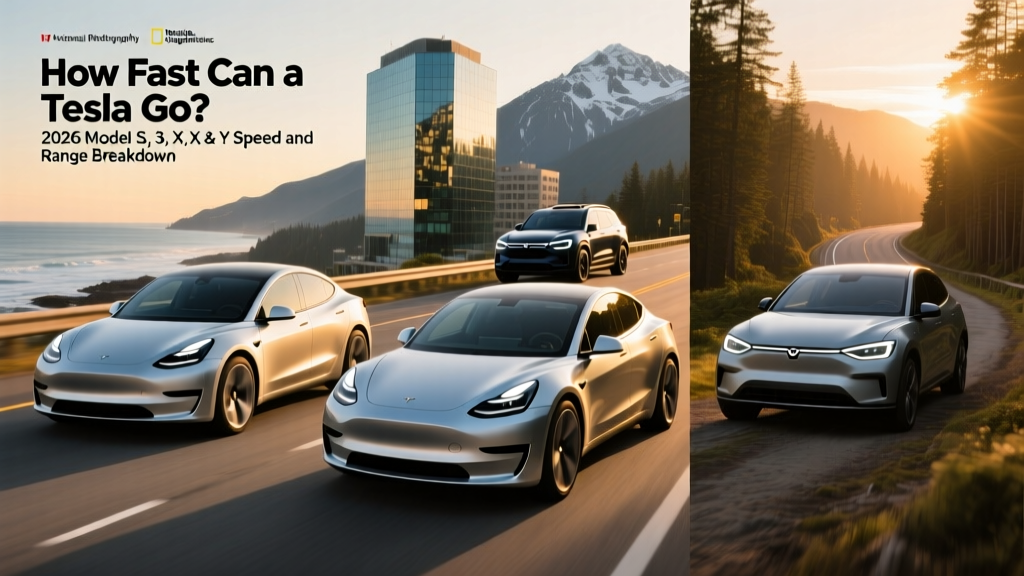
The Quick Answer: Tesla 0-60 Times Across the 2026 Lineup
When buyers ask "how fast can a Tesla go," they are usually asking two different questions: how quickly it accelerates, and what its top speed is. The answer varies enormously depending on which model and powertrain you choose. A base Model 3 Rear-Wheel Drive hits 60 mph in a respectable 5.8 seconds, while a Model S Plaid demolishes the same benchmark in 1.99 seconds — making it one of the quickest production cars ever built, regardless of powertrain type.
But straight-line speed is only part of the ownership equation. Real buyers need to know how that performance trades off against range, charging speed, cargo practicality, and price. Below, we profile every Tesla currently on sale in the U.S. for the 2026 model year with exact EPA figures, battery specs, charging curves, and federal tax credit eligibility.
2026 Tesla Model 3: The Accessible Performance Benchmark
The refreshed Model 3 (internally called "Highland") remains Tesla's volume seller and the entry point into the brand. For 2026, it is offered in three configurations: Rear-Wheel Drive, Long Range AWD, and Performance AWD.
| Spec | RWD | Long Range AWD | Performance AWD |
|---|---|---|---|
| 0-60 mph | 5.8 sec | 4.2 sec | 2.9 sec |
| Top Speed | 125 mph | 125 mph | 163 mph |
| Horsepower | 271 hp | 346 hp | 510 hp |
| Drivetrain | RWD (single motor) | AWD (dual motor) | AWD (dual motor) |
| Battery (usable) | ~57.5 kWh (LFP) | ~75 kWh (NMC) | ~75 kWh (NMC) |
| EPA Range | 272 mi | 341 mi | 315 mi |
| MPGe (combined) | 132 MPGe | 134 MPGe | 121 MPGe |
| Efficiency | 25 kWh/100mi | 25 kWh/100mi | 28 kWh/100mi |
| Base MSRP | $38,990 | $45,990 | $52,990 |
Charging Speed
The Model 3 Long Range and Performance support a peak DC fast-charge rate of 250 kW on Tesla Superchargers (NACS connector). In practice, the charge curve peaks near 250 kW only between roughly 10–30% state of charge, then tapers progressively. A 10–80% session takes approximately 25–28 minutes under optimal battery preconditioning. The RWD's LFP pack charges at a slightly lower peak of around 170 kW, making its 10–80% time closer to 30–33 minutes.
At home on a Level 2 Tesla Wall Connector (48 amps / 11.5 kW), the Long Range adds roughly 44 miles of range per hour of charging — enough to fully replenish overnight on a standard 240V circuit.
Cargo, Interior, and Tech
The Model 3 offers 23 cu ft of cargo space (rear trunk plus front trunk/frunk), which is modest for its class but adequate for two passengers' luggage on road trips. Rear legroom measures 35.2 inches. The minimalist interior routes nearly all controls through the 15.4-inch center touchscreen. Standard features include Tesla's Basic Autopilot (SAE Level 2 driver assistance — lane centering and adaptive cruise, requiring full driver attention at all times). Full Self-Driving (Supervised) remains an optional $8,000 add-on, which is also Level 2 despite its name.
2026 Tesla Model Y: The Family Crossover Speed Demon
The Model Y continues as America's best-selling EV. The 2026 "Juniper" refresh brought updated styling, improved suspension tuning, and slightly revised battery calibration. It competes directly with the Hyundai Ioniq 5, Ford Mustang Mach-E, and Kia EV6 — but none of those match its combination of cargo volume and Performance-trim acceleration.
| Spec | Long Range AWD | Performance AWD |
|---|---|---|
| 0-60 mph | 4.8 sec | 3.5 sec |
| Top Speed | 135 mph | 155 mph |
| Horsepower | 384 hp | 510 hp |
| Battery (usable) | ~75 kWh (NMC) | ~75 kWh (NMC) |
| EPA Range | 320 mi | 293 mi |
| MPGe (combined) | 123 MPGe | 115 MPGe |
| Cargo Volume | 76 cu ft (rear seats folded) / 30 cu ft (behind 2nd row) | |
| Base MSRP | $46,990 | $52,490 |
Charging Speed
Both Model Y trims peak at 250 kW on V3 Superchargers. The 10–80% charge time is approximately 27–30 minutes with battery preconditioning active (the car automatically warms the pack when you navigate to a Supercharger). Level 2 home charging at 11.5 kW adds roughly 42 miles per hour. An optional Rear-Wheel Drive variant with an LFP battery is available in limited markets at a lower price point (~$39,990) with a 260-mile EPA range and ~170 kW peak DC charging.
2026 Tesla Model S: Flagship Speed and Grand-Touring Range
The Model S is where Tesla's performance reputation was built, and the current-generation Plaid variant remains the answer to "how fast can a Tesla go" in absolute terms. The standard dual-motor Model S is no slouch either, with a 3.1-second 0-60 time and the longest EPA range in the Tesla lineup.
| Spec | Long Range (Dual Motor) | Plaid (Tri-Motor) |
|---|---|---|
| 0-60 mph | 3.1 sec | 1.99 sec |
| Top Speed | 155 mph | 200 mph |
| Horsepower | 670 hp | 1,020 hp |
| Drivetrain | AWD (dual motor) | AWD (tri-motor) |
| Battery (usable) | ~95 kWh (NMC) | ~95 kWh (NMC) |
| EPA Range | 402 mi | 359 mi |
| MPGe (combined) | 120 MPGe | 106 MPGe |
| Cargo Volume | 28 cu ft (rear trunk + frunk) | |
| Base MSRP | $79,990 | $94,990 |
Charging Speed
Both Model S variants peak at 250 kW on V3 Superchargers. With the larger ~95 kWh battery, the 10–80% session takes approximately 30–35 minutes — slightly longer than the Model 3 because there is more total energy to add, even at the same peak power. The charge curve holds above 150 kW longer than the smaller packs, so sustained charging is strong. Level 2 home charging at 11.5 kW (48A) adds roughly 41 miles per hour; a full charge from 10% takes about 9 hours.
2026 Tesla Model X: Three-Row SUV Performance
The Model X is the outlier in the lineup — heavy, expensive, and niche — but it answers the family-hauler speed question emphatically. The Plaid variant hits 60 mph in 2.5 seconds, which is absurd for a three-row SUV weighing over 5,000 pounds.
| Spec | Long Range (Dual Motor) | Plaid (Tri-Motor) |
|---|---|---|
| 0-60 mph | 3.8 sec | 2.5 sec |
| Top Speed | 155 mph | 163 mph |
| Horsepower | 670 hp | 1,020 hp |
| Battery (usable) | ~95 kWh (NMC) | ~95 kWh (NMC) |
| EPA Range | 335 mi | 326 mi |
| MPGe (combined) | 103 MPGe | 98 MPGe |
| Cargo Volume | 91 cu ft (5-seat, seats folded) / 81 cu ft (6-seat config) | |
| Base MSRP | $84,990 | $99,990 |
Real-world range for the Model X trails EPA estimates more than the sedan siblings due to the vehicle's larger frontal area and weight. Plan for 270–300 miles on highway road trips in the Long Range, and 250–280 in the Plaid. Cold weather reduces these figures by roughly 20%.
Federal Tax Credit Eligibility: What You'll Actually Pay
Tesla's tax credit situation in 2026 requires careful attention to IRS §30D rules. The credit is not a flat $7,500 for every buyer — eligibility depends on MSRP caps, buyer income limits, and battery-component/critical-mineral sourcing requirements that have tightened significantly since the Inflation Reduction Act took effect.
| Model | Base MSRP | Under MSRP Cap? | Estimated Credit | Key Caveat |
|---|---|---|---|---|
| Model 3 RWD | $38,990 | Yes (sedan cap: $55,000) | Up to $7,500 | Battery sourcing must meet 2026 critical-mineral thresholds; verify on IRS.gov before purchase |
| Model 3 Long Range | $45,990 | Yes | Up to $7,500 | Same sourcing rules apply |
| Model 3 Performance | $52,990 | Yes | Up to $7,500 | Options can push near cap |
| Model Y Long Range | $46,990 | Yes (SUV cap: $80,000) | Up to $7,500 | Classified as SUV — higher MSRP cap |
| Model Y Performance | $52,490 | Yes | Up to $7,500 | Eligible if sourcing rules met |
| Model S (all trims) | $79,990+ | No (exceeds $55K sedan cap) | $0 | Too expensive for §30D |
| Model X (all trims) | $84,990+ | No (exceeds $80K SUV cap) | $0 | Too expensive for §30D |
Income caps also apply. For 2026, modified adjusted gross income (MAGI) must not exceed $150,000 (single), $225,000 (head of household), or $300,000 (married filing jointly). The credit can be transferred to the dealer at point of sale as an immediate price reduction — you do not need to wait until tax filing. Always confirm current eligibility on IRS.gov and consult a tax professional, as battery-sourcing rules are updated periodically.
How Tesla Speed Compares to Key Rivals
Putting Tesla's acceleration numbers in context reveals where the brand still leads and where competitors have caught up.
| Vehicle | 0-60 mph | EPA Range | Base MSRP |
|---|---|---|---|
| Tesla Model 3 Performance | 2.9 sec | 315 mi | $52,990 |
| Hyundai Ioniq 5 N | 3.4 sec | 260 mi | $66,000 |
| BMW i4 M50 | 3.7 sec | 270 mi | $67,000 |
| Tesla Model Y Performance | 3.5 sec | 293 mi | $52,490 |
| Ford Mustang Mach-E GT | 3.5 sec | 280 mi | $59,000 |
| Porsche Taycan 4S | 3.8 sec | 277 mi | $103,000 |
| Tesla Model S Plaid | 1.99 sec | 359 mi | $94,990 |
| Lucid Air Sapphire | 1.89 sec | 427 mi | $249,000 |
The Model 3 Performance and Model Y Performance deliver supercar-rivaling acceleration at a price point no competitor matches. The Model S Plaid's 1.99-second run is eclipsed only by the Lucid Air Sapphire, which costs 2.6 times as much. For buyers whose primary question is "how fast can a Tesla go," the value proposition is clear: Tesla offers the cheapest path to sub-3-second acceleration in the automotive market.
Warranty, Ownership Costs, and Who Should Buy
All 2026 Teslas come with a 4-year/50,000-mile basic vehicle warranty and an 8-year battery and drive unit warranty. The battery warranty guarantees at least 70% capacity retention over the warranty period — meaning Tesla will replace or repair the pack if it degrades below that threshold. According to Tesla's official warranty page, the 8-year mileage limit varies by model: 100,000 miles for Model 3/Y (RWD with LFP) and 120,000 miles for Long Range and Performance variants, as well as Model S/X.
Pros
- Class-leading acceleration per dollar across all trims
- Supercharger network access — the most reliable DC fast-charging network in North America
- Over-the-air updates continuously improve vehicle performance and features
- Strong resale value relative to non-Tesla EVs
- Industry-leading efficiency (kWh/100mi) in Model 3 and Model Y
Cons
- Minimalist interior lacks physical controls — everything through the touchscreen
- Build quality inconsistency (panel gaps, paint) still reported more than legacy brands
- Model S and Model X are priced out of federal tax credit eligibility
- FSD (Supervised) remains Level 2 and requires constant driver supervision despite the name
- Insurance premiums run 15–30% higher than comparable non-Tesla vehicles
Who Each Model Suits Best
- Model 3 RWD: Budget-conscious commuters who can charge at home and want the lowest cost-per-mile EV with acceptable performance. The LFP battery is ideal for daily 100% charging.
- Model 3 Long Range / Performance: Driving enthusiasts and road-trippers who want sub-5-second (or sub-3-second) acceleration with 300+ mile range and access to Superchargers.
- Model Y Long Range: Families needing three-across rear seating, 76 cu ft of cargo space, and strong range for road trips. The default choice for two-child households going electric.
- Model Y Performance: Family buyers who refuse to sacrifice acceleration for practicality.
- Model S Long Range: Luxury grand-tourers prioritizing range (402 EPA miles) and refinement over cutting-edge performance.
- Model S Plaid: Performance buyers who want the fastest sedan money can buy without spending Lucid or Rimac money.
- Model X: Three-row families with a large budget who want EV practicality and don't mind paying a premium for falcon-wing doors and tri-motor performance.
Frequently Asked Questions
What is the fastest Tesla you can buy in 2026?
The Tesla Model S Plaid, with a 1.99-second 0-60 mph time and a 200 mph top speed. It produces 1,020 horsepower from its tri-motor all-wheel-drive powertrain. Among SUVs, the Model X Plaid hits 60 in 2.5 seconds.
Does Tesla top speed matter in real driving?
Rarely. U.S. speed limits max out at 85 mph (on a single Texas toll road). Where top speed matters is high-speed passing confidence and track use. The more practical metric is 50–80 mph passing acceleration, where all Teslas excel due to instant electric torque.
How fast does a Tesla charge on a road trip?
On a V3 Supercharger (250 kW peak), a Model 3 Long Range or Model Y adds roughly 170–200 miles of range in 15 minutes under optimal conditions (preconditioned battery, low state of charge). Charging slows significantly above 80% SoC — the last 20% can take as long as the first 60%. Plan road-trip stops around 10–80% sessions of 25–30 minutes.
Is a Tesla faster than a gas sports car?
In straight-line acceleration, yes — the Model 3 Performance (2.9 sec to 60) matches or beats a Porsche 911 Carrera, a BMW M3, and a Chevrolet Corvette Stingray. However, gas sports cars typically offer superior track handling, braking endurance, and driver engagement at sustained high speeds. Tesla's advantage is instant torque from a standstill, not lap times.
Does the Model 3 or Model Y qualify for the $7,500 federal tax credit?
Potentially yes, subject to three requirements: (1) your MAGI is under the IRS income caps ($150K single / $300K joint for 2026), (2) the vehicle MSRP is under the cap ($55K for sedans, $80K for SUVs), and (3) the battery meets 2026 critical-mineral and component-sourcing thresholds. The credit can be applied at the dealership as an instant price reduction. Always verify current eligibility at IRS.gov before committing to a purchase.
How does cold weather affect Tesla performance and range?
Cold temperatures reduce battery efficiency and increase cabin heating demand. Expect 20–30% range loss below freezing. Tesla's heat pump (standard on all 2026 models) mitigates this better than resistive heaters, and preconditioning the battery while plugged in recovers much of the charging-speed loss. Acceleration is largely unaffected — electric motors deliver full torque regardless of ambient temperature.
Sources: EPA fuel economy data via fueleconomy.gov; Tesla official specifications; IRS §30D electric vehicle credit guidance at irs.gov.