Quick Answer: How Do You Build an Electric Car?
You have two realistic paths to "building" an electric car in 2026: (1) a DIY EV conversion of a gas-powered donor vehicle, which typically costs $15,000–$60,000 in parts and labor and yields 80–200 miles of range, or (2) buying a factory-built EV from an established automaker, where base prices start around $29,000 before incentives and EPA-rated ranges reach 250–400+ miles. For most buyers, purchasing a new or used factory EV delivers better range, safety, warranty, and charging infrastructure compatibility than a home-built conversion. DIY builds remain a niche pursuit for hobbyists, engineers, and fleet operators with specific needs.
What Does "Building" an Electric Car Actually Mean?
The phrase "how do you build an electric car" covers a spectrum. At one end, it means assembling a conversion EV: pulling a gas engine, fuel tank, and exhaust from a donor chassis and installing an electric motor, battery pack, inverter, and charger. At the other end, it means configuring and purchasing a factory EV — choosing battery size, drivetrain, and options — which is how 99% of drivers actually "build" their electric car today.
Let's cover both paths with real numbers so you can decide which makes sense for your budget, skills, and driving needs.
DIY EV Conversion: Components, Costs, and Realistic Range
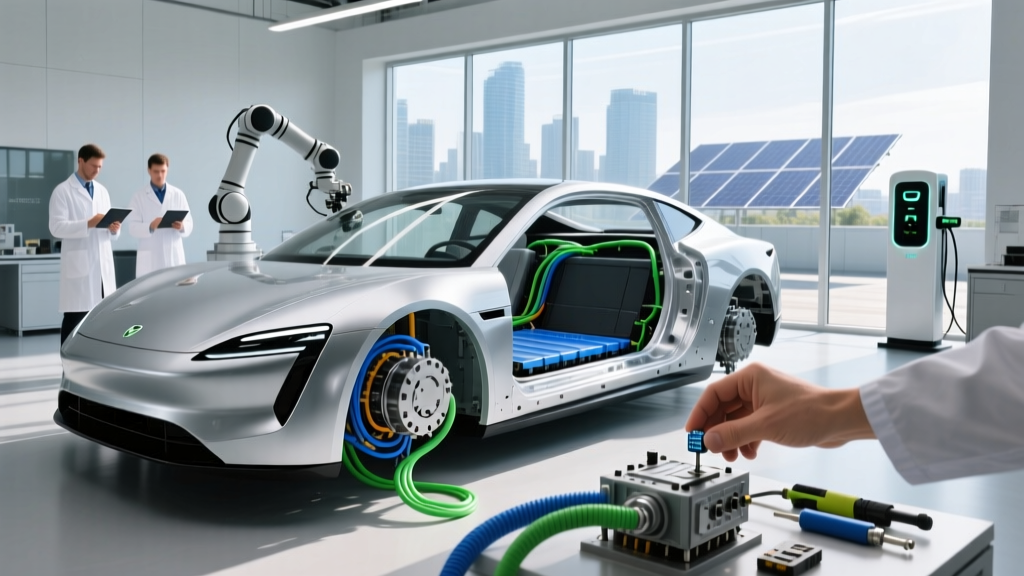
A conversion starts with a donor vehicle — typically a lightweight, manual-transmission car or truck (popular choices include older Honda Civics, VW Golfs, Porsche 944s, and Ford Rangers). You strip the internal combustion powertrain and install:
- Electric motor — NetGain Hyper9 or similar AC induction motor ($2,500–$5,000)
- Motor controller/inverter — matches motor to battery voltage ($1,500–$3,500)
- Battery pack — salvaged Tesla modules, Nissan Leaf packs, or new LFP cells ($5,000–$25,000 depending on capacity)
- Battery management system (BMS) — monitors cell voltage, temperature, and balancing ($500–$1,500)
- Onboard charger — for Level 1/Level 2 AC charging ($800–$2,500)
- DC-DC converter — steps high-voltage pack down to 12V for lights, wipers, infotainment ($200–$600)
- Throttle interface, contactors, wiring, safety cut-offs ($500–$2,000)
| Component | Budget Build | Mid-Range Build | High-Performance Build |
|---|---|---|---|
| Donor vehicle | $1,500 | $4,000 | $10,000+ |
| Motor + controller | $3,500 | $5,500 | $9,000 |
| Battery pack (kWh) | 20 kWh ($5,000) | 40 kWh ($10,000) | 75 kWh ($20,000) |
| BMS + DC-DC + charger | $1,500 | $2,500 | $4,000 |
| Wiring, fabrication, misc. | $1,500 | $3,000 | $7,000 |
| Total (parts only) | $13,000 | $25,000 | $50,000+ |
| Professional labor (if needed) | $2,000–$5,000 | $5,000–$15,000 | $15,000–$30,000 |
Realistic Range and Performance from a Conversion
A budget conversion with a 20 kWh pack in a lightweight car (2,500 lb curb weight) might achieve 70–100 miles of range at city speeds. A mid-range 40 kWh build can reach 120–160 miles. Only high-budget builds with 60+ kWh packs approach the 200+ mile range common in factory EVs. Most conversions lack DC fast charging entirely — you're limited to Level 2 AC charging at 3.3–7.2 kW, meaning a full charge takes 6–12 hours.
Performance-wise, conversions typically produce 80–150 horsepower with 0-60 mph times of 8–14 seconds. That's adequate for commuting but far from the 3.5-second 0-60 times of a Tesla Model 3 Performance or the 320-mile EPA range of a Hyundai Ioniq 6.
Factory-Built EVs: What You Get Instead
Compare a conversion to what mainstream factory EVs deliver in 2026:
| Metric | DIY Conversion (Mid) | 2026 Chevy Equinox EV (2LT) | 2026 Toyota Camry (Gas) |
|---|---|---|---|
| Total cost | $25,000–$40,000 | $33,600 MSRP | $28,400 MSRP |
| EPA-rated range / MPG | ~120–160 mi (no EPA cert.) | 315 mi EPA | 32 MPG combined |
| Battery / Tank | 40 kWh (NMC or salvaged) | 85 kWh (NMC) | 13.2 gal |
| Fast charging | None (Level 2 only) | Peak 150 kW, 10-80% ~30 min | N/A |
| 0-60 mph | ~10 sec | ~7.9 sec | ~7.6 sec |
| Warranty | None (self-built) | 8 yr/100,000 mi battery | 3 yr/36,000 mi basic |
| Federal tax credit (§30D) | Not eligible | Up to $7,500 (eligibility varies) | Not eligible |
| Safety ratings (NHTSA/IIHS) | Not tested | IIHS Top Safety Pick | IIHS Top Safety Pick |
Per fueleconomy.gov, the average 2026 factory EV achieves 100–130 MPGe combined, translating to roughly $0.04–$0.06 per mile on the national average electricity rate of $0.17/kWh. A comparable gas car at 30 MPG and $3.40/gallon costs about $0.11/mile in fuel alone.
Real Costs and Savings: EV vs. Gas vs. Conversion
Here's what five years of ownership looks like, assuming 12,000 miles/year and national average energy costs:
| Cost Category | DIY Conversion | Factory EV (Equinox EV) | Gas Car (Camry) |
|---|---|---|---|
| Purchase / build price | $32,000 | $33,600 | $28,400 |
| Federal tax credit | $0 | Up to $7,500* | $0 |
| Effective purchase | $32,000 | ~$26,100 | $28,400 |
| Fuel/energy (5 yr) | $3,060 (home L2) | $3,400 (home L2) | $6,800 |
| Maintenance (5 yr) | $1,500–$4,000 | $1,800 | $3,500 |
| Insurance (5 yr avg.) | $7,500 (specialty) | $9,000 | $7,000 |
| Total 5-yr cost | ~$44,000–$47,000 | ~$40,300 | ~$45,700 |
*The §30D federal tax credit has MSRP caps ($55,000 sedans, $80,000 SUVs/trucks), buyer income limits ($150K single / $300K joint), and battery critical-mineral sourcing requirements. Eligibility varies by model year and trim. Check current rules at irs.gov. The credit can be transferred to the dealer at point of sale as a purchase-price reduction.
Common Misconceptions About Building an EV
| Myth | Fact |
|---|---|
| "Building your own EV saves a ton of money." | A mid-range conversion costs $25K–$40K and yields 120–160 miles of range with no fast charging, no warranty, and no safety certification. A factory Equinox EV with 315 miles of range starts at $33,600 and qualifies for up to $7,500 in federal credits. |
| "EV batteries need replacing every few years." | Modern NMC and LFP packs are warrantied for 8 years/100,000 miles at 70%+ capacity retention (fueleconomy.gov). Real-world data shows most packs retain 85-90% after 100K miles. Replacement costs $8,000–$20,000 if needed out of warranty. |
| "You can't drive EVs in cold weather." | Cold reduces range 15-30% in freezing temps due to battery chemistry and cabin heating. A 315-mile EV might deliver 230-260 miles at 20°F. Preconditioning the battery while plugged in recovers significant range. Heat pumps (standard on many 2026 models) reduce heating energy draw by 30-50%. |
| "Conversions get you DC fast charging." | Adding CCS or NACS DC fast charging to a conversion requires a compatible high-voltage architecture (400V–800V), a certified charge controller, and safety interlocks that most hobbyist builds cannot meet. Most conversions are Level 2 only. |
| "EVs cost more to insure." | Sometimes true — EV insurance averages 10-20% higher than comparable gas cars due to repair costs and battery replacement risk. But the gap is narrowing as EV parts availability improves and more insurers offer EV-specific policies. |
Real-World Ownership Considerations Before You Decide
Home Charging Access
This is the single biggest ownership variable. If you can install a Level 2 home charger (240V, 32–48 amps, delivering 7.7–11.5 kW), you'll wake up every morning with a full "tank." Installation costs range from $500–$2,500 for a straightforward setup to $3,000–$7,000 if your electrical panel needs an upgrade from 100A to 200A service. Without home charging, you'll rely on public Level 2 and DC fast chargers — workable but less convenient and more expensive ($0.30–$0.50/kWh at public DC stations vs. $0.12–$0.17/kWh at home).
Driving Patterns
If your daily round-trip commute is under 80 miles, virtually any factory EV (or even a budget conversion) covers it easily. If you regularly drive 200+ miles or take frequent road trips, you need a factory EV with 250+ miles of EPA range and DC fast charging at 150+ kW. Conversions simply can't serve this use case.
Climate
In regions with sustained sub-freezing winters (Minnesota, Maine, Colorado), budget an extra 20-30% of range for cold-weather loss. A factory EV with a heat pump and battery preconditioning handles this far better than a conversion, which typically lacks sophisticated thermal management.
Decision Framework: Should You Build or Buy?
Choose a DIY EV Conversion If:
- You're a hobbyist or engineer who wants a hands-on project and values the learning experience over practicality
- You have a specific donor vehicle you love (classic car, lightweight sports car) and want to electrify it
- Your daily driving is under 60 miles and you have reliable home charging
- You accept zero warranty, no NHTSA/IIHS safety rating, no DC fast charging, and no federal tax credit eligibility
- You have access to a garage, tools, high-voltage safety training, and 100–300+ hours of build time
Choose a Factory-Built EV If:
- You need a reliable daily driver with 250+ miles of range and DC fast charging for road trips
- You want a battery warranty (8 yr/100,000 mi minimum), NHTSA crash-test ratings, and ADAS features like automatic emergency braking and lane-keeping
- You want to take advantage of the §30D federal tax credit (up to $7,500, subject to income, MSRP, and sourcing rules)
- You value resale value — factory EVs from established brands hold value; conversions are nearly impossible to finance or insure at their build cost
- You don't have the time, skills, or workspace for a multi-month fabrication project
Choose a Plug-In Hybrid (PHEV) If:
- You lack reliable home charging or frequently drive in areas with sparse charging infrastructure
- You want 25–50 miles of electric-only range for daily commuting plus a gas engine for long trips with zero range anxiety
- You want a lower purchase price (PHEVs start around $33,000–$40,000) while still reducing fuel consumption by 50-70%
Frequently Asked Questions
Is it legal to build your own electric car?
Yes, but you must register it with your state DMV, which typically requires a special inspection for homemade or modified vehicles. Requirements vary widely — some states require brake certifications, high-voltage safety inspections, and proof of component sourcing. Insurance is available through specialty carriers but often costs more than standard auto policies.
How long does a DIY EV conversion take?
For a first-time builder working evenings and weekends, expect 200–500 hours over 3–12 months. Professional conversion shops can complete a build in 4–8 weeks but charge $15,000–$30,000+ in labor on top of parts.
Can I use Tesla battery modules in a conversion?
Salvaged Tesla modules (from wrecked Model S/X/3 vehicles) are popular in conversions due to their energy density. However, they require a compatible BMS, careful cell balancing, and thermal management. Sourcing them legally from salvage yards is possible, but warranty is nonexistent and cell degradation varies by donor vehicle history.
What's the cheapest factory EV I can buy in 2026?
The 2026 Nissan Leaf S starts around $28,140 with 149 miles of EPA range. The Chevy Equinox EV 2LT starts at $33,600 with 315 miles of range. Both may qualify for the §30D credit depending on your income, the vehicle's battery sourcing, and MSRP caps — always verify current eligibility on irs.gov before purchasing.
Do EVs really save money long-term?
For most drivers with home charging, yes. Fuel savings alone run $600–$1,200/year vs. a comparable gas car. Maintenance savings (no oil changes, fewer brake replacements due to regenerative braking) add $200–$500/year. Over five years, total savings of $4,000–$8,500 are typical, enough to offset the higher purchase price of many EVs — especially when the federal tax credit applies.