What Is Tesla Slip Start and Why Does It Matter?
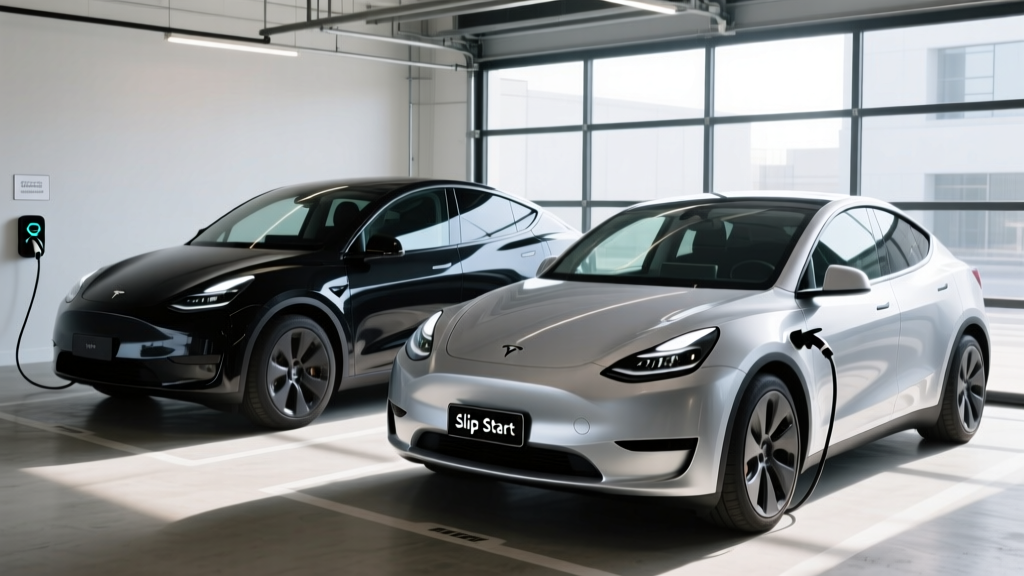
If you've been searching for Tesla Slip Start, you've likely encountered a setting buried deep in your Tesla's service or driving menus — or you've seen the term surface on forums after a snowy commute went sideways. Slip Start is a traction-management feature Tesla introduced primarily for rear-wheel-drive (RWD) and dual-motor vehicles that modulates torque delivery at launch when the system detects low-grip conditions such as ice, snow, wet pavement, or loose gravel.
Unlike traditional traction control systems that brake a spinning wheel after slip occurs, Tesla's Slip Start preemptively limits the torque ramp-up from the electric motor(s) to prevent excessive wheel spin before it begins. Because electric motors deliver instant torque — often hundreds of pound-feet at zero RPM — managing that initial launch on slippery surfaces requires a fundamentally different approach than internal-combustion traction control.
For 2026, Slip Start remains integrated into Tesla's broader traction and stability control suite across the Model 3 and Model Y lineups. It operates automatically in most conditions but can be toggled in certain scenarios via the vehicle's touchscreen. Below, we break down how it works, which models benefit most, and provide a complete spec profile of the vehicles where it matters most.
How Tesla Slip Start Works: The Engineering
Tesla's electric powertrain gives engineers a unique advantage: motor torque can be adjusted in milliseconds — far faster than any mechanical limited-slip differential or brake-based traction system. Here's the sequence when Slip Start activates:
- Surface detection: Wheel-speed sensors and the inertial measurement unit (IMU) detect a mismatch between commanded torque and actual wheel rotation, indicating low friction.
- Torque limiting: The motor controller reduces the torque ramp rate, delivering power more gradually rather than the full instant-torque surge EVs are known for.
- Individual wheel braking: If one wheel still spins faster than the others, the stability control system applies targeted brake pressure to transfer torque to the wheel with more grip (via the open differential).
- Continuous adjustment: The system re-evaluates grip every few milliseconds and progressively allows more torque as traction improves.
In dual-motor (AWD) Teslas, the front and rear motors can be independently controlled, giving the system an additional degree of freedom — it can shift torque front-to-rear almost instantly. This is why Slip Start is most noticeable (and most discussed) on RWD variants of the Model 3 and Model Y, where all drive torque goes through a single rear axle.
2026 Tesla Model 3 RWD: Full Specs and Profile
The Model 3 RWD is where Slip Start gets the most real-world attention, since all propulsion flows through the rear wheels. Here's the complete 2026 specification profile:
| Spec | Value |
|---|---|
| EPA Range | 363 miles |
| Battery (usable) | ~60 kWh (LFP chemistry) |
| Drivetrain | Rear-Wheel Drive (single motor) |
| Horsepower | 271 hp |
| Torque | 317 lb-ft |
| 0–60 mph | 5.8 seconds |
| Top Speed | 125 mph |
| MPGe (combined) | 132 MPGe |
| Energy Consumption | 25 kWh/100 mi |
| Max DC Fast Charge | 170 kW peak |
| 10–80% DC Charge Time | ~25 minutes |
| Level 2 Charge Rate | 11.5 kW (~44 mi/hr) |
| Cargo Volume | 23 cu ft (trunk) + 3.1 cu ft (frunk) |
| Rear Legroom | 35.2 inches |
| Battery Warranty | 8 years / 100,000 miles |
| Base MSRP | $38,990 |
2026 Tesla Model Y RWD and Long Range AWD
The Model Y is Tesla's best-selling vehicle globally and the crossover where Slip Start matters for families navigating snowy school runs. The 2026 lineup includes the RWD base model and the Long Range AWD.
| Spec | Model Y RWD | Model Y Long Range AWD |
|---|---|---|
| EPA Range | 320 miles | 340 miles |
| Battery (usable) | ~60 kWh (LFP) | ~75 kWh (NMC) |
| Drivetrain | RWD (single motor) | Dual-Motor AWD |
| Horsepower | 295 hp | 384 hp |
| 0–60 mph | 6.6 sec | 4.8 sec |
| Max DC Charge | 170 kW | 250 kW |
| 10–80% Time | ~27 min | ~18 min |
| MPGe (combined) | 123 MPGe | 119 MPGe |
| Cargo Volume | 30 cu ft (rear up) | 30 cu ft (rear up) |
| Base MSRP | $44,990 | $48,990 |
The Long Range AWD's dual-motor setup inherently handles low-traction starts better than the RWD — the front motor can pick up slack when the rear wheels slip. Slip Start still operates on the AWD model but intervenes less frequently and less noticeably. If you live in a region with regular snow or ice, the AWD variant's $4,000 premium buys meaningfully better traction confidence beyond just Slip Start's software interventions.
Charging Speed: What to Expect at Home and on the Road
Charging speed remains a top concern for EV buyers. Here's what 2026 Tesla owners actually experience:
| Level | Power | Miles Added per Hour | Use Case |
|---|---|---|---|
| Level 1 (120V) | ~1.4 kW | ~5 mi/hr | Emergency / overnight trickle |
| Level 2 (240V, 48A) | 11.5 kW | ~44 mi/hr | Home daily charging |
| DC Fast (RWD) | 170 kW peak | ~180 mi in 15 min | Road trips, Superchargers |
| DC Fast (LR AWD) | 250 kW peak | ~200 mi in 15 min | Road trips, Superchargers |
Charging curve reality: The 250 kW peak on Long Range models is sustained only between roughly 10–30% state of charge. Above 50%, the rate tapers significantly — expect ~80 kW by 70% SoC and ~40 kW above 85%. This is normal lithium-ion behavior, not a Tesla-specific limitation. The 10–80% time of ~18 minutes (LR AWD) assumes you've preconditioned the battery by navigating to a Supercharger in the car's navigation, which warms the pack for optimal charge acceptance.
For home Level 2 charging, a Tesla Wall Connector on a 60-amp circuit delivers the full 11.5 kW (48A). Most owners charging overnight from 30% to 80% will add ~220 miles in about 5 hours — more than enough for daily use. Installation costs typically range from $800–$2,000 depending on panel proximity and local permitting, according to HomeAdvisor electrical cost data.
Pricing, Tax Credits, and Total Cost
| Model / Trim | Base MSRP | Est. After §30D Credit | Credit Eligibility Notes |
|---|---|---|---|
| Model 3 RWD | $38,990 | $31,490* | Eligible if buyer meets income caps & sourcing rules |
| Model 3 Long Range AWD | $45,490 | $37,990* | MSRP under $55K sedan cap; income limits apply |
| Model Y RWD | $44,990 | $37,490* | Eligible — MSRP under $80K SUV cap |
| Model Y Long Range AWD | $48,990 | $41,490* | Eligible — MSRP under $80K SUV cap |
*The IRS §30D Clean Vehicle Credit provides up to $7,500 for qualifying new EVs. Eligibility depends on:
- Buyer income caps: $150K single / $225K head of household / $300K joint (modified AGI)
- MSRP caps: $55,000 for sedans (Model 3) / $80,000 for SUVs and trucks (Model Y)
- Battery sourcing: Critical minerals and battery components must meet escalating North American / free-trade-partner thresholds — these tighten annually through 2032
- Point-of-sale transfer: As of 2024, the credit can be transferred to the dealer at purchase, reducing your out-of-pocket cost immediately rather than waiting for tax filing
Tesla's current battery-sourcing compliance for US-built Model 3 and Model Y has generally qualified for the full $7,500, but this can change as FEOC (Foreign Entity of Concern) restrictions tighten. Always verify current eligibility on fueleconomy.gov before purchasing.
Slip Start vs. Competitors: How Does Tesla's Traction Management Compare?
Tesla isn't the only automaker managing electric torque on slippery surfaces. Here's how Slip Start stacks up against key rivals:
Tesla Slip Start
Approach: Software-based motor torque ramp limiting + individual wheel braking
Advantage: Millisecond response; no mechanical lag
Limitation: RWD models still physically limited by rear-axle-only traction
Hyundai Ioniq 5 AWD Traction
Approach: Dual-motor torque vectoring + e-LSD simulation via braking
Advantage: Front/rear torque split adjustable in real time
Limitation: Slightly heavier system; AWD required for best performance
The fundamental physics are the same across all EVs: instant electric torque demands sophisticated software management on low-grip surfaces. Tesla's advantage is the vertical integration of motor controller, battery management, and stability control — all designed in-house and updated via over-the-air software. The disadvantage on RWD models is simply that no amount of software can create grip that doesn't exist; winter tires remain the single most impactful upgrade for RWD Tesla owners in snowy climates.
✓ Pros
- Millisecond torque modulation faster than any mechanical system
- OTA updates continuously refine traction algorithms
- RWD models still achieve strong efficiency (132 MPGe combined)
- Full Supercharger network access for road trips
- LFP battery offers long cycle life and 100% daily charging
- Class-leading software and infotainment
✗ Cons
- RWD models still struggle in deep snow vs. AWD competitors
- LFP battery more prone to cold-weather range loss
- No physical buttons — all adjustments via touchscreen
- Slip Start settings not easily accessible in standard menus
- Insurance premiums above segment average
- Minimalist interior not for everyone
Who Should Buy a Tesla With Slip Start?
Decision Framework
Choose the Model 3 RWD if: You commute in mild-to-moderate climates, prioritize efficiency and lowest purchase price, and can install home Level 2 charging. Slip Start handles occasional rain and light frost adequately.
Choose the Model Y Long Range AWD if: You regularly face snow, ice, or mountain passes. The dual-motor AWD system makes Slip Start a background feature you'll barely notice — because it rarely needs to intervene. The 250 kW DC fast charging also makes road trips meaningfully quicker.
Look elsewhere if: You need a traditional instrument cluster, prefer dealer service networks, or live in an area with limited Supercharger and third-party DC charging infrastructure.
Frequently Asked Questions
Can I manually enable Tesla Slip Start?
On most 2026 firmware versions, Slip Start operates automatically as part of the stability control system. Some service-menu versions expose a toggle, but Tesla does not officially document it as a user-facing setting. The system activates whenever wheel-speed sensors detect low-traction conditions at launch.
Does Slip Start replace the need for winter tires?
No. Slip Start manages torque delivery, but traction ultimately depends on the tire-to-road contact patch. On a RWD Model 3 or Model Y, dedicated winter tires (such as the Michelin X-Ice or Nokian Hakkapeliitta) dramatically outperform all-season tires in snow and ice — regardless of software traction aids. Tesla sells approved winter tire packages through its service centers.
What is the real-world range of the 2026 Model 3 RWD?
The EPA rates it at 363 miles. In real-world highway driving at 70–75 mph, expect 280–310 miles. In freezing temperatures, that drops to approximately 230–260 miles. City driving with regenerative braking recovers more energy, often yielding 320–340 actual miles.
Does the 2026 Model 3 qualify for the full $7,500 federal tax credit?
As of early 2026, the US-built Model 3 generally qualifies for the full $7,500 under IRS §30D rules, provided the buyer's modified AGI falls under the income caps ($150K single / $300K joint) and the battery sourcing requirements are met. Always verify on fueleconomy.gov at time of purchase, as sourcing rules tighten annually.
How fast does the Model Y Long Range AWD charge?
It peaks at 250 kW on a V3 or V4 Supercharger, achieving a 10–80% charge in approximately 18 minutes with battery preconditioning. The charge rate tapers significantly above 80% — plan to unplug at 80% on road trips for the best time efficiency.
Is Slip Start available on the Model S and Model X?
Yes, all current Tesla vehicles with stability control include Slip Start functionality. However, since the Model S and Model X are exclusively dual-motor AWD (or tri-motor in Plaid), the system intervenes far less frequently than on RWD Model 3 and Model Y variants.