Quick Verdict: A Practical Family EV With Honda DNA
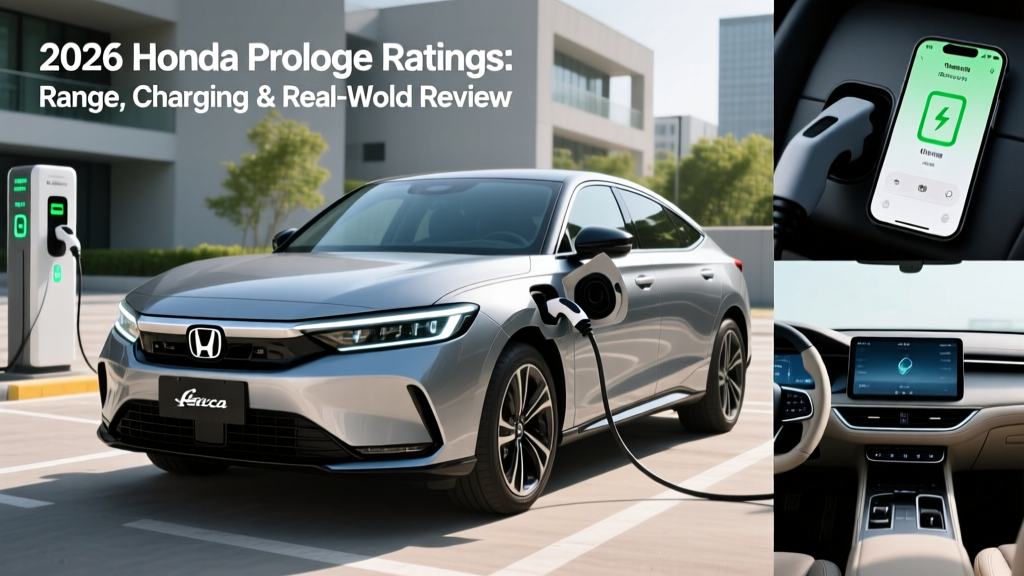
The Honda Prologue returns for 2026 as Honda's first dedicated battery-electric SUV built on General Motors' Ultium platform. For buyers who want a midsize electric crossover that drives like a Honda, carries five adults comfortably, and qualifies for federal incentives, the Prologue occupies a compelling middle ground. It isn't the longest-range EV in its class, nor the quickest to charge, but it delivers a well-rounded package with competitive pricing, Honda's reputation for reliability, and a cabin that feels a generation ahead of its gas-powered siblings.
Our 2026 Honda Prologue ratings evaluate every metric that matters to real buyers: EPA range versus highway reality, charging speed at public DC stations and at home, total cost after the §30D federal tax credit, and how it stacks up against the Hyundai Ioniq 5, Tesla Model Y, and Ford Mustang Mach-E.
Range, Efficiency, and the Real-World Reality Check
The 2026 Honda Prologue comes in two drivetrain configurations that meaningfully affect range. The front-wheel-drive (FWD) EX and Touring trims carry an EPA-estimated 308 miles of range, while the all-wheel-drive (AWD) Elite trim drops to EPA 281 miles. Both use the same 85 kWh usable lithium-ion battery pack with NMC (nickel manganese cobalt) chemistry.
| Trim / Drivetrain | EPA Range | Expected Highway (70 mph) | Expected Cold Weather (20°F) |
|---|---|---|---|
| EX / Touring (FWD) | 308 mi | ~255–270 mi | ~215–235 mi |
| Elite (AWD) | 281 mi | ~235–250 mi | ~195–215 mi |
Highway driving at sustained 70+ mph reduces range by roughly 12–15% versus the EPA combined figure. Cold weather below freezing can cut range by 25–30%, particularly if you're using cabin heat without preconditioning. The Prologue's battery thermal management system helps mitigate extreme losses, but NMC chemistry is inherently more temperature-sensitive than LFP. Always precondition the battery before DC fast charging in cold weather — it makes a measurable difference in charge speed.
Efficiency ratings land at 107 MPGe combined for FWD trims and 97 MPGe combined for AWD, translating to roughly 31 kWh/100 mi (FWD) and 35 kWh/100 mi (AWD) according to fueleconomy.gov. These figures place the Prologue in the middle of the midsize EV SUV pack — behind the Tesla Model Y's efficiency but on par with the Ford Mustang Mach-E and slightly ahead of the Subaru Solterra.
Charging Speed: DC Fast, Level 2, and the Curve
Charging capability is where Ultium-platform vehicles have drawn scrutiny, and the 2026 Prologue shows incremental improvement. The maximum DC fast-charge rate peaks at 155 kW on a capable CCS connector (or NACS via the adapter Honda now includes). Honda quotes a 10–80% charge time of approximately 32 minutes under ideal conditions.
| Charge Level | Power / Rate | Time or Miles Added | Connector |
|---|---|---|---|
| Level 1 (120V household) | ~1.4 kW | ~4 mi/hr | J1772 / NACS adapter |
| Level 2 (240V home) | 11.5 kW | ~33 mi/hr (full charge ~8.5 hrs) | J1772 / NACS adapter |
| DC Fast Charge | Peak 155 kW | 10–80% in ~32 min | CCS / NACS adapter |
Here's the charging-curve reality that spec sheets don't show: the Prologue holds its peak 155 kW rate only from roughly 10–35% state of charge. From 35–60% it tapers to approximately 110–120 kW, and above 80% it drops steeply to under 50 kW. On a road trip, this means your best strategy is to charge in short bursts from 15% to 65% rather than waiting for 80% or higher. A 15–65% session takes about 22–24 minutes and adds roughly 140 miles — enough for most highway stretches between chargers.
For home charging, the 11.5 kW onboard charger is competitive. A full charge from near-empty takes about 8.5 hours on a Level 2 home station, meaning an overnight session easily refills the battery. Honda includes a dual-level charge cord with the vehicle that can plug into a standard 120V outlet (slow, but useful for emergencies) or a 240V NEMA 14-50 outlet for roughly 20 miles of range per hour.
Performance and Drivetrain
The Prologue is not positioned as a performance EV, and that's appropriate for its target buyer. The FWD models produce 212 horsepower and 236 lb-ft of torque from a single front motor, reaching 0–60 mph in approximately 7.6 seconds. The AWD Elite adds a rear motor for a combined 288 horsepower and 324 lb-ft, dropping the 0–60 time to roughly 6.2 seconds.
| Spec | EX / Touring (FWD) | Elite (AWD) |
|---|---|---|
| Battery (usable) | 85 kWh, NMC | 85 kWh, NMC |
| EPA Range | 308 mi | 281 mi |
| Horsepower | 212 hp | 288 hp |
| 0–60 mph | ~7.6 sec | ~6.2 sec |
| Drivetrain | FWD, single motor | AWD, dual motor |
| Max DC Charge | 155 kW | 155 kW |
| 10–80% DC Time | ~32 min | ~32 min |
| Level 2 Charge Rate | 11.5 kW | 11.5 kW |
| MPGe (combined) | 107 | 97 |
| Towing Capacity | 1,500 lbs | 1,500 lbs |
Ride quality is where the Prologue earns strong ratings. The suspension tuning is compliant and quiet — noticeably more refined than the Chevrolet Blazer EV it shares a platform with. Steering is light but precise, and regenerative braking offers adjustable levels via steering-wheel paddles, including a one-pedal driving mode that can bring the vehicle to a complete stop.
Interior, Cargo, and Technology
The Prologue's cabin is a genuine step up from Honda's recent gas models. An 11.3-inch touchscreen running Google Built-in (with native Google Maps, Assistant, and Play Store) anchors the dash, paired with an 11-inch digital instrument cluster. Wireless Apple CarPlay and Android Auto are standard across all trims. The center console features a column-mounted shifter, freeing up substantial storage space below.
Passenger room is generous for the midsize class:
- Front legroom: 42.1 inches
- Rear legroom: 38.6 inches
- Front headroom: 40.0 inches
- Rear headroom: 38.3 inches
Cargo volume measures 25.2 cubic feet behind the second row and 57.7 cubic feet with the rear seats folded. There is no front trunk (frunk) — the space is occupied by HVAC and power electronics. This is a notable drawback versus the Tesla Model Y (which offers a small frunk) and the Hyundai Ioniq 5.
Driver-assistance technology includes the full Honda Sensing suite as standard: adaptive cruise control with low-speed follow, lane-keeping assist, lane-departure warning, automatic emergency braking, and traffic-sign recognition. This is SAE Level 2 driver assistance — the driver must remain fully engaged with hands on the wheel and eyes on the road. It is not a self-driving system. The Elite trim adds a hands-on-wheel lane-centering system that works well on divided highways but does not permit hands-off operation.
Pricing, Trims, and Federal Tax Credit Eligibility
Honda has kept the Prologue's pricing competitive for 2026, and the trim structure is straightforward:
| Trim | Drivetrain | Base MSRP | Est. Price After §30D Credit* |
|---|---|---|---|
| EX | FWD | $48,795 | ~$41,295 |
| Touring | FWD | $51,795 | ~$44,295 |
| Elite | AWD | $56,295 | ~$48,795 |
*Estimated prices assume full $7,500 §30D federal tax credit eligibility. Actual credit depends on individual tax liability, income limits, and battery-sourcing compliance. See IRS rules below.
As-tested, our AWD Elite with the $695 Northern Lights Purple paint and $200 cargo package came to $57,190 before destination. After the potential $7,500 credit, the effective price lands near $49,690 — competitive with a well-equipped Ford Mustang Mach-E Premium AWD.
According to IRS.gov, the Honda Prologue must meet — and the buyer must meet — the following to claim up to $7,500:
- MSRP cap: Vehicle MSRP must be ≤ $80,000 for SUVs (all Prologue trims qualify)
- Buyer income cap: Modified AGI ≤ $150,000 (single) or ≤ $300,000 (joint)
- Battery sourcing: Critical minerals and battery components must meet phased-in domestic/free-trade-area sourcing thresholds (Honda has confirmed the Prologue's Ultium battery meets 2026 thresholds)
- Point-of-sale transfer: Buyers may transfer the credit to the dealer at purchase for an immediate price reduction, or claim it on their federal tax return
- Tax liability: Credit is non-refundable — you must owe at least $7,500 in federal tax to claim the full amount
Always verify current-year eligibility with a tax professional and the IRS before purchasing. Rules and sourcing requirements are subject to annual adjustments.
Ownership: Warranty, Reliability, and Running Costs
Honda backs the Prologue with a competitive warranty package:
- Battery & drive unit: 8 years / 100,000 miles (capacity retention guaranteed above 70%)
- New vehicle limited: 3 years / 36,000 miles
- Powertrain: 5 years / 60,000 miles
- Corrosion: 5 years / unlimited miles
The 70% capacity retention threshold at 8 years/100,000 miles is industry-standard, though some competitors (Hyundai/Kia) offer 10-year/100,000-mile battery coverage. NMC battery degradation data from GM's Ultium platform is still maturing, but early indicators from the Cadillac Lyriq and Chevrolet Blazer EV suggest approximately 5–8% capacity loss over the first 60,000 miles under normal use — well within the warranty threshold.
Running costs favor the Prologue strongly versus a gas equivalent. At a national average of $0.16/kWh for home charging, a full 85 kWh charge costs roughly $13.60, yielding about $0.044 per mile. A comparable gas SUV at 25 MPG and $3.50/gallon costs $0.14 per mile — a 3x difference. Over 15,000 annual miles, home charging saves approximately $1,440 per year versus gasoline.
How the Prologue Rates Against Key Competitors
| Spec | Honda Prologue (FWD) | Hyundai Ioniq 5 (RWD LR) | Tesla Model Y (LR RWD) | Ford Mach-E (RWD ER) |
|---|---|---|---|---|
| EPA Range | 308 mi | 303 mi | 320 mi | 320 mi |
| Battery (kWh) | 85 | 77.4 | 75 | 91 |
| Max DC Charge | 155 kW | 240 kW | 250 kW | 150 kW |
| 10–80% Time | ~32 min | ~18 min | ~22 min | ~38 min |
| 0–60 mph | 7.6 sec | 7.0 sec | 6.5 sec | 6.3 sec |
| Cargo (rear up) | 25.2 cu ft | 27.2 cu ft | 30.2 cu ft | 29.7 cu ft |
| Base MSRP | $48,795 | $46,650 | $46,630 | $44,995 |
The Prologue's key advantage is ride comfort and cabin quietness — areas where Honda's tuning philosophy stands apart from its platform-mate, the Blazer EV. Its weaknesses versus competitors are clear: slower DC charging than the Ioniq 5 and Model Y, no frunk, and less cargo volume. For buyers who prioritize a smooth, composed ride and Honda's dealer network over maximum charging speed, the trade-off is reasonable.
- Refined, quiet ride quality above class average
- Google Built-in infotainment is responsive and well-integrated
- Competitive pricing with full §30D tax credit eligibility
- Generous rear-seat legroom (38.6 in)
- Honda Sensing ADAS standard on all trims
- Honda dealer network for service and support
- DC charging peaks at 155 kW — slower than Ioniq 5 and Model Y
- No front trunk (frunk)
- Cargo volume trails key competitors
- 1,500-lb towing capacity is low for the class
- AWD range drops to 281 mi
- No hands-free driving option (Level 2 only)
Who Should Buy the 2026 Honda Prologue?
- You want a comfortable, quiet daily-driver EV with Honda's dealer support network
- Your typical commute is under 80 miles round-trip and you charge at home
- You value ride refinement over maximum acceleration or charging speed
- You need a back seat that comfortably fits two adults on longer trips
- You qualify for the full $7,500 §30D credit and want a sub-$42,000 effective price on the EX trim
- You take frequent 400+ mile road trips and need the fastest possible DC charging (consider Ioniq 5)
- You need maximum cargo space or a frunk (consider Model Y)
- You want hands-free highway driving capability (consider Ford BlueCruise on the Mach-E or GM Super Cruise on the Blazer EV)
- You need more than 1,500 lbs of towing capacity
Frequently Asked Questions
What is the real-world range of the 2026 Honda Prologue?
The EPA rates the FWD Prologue at 308 miles and the AWD Elite at 281 miles. In real-world highway driving at 70 mph, expect approximately 255–270 miles (FWD) or 235–250 miles (AWD). In cold weather below 25°F, plan for 215–235 miles (FWD) or 195–215 miles (AWD). Preconditioning the battery before departure helps preserve range.
How fast does the Prologue charge at home and on the road?
On a Level 2 home charger (240V), the Prologue charges at 11.5 kW, adding roughly 33 miles per hour and fully recharging in about 8.5 hours. On a DC fast charger, it peaks at 155 kW and reaches 10–80% in approximately 32 minutes under ideal conditions. The charging curve tapers significantly above 60% SoC.
Does the 2026 Honda Prologue qualify for the $7,500 federal tax credit?
Yes, the Prologue qualifies under current IRS §30D rules — its MSRP is well under the $80,000 SUV cap, and Honda has confirmed the Ultium battery meets 2026 critical-mineral and component sourcing requirements. However, buyer eligibility also depends on income caps ($150K single / $300K joint modified AGI) and sufficient federal tax liability. The credit can be transferred to the dealer at point of sale for an immediate price reduction.
Is the Honda Prologue worth buying over the Tesla Model Y or Hyundai Ioniq 5?
It depends on your priorities. The Model Y offers more cargo space, longer range, and access to the Supercharger network natively. The Ioniq 5 charges significantly faster (240 kW peak). The Prologue's advantage is ride comfort, cabin quietness, and Honda's dealer network — areas where neither Tesla nor Hyundai match it. If daily comfort matters more than road-trip charging speed, the Prologue is a strong choice.
What is the battery warranty on the Prologue?
Honda covers the high-voltage battery and drive unit for 8 years or 100,000 miles, whichever comes first, with a guaranteed capacity retention above 70%. The new-vehicle limited warranty covers 3 years/36,000 miles and the powertrain warranty covers 5 years/60,000 miles.
Can the Prologue use Tesla Superchargers?
Yes. Honda includes a NACS adapter with the 2026 Prologue, enabling access to Tesla's Supercharger network (V3 and V4 stalls). Honda's navigation system, powered by Google Maps, routes through Supercharger stations and can precondition the battery for optimal charge speed upon arrival.