If you've been watching Honda's electric pivot, the Prologue is the brand's first serious stab at a mainstream electric SUV — and for 2026, it remains one of the most aggressively leased EVs on the market. Honda Financial Services has been stacking incentives, and dealers are advertising monthly payments that undercut comparable gas-powered CR-V leases once you factor in fuel savings. But lease math is notoriously opaque. This review dissects the 2026 Honda Prologue's real-world range, charging performance, pricing, and current lease landscape so you can tell whether those advertised specials are genuinely compelling or just cleverly structured.
2026 Honda Prologue: The Quick Spec Snapshot
| Spec | FWD (EX / EX-L) | AWD (EX-L / Elite) |
|---|---|---|
| EPA Range | 296 miles | 281 miles (Elite: 270 mi) |
| Battery (usable) | 85.0 kWh, NMC lithium-ion | |
| Horsepower | 212 hp | 288 hp |
| Torque | 236 lb-ft | 332 lb-ft |
| 0–60 mph | ~7.6 sec | ~5.8 sec |
| Max DC Fast Charge | 150 kW (peak) | |
| 10–80% DCFC Time | ~34 minutes | |
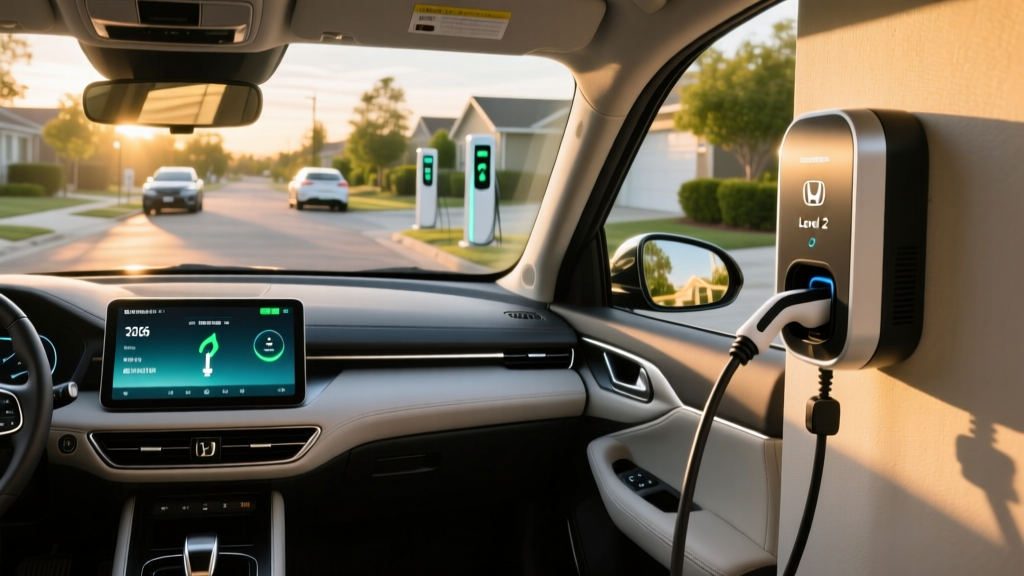
| Level 2 Home Charging | 11.5 kW (~32 mi/hr) | |
| Efficiency (FWD) | 99 MPGe combined / 34 kWh/100mi | |
| Base MSRP (EX FWD) | $47,400 | |
| Battery Warranty | 8 yr / 100,000 mi | |
Source: fueleconomy.gov, Honda Newsroom
Real-World Range: What the EPA Sticker Doesn't Tell You
EPA Estimate: 296 mi (FWD) / 281 mi (AWD)
Real-World Highway (70 mph, mild weather): ~245–265 mi
Cold Weather (below 32°F, mixed driving): ~200–230 mi
Best-Case City/Regen-Heavy: ~280–295 mi
The Prologue's 85.0 kWh NMC (nickel-manganese-cobalt) battery is sourced from the GM/Honda Ultium platform, and it delivers competitive but not class-leading range. The FWD EX and EX-L trims hit 296 miles on the EPA cycle, which is respectable. However, highway driving at sustained speeds above 70 mph cuts that figure by roughly 10–15%, putting realistic road-trip range between 245 and 265 miles. Cold weather is the bigger penalty — expect a 20–30% reduction when temperatures drop below freezing, particularly if you're using cabin heat frequently. The Prologue does include a heat pump on AWD trims, which mitigates some of this loss, but FWD models rely on resistive heating, making winter efficiency noticeably worse in northern climates.
Compared to the Hyundai Ioniq 5 Long Range (311 mi EPA) or Kia EV6 (310 mi EPA), the Prologue trails by about 15 miles on paper and roughly 20 miles in real-world highway testing. For daily commuting under 80 miles round-trip, this is a non-issue. For frequent 300+ mile road trips, you'll be stopping more often than Ioniq 5 or EV6 drivers.
Charging Performance: Adequate, Not Best-in-Class
| Charging Level | Power / Rate | Speed |
|---|---|---|
| Level 1 (120V household) | 1.4 kW | ~4 mi/hr |
| Level 2 (240V home/public) | 11.5 kW | ~32 mi/hr (full charge ~9 hrs) |
| DC Fast Charge (peak) | 150 kW | 10–80% in ~34 min |
The Prologue's 150 kW peak DC fast-charging rate is the most significant compromise in this package. The Hyundai Ioniq 5 and Kia EV6 both support up to 235–240 kW on 800V architectures, achieving 10–80% charges in roughly 18 minutes. The Prologue's 34-minute 10–80% session on a 150+ kW station is functional but noticeably slower on long road trips. On Electrify America or EVgo 350 kW stations, you'll max out the Prologue's onboard acceptance at 150 kW — and that peak only holds briefly before the charge curve tapers above 55–60% State of Charge.
For home charging, the 11.5 kW onboard charger is competitive. A full Level 2 session from empty takes roughly 9 hours, which works well for overnight replenishment. You'll need a 48-amp dedicated circuit (NEMA 14-50 or hardwired) to achieve the full 11.5 kW rate. Budget $500–$1,500 for a quality Level 2 home charger (ChargePoint Home Flex, Emporia Level 2, or Tesla Universal Wall Connector) plus $800–$2,500 for professional installation depending on panel proximity and local permit requirements.
Honda includes two years of complimentary DC fast charging through EVgo (up to 100 kWh or a set number of sessions depending on current terms), which helps offset the slower charge rate during the initial ownership period.
Lease Specials: Decoding the Monthly Payment
The 2026 Honda Prologue has been one of the most heavily subsidized EV leases in the mainstream market. Here's why: Honda Financial Services structures Prologue leases to capture the IRS §30D federal tax credit as a capitalized-cost reduction — effectively passing the $7,500 credit to the lessee as a lower monthly payment, even if the buyer wouldn't qualify for the credit on a purchase due to income caps.
- Purchase eligibility: Modified AGI ≤ $150K (single) / $300K (joint); MSRP ≤ $80K (SUVs); battery sourcing rules apply
- Lease eligibility: The lessor (Honda Financial) claims the commercial clean vehicle credit (§45W) and typically passes savings as a cap-cost reduction — no buyer income cap applies
- Prologue eligibility: As a GM Ultium-based vehicle assembled in North America, the Prologue qualifies for the full $7,500 when leased through Honda Financial Services
- Point-of-sale transfer: On purchases, the credit can be applied at the dealer; on leases, it's baked into the money factor and residual
Always verify current-year rules at irs.gov and consult a tax professional. Incentive structures change.
Typical 2026 Prologue lease structures we've seen advertised:
| Trim | MSRP | 36-Mo Lease (10K/yr) | Due at Signing | Effective Monthly |
|---|---|---|---|---|
| EX FWD | $47,400 | $279–$329/mo | $2,500–$3,999 | $349–$440 (amortized) |
| EX-L AWD | $53,200 | $339–$399/mo | $3,000–$4,500 | $422–$524 (amortized) |
| Elite AWD | $59,200 | $389–$459/mo | $3,500–$5,000 | $486–$598 (amortized) |
The "effective monthly" column amortizes the due-at-signing amount across the 36-month term so you can compare apples to apples against purchase financing. The advertised $279/mo headline rate on the EX FWD typically requires $3,999 down — which is really a $390/mo effective cost. Still, for a midsize electric SUV with nearly 300 miles of range, that's competitive with a gas CR-V EX lease once you subtract fuel and maintenance savings (roughly $120–$150/mo depending on local electricity and gas prices).
Driving, Tech, and Daily Livability
The Prologue rides on GM's BEV3 platform (shared with the Chevrolet Blazer EV and Cadillac Lyriq), and it drives like a competent, softly tuned crossover rather than a sporty EV. The AWD model's 288 hp and 5.8-second 0–60 time provide confident merging and passing, but the steering is numb and the suspension prioritizes comfort over engagement. Ride quality is genuinely good — it absorbs highway expansion joints and city potholes with composure that the stiffer-sprung Ioniq 5 can't match.
Inside, the Prologue uses an 11.3-inch touchscreen infotainment system running Google Built-In (Google Maps, Google Assistant, Play Store apps). Wireless Apple CarPlay and Android Auto are standard. The cabin materials on EX-L and Elite trims are a step above what you'll find in a Hyundai or Kia at this price — soft-touch surfaces, real stitching, and a clean, horizontal dashboard layout. Cargo volume is 28.8 cu ft behind the rear seats and 57.7 cu ft with the rear seats folded, which trails the Ioniq 5 (59.3 cu ft) but beats the Ford Mustang Mach-E (54.4 cu ft).
Driver assistance comes via Honda Sensing, which includes adaptive cruise control with low-speed follow, lane-keeping assist, and traffic-sign recognition. This is an SAE Level 2 system — meaning you must keep your hands on the wheel and eyes on the road at all times. It's competent for highway cruising but doesn't offer hands-free driving like GM's Super Cruise or Ford's BlueCruise. For a vehicle sharing the Ultium platform, the absence of Super Cruise availability is a missed opportunity and a notable drawback versus the Chevrolet Blazer EV, which offers it.
Prologue vs. the Competition: Where It Stands
| Spec | Honda Prologue AWD | Hyundai Ioniq 5 AWD | Kia EV6 AWD | Tesla Model Y LR AWD |
|---|---|---|---|---|
| EPA Range | 281 mi | 290 mi | 282 mi | 303 mi |
| Battery | 85 kWh NMC | 77.4 kWh NMC | 77.4 kWh NMC | ~75 kWh NMC |
| Peak DCFC | 150 kW | 235 kW | 240 kW | 250 kW |
| 10–80% Time | ~34 min | ~18 min | ~18 min | ~20 min |
| 0–60 mph | 5.8 sec | 5.0 sec | 5.1 sec | 4.8 sec |
| Base MSRP (AWD) | $53,200 | $50,200 | $51,900 | $48,990 |
| Super Cruise / Hands-Free | No | No | No | Yes (FSD Supervised*) |
*Tesla FSD Supervised remains SAE Level 2 — driver must remain fully engaged.
The Prologue's key advantage over these rivals is lease pricing. Honda's aggressive incentives and the $7,500 lease credit pass-through consistently produce lower monthly payments than similarly equipped Ioniq 5 or EV6 leases, especially at the EX FWD tier. Its ride comfort and cabin refinement also edge out the Hyundai/Kia pair. Where it loses decisively is charging speed — 34 minutes vs. 18 minutes for a 10–80% charge is a meaningful gap on road trips — and in Supercharger network access. The Ioniq 5, EV6, and Model Y all charge faster and (for Tesla) access the most reliable public charging network. Honda has announced NACS adoption for future models, but the 2026 Prologue uses CCS1, meaning you'll rely on Electrify America, EVgo, and ChargePoint for DC fast charging.
- Competitive lease pricing with $7,500 credit baked in
- Comfortable ride quality and quiet cabin
- Google Built-In infotainment is fast and intuitive
- Strong build quality and Honda dealer service network
- 296-mi EPA range (FWD) covers most commutes easily
- 150 kW peak DCFC is slowest in its class
- No hands-free driving assist (no Super Cruise option)
- CCS1 connector limits access vs. NACS-equipped rivals
- FWD models lack a heat pump — cold-weather range suffers
- Cargo space trails Ioniq 5 and Model Y
Who Should Lease the Prologue — And Who Shouldn't
Choose the Honda Prologue if:
- You want the lowest monthly lease payment in the midsize EV SUV segment
- Your daily commute is under 80 miles and you can charge at home
- You rarely take road trips over 250 miles one-way
- You value ride comfort and cabin quietness over sporty handling
- You want Honda's dealer network for service and warranty work
Look elsewhere if:
- You take frequent 300+ mile road trips (the 150 kW charging will frustrate you)
- You live in a cold climate and need maximum winter range (consider AWD Ioniq 5 with heat pump)
- You want hands-free highway driving (look at a Blazer EV with Super Cruise or Ford Mach-E with BlueCruise)
- You want Tesla Supercharger network access without adapters
Frequently Asked Questions
Does the Honda Prologue qualify for the $7,500 federal EV tax credit?
Yes — when leased through Honda Financial Services, the Prologue qualifies for the full $7,500 federal credit, which is applied as a capitalized-cost reduction (lowering your monthly payment). On a purchase, eligibility depends on your income (≤$150K single / ≤$300K joint filers), the vehicle's MSRP (must be ≤$80K for SUVs), and battery-sourcing requirements. The lease route bypasses the buyer income cap. Always confirm current rules at irs.gov.
What is the real-world range of the Honda Prologue?
The EPA rates the FWD Prologue at 296 miles and the AWD at 281 miles. In real-world highway driving at 70 mph, expect 245–265 miles. In freezing temperatures, range can drop to 200–230 miles, especially on FWD models without a heat pump.
How fast does the Prologue charge at home and on the road?
At home on a 240V Level 2 charger (11.5 kW), the Prologue adds about 32 miles of range per hour, with a full charge taking roughly 9 hours. On a DC fast charger, it peaks at 150 kW and charges from 10–80% in approximately 34 minutes — slower than the Ioniq 5 and EV6, which achieve the same in about 18 minutes.
Is the Honda Prologue better than the Hyundai Ioniq 5?
It depends on your priorities. The Prologue wins on lease pricing, ride comfort, and cabin refinement. The Ioniq 5 wins on charging speed (235 kW vs. 150 kW), slightly better range, more cargo space, and a more engaging drive. For road-trippers, the Ioniq 5 is the stronger pick. For budget-conscious commuters who lease, the Prologue's monthly payment advantage is hard to beat.
Can I use Tesla Superchargers with the Honda Prologue?
The 2026 Prologue uses the CCS1 connector and does not natively support Tesla's NACS plug. Honda has confirmed future models will adopt NACS, and CCS-to-NACS adapters are expected to become available, but as of early 2026, Prologue owners rely on the Electrify America, EVgo, and ChargePoint networks for DC fast charging.
What is the battery warranty on the Prologue?
Honda covers the Prologue's high-voltage battery for 8 years or 100,000 miles (whichever comes first), with a capacity-retention threshold typically set at 70% of original capacity. The limited vehicle warranty is 3 years / 36,000 miles, and the powertrain warranty is 5 years / 60,000 miles.