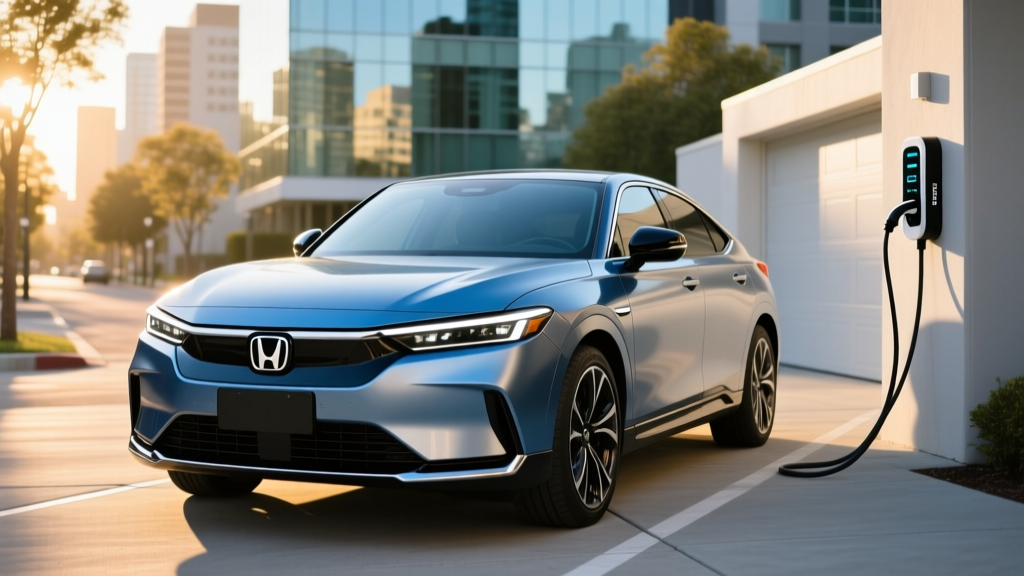
If you are researching Honda Prologue financing, you are likely weighing a midsize electric SUV that undercuts rivals on price while borrowing General Motors' proven Ultium platform. The 2026 Honda Prologue carries over the mechanicals that debuted in 2024 — an 85 kWh usable NMC battery, up to 308 miles of EPA range, and optional dual-motor AWD — but the financial picture has shifted with updated IRS §30D sourcing rules and Honda's own incentive stack.
This guide walks through the actual numbers a buyer needs: trim pricing, federal and state credit eligibility, lease versus buy math, charging costs, and how the Prologue's total cost of ownership compares to the Hyundai Ioniq 5, Tesla Model Y, and Chevrolet Blazer EV.
2026 Honda Prologue Pricing and Trim Breakdown
Honda simplified the Prologue lineup for 2026 to three trims, all built on the GM BEV3 architecture at the Spring Hill, Tennessee plant. Destination charges add $1,395 across the board.
| Trim | Drivetrain | MSRP | EPA Range | Key Additions |
|---|---|---|---|---|
| EX | FWD (single motor) | $43,100 | 308 mi | 19" wheels, Honda Sensing, 11.3" display |
| Touring | FWD or AWD | $49,400 / $51,900 | 296 mi (FWD) / 283 mi (AWD) | Leather, Bose 12-speaker, panoramic roof |
| Elite AWD | AWD (dual motor) | $55,900 | 273 mi | 21" wheels, ventilated seats, HUD, hands-free liftgate |
The EX FWD at $43,100 is the value play and the trim most likely to clear the federal credit's MSRP cap. Touring and Elite trims push past $50,000, which still qualifies under the SUV MSRP ceiling of $80,000 but erodes the price advantage versus a loaded Model Y or Ioniq 5 Limited.
Federal Tax Credit Eligibility for the Prologue
The Prologue's eligibility for the full $7,500 IRS §30D Clean Vehicle Credit depends on three moving targets: battery sourcing, buyer income, and point-of-sale transfer rules that remain in effect for 2026.
- MSRP cap: Prologue qualifies (SUV ceiling is $80,000; highest trim is $55,900).
- Buyer income cap: AGI must not exceed $150,000 single / $225,000 head of household / $300,000 joint.
- Battery sourcing: The Ultium pack uses GM-sourced cathode with increasing North American critical-mineral content. For 2026, Honda lists the Prologue as eligible for the full $7,500 ($3,750 battery components + $3,750 critical minerals) on the fueleconomy.gov qualified vehicle list — but confirm your specific VIN at purchase.
- Point-of-sale transfer: Buyers can assign the credit to the dealer at signing, reducing the financed amount by $7,500 on day one.
For a buyer in the 22% federal tax bracket with insufficient tax liability to absorb the full credit, the point-of-sale transfer is the critical mechanism — it converts a non-refundable credit into an immediate discount.
| Line Item | Amount |
|---|---|
| MSRP + destination | $44,495 |
| Federal §30D credit (POS transfer) | −$7,500 |
| Typical state/utility rebate (varies) | −$1,000 to −$3,000 |
| Effective out-of-pocket | $33,995 – $35,995 |
That puts a 308-mile AWD-capable midsize SUV in the same net-price bracket as a well-equipped Honda CR-V Hybrid — the comparison Honda itself is counting on to pull loyal buyers into EVs.
Real-World Range: Beyond the EPA Sticker
The Prologue's 85 kWh usable battery (NMC chemistry, GM Ultium pouch cells) delivers efficiency of roughly 3.2–3.5 mi/kWh, which translates to about 108 MPGe combined on the EX FWD per EPA data. That is competitive with the Blazer EV (its platform sibling) but trails the Hyundai Ioniq 5's ~114 MPGe combined thanks to the Ioniq's lighter curb weight and more aggressive thermal management.
For a 40-mile round-trip commuter with home charging, the Prologue requires plug-in roughly every 5–6 days in summer and every 4 days in winter. Road trippers should plan DC stops every 200–220 miles to stay in the battery's sweet spot and avoid the steep charge-curve taper above 80% SoC.
Charging Speed: DC Fast, Level 2, and the Curve Reality
| Level | Power | Miles Added per Hour | Notes |
|---|---|---|---|
| Level 1 (120V) | ~1.4 kW | ~4 mi/hr | Emergency/trickle only |
| Level 2 (240V, 48A) | 11.5 kW | ~35 mi/hr | Full charge in ~9 hr; overnight ready |
| DC Fast (peak) | 155 kW | ~200 mi in 30 min | 10–80% in ~35 min; tapers hard above 80% |
The Prologue's 155 kW peak DC rate is its most dated spec. Rivals like the Ioniq 5 (240 kW peak, 10–80% in ~18 min) and Model Y (250 kW peak) pull away on long road trips. On an Electrify America or EVgo 350 kW stall, the Prologue sustains ~130–140 kW from 10–50% SoC, then tapers to ~60 kW by 70%, and crawls past 80%. A realistic 10–80% session takes 34–38 minutes — adequate, but not class-leading.
Home Level 2 charging is where the Prologue shines. The 11.5 kW onboard charger means a full 0–100% session takes about 9 hours on a 48A hardwired wallbox. Budget roughly $600–$1,200 installed for a ChargePoint Home Flex or Wallbox Pulsar Plus on an existing 60A circuit; panel upgrades can add $1,500–$3,000 if you are on a 100A service.
Performance, Cargo, and Daily Usability
| Spec | EX FWD | Touring AWD | Elite AWD |
|---|---|---|---|
| 0–60 mph | 7.8 sec | 5.9 sec | 5.5 sec |
| Horsepower | 212 hp | 288 hp | 288 hp |
| Torque | 236 lb-ft | 325 lb-ft | 325 lb-ft |
| Cargo (rear seats up) | 25.2 cu ft | 25.2 cu ft | 25.2 cu ft |
| Cargo (seats folded) | 57.7 cu ft | 57.7 cu ft | 57.7 cu ft |
| Rear legroom | 41.1 in | 41.1 in | 41.1 in |
| Towing | 1,500 lb | 1,500 lb | 1,500 lb |
The dual-motor AWD Prologue is genuinely quick — 5.5 seconds to 60 mph is hot-hatch territory in a 4,900-lb SUV. The FWD EX feels adequate around town but shows its weight on highway on-ramps. Steering is Honda-pleasant but numb; ride quality is tuned soft, which suits commuters but invites body roll in corners.
Cargo volume (25.2 / 57.7 cu ft) trails the Model Y (30.2 / 72.1 cu ft) and Ioniq 5 (27.2 / 59.3 cu ft) noticeably. There is no frunk — the Ultium platform's under-hood space is occupied by HVAC and power electronics. For families hauling a double stroller plus groceries, the Prologue works but requires Tetris more often than a Model Y.
Tech, Driver Assists, and Notable Drawbacks
Honda fitted the Prologue with an 11.3-inch touchscreen running Google Built-In (Maps, Assistant, Play Store), wireless Apple CarPlay and Android Auto, and a 11-inch digital cluster. Honda Sensing EV bundles adaptive cruise, lane centering, blind-spot cameras, and low-speed braking assist — all SAE Level 2, meaning the driver must stay engaged at all times. There is no hands-free system comparable to GM's Super Cruise or Ford's BlueCruise, a missed opportunity given the shared platform.
Drawbacks worth flagging:
- No frunk and no V2L (vehicle-to-load) capability.
- DC fast charging peaks at 155 kW — 2026 buyers may notice at 350 kW stations.
- Rear visibility is compromised by thick C-pillars; a digital rear mirror is not offered.
- Regen braking is mild even on max setting — one-pedal driving is not fully achievable.
- Insurance premiums run 15–20% higher than a comparable CR-V Hybrid in most ZIP codes.
Lease vs Buy: The Honda Prologue Financing Decision
Honda Financial Services typically offers 36-month leases on the Prologue with money factors that, in early 2026, translate to effective APRs around 3.5–4.5% for tier-1 credit. The lease route unlocks a separate advantage: the commercial clean vehicle credit (§45W) that Honda's captive finance arm can pass through as a capitalized-cost reduction — often $7,500 even when retail §30D eligibility is uncertain due to sourcing paperwork.
Buying with the point-of-sale §30D transfer makes sense if you plan to keep the Prologue beyond 4 years, drive more than 15,000 miles annually, or live in a state without favorable lease-money-factor subsidies. A 72-month loan at 6.5% APR on a $37,000 net-price EX yields roughly $618/month versus a typical $379–$429/month lease with $2,500 due at signing.
Depreciation is the wildcard. The Prologue's GM-sourced battery and Honda badge suggest strong residuals, but early-model-year EVs historically soften 50–55% over 5 years versus 35–40% for mainstream hybrids. Lease protection insulates you from that risk.
Competitor Comparison: Is the Prologue Worth It?
| Metric | Honda Prologue EX | Hyundai Ioniq 5 SEL | Tesla Model Y LR | Chevy Blazer EV 2LT |
|---|---|---|---|---|
| Base MSRP | $43,100 | $45,500 | $46,990 | $44,600 |
| EPA Range | 308 mi | 303 mi | 320 mi | 279 mi |
| DC Peak kW | 155 kW | 240 kW | 250 kW | 190 kW |
| 10–80% Time | ~35 min | ~18 min | ~22 min | ~30 min |
| Cargo (cu ft) | 25.2 / 57.7 | 27.2 / 59.3 | 30.2 / 72.1 | 25.8 / 60.1 |
| Federal Credit | $7,500 | $7,500 | $7,500 | $7,500 |
The Prologue wins on starting price and dealer familiarity — Honda's 1,000+ US dealerships offer a lower-friction purchase and service experience than Tesla's direct model. It loses on charging speed and cargo volume. Choose the Prologue if you prioritize Honda build quality, Google-based infotainment, and a sub-$36k net price. Choose the Ioniq 5 if road-trip charging speed matters; choose the Model Y if cargo and Supercharger access are non-negotiable.
Warranty and Long-Term Ownership
Honda covers the Prologue with a 3-year/36,000-mile bumper-to-bumper warranty and an 8-year/100,000-mile battery and powertrain warranty with a 70% capacity retention threshold — industry-standard and aligned with GM's Ultium coverage. Honda also includes 2 years/24,000 miles of scheduled maintenance and 3 years of roadside assistance.
Long-term battery degradation on the Ultium NMC pack is tracking well in GM's own Lyriq and Blazer EV fleets, with most owners reporting 3–5% loss over the first 40,000 miles. Honda's thermal management system (liquid-cooled, with preconditioning for DC sessions) should deliver similar results. Plan to keep home charging between 20–80% SoC for daily use and reserve 100% charges for road-trip mornings.
Honda Prologue Financing FAQ
Does the 2026 Honda Prologue qualify for the $7,500 federal tax credit?
Yes, as of early 2026 the Prologue is listed on fueleconomy.gov as eligible for the full $7,500 §30D credit, provided the buyer meets AGI limits ($150k single / $300k joint) and transfers the credit at point of sale or claims it at tax filing. Always verify your VIN's eligibility on the IRS portal before signing.
What is the real-world range of the Honda Prologue?
The EPA rates the EX FWD at 308 miles. Real-world highway driving at 70 mph yields roughly 255–275 miles in mild weather and 210–230 miles in sub-freezing temperatures. AWD Elite trims average 230–250 miles highway in summer.
How fast does the Prologue charge at home and on DC?
Home Level 2 at 11.5 kW adds ~35 miles per hour, fully recharging in about 9 hours. DC fast charging peaks at 155 kW, with 10–80% taking approximately 35 minutes — slower than the Ioniq 5 or Model Y.
Should I lease or finance the Honda Prologue?
Lease if you want lower monthly payments, depreciation protection, and potential pass-through of commercial credits. Finance with a §30D point-of-sale transfer if you drive over 15k miles/year, plan to keep the vehicle 5+ years, or want to avoid lease-end disposition fees.
How does Prologue financing compare to a CR-V Hybrid?
A Prologue EX at ~$36k net (after credit) is price-competitive with a loaded CR-V Hybrid EX-L (~$39k). Fuel savings of ~$900/year (at $3.50/gal and $0.14/kWh national averages) offset the Prologue's higher insurance premiums within 3–4 years for a 15k-mile/year driver.
What are the biggest pros and cons of the Prologue?
Pros: Competitive net pricing after credits, Honda dealer network, comfortable ride, Google Built-In infotainment, strong AWD performance on Touring/Elite. Cons: 155 kW DC peak is slow for 2026, no frunk, modest cargo space, no hands-free driving option, mild regen braking.
Bottom Line: Who Should Finance a Honda Prologue?
The 2026 Honda Prologue makes the strongest financial case for existing Honda loyalists transitioning from a CR-V or Pilot who want a midsize electric SUV without leaving the brand's dealer and service ecosystem. With the full $7,500 federal credit applied at point of sale, the EX FWD lands near $36,000 — a compelling entry into a 300+ mile EV with Honda build quality and Google-based tech.
Financing the Prologue is straightforward through Honda Financial Services or third-party lenders, with 60–72 month terms widely available. The lease-vs-buy decision hinges on your mileage, ownership horizon, and risk tolerance for EV depreciation. Road-trippers and heavy commuters may prefer the faster-charging Ioniq 5 or Model Y, but for suburban families with home Level 2 access and a 40-mile daily commute, the Prologue's math works — especially when you factor in the $7,500 the IRS hands back on day one.