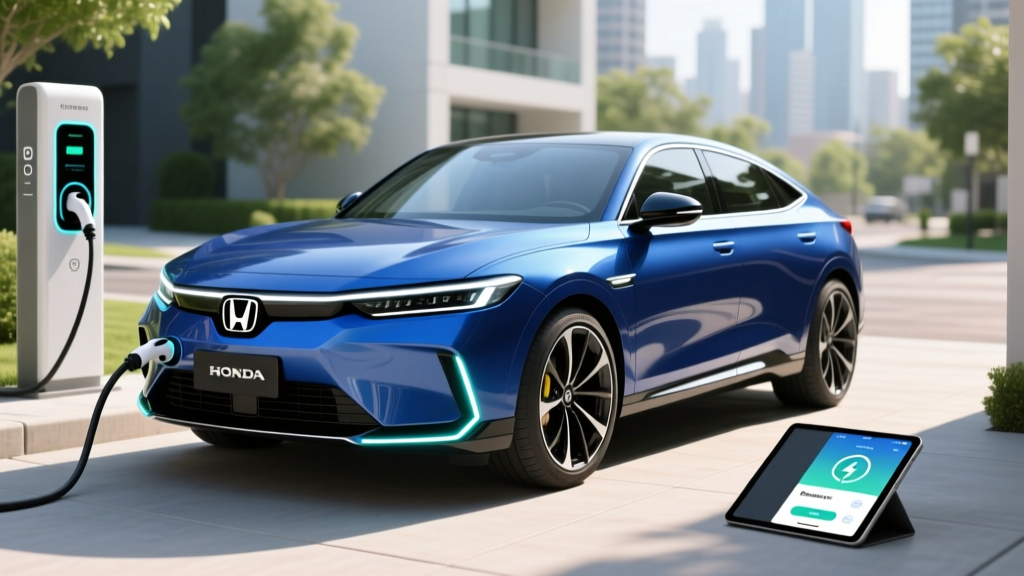
Honda's first mass-market electric SUV, the Prologue, entered a crowded midsize EV field built on General Motors' Ultium platform. For buyers researching Honda Prologue finance offers, the math hinges on three moving targets: the base MSRP by trim, prevailing dealer incentives and lease bonuses, and federal tax credit eligibility under IRS §30D. Below, we dissect what you'll actually pay, what you'll actually drive, and whether the Prologue earns a spot on your shortlist against rivals like the Hyundai Ioniq 5, Tesla Model Y, and Chevrolet Blazer EV.
Quick Verdict: Who Should Finance a Honda Prologue?
The Prologue is a competent, comfortable midsize electric crossover that prioritizes ride quality, cabin space, and mainstream familiarity over cutting-edge efficiency or blistering charge speeds. It's best suited for households that want a spacious two-row EV with Honda's dealer network behind it, primarily commute under 50 miles daily, and can charge at home overnight. Road-trippers and efficiency obsessives will find stronger options elsewhere.
Choose the Prologue if: you value Honda brand trust, spacious rear seats, a smooth ride, and competitive lease deals. Look elsewhere if: you need 350+ mile range, ultra-fast 350 kW charging, or the lowest cost-per-mile efficiency in the segment.
2026 Honda Prologue Pricing, Trims & Finance Offers
Honda positions the Prologue across three trims. Pricing below reflects MSRP before destination; dealer markups or discounts vary by region.
| Trim | Drivetrain | MSRP (est.) | Est. w/ Destination | Federal Credit Potential | Effective Price |
|---|---|---|---|---|---|
| EX | FWD | $47,400 | $48,795 | Up to $7,500* | ~$41,295 |
| EX AWD | AWD | $49,400 | $50,795 | Up to $7,500* | ~$43,295 |
| Touring AWD | AWD | $57,400 | $58,795 | Up to $7,500* | ~$51,295 |
*Federal §30D credit eligibility depends on buyer income caps, MSRP caps (SUVs: $80,000), battery critical-mineral and component sourcing, and point-of-sale transfer rules. Always verify current eligibility at IRS.gov and with your tax professional.
Finance vs. Lease: Where the Real Deals Live
Honda and GM have historically subsidized Prologue leases aggressively — in past model years, lease offers have included $7,500+ in dealer cash applied as capitalized-cost reductions, pushing effective monthly payments well below what purchase financing yields. If you're comfortable with a 36-month lease and mileage limits (typically 10,000–12,000 mi/yr), leasing has consistently been the cheapest path into a Prologue. Purchase financing through Honda Financial Services typically tracks the national average for new-vehicle APRs; check current promotional rates, as they fluctuate monthly with the Fed funds rate.
Federal Tax Credit: The §30D Checklist
- MSRP cap: SUVs must not exceed $80,000 — all Prologue trims qualify on price.
- Buyer income cap: Modified AGI ≤ $300,000 (joint), $225,000 (head of household), $150,000 (single).
- Battery sourcing: Critical minerals and battery components must meet phased-in domestic/free-trade-area thresholds that tighten annually. This is the most common disqualifier — confirm current-year compliance with your dealer.
- Point-of-sale transfer: Eligible buyers can apply the credit as a down-payment reduction at purchase, lowering the financed amount immediately.
Range, Battery & Efficiency: EPA vs. Real World
The Prologue uses an 85 kWh (usable) lithium-ion battery pack with NMC (nickel-manganese-cobalt) chemistry, shared with the Chevrolet Blazer EV and Cadillac Lyriq. Here's what that delivers:
| Spec | EX FWD | EX AWD / Touring AWD |
|---|---|---|
| EPA Range | 308 mi | 281–294 mi |
| Battery (usable) | ~85 kWh, NMC | |
| MPGe (combined) | ~99 MPGe | ~91 MPGe |
| Efficiency | ~34 kWh/100mi | ~37 kWh/100mi |
Real-World Range Reality: The EPA's 308-mile FWD figure assumes mixed driving. Expect approximately 255–275 miles on sustained highway driving at 70–75 mph. In cold weather (below 30°F), range can drop 20–30%, bringing a worst-case winter highway figure near 200–220 miles for the FWD model. AWD trims start lower and lose proportionally similar percentages. The Prologue's efficiency trails segment leaders like the Ioniq 5 (~30 kWh/100mi) due to its heavier curb weight and less aerodynamic profile.
Data sourced from fueleconomy.gov and confirmed against Honda's official specifications.
Charging Speed: DC Fast, Level 2 & Home Setup
Charging is where the Prologue shows its Ultium-platform roots — competent but not class-leading. The peak DC fast-charge rate is 155 kW, which is adequate but falls short of 800-volt rivals like the Ioniq 5 and Kia EV6 (both capable of 240+ kW).
| Charging Level | Power | Speed / Time | Notes |
|---|---|---|---|
| Level 1 (120V) | ~1.4 kW | ~4 mi/hr | Emergency/trickle only |
| Level 2 (240V, home) | 11.5 kW | ~32 mi/hr; full charge ~9 hr | Requires 48A circuit (60A breaker) |
| DC Fast Charge | 155 kW peak | 10–80% in ~34 min | CCS connector; tapers above 80% |
Charging Curve Reality
The 155 kW peak only sustains briefly between roughly 10–30% State of Charge. From 30–60%, expect approximately 110–130 kW, and above 80%, the rate drops sharply to under 40 kW to protect battery longevity. A 10–80% session at a reliable 150+ kW Electrify America or EVgo station takes about 34 minutes — plan for 40–45 minutes including plug-in and authentication overhead on road trips.
Home Charging Setup
At 11.5 kW, a full overnight charge adds roughly 250+ miles — more than enough for daily driving. Budget $500–$2,000 for a quality Level 2 home charger (e.g., ChargePoint Home Flex, Emporia Vue) plus $800–$2,500 for electrician installation depending on panel proximity and whether a 200-amp panel upgrade is needed. Honda has offered home-charger installation bundles with past Prologue purchases — ask your dealer about current programs.
Performance, Drivetrain & Ride Quality
| Metric | FWD | AWD |
|---|---|---|
| Horsepower | 212 hp | 288 hp |
| Torque | 236 lb-ft | 324 lb-ft |
| 0–60 mph | ~8.2 sec | ~6.2 sec |
| Towing Capacity | 1,500 lb (not rated for heavy towing) | |
The AWD dual-motor setup delivers confident highway merging and passing. Ride quality is a Prologue strength — the suspension absorbs bumps with a composure that outclasses many rivals, though the steering is numb and the ~4,800-lb curb weight is felt in corners. Regenerative braking offers adjustable levels via paddle shifters, but one-pedal driving is not as aggressive or seamless as Tesla's or Nissan's implementations.
Interior, Cargo & Technology
The Prologue's cabin borrows heavily from GM's Ultium parts bin rather than Honda's typical design language. You'll find an 11.3-inch touchscreen running Google Built-In (with native Google Maps, Assistant, and Play Store), an 11-inch digital instrument cluster, and wireless Apple CarPlay/Android Auto on higher trims.
Space & Dimensions
- Cargo (behind 2nd row): 25.2 cu ft
- Cargo (seats folded): 57.7 cu ft
- Rear legroom: 39.6 inches — generous for the segment
- No frunk: Unlike some EVs, the Prologue has no front trunk
Driver Assistance
Honda Sensing is standard: adaptive cruise control, lane-keeping assist, automatic emergency braking, and blind-spot monitoring. This is SAE Level 2 driver assistance — you must remain engaged with hands on the wheel and eyes on the road at all times. It does not offer hands-free highway driving like GM's Super Cruise (available on the Blazer EV) or Ford's BlueCruise. This is a notable omission for a vehicle in this price range.
ADAS Limitation: Honda Sensing is a Level 2 driver-assist system, not autonomous driving. The driver is fully responsible for vehicle control at all times. Do not confuse this with Level 4 robotaxi services like Waymo.
Warranty & Long-Term Ownership
| Coverage | Term |
|---|---|
| Basic (bumper-to-bumper) | 3 years / 36,000 mi |
| Powertrain | 5 years / 60,000 mi |
| Battery | 8 years / 100,000 mi (capacity retention ≥70%) |
The 8-year/100,000-mile battery warranty is standard for the segment and aligns with federal minimums. NMC chemistry historically shows moderate degradation — expect roughly 5–10% capacity loss over the first 100,000 miles based on Ultium-platform fleet data. Honda's battery warranty guarantees at least 70% capacity retention, though real-world data suggests most packs retain 85–90% at the warranty boundary.
Prologue vs. Key Competitors: Is It Worth Buying?
| Spec | Honda Prologue AWD | Hyundai Ioniq 5 AWD | Tesla Model Y LR AWD |
|---|---|---|---|
| EPA Range | 281 mi | 290 mi | 320 mi |
| Battery | 85 kWh (NMC) | 77.4 kWh (NMC) | ~78 kWh (NMC) |
| Peak DC Charge | 155 kW | 240 kW | 250 kW |
| 10–80% DC Time | ~34 min | ~18 min | ~22 min |
| 0–60 mph | 6.2 sec | 5.0 sec | 4.8 sec |
| Starting MSRP | ~$49,400 | ~$49,500 | ~$47,990 |
| Cargo (rear seats up) | 25.2 cu ft | 27.2 cu ft | 30.2 cu ft |
The Prologue trails on efficiency and charge speed but competes on ride comfort, rear-seat space, and Honda dealer familiarity. If fast charging and road-trip flexibility are priorities, the Ioniq 5 or Model Y are objectively stronger. If you want a calm, quiet commuter with a traditional dealership experience, the Prologue holds its ground.
Pros & Cons
Pros
- Spacious rear seats (39.6" legroom) and comfortable ride
- Competitive lease incentives often make it the cheapest midsize EV to lease
- Honda dealer network for service and support
- Google Built-In infotainment with native Maps
- Eligible for up to $7,500 federal credit (verify sourcing annually)
Cons
- DC charging peaks at only 155 kW — slow for the price point
- Efficiency trails rivals (~37 kWh/100mi AWD)
- No hands-free driving feature (no Super Cruise equivalent)
- No front trunk (frunk)
- Interior materials and design feel more GM than Honda
FAQ: Honda Prologue Finance & Ownership Questions
What is the real-world range of the Honda Prologue?
The FWD Prologue achieves an EPA-estimated 308 miles, but real-world highway driving at 70–75 mph yields approximately 255–275 miles. In cold weather below 30°F, expect 200–220 miles. AWD trims rate at 281–294 miles EPA, with proportionally lower real-world figures.
How fast does the Prologue charge at home and on the road?
At home on a Level 2 (240V/48A) charger, the Prologue adds about 32 miles of range per hour, fully charging overnight in roughly 9 hours. On DC fast chargers, it peaks at 155 kW, achieving a 10–80% charge in approximately 34 minutes under optimal conditions.
How much does the Prologue cost after the federal tax credit?
With the full $7,500 §30D credit applied at point of sale, the FWD EX drops from ~$48,795 (with destination) to roughly $41,295. However, credit eligibility depends on your income, the vehicle's battery sourcing compliance for the purchase year, and MSRP caps. Confirm eligibility before signing.
Does the Honda Prologue qualify for the $7,500 federal EV tax credit?
It has qualified in prior model years, but eligibility under IRS §30D depends on battery critical-mineral and component sourcing rules that tighten annually. The MSRP and income caps are not an issue for the Prologue. Check the current-year list at fueleconomy.gov and verify with your tax advisor.
Is the Prologue worth buying over the Ioniq 5 or Model Y?
If you prioritize lease affordability, ride comfort, and Honda dealer proximity, yes. If you prioritize fast charging, maximum range, or hands-free highway driving, the Ioniq 5 and Model Y are stronger choices. The Prologue is a comfort-first commuter, not a road-trip optimizer.
What is the Prologue's battery warranty?
Honda covers the battery for 8 years or 100,000 miles, guaranteeing at least 70% capacity retention. NMC-based Ultium packs have shown moderate degradation in early fleet data, typically retaining 85–90% capacity at 100,000 miles.
Can the Prologue tow?
The Prologue is rated for up to 1,500 pounds — enough for a small utility trailer or a couple of dirt bikes, but not suitable for boat or camper towing. If towing is a priority, consider the Rivian R1S or Ford F-150 Lightning.