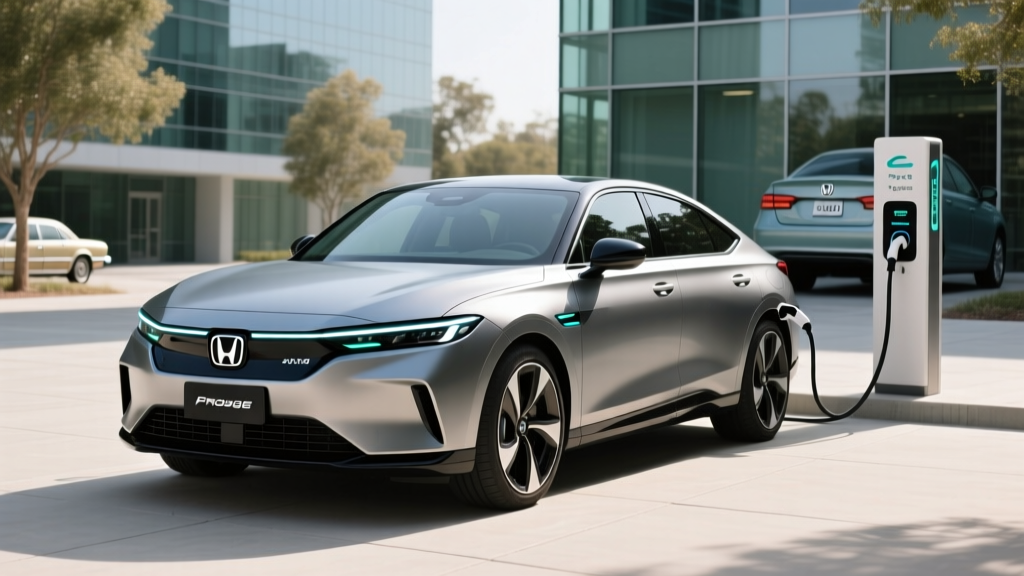
If you've been holding onto a mid-2000s sedan and researching the bolt pattern for 2004 Honda Accord wheels to find replacement rims, you might also be wondering whether it's time to trade that Accord for something electric. Honda's answer is the 2026 Honda Prologue, the brand's first mass-market battery-electric SUV built on GM's Ultium platform. It's a significant leap from the reliable-but-aging Accord, and this review breaks down every number you need to decide.
Quick Verdict: The Prologue's Place in Honda's Lineup
The 2026 Honda Prologue is a midsize two-row electric SUV that slots between the CR-V and Pilot in spirit, competing directly with the Hyundai Ioniq 5, Ford Mustang Mach-E, and Tesla Model Y. Honda leaned on GM's Ultium battery architecture, meaning you get proven cell chemistry, a widely shared service network, and competitive — if not class-leading — charging speeds. For loyal Honda owners migrating from an Accord, Civic, or even that long-running 2004 model whose bolt pattern (5x114.3 mm, for the record) you've memorized, the Prologue offers familiar ergonomics wrapped in an electric powertrain.
| Spec | EX (FWD) | Touring (AWD) |
|---|---|---|
| EPA Range | 308 mi | 283 mi |
| Battery (usable) | 85 kWh, NMC (Ultium) | 85 kWh, NMC (Ultium) |
| Horsepower / Torque | 212 hp / 236 lb-ft | 288 hp / 333 lb-ft |
| 0–60 mph | ~7.6 sec | ~5.9 sec |
| Drivetrain | FWD, single motor | AWD, dual motor |
| Max DC Fast Charge | 150 kW (peak) | 150 kW (peak) |
| 10–80% DCFC Time | ~34 min | ~34 min |
| Level 2 Charge Rate | 11.5 kW (~37 mi/hr) | 11.5 kW (~37 mi/hr) |
| MPGe (combined) | 107 MPGe | 95 MPGe |
| Efficiency | 31 kWh/100 mi | 35 kWh/100 mi |
| Cargo (behind rear seats) | 25.2 cu ft | 25.2 cu ft |
| Cargo (seats folded) | 57.7 cu ft | 57.7 cu ft |
| Rear Legroom | 39.8 in | 39.8 in |
| Battery Warranty | 8 yr / 100,000 mi | |
| Base MSRP | $47,500 | $57,900 |
Range and Efficiency: EPA Sticker vs. Real-World Driving
Honda uses GM's Ultium pouch cells in an NMC (nickel manganese cobalt) configuration, prioritizing energy density over the longer cycle life of LFP chemistry. The 85 kWh usable capacity is competitive with the segment — slightly less than the Ioniq 5 Long Range (84 kWh usable in a lighter package) but adequate for the Prologue's curb weight of roughly 4,900 lbs (FWD).
Efficiency lands at 31 kWh per 100 miles for the FWD model, which translates to 107 MPGe combined per fueleconomy.gov. That's mid-pack for the segment. The Hyundai Ioniq 5 RWD achieves 114 MPGe combined, while the heavier Ford Mustang Mach-E AWD Extended Range sits around 101 MPGe. The Prologue's boxier SUV profile and GM-sourced thermal management system explain the slight efficiency penalty versus sleeker competitors.
One practical note for Accord upgraders: if your daily commute was 30 miles round-trip, you were filling up that 2004 Accord every 10–12 days. With the Prologue, a single charge covers roughly two weeks of the same commute, and you'll do most of that "refueling" at home overnight.
Charging Speed: DC Fast Charging and Home Level 2
Charging speed is where Ultium-platform vehicles show their engineering priorities. The Prologue supports a 150 kW peak DC fast-charge rate via its CCS connector. In practice, the charge curve holds near peak between 10–40% state of charge, then tapers progressively. A 10–80% session takes approximately 34 minutes at a 150+ kW station. If you arrive at a 50 kW charger, that same session stretches to roughly 75 minutes.
For context, the Hyundai Ioniq 5 and Kia EV6 can peak at 240 kW on 800V architecture, achieving 10–80% in about 18 minutes. The Tesla Model Y peaks around 250 kW on V3 Superchargers. The Prologue's 150 kW ceiling is adequate for road trips with planned stops but noticeably slower than the class leaders.
| Charging Level | Power (kW) | Time / Rate | Best For |
|---|---|---|---|
| Level 1 (120V outlet) | ~1.4 kW | ~4 mi/hr added | Emergency / trickle top-up |
| Level 2 (240V home) | 11.5 kW | ~37 mi/hr; full charge in ~9 hr | Daily home charging |
| DC Fast Charge | 150 kW peak | 10–80% in ~34 min | Road trips, quick top-ups |
Home charging setup: The Prologue's onboard charger accepts up to 11.5 kW on Level 2, meaning you'll want a 48-amp hardwired Wall Connector or equivalent on a 60-amp circuit. Expect a full overnight charge to replenish the 85 kWh pack in roughly 9 hours. Honda includes a dual-level charge cord (120V/240V) that can deliver up to 3.3 kW on a standard NEMA 14-50 outlet — adequate for ~13 miles of range per hour, which works if your daily driving is under 60 miles.
Connector note: The 2026 Prologue ships with a CCS1 connector. Honda has announced future NACS (Tesla-style) adoption across its lineup, but for the 2026 model year, CCS remains the standard. Adapters for Tesla Supercharger access (J3400/NACS) are available through Honda dealers, expanding your public charging network significantly.
Performance and Driving Dynamics
The base FWD Prologue EX produces 212 horsepower and 236 lb-ft of torque from a single front-mounted motor. The 0–60 mph time of roughly 7.6 seconds is adequate for highway merging but won't thrill anyone coming from a sporty Accord V6. The dual-motor AWD Touring bumps output to 288 hp and 333 lb-ft, dropping the 0–60 to 5.9 seconds — more in line with what buyers expect from a modern electric SUV.
Ride quality is tuned for comfort over sportiness, which aligns with Honda's brand positioning. The suspension absorbs highway imperfections well, and cabin noise isolation is a significant upgrade from any 2004-era vehicle. Regenerative braking offers multiple levels selectable via paddle shifters behind the steering wheel, including a near-one-pedal-driving mode at the strongest setting. However, full one-pedal driving to a complete stop isn't as seamless as Tesla's or GM's own implementations in the Equinox EV.
Towing capacity is rated at 1,500 lbs across all trims — enough for a small utility trailer or a pair of dirt bikes, but not competitive with the Mach-E (up to 2,700 lbs) or the Rivian R1S. If towing is a priority, the Prologue isn't your best option.
Interior, Tech, and Daily Livability
Honda applied its own interior design language over the GM Ultium bones. The result is a cabin that feels more "Honda" than "GM parts bin," which matters for brand-loyal buyers. The Touring trim features an 11.3-inch touchscreen with Google Built-in (Google Maps, Google Assistant, Play Store), wireless Apple CarPlay and Android Auto, and a 12-speaker Bose audio system. Lower trims use an 11-inch screen with Honda's proprietary infotainment — functional but less polished than the Google-based system.
Driver assistance: The Prologue comes standard with Honda Sensing 360, which includes adaptive cruise control with stop-and-go, lane-keeping assist, blind-spot monitoring, and rear cross-traffic braking. This is a Level 2 SAE driver-assist system — it does not drive itself, and you must keep your hands on the wheel and eyes on the road at all times. It's competitive with Toyota Safety Sense and Subaru EyeSight but a step below GM's Super Cruise (hands-free on mapped highways) in terms of convenience. Notably, the Prologue does not currently offer Super Cruise, even though it shares the Ultium platform with vehicles that do.
Passenger space is generous: 39.8 inches of rear legroom beats the Ioniq 5 (39.4 in) and rivals the Model Y. The flat floor (no transmission tunnel) makes the middle rear seat genuinely usable for adults on short trips. Cargo volume at 25.2 cu ft behind the second row is competitive, expanding to 57.7 cu ft with seats folded. There is no front trunk (frunk), which is a missed opportunity for an EV and a differentiator that the Ioniq 5, Mach-E, and Model Y all exploit.
Pricing, Trims, and Federal Tax Credit Eligibility
The 2026 Prologue lineup spans three trims:
- EX (FWD): $47,500 MSRP
- Touring (AWD): $57,900 MSRP
- Elite (AWD): $59,400 MSRP (added premium features, panoramic roof)
Destination charges add approximately $1,395. As-tested pricing on a loaded Elite with premium paint lands around $61,500.
| Trim | MSRP | Max §30D Credit | Effective Price* |
|---|---|---|---|
| EX (FWD) | $47,500 | Up to $7,500 | ~$40,000 |
| Touring (AWD) | $57,900 | Up to $7,500 | ~$50,400 |
| Elite (AWD) | $59,400 | Up to $7,500 | ~$51,900 |
*Effective price assumes full $7,500 credit eligibility. Actual credit depends on buyer income, battery component sourcing, and MSRP caps. See IRS §30D guidelines for current-year rules. Point-of-sale transfer is available, reducing your dealer cost directly.
Tax credit eligibility nuances: The Prologue qualifies under the SUV MSRP cap of $80,000, so all trims clear that hurdle. However, the battery sourcing and critical minerals requirements under §30D can reduce or eliminate the credit depending on where the Ultium cells and their raw materials are sourced. For 2026, GM has worked to shift supply chains toward North American and free-trade-agreement partners, but the exact credit amount ($3,750 for critical minerals + $3,750 for battery components, or the full $7,500) varies. Always verify on the IRS qualified vehicles list before purchasing. Buyer income caps also apply: $150,000 single / $300,000 joint modified adjusted gross income.
Pros, Cons, and Who Should Buy the Prologue
Pros
- Familiar Honda interior ergonomics and build quality
- Competitive 308-mile EPA range (FWD)
- Spacious rear seat and cargo area for a midsize EV SUV
- Standard Honda Sensing 360 driver-assist suite
- Google Built-in infotainment on Touring/Elite trims
- 8-year/100,000-mile battery warranty
- Eligible for up to $7,500 federal tax credit (verify sourcing)
Cons
- 150 kW DC fast-charge peak is slower than Ioniq 5, EV6, Model Y
- No front trunk (frunk) — wasted EV packaging opportunity
- FWD base model feels underpowered at 212 hp
- No Super Cruise or hands-free driving option despite Ultium platform
- Efficiency (31 kWh/100 mi) trails sleeker competitors
- Towing limited to 1,500 lbs
Who the Prologue suits best: This EV is ideal for Honda-loyal commuters and small families who want a comfortable, tech-forward daily driver with enough range for weekend road trips. If you prioritize cabin familiarity, dealer proximity, and straightforward ownership over cutting-edge charging speed or performance, the Prologue delivers. It's less suited for buyers who frequently tow, who need the fastest possible DC charging for long-distance driving, or who want hands-free highway assist.
How the Prologue Stacks Up Against Key Competitors
Against the Hyundai Ioniq 5: The Ioniq 5 charges faster (240 kW peak, 10–80% in ~18 min), has a frunk, and offers slightly better efficiency. The Prologue counters with more rear legroom and Honda's dealer network.
Against the Tesla Model Y: The Model Y offers Supercharger network exclusivity (diminishing with NACS adoption), faster charging, Autopilot/FSD (Supervised), and a frunk. The Prologue wins on interior material quality and traditional dealer service access.
Against the Ford Mustang Mach-E: The Mach-E is sportier to drive, offers more power in GT trims, and tows up to 2,700 lbs. The Prologue is roomier in the back seat and quieter on the highway.
If you're upgrading from a long-running Honda like the 2004 Accord — and yes, that car's 5x114.3 mm bolt pattern means aftermarket wheel options are plentiful and cheap — the Prologue's appeal is continuity. You stay in the Honda ecosystem, gain electric drivetrain benefits, and get a modern safety and tech suite. The transition cost, after the federal tax credit, is roughly equivalent to what a well-equipped Pilot costs, making the value proposition compelling for buyers ready to electrify.
Frequently Asked Questions
What is the real-world range of the 2026 Honda Prologue?
The FWD EX achieves an EPA-rated 308 miles. Real-world highway driving at 70–75 mph yields approximately 255–275 miles. In freezing temperatures, expect 215–240 miles. The AWD Touring's EPA rating is 283 miles, with real-world highway range around 235–255 miles in mild conditions.
How fast does the Prologue charge at home and on DC fast chargers?
On a Level 2 home charger (240V, 48A), the Prologue charges at 11.5 kW, adding roughly 37 miles of range per hour and reaching a full charge in about 9 hours. On DC fast chargers, it peaks at 150 kW, achieving 10–80% in approximately 34 minutes.
Does the 2026 Honda Prologue qualify for the federal EV tax credit?
The Prologue is eligible for up to $7,500 under IRS §30D, subject to battery component and critical mineral sourcing requirements, buyer income caps ($150K single / $300K joint), and the $80,000 SUV MSRP cap (all trims qualify). Point-of-sale transfer is available. Verify current eligibility on the IRS qualified vehicles page before purchase.
Is the Prologue worth buying over the Hyundai Ioniq 5 or Tesla Model Y?
If you prioritize Honda's dealer network, interior familiarity, rear-seat space, and a traditional purchase experience, yes. If charging speed, performance, or hands-free driving tech matter more, the Ioniq 5 and Model Y have advantages. The Prologue is a comfort-oriented choice, not a technology-leading one.
What is the bolt pattern for the 2004 Honda Accord, and does it relate to the Prologue?
The 2004 Honda Accord uses a 5x114.3 mm (5x4.5 inch) bolt pattern with a 64.1 mm center bore and M12x1.5 lug nuts. The 2026 Prologue uses a different bolt pattern (5x120 mm) as it's built on GM's Ultium platform. Wheels are not interchangeable between the two vehicles.
What is the battery warranty on the Honda Prologue?
Honda covers the Prologue's Ultium battery pack for 8 years or 100,000 miles, whichever comes first, against defects and excessive capacity loss (typically defined as dropping below 60–70% of original capacity, per Honda's warranty documentation). The general vehicle warranty is 3 years/36,000 miles bumper-to-bumper and 5 years/60,000 miles powertrain.