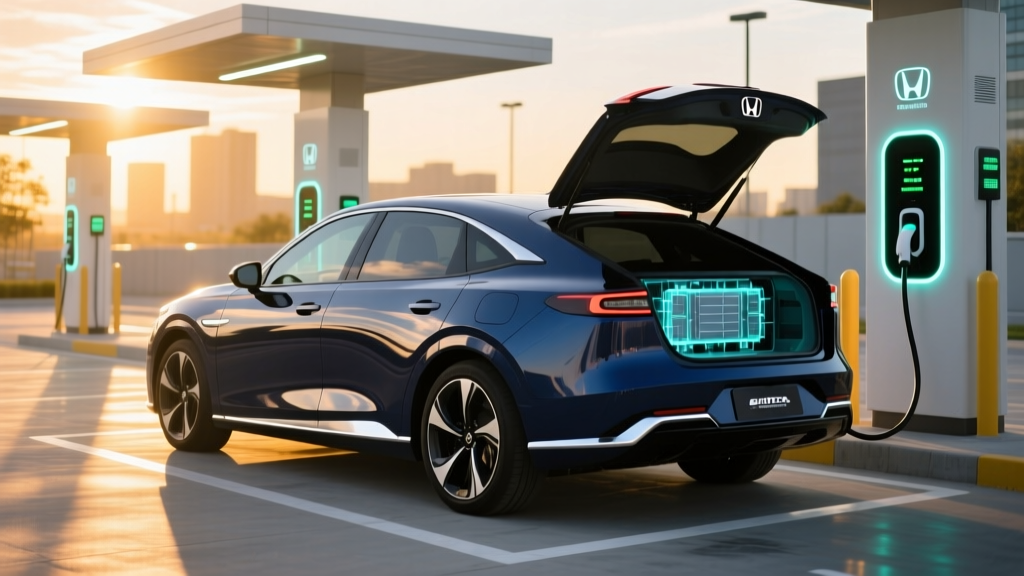
If you've been browsing automotive forums or dealer sites lately, you've likely seen the buzz around Honda Prologue EV lease deals. In 2024 and 2025, Honda aggressively subsidized leases on the Prologue—its first modern battery-electric vehicle built on GM's Ultium platform—effectively passing a $7,500 federal incentive through to lessees. But as we move deeper into 2026, the landscape has shifted. Lease cash has tightened, the EV tax credit has entered its final calendar year before scheduled phase-outs, and the math on whether to lease or buy a Prologue requires a sharper pencil.
This guide strips away the marketing gloss. We'll run the real 5-year ownership numbers, explain the specific IRS §30D and commercial clean vehicle credit rules that make leasing so attractive, and tell you exactly what a Prologue costs to fuel, insure, and maintain compared to a gas-powered Honda Passport.
The 2026 Honda Prologue: Current Lease Landscape
For the 2026 model year, the Honda Prologue remains a two-row midsize SUV sharing its bones (and 85 kWh usable Ultium battery) with the Chevrolet Blazer EV. EPA range stands at 296 miles for the FWD EX/Elite trims and 281 miles for the AWD Touring. Real-world highway driving at 70 mph typically yields 250–265 miles; expect a 15–20% drop in freezing temperatures.
As of early 2026, Honda's national lease cash on the Prologue has moderated from the staggering $12,000+ stack we saw in mid-2024. Current typical offers hover around $399–$479 per month for 36 months on the EX FWD trim with $3,999 due at signing, depending on region and dealer inventory. The critical factor: under the IRS commercial clean vehicle credit (IRC §45W), leasing companies can claim a $7,500 credit on leased EVs regardless of the lessee's income or the vehicle's battery sourcing, then pass that savings into the monthly payment. This "lease loophole" remains active for 2026 but is under ongoing legislative scrutiny.
Federal Tax Credit: Buy vs. Lease Rules for 2026
Understanding the two different federal incentive paths is essential before signing anything.
IRC §30D — Buying a Prologue (New Clean Vehicle Credit)
- Credit amount: Up to $7,500 ($3,750 for critical minerals + $3,750 for battery components).
- MSRP cap: Vehicle must have an MSRP ≤ $80,000 (SUVs/vans). Prologue qualifies.
- Buyer income cap (MAGI): $150k single / $225k head of household / $300k joint filers.
- Battery sourcing: Strict critical-mineral and component requirements that phase in annually. The Prologue's North American assembly helps, but verify current-year mineral sourcing compliance on the fueleconomy.gov credit lookup tool before purchasing.
- Point-of-sale transfer: You can transfer the credit to the dealer at purchase to reduce the cash price — dealer must be IRS-registered.
IRC §45W — Leasing a Prologue (Commercial Clean Vehicle Credit)
- Credit amount: Up to $7,500 claimed by the lessor (leasing company), typically passed to you as lease cash.
- No income cap for the lessee.
- No MSRP cap, no battery-sourcing restrictions.
- Caveat: The lessor is not legally required to pass the full $7,500 through. Always confirm the exact "lease cash" amount in writing before signing.
Rules are current for 2026 and subject to legislative change. Consult a tax professional and IRS.gov for your specific situation.
5-Year Total Cost of Ownership: Prologue vs. Honda Passport
Let's put the Prologue EX AWD (MSRP ~$50,400 before incentives) head-to-head with a comparably equipped Honda Passport EX-L AWD (MSRP ~$46,000) over 5 years and 75,000 miles.
| Cost Category | Honda Prologue EV (AWD) | Honda Passport (Gas AWD) |
|---|---|---|
| Purchase/Lease Cost (after incentives) | $42,900 net (with $7,500 credit applied) | $46,000 |
| Fuel/Energy (75k miles) | $4,500 (home charging @ $0.14/kWh, 3.0 mi/kWh) | $10,500 (@ $3.50/gal, 21 MPG combined) |
| Maintenance | $1,800 (cabin filter, wipers, tire rotation) | $4,200 (oil, filters, brakes, fluids) |
| Insurance (5-yr avg) | $11,500 | $8,800 |
| Depreciation (est. residual) | -$19,000 (45% retained value) | -$17,500 (62% retained value) |
| Total 5-Year Cost | $41,700 | $52,000 |
Assumptions: 15,000 miles/year, national avg electricity and gas rates. Your results vary by utility tariff, driving pattern, and local fuel prices. Source: fueleconomy.gov and AAA Your Driving Costs 2025.
Charging vs. Gas: The Per-Mile Math
The Prologue's efficiency averages 3.0 miles per kWh (roughly 112 MPGe combined). At the U.S. residential average of $0.16 per kWh (EIA, 2025), your fuel cost is approximately $0.053 per mile charging at home.
| Scenario | Cost per Mile | Cost per 300-mile Road Trip |
|---|---|---|
| Prologue — Home Level 2 ($0.16/kWh) | $0.053 | $15.90 |
| Prologue — DC Fast Charging ($0.45/kWh avg) | $0.150 | $45.00 |
| Honda Passport (21 MPG @ $3.50/gal) | $0.167 | $50.10 |
The takeaway: home charging is non-negotiable for EV savings. If you rely exclusively on public DC fast chargers, your per-mile cost approaches gas-car territory. The Prologue's peak DC charge rate of 150 kW (10–80% in ~32 minutes) is adequate but not class-leading, so plan road-trip stops accordingly.
Maintenance Savings: Where EVs Quietly Win
| Service Item | Prologue EV | Gas Passport |
|---|---|---|
| Engine oil changes | Never | Every 7,500 mi (~$60 ea) |
| Transmission fluid | Sealed, no scheduled change | Every 30k–60k mi |
| Brake pads | 100k+ mi (regen braking) | 30k–50k mi replacement |
| Spark plugs / ignition | N/A | Every 100k mi |
| Coolant / belts | Battery thermal loop, long interval | Periodic replacement |
| Cabin air filter | Every 15k–20k mi (~$30) | Every 15k–20k mi (~$30) |
Regenerative braking is the unsung hero here. Because the Prologue's motor handles most deceleration, mechanical brake wear is minimal. Many EV owners report original brake pads at 80,000+ miles. Over five years, expect to save $2,000–$2,500 in routine maintenance versus a comparable gas SUV.
The Insurance Reality Check
Here's where the Prologue costs more. EV insurance premiums typically run 15–25% higher than equivalent gas vehicles. Why?
- Higher repair costs: Battery pack damage often triggers total-loss thresholds; specialized high-voltage training is required for body shops.
- Parts cost: Ultium-specific components carry premium pricing and longer supply chains.
- Vehicle MSRP: Insurers factor replacement cost; the Prologue's ~$50k base price is higher than many gas alternatives.
Based on national averages, expect Prologue insurance around $2,200–$2,500/year for a clean-record driver in their 40s, versus roughly $1,750 for a Passport. Shop quotes from EV-friendly carriers (Tesla Insurance, Progressive, Geico) before signing — the spread can be $400+/year between insurers.
Depreciation and Resale Value Trends
EV depreciation has been volatile. Following the 2023–2024 price wars (led by Tesla) and rapid tech obsolescence, used EV values softened considerably. The Prologue, as a first-generation nameplate, faces additional uncertainty versus established EVs like the Model Y or Ioniq 5.
Current projections suggest a 3-year-old Prologue will retain 45–50% of MSRP, versus 55–65% for a gas Passport. This gap narrows if gas prices rise or if Honda issues battery-software updates that extend range. This is why leasing often makes more financial sense than buying the Prologue: you transfer depreciation risk to the lessor and can walk away at term.
State, Local, and Utility Incentives
Stack these on top of federal credits:
- California (CVRP): Up to $2,000 rebate for income-qualified buyers; $7,500 for low-income in disadvantaged communities.
- Colorado: State EV tax credit up to $5,000 (income-capped, phases down annually).
- New York (Drive Clean Plus): Up to $2,000 point-of-sale rebate for income-qualified residents.
- Utility rebates: Many co-ops and IOUs (PG&E, ConEd, Xcel) offer $500–$1,500 for home Level 2 charger installation or off-peak charging credits.
- HOV lane access: Available in CA, CO, FL, MD, and others for EVs — a substantial non-monetary perk in congested metros.
Incentives vary by ZIP code, income, and utility. Check afdc.energy.gov and your state energy office for current programs.
Verdict: Should You Lease the 2026 Prologue?
Lease the Prologue if:
- You earn above the §30D income caps and want the $7,500 benefit via the §45W lease loophole.
- You want to hedge against EV depreciation and battery tech obsolescence.
- You have reliable home Level 2 charging access.
- You plan to drive 10k–15k miles/year (within typical lease limits).
Buy (or consider alternatives) if:
- You qualify for the full §30D purchase credit and plan to keep the vehicle 8+ years.
- You drive 20k+ miles/year (lease penalties eat savings).
- You cannot install a home charger and would rely entirely on public DC fast charging.
Frequently Asked Questions
Can I buy out my Honda Prologue lease at the end?
Yes, Honda Financial Services typically offers a purchase option at the residual value stated in your contract. However, if EV values have dropped further, the residual may exceed market value — negotiate or walk away.
Does the Prologue qualify for the $7,500 federal tax credit if I buy it?
Possibly, but verify on fueleconomy.gov. The §30D credit depends on your MAGI, the vehicle's MSRP, and current-year battery sourcing requirements. Leasing sidesteps these restrictions via the §45W commercial credit.
How long does the Prologue battery last?
Honda warrants the Ultium battery for 8 years / 100,000 miles against defects and capacity loss below 70%. Real-world Ultium degradation data from GM siblings suggests 8–12% loss over 100k miles with normal use.
What's the real-world range of the 2026 Prologue?
EPA rates the FWD EX at 296 miles; AWD Touring at 281 miles. Expect 250–265 miles in mixed highway driving, and as low as 220–230 miles in sub-freezing weather without preconditioning.
Are Honda Prologue EV lease deals still good in 2026?
They've tightened versus the extraordinary 2024–2025 offers, but $399–$479/month with lease cash applied remains competitive in the midsize EV SUV segment. Always compare the total lease cost (monthly × term + due at signing + disposition fee) against a purchase with §30D applied.