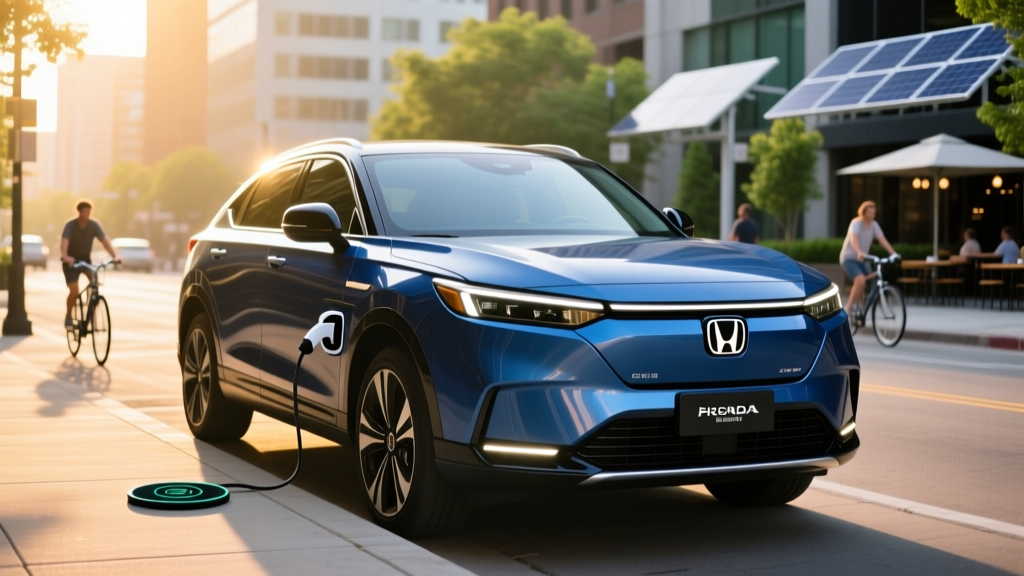
Honda's first mass-market electric SUV arrived as a collaboration rather than an in-house ground-up build. The Honda Prologue electric SUV rides on General Motors' Ultium platform — the same architecture underpinning the Chevrolet Blazer EV and Cadillac Lyriq — but wears Honda styling, tuning, and infotainment. For the 2026 model year, it remains Honda's only fully electric offering in the U.S., positioned as a two-row midsize crossover aimed squarely at families transitioning from the CR-V or Passport.
After spending time with the Prologue across highway commutes, suburban errands, and DC fast-charging stops, the picture is clear: this is a competent, comfortable electric cruiser with sensible range and competitive charging, but it trades some efficiency and tech polish against segment leaders like the Hyundai Ioniq 5 and Tesla Model Y. Here's every number that matters.
Spec Snapshot: Honda Prologue at a Glance
| Spec | EX (FWD) | Touring (AWD) |
|---|---|---|
| EPA Range | 308 miles | 283 miles |
| Battery (usable) | 85 kWh, NMC lithium-ion (Ultium) | |
| Powertrain | Single-motor FWD | Dual-motor AWD |
| Horsepower / Torque | 212 hp / 236 lb-ft | 288 hp / 332 lb-ft |
| 0–60 mph | ~7.5 sec | ~6.0 sec |
| Max DC Fast Charge | 150 kW peak | |
| 10–80% DCFC Time | ~35 minutes | |
| Level 2 Home Charging | 11.5 kW (~32 mi/hr) | |
| EPA Efficiency | 99 MPGe combined | 92 MPGe combined |
| Cargo (rear seats up/down) | 25.2 / 57.7 cu ft | |
| Base MSRP (incl. destination) | $48,300 | $57,100 |
| Battery/Powertrain Warranty | 8 years / 100,000 miles | |
Range and Efficiency: The Real-World Picture
The EPA rates the front-wheel-drive Prologue EX at 308 miles on a full charge, while the dual-motor Touring drops to 283 miles due to added weight and drivetrain losses. Honda uses an 85 kWh usable NMC (nickel-manganese-cobalt) Ultium battery pack across all trims — not the LFP chemistry found in some base-model competitors. NMC offers higher energy density, which helps the Prologue achieve its range in a relatively compact package, though it requires more careful thermal management over the long term.
EPA Sticker: 308 mi (FWD) / 283 mi (AWD)
Mixed highway driving (65–75 mph): Expect ~255–275 mi (FWD), ~235–255 mi (AWD)
Cold weather (below 32°F): Reduce EPA figures by 20–30%; ~215–245 mi (FWD)
City/regen-heavy driving: Can approach or slightly exceed EPA in mild temps
The Prologue lacks a heat pump — Honda uses resistive cabin heating, which increases energy draw noticeably in winter conditions. Preconditioning the cabin while plugged in is essential for preserving range in cold months.
Efficiency lands at 99 MPGe combined (34 kWh/100 mi) for FWD and 92 MPGe (37 kWh/100 mi) for AWD, per fueleconomy.gov. These figures trail the Hyundai Ioniq 5's 114 MPGe and the Tesla Model Y's 122 MPGe. The Prologue is a heavier, more traditionally shaped SUV, and that shows at the energy pump.
Charging Speed: DC Fast Charging and Home Setup
The Prologue peaks at 150 kW on a DC fast charger using its CCS connector. In practice, the charging curve holds near peak output from roughly 10% to 40% state of charge, then tapers progressively. Honda quotes a 10–80% charge in approximately 35 minutes under ideal conditions — competitive for the Ultium platform but slower than the Ioniq 5's 800-volt architecture (which achieves 10–80% in ~18 minutes at 240 kW).
| Charging Level | Power | Speed / Notes |
|---|---|---|
| Level 1 (120V household) | ~1.4 kW | ~4 miles per hour — emergency/trickle only |
| Level 2 (240V home) | 11.5 kW | ~32 miles per hour; full charge in ~9 hours |
| DC Fast Charge (CCS) | 150 kW peak | 10–80% in ~35 min; adds ~70 mi in 10 min at peak |
For home Level 2 charging, the Prologue's onboard charger accepts up to 11.5 kW on a 48-amp circuit. This means a full overnight replenishment from near-empty in about nine hours — standard for the class. A 200-amp electrical panel is typically sufficient for a Level 2 installation, though homes with older 100-amp service may require a panel upgrade ($1,500–$3,000) before adding a dedicated 60-amp EV circuit.
One practical note: the Prologue uses a CCS1 connector, not NACS (Tesla's plug). Honda has committed to transitioning future models to NACS, and adapters may become available, but as of the 2026 model year, Prologue owners rely on Electrify America, EVgo, ChargePoint, and other CCS-equipped networks for DC fast charging. Network reliability varies — plan road trips around verified charger availability.
Performance and Driving Impressions
The single-motor FWD Prologue delivers 212 horsepower and 236 lb-ft of torque — adequate for merging and passing but not thrilling. The 0–60 mph time of roughly 7.5 seconds feels relaxed for an EV, where instant torque usually masks modest power figures. The dual-motor AWD Touring upgrades to 288 hp and 332 lb-ft, dropping 0–60 to about 6.0 seconds, which feels substantially more responsive.
Ride quality is where the Prologue earns its Honda badge. The suspension tuning is compliant and composed — closer to a Passport than a sporty EV. Road noise is well-managed at highway speeds, and the steering is weighted appropriately, if not particularly communicative. Regenerative braking is adjustable via steering-wheel paddles, though the Prologue does not offer true one-pedal driving to a full stop in all modes — you'll still use the brake pedal regularly.
Towing capacity is rated at 1,500 pounds across all trims, which handles a small utility trailer or a pair of dirt bikes but rules out most camper trailers. This is typical for the segment, though the Ford Mustang Mach-E and Tesla Model Y offer similar or slightly higher ratings.
Interior, Cargo, and Technology
Inside, the Prologue borrows heavily from GM's parts bin — the 11.3-inch touchscreen and 11-inch digital instrument cluster are shared with the Blazer EV. The Google Built-in infotainment system includes native Google Maps navigation, Google Assistant, and Play Store apps. Wireless Apple CarPlay and Android Auto are standard. The system is functional and responsive, though the menu hierarchy requires some acclimation if you're coming from Honda's own interface in the CR-V or Accord.
Passenger space is generous for a two-row midsize SUV:
- Front legroom: 41.4 inches
- Rear legroom: 38.6 inches
- Cargo behind rear seats: 25.2 cu ft
- Cargo with rear seats folded: 57.7 cu ft
There is no front trunk (frunk) — the Ultium platform's packaging reserves that space for power electronics. A small under-floor storage bin in the rear cargo area helps organize charging cables and groceries.
The Honda Sensing suite of driver-assistance features is standard: adaptive cruise control with stop-and-go, lane-keeping assist, blind-spot monitoring, and automatic emergency braking. These are SAE Level 2 systems, meaning the driver must remain fully engaged with hands on the wheel and eyes on the road. Honda does not currently offer a hands-free highway driving system comparable to GM's Super Cruise or Ford's BlueCruise — a notable gap for a vehicle at this price point.
Pricing, Trims, and Federal Tax Credit Eligibility
The 2026 Honda Prologue is offered in three trims. Pricing includes destination:
| Trim | Drivetrain | MSRP | Est. Price After §30D Credit* |
|---|---|---|---|
| EX | FWD | $48,300 | ~$40,800 |
| Touring | AWD | $53,300 | ~$45,800 |
| Elite | AWD | $57,100 | ~$49,600 |
*Federal tax credit estimates assume full eligibility. Actual credit depends on IRS §30D requirements — see below.
- MSRP cap: SUVs/vans/pickups must be ≤ $80,000 — all Prologue trims qualify ✓
- Buyer income cap: AGI ≤ $150,000 (single) / $300,000 (joint) / $225,000 (head of household)
- Battery sourcing: Critical minerals and battery components must meet phased-in domestic/free-trade-agreement thresholds — verify current-year compliance on irs.gov before purchasing
- Point-of-sale transfer: Eligible buyers can apply the credit as an upfront discount at the dealer, reducing the purchase price immediately rather than waiting for tax filing
- New vs. used: §30D applies to new vehicles; a separate §25E credit of up to $4,000 exists for used EVs
As-tested, a well-equipped Prologue Elite with all-wheel drive and metallic paint lands near $58,500 before incentives. With the full $7,500 credit applied at point of sale, that drops to roughly $51,000 — still a premium over a loaded CR-V Hybrid but competitive with equivalently trimmed electric rivals.
Warranty and Long-Term Ownership
Honda backs the Prologue with:
- Battery & drive unit warranty: 8 years / 100,000 miles (covers capacity loss below 70% state of health)
- New vehicle limited warranty: 3 years / 36,000 miles
- Corrosion warranty: 5 years / unlimited miles
- Roadside assistance: 3 years / 36,000 miles
The 70% capacity retention threshold is industry-standard and matches GM's Ultium warranty terms. Real-world Ultium degradation data is still accumulating, but early reports from Lyriq and Blazer EV owners suggest modest degradation of 3–5% over the first 30,000 miles — within expectations for NMC chemistry with active liquid thermal management.
How the Prologue Stacks Up Against Key Rivals
| Spec | Honda Prologue (FWD) | Hyundai Ioniq 5 (RWD LR) | Tesla Model Y (LR) |
|---|---|---|---|
| EPA Range | 308 mi | 303 mi | 330 mi |
| Battery | 85 kWh (NMC) | 77.4 kWh (NMC) | ~75 kWh (NMC) |
| Peak DCFC | 150 kW | 240 kW (800V) | 250 kW |
| 10–80% Time | ~35 min | ~18 min | ~25 min |
| Efficiency (MPGe) | 99 combined | 114 combined | 122 combined |
| Base MSRP | $48,300 | $46,650 | $46,630 |
| Connector | CCS1 | CCS1 / NACS (2025+) | NACS |
| Cargo (seats up) | 25.2 cu ft | 27.2 cu ft | 30.2 cu ft |
The Prologue's advantage lies in its ride comfort, Honda brand trust among mainstream buyers, and straightforward dealership service network. Where it loses ground: charging speed (the Ioniq 5's 800V architecture is meaningfully faster on road trips), efficiency (the Model Y and Ioniq 5 both extract more miles per kWh), and cargo volume. If you prioritize road-trip charging speed above all else, the Ioniq 5 or Model Y are stronger picks. If you value a quiet, comfortable ride and plan to charge mostly at home, the Prologue holds its own.
- Comfortable, composed ride quality
- 308-mi EPA range (FWD) is competitive
- Spacious rear seat and good visibility
- Google Built-in infotainment with native navigation
- All trims under the $80K MSRP cap for §30D credit
- Honda dealer network for service familiarity
- 150 kW peak DCFC is slower than rivals
- No heat pump — cold-weather range suffers
- Efficiency trails Ioniq 5 and Model Y
- No hands-free driving system (Level 2 only)
- CCS-only connector; no native NACS access
- No frunk for cable/gear storage
- Infotainment is GM-sourced, not Honda-native
Who Should Buy the Honda Prologue?
Choose the Prologue if: You want a comfortable, family-oriented electric SUV with 300+ miles of range, prioritize ride quality over sportiness, charge primarily at home, and trust the Honda brand for long-term ownership. It's a strong fit for CR-V upgraders who want to go electric without a steep learning curve.
Look elsewhere if: You road-trip frequently and need the fastest possible DC charging (consider the Ioniq 5 or Model Y), you live in a cold climate where a heat pump matters for winter range, you want access to the Tesla Supercharger network natively, or you need maximum cargo space for hauling gear.
Frequently Asked Questions
What is the real-world range of the Honda Prologue?
The EPA rates the FWD Prologue at 308 miles and the AWD at 283 miles. In real-world highway driving at 70–75 mph, expect roughly 255–275 miles (FWD) or 235–255 miles (AWD). In freezing temperatures, reduce those figures by 20–30% due to the lack of a heat pump and increased cabin heating demand.
How fast does the Prologue charge at home and on the road?
On a Level 2 home charger (240V, 48A), the Prologue accepts up to 11.5 kW, adding about 32 miles of range per hour and fully recharging overnight in ~9 hours. On a DC fast charger, it peaks at 150 kW and charges from 10–80% in approximately 35 minutes. That's adequate but noticeably slower than 800-volt competitors like the Ioniq 5.
Does the Honda Prologue qualify for the $7,500 federal tax credit?
All Prologue trims fall under the $80,000 MSRP cap for SUVs, making them potentially eligible for the full $7,500 §30D credit. However, eligibility also depends on your adjusted gross income (≤$150K single / ≤$300K joint), the vehicle's battery critical-mineral and component sourcing meeting current-year thresholds, and purchasing new. Verify on irs.gov and consult a tax professional before relying on the credit.
Is the Honda Prologue worth buying over the Tesla Model Y or Hyundai Ioniq 5?
It depends on your priorities. The Prologue offers a more comfortable ride and Honda's dealer network but charges slower, has lower efficiency, and lacks Supercharger access. The Model Y leads in range, efficiency, and charging infrastructure. The Ioniq 5 charges fastest and offers the best value. If comfort and brand familiarity matter most, the Prologue is a solid choice; if specs and road-trip practicality lead your decision, look at the alternatives.
Does the Prologue have a front trunk (frunk)?
No. The Ultium platform's power electronics occupy the space where a frunk would typically be. You'll store charging cables in the rear cargo area's under-floor bin.
What is the battery warranty on the Honda Prologue?
Honda covers the battery and drive unit for 8 years or 100,000 miles, whichever comes first. The warranty guarantees the battery will retain at least 70% of its original capacity during that period. If degradation exceeds 30%, Honda will repair or replace the battery pack at no cost.