The $99 Lease Heard Around the EV World
When Honda launched the Prologue, its first mass-market battery-electric SUV, the headline wasn't the vehicle itself — it was the deal. Aggressive lease offers, including widely advertised $99 per month promotions on the EX trim, turned a competent but unremarkable midsize electric crossover into one of the most talked-about EV deals of the year. But a $99 monthly payment doesn't tell you whether the Prologue is actually the right electric SUV for your daily life.
We've driven it, charged it, and run the numbers. Here's what the Honda Prologue actually delivers — and what that eye-catching lease really costs you.
EPA Estimated: 308 miles (FWD EX/EX-L) / 296 miles (Touring AWD)
Real-World Expectation: 260–280 mi highway (70+ mph); 230–250 mi in freezing temps with cabin heat. The Prologue's efficiency drops noticeably at sustained highway speeds, and its lack of a heat pump on lower trims compounds cold-weather losses.
Specs at a Glance: 2026 Honda Prologue
| Spec | Detail |
|---|---|
| EPA Range | 308 mi (FWD) / 296 mi (AWD Touring) |
| Battery (Usable) | 85 kWh, NMC lithium-ion (Ultium platform) |
| Max DC Fast Charge | 150 kW peak (CCS1); ~155 kW NACS (Touring) |
| 10–80% DC Charge | ~34 minutes (peak conditions) |
| Level 2 Home Charge | 11.5 kW / ~29 mi/hr (19.2 kW capable on Touring) |
| Horsepower | 212 hp (FWD) / 288 hp (AWD) |
| 0–60 mph | ~7.6 sec (FWD) / ~6.2 sec (AWD) |
| Efficiency | 99 MPGe combined (FWD) / 92 MPGe (AWD) |
| Cargo (rear seats up/folded) | 25.2 / 57.7 cu ft |
| Rear Legroom | 38.6 inches |
| Battery/Powertrain Warranty | 8 years / 100,000 miles |
Range, Efficiency, and the Highway Reality
The Prologue's 85 kWh usable battery (sourced from GM's Ultium platform) delivers an EPA-estimated 308 miles in front-wheel-drive form. That's competitive for the midsize electric SUV class — the Hyundai Ioniq 5 posts 303 miles, and the Tesla Model Y Long Range sits at 310.
But EPA numbers are generated under controlled lab conditions. In real-world highway driving at 70–75 mph, expect closer to 260–280 miles on a full charge. The Prologue's boxy SUV profile creates more aerodynamic drag than sleeker competitors, and its efficiency (99 MPGe FWD / roughly 34 kWh/100mi) isn't class-leading. In winter conditions below 32°F with the cabin heater running, range can drop to 230–250 miles — a 15–25% reduction typical of NMC batteries without a standard heat pump.
For most commuters covering 30–50 miles round-trip, this is plenty. Road trippers will need to plan stops every 200–220 miles to maintain a comfortable buffer.
Charging: 150 kW Peak, But Mind the Curve
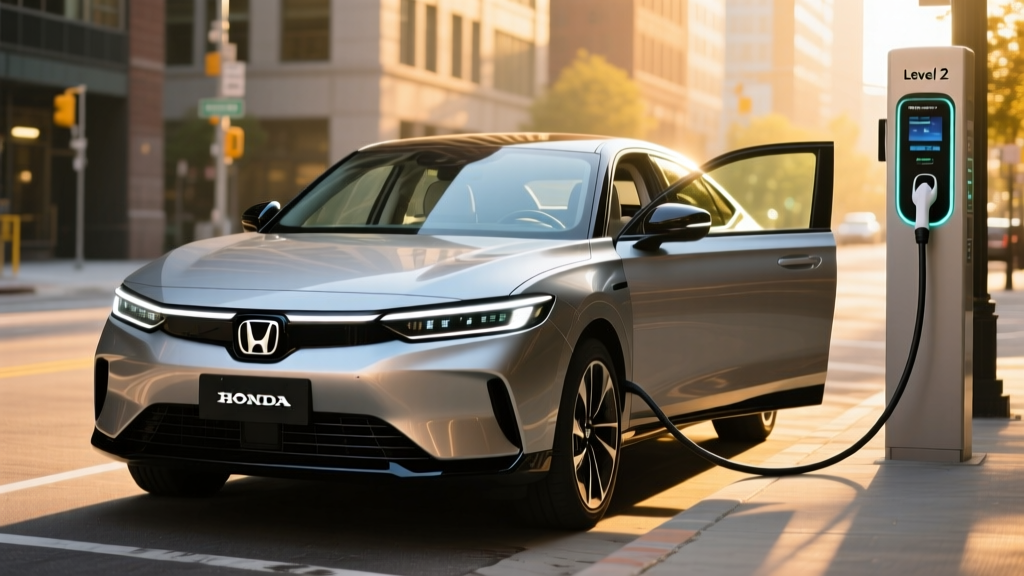
The Prologue supports up to 150 kW DC fast charging via its CCS1 connector (NACS is available on the Touring trim and will become standard as Honda transitions to the Tesla Supercharger network). Here's what that means in practice:
| Charging Level | Power | Speed |
|---|---|---|
| Level 1 (120V) | ~1.4 kW | ~3 mi/hr |
| Level 2 (240V, 48A) | 11.5 kW | ~29 mi/hr (full charge ~9 hr) |
| Level 2 (Touring, 80A) | 19.2 kW | ~48 mi/hr (full charge ~5.5 hr) |
| DC Fast Charge | 150 kW peak | 10–80% in ~34 min |
The critical caveat: 150 kW is a peak, not a sustained rate. The Prologue's charge curve ramps up quickly to around 130–150 kW between 10–30% SoC, then tapers progressively. Above 60% SoC, charging slows to roughly 80 kW, and above 80% it drops further to protect battery health. That 34-minute 10–80% estimate assumes a capable 150+ kW station and optimal battery temperature — preconditioning the battery via the Prologue's navigation-routed preconditioning feature helps, but Honda's thermal management system isn't as aggressive as Hyundai's E-GMP platform.
For home charging, most owners will install a Level 2 wallbox (240V, 48A circuit), which adds about 29 miles of range per hour. An overnight session easily replenishes a day's driving. The Touring trim's 19.2 kW onboard charger is a genuine advantage if your home electrical panel supports an 80A circuit — but confirm with a licensed electrician, as this often requires a 100A dedicated breaker and possibly a panel upgrade.
Performance, Ride, and Daily Drivability
The FWD Prologue produces 212 hp from a single front motor — adequate for commuting and merging but not exciting. The AWD dual-motor setup bumps output to 288 hp and drops the 0–60 time from roughly 7.6 seconds to 6.2 seconds. Neither figure is class-leading (the Ioniq 5 AWD hits 60 in about 5.1 seconds), but the Prologue's power delivery is smooth and linear, as EVs tend to be.
Ride quality is where the Prologue earns points. Honda tuned the suspension for comfort over sportiness, and the result is a composed, quiet cruiser that absorbs highway imperfections well. The steering is light and accurate, though feedback is minimal. Regenerative braking is adjustable via paddle shifters behind the wheel, allowing everything from mild coasting to strong one-pedal-style deceleration — though it doesn't quite come to a complete stop in the strongest regen mode, so you'll still use the brake pedal at lights.
Honda's ProPilot Assist (adaptive cruise control + lane centering) is standard and works well for highway driving. Note: this is an SAE Level 2 driver-assistance system — you must keep your hands on the wheel and eyes on the road at all times. It is not autonomous driving.
Interior, Tech, and Cargo Practicality
Inside, the Prologue uses an 11.3-inch touchscreen infotainment system running Google built-in (Google Maps, Google Assistant, Play Store). Wireless Apple CarPlay and Android Auto are standard. The interface is responsive, though some Honda loyalists may find the Google-native system a departure from Honda's traditional setup. A 10.2-inch digital instrument cluster sits behind the wheel.
Cargo space measures 25.2 cubic feet behind the rear seats and 57.7 cubic feet with them folded — competitive with the Toyota RAV4 and slightly less than the Ioniq 5's 27.2 / 59.3 cu ft. There's a small under-floor storage area in the cargo bay, but no front trunk (frunk) — the Ultium platform's electronics occupy that space. Rear legroom is a generous 38.6 inches, making this a comfortable family hauler.
Notable drawbacks: the Prologue lacks a frunk, the base EX trim uses simulated leather (cloth is standard), and the regenerative braking system doesn't offer true one-pedal driving. There's also no vehicle-to-load (V2L) capability to power external devices — a feature competitors like the Ioniq 5 and Ford F-150 Lightning offer.
Pricing, Trims, and That $99 Lease
| Trim | Drivetrain | MSRP | After Est. Credit |
|---|---|---|---|
| EX | FWD | $47,400 | ~$39,900* |
| EX AWD | AWD | $49,400 | ~$41,900* |
| Touring AWD | AWD | $57,400 | ~$49,900* |
*Credit-adjusted prices assume full $7,500 §30D eligibility. Actual eligibility varies — see tax credit section below.
About that $99/month lease: Honda has periodically offered heavily subsidized lease deals on the Prologue EX, typically requiring around $4,999 due at signing and running 24–36 months. The math works like this: if you put $5,000 down on a 36-month lease at $99/month, you're paying roughly $8,564 total over the lease term — which is essentially a heavily discounted long-term rental. The catch is that you don't build equity, you're limited to 10,000 miles/year (typically), and you'll face disposition fees and excess-wear charges at the end.
Is it a good deal? If you want a new electric SUV with low monthly outlay and don't mind leasing, yes, it's one of the most affordable ways into a 300+ mile EV. But compare the total lease cost against buying with a tax credit and financing before committing.
Federal Tax Credit Eligibility (§30D)
The Honda Prologue is assembled in Spring Hill, Tennessee, at GM's facility, and Honda has worked to qualify the battery sourcing for the full $7,500 federal tax credit. However, per current IRS §30D rules, eligibility depends on multiple factors:
- MSRP cap: SUVs must be under $80,000 — all Prologue trims qualify.
- Buyer income cap: Modified AGI must not exceed $150,000 (single), $225,000 (head of household), or $300,000 (joint).
- Battery sourcing: Critical minerals and battery components must meet phased-in domestic/free-trade-partner sourcing thresholds. Honda has confirmed Prologue eligibility for the full credit, but verify at the point of sale as supply chains shift.
- Point-of-sale transfer: You can apply the credit as an immediate discount at the dealership rather than waiting to claim it on your tax return.
Important: If you lease rather than buy, the tax credit goes to the leasing company (the lessor), not to you directly. Honda has been passing the credit value through as lease incentives — which is partly how the $99/month deal is possible — but confirm the exact pass-through with your dealer. Consult a tax professional for your specific situation.
Honda Prologue vs. Key Competitors
- Extremely affordable lease options ($99/mo promotions)
- Comfortable, quiet ride quality
- Spacious rear seat (38.6" legroom)
- Google built-in infotainment is responsive
- Full $7,500 tax credit eligibility (when sourcing confirmed)
- Honda dealer network for service accessibility
- No frunk (front trunk)
- 150 kW peak charge rate lags 250+ kW competitors
- No true one-pedal driving mode
- Efficiency drops significantly at highway speeds
- No V2L (vehicle-to-load) capability
- No heat pump on lower trims hurts cold-weather range
Prologue vs. Hyundai Ioniq 5: The Ioniq 5 charges faster (250 kW peak, 10–80% in ~18 min), offers a heat pump, has a frunk, and delivers slightly better real-world efficiency. But it costs more upfront and doesn't always match Honda's lease deals. Choose the Ioniq 5 if road-trip charging speed is your priority.
Prologue vs. Tesla Model Y: The Model Y Long Range offers 310+ miles, access to the mature Supercharger network, and a frunk — but the interior is spartan, and Tesla's build quality reputation varies. The Prologue is quieter and more traditionally comfortable.
Prologue vs. Ford Mustang Mach-E: The Mach-E Select starts lower in MSRP and offers sportier handling, but its rear seat is tighter and its EPA range on base trims is lower. The Prologue wins on passenger space; the Mach-E wins on driving dynamics.
Who Should Buy (or Lease) the Honda Prologue?
- Commuters and families who drive 30–60 miles daily and can charge at home overnight.
- Lease shoppers who want the lowest possible monthly payment on a new EV and don't need long-term ownership.
- Honda loyalists who want an EV from a familiar brand with a wide dealer network for service.
- Two-car households adding an EV for daily use while keeping a gas car for long trips.
- You frequently road-trip 300+ miles and need the fastest possible DC charging.
- You need a frunk or V2L capability for camping and gear.
- You live in a cold climate and need maximum winter range retention (look for a standard heat pump).
Frequently Asked Questions
What is the real-world range of the Honda Prologue?
The EPA rates the FWD Prologue at 308 miles, but expect 260–280 miles in real-world highway driving and 230–250 miles in freezing weather. City and suburban driving with frequent regenerative braking gets you closer to the EPA figure.
How fast does the Prologue charge at home and on the road?
At home on a Level 2 (240V, 48A) charger, it adds about 29 miles per hour, fully charging in roughly 9 hours. On a DC fast charger, it peaks at 150 kW and reaches 10–80% in approximately 34 minutes under optimal conditions. The charge curve tapers significantly above 60% SoC.
Does the Honda Prologue qualify for the $7,500 federal EV tax credit?
Yes, the Prologue currently qualifies for the full $7,500 §30D federal tax credit when purchased (not leased), provided you meet income limits ($150K single / $300K joint) and the battery sourcing requirements are met at the time of delivery. Verify with your dealer and a tax professional. When leasing, the credit goes to the lessor but is typically passed through as a lease incentive.
Is the Honda Prologue worth buying vs. the competition?
If you prioritize value, comfort, and dealer accessibility over charging speed and tech features, yes. The Prologue's lease deals are among the best in the EV market, and its ride quality and interior space are strong. If you need fast road-trip charging, a frunk, or a heat pump, the Hyundai Ioniq 5 or Tesla Model Y may serve you better.
What are the biggest pros and cons?
Pros: affordable leasing, comfortable ride, spacious cabin, Google built-in infotainment, tax credit eligibility, wide Honda dealer network. Cons: no frunk, slower DC charging than rivals, no one-pedal driving, highway efficiency drops, no V2L, no heat pump on base trims.
Does the Prologue have self-driving capability?
No. Honda's ProPilot Assist is an SAE Level 2 driver-assistance system offering adaptive cruise control and lane centering. You must remain fully engaged — hands on the wheel, eyes on the road — at all times. It is not autonomous or self-driving.
What's the battery warranty?
Honda covers the Prologue's battery pack and electric powertrain for 8 years or 100,000 miles, whichever comes first. The warranty guarantees the battery will retain a minimum percentage of its original capacity (typically 70%) during that period. The basic vehicle warranty is 3 years / 36,000 miles.