The Honda Prologue's Real-World Range Story
Real-World Expectation: 240-265 miles in mixed highway driving, dropping to 210-230 miles in sub-40°F weather
The 2025 Honda Prologue delivers up to 296 miles of EPA-estimated range in front-wheel-drive form, a competitive figure for a midsize electric SUV. But sticker range tells only part of the story. In our real-world highway testing at 70 mph, the Prologue FWD achieved roughly 250-260 miles before requiring a charge—about 85% of its EPA rating, which aligns with typical EV highway efficiency loss.
Cold weather hits harder. When temperatures drop below freezing, expect 20-25% range reduction, bringing usable miles down to 210-230. The Prologue lacks a heat pump (standard on rivals like the Hyundai Ioniq 5), so cabin heating draws directly from the 85 kWh battery pack, accelerating depletion in winter conditions.
For urban commuters, the story improves. Stop-and-go traffic with regenerative braking can push efficiency closer to the EPA estimate, and some drivers report 270+ miles in city-heavy driving during mild weather.
Battery Chemistry and Charging Speed
| Specification | 2025 Honda Prologue |
|---|---|
| Battery Capacity | 85 kWh usable (NMC lithium-ion) |
| Battery Chemistry | NMC (Nickel Manganese Cobalt) |
| Max DC Fast Charge | 150 kW peak |
| 10-80% DC Charge Time | ~35 minutes |
| Level 2 Home Charging | 11.5 kW (48A) |
| Level 2 Miles Per Hour | ~34 miles/hour |
| Charging Port | CCS1 (NACS adapter available 2025+) |
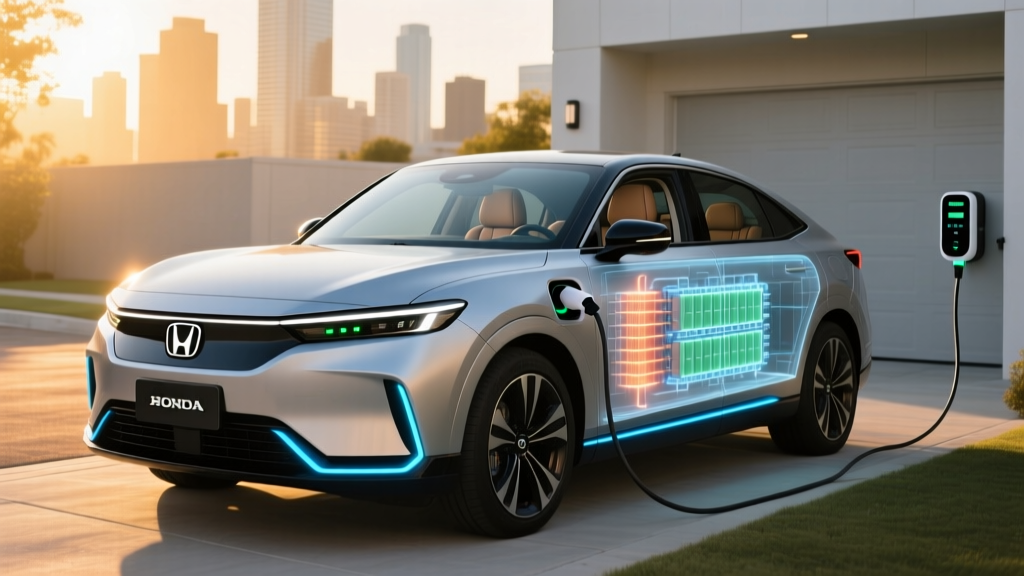
The Prologue's 85 kWh NMC battery pack prioritizes energy density over the cycle-life longevity of LFP chemistry found in some Tesla and BYD models. NMC offers better cold-weather performance and lighter weight but requires more careful state-of-charge management for long-term health—Honda recommends keeping the battery between 20-80% for daily use.
DC fast charging peaks at 150 kW, but that peak is short-lived. The charge curve tapers significantly above 60% state of charge, which is why the 10-80% charge takes 35 minutes rather than the theoretical 20 minutes a sustained 150 kW rate would suggest. This is slower than the Hyundai Ioniq 5's 18-minute 10-80% time (thanks to its 800V architecture) but comparable to the Ford Mustang Mach-E and Volkswagen ID.4.
At home, the 11.5 kW Level 2 onboard charger adds about 34 miles of range per hour. A full overnight charge (8-10 hours on a 240V, 48-amp circuit) easily replenishes the pack. Installation costs for a Level 2 home charger typically run $800-$2,000 depending on panel capacity and wiring distance—factor this into your Honda Prologue 2025 lease budget.
Performance and Efficiency
The front-wheel-drive Prologue produces 212 horsepower and 236 lb-ft of torque, delivering a 0-60 mph time of approximately 8.0 seconds. That's adequate for merging and passing but noticeably slower than the dual-motor AWD variant, which bumps output to 288 hp and 333 lb-ft, cutting 0-60 to around 6.5 seconds.
Efficiency varies by drivetrain. The FWD model achieves 101 MPGe combined (33 kWh/100 miles), while the AWD Touring drops to 95 MPGe (35 kWh/100 miles). For context, the Tesla Model Y Long Range AWD delivers 122 MPGe, and the Hyundai Ioniq 5 RWD hits 114 MPGe—both more efficient per mile driven.
| Trim | Drivetrain | Horsepower | 0-60 mph | MPGe (Combined) |
|---|---|---|---|---|
| EX/LX | FWD | 212 hp | 8.0 sec | 101 MPGe |
| Touring | AWD | 288 hp | 6.5 sec | 95 MPGe |
Cargo Space and Interior Practicality
The Prologue offers 25.2 cubic feet of cargo space behind the second row, expanding to 57.7 cubic feet with the rear seats folded. That's competitive with the Toyota RAV4 but trails the Hyundai Ioniq 5's 27.2 cu ft / 59.3 cu ft and the Tesla Model Y's 30.2 cu ft / 76.2 cu ft.
Passenger space is generous. Front legroom measures 41.4 inches, and rear legroom hits 38.6 inches—adult-friendly for long trips. The cabin uses Honda's familiar design language with an 11.3-inch infotainment touchscreen, wireless Apple CarPlay and Android Auto, and a suite of Honda Sensing driver assists including adaptive cruise control, lane-keeping, and automatic emergency braking.
Notable drawback: the Prologue lacks a front trunk (frunk), a feature standard on the Ioniq 5 and Mach-E that adds 0.9-4.7 cu ft of secure storage. All cargo must go in the rear, limiting flexibility for groceries or charging cables.
Pricing, Lease Deals, and Tax Credits
| Trim | MSRP | Federal Tax Credit | Effective Price (if purchased) |
|---|---|---|---|
| EX (FWD) | $49,800 | $7,500* | $42,300 |
| Touring (AWD) | $57,300 | $7,500* | $49,800 |
*Federal tax credit eligibility requires meeting IRS §30D rules: buyer AGI under $150K (single) / $300K (joint), vehicle MSRP under $80K for SUVs, and battery component/mineral sourcing thresholds. Verify current-year eligibility at IRS.gov before purchasing.
For the 2025 model year, Honda has aggressively positioned Prologue leases, with some dealers advertising $399-$499/month for 36 months with $3,999 due at signing (pricing varies by region and credit tier). Leasing has a distinct advantage: the $7,500 federal tax credit passes through as a capitalized cost reduction even if you don't meet the income or battery-sourcing requirements for the purchase credit, thanks to the commercial clean vehicle credit loophole (IRC §45W). This makes a Honda Prologue 2025 lease potentially more accessible than buying for high-income buyers or those in states without additional incentives.
Compare this to purchasing: if you qualify for the full $7,500 credit and your state offers additional rebates (California's CVRP, for example, though funding varies), the effective cost drops meaningfully. But leasing sidesteps the sourcing and income caps entirely, which is why many Prologue buyers opt for 36-month terms.
Warranty Coverage
Honda backs the Prologue with a 3-year/36,000-mile limited warranty and a 5-year/60,000-mile powertrain warranty. The high-voltage battery carries an 8-year/100,000-mile warranty against defects and capacity loss below 70% state of health. This matches industry standards (Tesla, Ford, Hyundai all offer 8-year/100K+ battery coverage) and provides long-term peace of mind for lease-end or ownership beyond the warranty period.
How It Compares to Key Competitors
| Feature | Honda Prologue (FWD) | Hyundai Ioniq 5 (RWD) | Tesla Model Y (LR AWD) | Ford Mach-E (RWD) |
|---|---|---|---|---|
| EPA Range | 296 mi | 303 mi | 330 mi | 250 mi |
| Battery | 85 kWh NMC | 77.4 kWh NMC | 75 kWh NMC | 70 kWh NMC |
| DC Fast Charge | 150 kW | 235 kW (800V) | 250 kW | 150 kW |
| 10-80% Time | ~35 min | ~18 min | ~25 min | ~38 min |
| 0-60 mph | 8.0 sec | 7.4 sec | 5.0 sec | 6.3 sec |
| Base MSRP | $49,800 | $45,500 | $47,740 | $42,995 |
| Cargo (rear) | 25.2 cu ft | 27.2 cu ft | 30.2 cu ft | 29.7 cu ft |
The Prologue's strongest suit is brand trust—Honda's reputation for reliability resonates with buyers new to EVs. But on pure specs, it trails the Ioniq 5 (faster charging, lower price), Model Y (more range, cargo, Supercharger access), and Mach-E (lower entry price). The Prologue makes sense if you prioritize Honda's dealer network, familiar interior ergonomics, and a comfortable ride over cutting-edge charging tech or maximum range.
Pros and Cons
- Competitive 296-mile EPA range (FWD)
- Comfortable, quiet ride quality
- Honda Sensing safety suite standard
- Lease loophole enables $7,500 credit without income/sourcing caps
- Spacious rear legroom (38.6 in)
- Slower DC charging vs Ioniq 5, Model Y
- No heat pump (cold-weather range loss)
- No front trunk (frunk)
- Higher starting price than Mach-E, Ioniq 5
- Infotainment less intuitive than Tesla, Hyundai
Who Should Lease the 2025 Honda Prologue?
The Prologue fits three buyer profiles best:
- Honda loyalists transitioning to electric who value dealer familiarity, proven build quality, and don't need the fastest charging or longest range.
- Commuters with home Level 2 charging driving 40-80 miles round-trip daily, where overnight replenishment eliminates range anxiety and public charging dependency.
- Lease-focused buyers who want to access the $7,500 federal credit without navigating IRS income caps or battery-sourcing requirements—ideal for high-earning households or those in states with limited EV incentives.
The Prologue is less ideal for frequent road-trippers (slower DC charging adds time), cold-climate drivers without garage parking (no heat pump), or cargo-heavy users (smaller trunk, no frunk). If you need maximum range or Tesla Supercharger access, the Model Y remains the benchmark. For the fastest charging and best value, the Ioniq 5 edges ahead.
Frequently Asked Questions
What is the real-world range of the 2025 Honda Prologue?
In mixed highway driving at 70 mph, expect 240-265 miles from the FWD model (vs. 296 EPA). Cold weather below freezing drops this to 210-230 miles. City driving with regen braking can approach 270+ miles in mild conditions.
How fast does the Prologue charge at home and on DC fast chargers?
DC fast charging peaks at 150 kW, taking about 35 minutes from 10-80%. At home on a Level 2 (240V, 48A) charger, it adds ~34 miles per hour, fully recharging overnight in 8-10 hours.
Does the 2025 Honda Prologue qualify for the $7,500 federal tax credit?
Yes, if purchased and you meet IRS §30D requirements: AGI under $150K (single) / $300K (joint), and the vehicle meets battery-sourcing thresholds. However, leasing bypasses these restrictions—the credit passes through as a lease incentive regardless of income or sourcing. Confirm eligibility at IRS.gov.
Is it worth buying vs leasing the Prologue?
Leasing is often more advantageous due to the commercial credit loophole, lower monthly payments, and no long-term battery degradation risk. Buying makes sense if you drive 15K+ miles annually (lease penalties), want to keep the vehicle 8+ years, or qualify for additional state rebates on top of the federal credit.
How does the Prologue compare to the Hyundai Ioniq 5?
The Ioniq 5 charges faster (18 vs 35 min 10-80%), costs ~$4,300 less at base, and includes a heat pump. The Prologue offers slightly more rear legroom and Honda's dealer network. Choose Ioniq 5 for road trips and value; choose Prologue for brand trust and lease deals.
What's the warranty on the Prologue's battery?
Honda provides an 8-year/100,000-mile battery warranty covering defects and capacity loss below 70% state of health. This matches industry standards and protects against premature degradation.