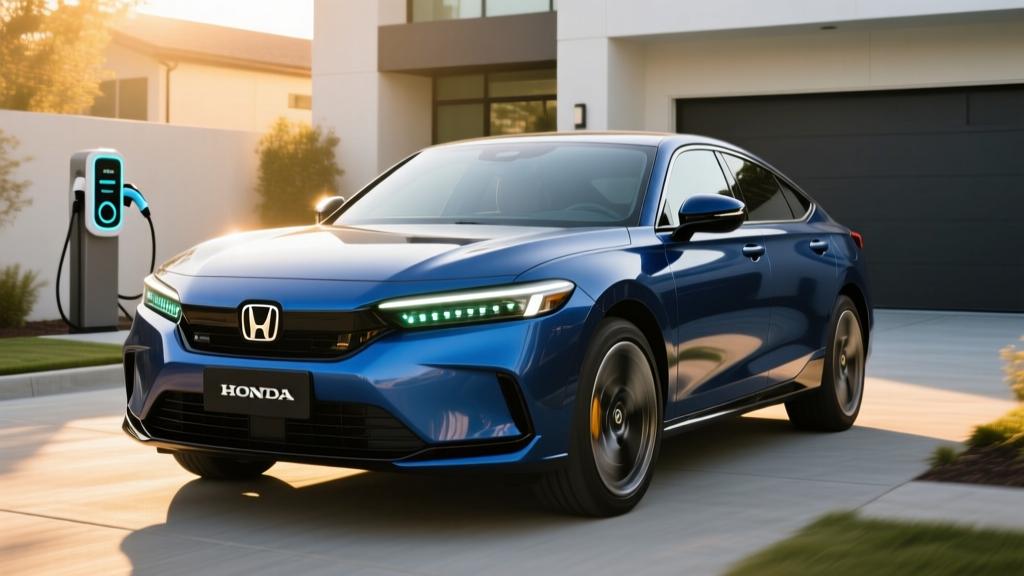
Quick Verdict: Honda's Mainstream Electric SUV Grows Up
The 2026 Honda Prologue returns for its second full model year on General Motors' Ultium platform, and the formula has matured. Honda tuned the dual-motor all-wheel-drive variant to deliver a respectable 0-60 mph time of approximately 5.8 seconds, while the front-wheel-drive base model clocks in around 7.8 seconds. These aren't Tesla Plaid numbers, but they're more than adequate for highway merging and confident overtaking — and they represent a meaningful improvement over Honda's earlier compliance-car efforts like the Clarity Electric.
With an EPA-estimated range reaching up to 308 miles on the FWD Elite trim, DC fast charging that peaks at 150 kW, and a starting MSRP near $47,400 before incentives, the Prologue slots into the highly competitive midsize electric SUV segment alongside the Hyundai Ioniq 5, Ford Mustang Mach-E, and Chevrolet Blazer EV. Here's everything you need to know before signing the paperwork.
Honda Prologue Specs at a Glance
| Specification | FWD (EX/Touring) | AWD (Touring/Elite) |
|---|---|---|
| EPA Range | 308 mi (EX FWD) | 281–294 mi |
| Battery (usable) | 85 kWh, NMC (Ultium) | |
| Horsepower | 212 hp | 288 hp |
| Torque | 236 lb-ft | 333 lb-ft |
| 0-60 mph | ~7.8 sec | ~5.8 sec |
| Drivetrain | Single-motor FWD | Dual-motor AWD |
| DC Fast Charge Peak | 150 kW | |
| 10–80% DC Time | ~35 minutes | |
| Level 2 Home Charge | 11.5 kW (~31 mi/hr) | |
| EPA Efficiency (combined) | 99 MPGe | 94–96 MPGe |
| Base MSRP | $47,400 (EX) | $50,400 (Touring AWD) |
| Battery Warranty | 8 yr / 100,000 mi | |
Range and Efficiency: What the EPA Number Doesn't Tell You
The headline figure — 308 miles on the EX FWD — is competitive for the class. But as any seasoned EV owner will tell you, the sticker number is a starting point, not a guarantee. The Prologue uses an 85 kWh usable NMC (nickel-manganese-cobalt) Ultium battery pack, shared with the Chevrolet Blazer EV and Cadillac Lyriq. Honda opted not to offer an LFP (lithium iron phosphate) variant, meaning you get higher energy density but should follow the 80% daily charge recommendation to preserve long-term cell health.
EPA estimates 308 mi (FWD) / 294 mi (AWD Touring). In mixed highway driving at 70–75 mph, expect 250–275 miles. In cold weather (below 32°F), plan for a 20–30% reduction, putting real-world winter range closer to 190–230 miles depending on cabin heat usage. The Prologue lacks a heat pump — it uses resistive PTC heating — which is a notable efficiency penalty in freezing climates compared to competitors like the Ioniq 5 or Tesla Model Y.
Efficiency lands at 99 MPGe combined for the FWD and 94–96 MPGe for the AWD variants, translating to roughly 34–36 kWh per 100 miles. That's slightly behind the segment leaders — the Ioniq 5 RWD achieves 114 MPGe — but the Prologue's larger, heavier build and less aggressive aero explain the gap. According to fueleconomy.gov, the AWD Prologue consumes about 35 kWh/100 mi in mixed driving.
Charging Speed: DC Fast and Home Level 2 Breakdown
Charging is where the Ultium platform shows both its strengths and its 2024-era limitations. The Prologue supports a peak DC fast-charge rate of 150 kW via its CCS connector (Honda has not adopted NACS for the 2026 model year, though a future refresh may transition). At peak, you'll add roughly 100 miles of range in 15 minutes on a functioning 150+ kW Electrify America or EVgo station.
| Charging Level | Power / Rate | Speed (Approx.) |
|---|---|---|
| Level 1 (120V household) | 1.4 kW | ~4 miles per hour |
| Level 2 (240V home, 48A) | 11.5 kW | ~31 miles per hour |
| DC Fast Charge (peak) | 150 kW | 10–80% in ~35 min |
| DC Fast Charge (sustained avg) | ~95–110 kW | Average over full session |
The critical nuance: peak kW is not sustained kW. The Prologue hits 150 kW only briefly between roughly 15–35% state of charge before tapering. From 60–80%, expect rates closer to 60–75 kW. This charge-curve taper means the full 10–80% session averages around 95–110 kW, which is why the total time stretches to roughly 35 minutes. That's competitive with the Ford Mach-E but slower than the Hyundai Ioniq 5's 800V architecture, which sustains higher rates and achieves 10–80% in about 18 minutes.
For home charging, the onboard 11.5 kW AC charger is excellent. On a properly installed 48-amp Level 2 circuit (NEMA 14-50 or hardwired), you'll replenish the full 85 kWh battery in roughly 7.5 hours — easily overnight. Honda includes a dual-level charge cord (120V/240V) with every Prologue, though the 240V output on a standard 20A outlet is limited to about 3.6 kW (~10 mi/hr). Budget $500–$1,500 for a professional Level 2 home installation depending on your electrical panel's proximity to the garage.
Performance: The 0-60 Story and On-Road Behavior
Let's address the keyword directly: the Honda Prologue 0-60 time depends heavily on which powertrain you choose. The dual-motor AWD variant delivers 288 horsepower and 333 lb-ft of torque, launching to 60 mph in approximately 5.8 seconds. That puts it in the same ballpark as the Volkswagen ID.4 AWD Pro S (5.7 sec) and a hair behind the Mach-E Extended Range AWD (5.1 sec). The single-motor FWD model, with 212 hp and 236 lb-ft, takes about 7.8 seconds — perfectly fine for commuting but noticeably less punchy when you need to merge onto a fast-moving freeway.
Ride quality is where the Prologue earns its Honda badge. The suspension tuning is firm yet compliant, absorbing highway expansion joints without the floatiness that plagues some competitors. Steering is precise if not particularly communicative — this is a family hauler, not a canyon carver. The regenerative braking system offers adjustable levels via steering-wheel paddles, though Honda doesn't offer true one-pedal driving with a complete stop. You'll still need the friction brake pedal for final stops, which may disappoint EV veterans accustomed to the Chevy Bolt or Nissan Leaf's one-pedal modes.
One practical limitation: the Prologue is not rated for towing. If you need an electric SUV that can pull a small trailer or bike rack, the Ford Mach-E (up to 2,200 lbs with the California Route 1 package) or the Hyundai Ioniq 5 (up to 2,300 lbs with tow prep) offer that capability.
Interior, Tech, and Daily Livability
The Prologue's cabin is a pleasant surprise — Honda's design team avoided the sparse, tablet-on-a-stick aesthetic that some EV makers lean into. You get an 11.3-inch touchscreen running Google Built-in (yes, native Google Maps, Google Assistant, and the Play Store), an 11-inch digital instrument cluster, and physical knobs for climate and volume. Wireless Apple CarPlay and Android Auto are standard on all trims, as is a wireless phone charging pad.
Space is generous for the midsize segment:
- Cargo volume: 28.0 cu ft behind the rear seats, 57.7 cu ft with the 60/40 split folded
- Rear legroom: 38.6 inches
- Front headroom: 40.0 inches
- No frunk: The Ultium platform's front subframe houses HVAC and power electronics, eliminating front-trunk storage
On the driver-assistance front, Honda Sensing comes standard and includes adaptive cruise control with low-speed follow, lane-keeping assist, traffic-sign recognition, and automatic emergency braking. This is a solid SAE Level 2 system — meaning you must keep your hands on the wheel and eyes on the road at all times. It does not offer hands-free highway driving like GM's Super Cruise or Ford's BlueCruise, which is a missed opportunity given that the Prologue rides on GM hardware. Honda has signaled that a more advanced hands-free system may arrive in a future model year, but for 2026, you're supervising.
Pricing, Trims, and Federal Tax Credit Eligibility
The 2026 Honda Prologue is offered in three trims: EX (base, FWD or AWD), Touring (mid-level, FWD or AWD), and Elite (top-tier, AWD only). Pricing starts at $47,400 for the EX FWD, including destination, and climbs to approximately $57,900 for the Elite AWD with all packages.
| Trim | Drivetrain | MSRP | Est. After §30D Credit* |
|---|---|---|---|
| EX | FWD | $47,400 | ~$39,900 |
| EX | AWD | $50,400 | ~$42,900 |
| Touring | FWD | $51,400 | ~$43,900 |
| Touring | AWD | $54,400 | ~$46,900 |
| Elite | AWD | $57,900 | ~$50,400 |
*Federal tax credit estimates assume full §30D eligibility. Actual credit depends on your tax liability, income, and vehicle sourcing compliance.
- Income cap: AGI must not exceed $150,000 (single), $225,000 (head of household), or $300,000 (joint). Source: IRS.gov
- MSRP cap: SUVs/vans must have an MSRP at or below $80,000 — all Prologue trims qualify.
- Battery sourcing: Critical minerals and battery components must meet phased-in domestic/Fta-partner sourcing thresholds. Because the Prologue is assembled in Ramos Arizpe, Mexico, on a GM Ultium pack, eligibility for the full $7,500 depends on the current-year critical-mineral and component tests. Some buyers may qualify for $3,750 (half credit) depending on the model month's battery composition.
- Point-of-sale transfer: You can elect to transfer the credit to the dealer at purchase, reducing your out-of-pocket cost immediately — even if you have zero tax liability — provided income requirements are met.
- Always verify: Rules shift annually. Confirm eligibility with your tax professional and the IRS qualified vehicles list before purchasing.
Warranty and Long-Term Ownership Outlook
Honda covers the Prologue's battery and powertrain with an 8-year / 100,000-mile warranty, matching the industry standard set by federal mandate. The limited vehicle warranty runs 3 years / 36,000 miles. Honda guarantees the battery will retain at least 70% of its original capacity during the warranty period — if degradation exceeds 30%, the pack will be repaired or replaced at no cost.
Given the Ultium platform's active liquid thermal management system and GM's extensive validation data from the Cadillac Lyriq and Blazer EV, early signs suggest the NMC pack should hold up well. Most Ultium-based vehicles tested to date show roughly 5–8% degradation over the first 50,000 miles, which is in line with or better than industry averages. However, because Honda does not offer an LFP option, owners should avoid routinely charging to 100% — set your daily limit to 80% and reserve full charges for road trips.
Insurance costs for the Prologue are modestly higher than a comparable gas-powered Honda Passport or Pilot, averaging 10–15% more according to industry estimates. Get quotes from your carrier before purchase to avoid surprises.
Pros, Cons, and Who Should Buy the Prologue
Pros
- Strong 308-mile EPA range (FWD)
- Comfortable, well-appointed interior with physical controls
- Google Built-in infotainment is intuitive and fast
- Competitive AWD 0-60 of 5.8 seconds
- Generous rear-seat legroom (38.6 in)
- 11.5 kW Level 2 charging fills battery overnight
- Honda Sensing safety suite standard on all trims
Cons
- No heat pump — cold-weather range suffers significantly
- 150 kW peak DC charging is behind 800V competitors
- No frunk (front trunk) for extra storage
- No hands-free driving option (Super Cruise not available)
- Not rated for towing
- FWD base model's 7.8-sec 0-60 feels leisurely
- CCS connector, not NACS — limits Tesla Supercharger access
- Daily commuters with home Level 2 charging who want a comfortable, quiet ride and Google-native navigation.
- Families who need rear-seat space for child seats and cargo flexibility without stepping up to a three-row EV.
- Honda loyalists transitioning from a CR-V or Passport who want dealership familiarity and Honda Sensing safety tech.
- Cold-climate buyers in northern states — the lack of a heat pump is a real efficiency penalty.
- Road-trip warriors who need the fastest possible DC charging and Tesla Supercharger network access.
- Towing households — the Prologue has zero tow rating.
Frequently Asked Questions
What is the Honda Prologue's real-world range?
The EPA rates the FWD Prologue at 308 miles and the AWD at 281–294 miles. In real-world highway driving at 70+ mph, expect 250–275 miles. In sub-freezing temperatures, plan for 190–230 miles due to the resistive heating system and lack of a heat pump. Your mileage will vary based on terrain, speed, and climate-control usage.
How fast does the Honda Prologue charge at home and on the road?
At home on a 48-amp Level 2 charger (240V), the Prologue charges at 11.5 kW, adding about 31 miles per hour — a full charge takes roughly 7.5 hours. On a DC fast charger, it peaks at 150 kW and reaches 10–80% in about 35 minutes, though sustained rates average closer to 95–110 kW due to charge-curve taper above 60% SoC.
Does the 2026 Honda Prologue qualify for the $7,500 federal tax credit?
It may qualify for the full $7,500, a partial $3,750, or no credit depending on the battery's critical-mineral and component sourcing for the specific model month, as well as your income. The Prologue's MSRP is well below the $80,000 SUV cap. Check the IRS qualified vehicles list and consult a tax professional before purchasing. The credit can be transferred to the dealer at point of sale to reduce your purchase price directly.
Is the Honda Prologue worth buying over the Hyundai Ioniq 5 or Ford Mach-E?
It depends on your priorities. The Ioniq 5 charges faster (10–80% in ~18 min on 800V), offers a heat pump, and has a frunk — but its rear seat is slightly tighter. The Mach-E offers more power, a hands-free BlueCruise option, and towing capability. The Prologue wins on interior comfort, Google Built-in usability, and Honda's dealer network. If you value a refined cabin and straightforward tech over maximum charging speed, the Prologue is a strong pick.
What is the Honda Prologue's 0-60 time?
The dual-motor AWD Prologue reaches 0-60 mph in approximately 5.8 seconds with 288 hp. The single-motor FWD model takes about 7.8 seconds with 212 hp. The AWD variant is the clear choice if acceleration confidence matters to you.
Does the Prologue have a front trunk (frunk)?
No. The Ultium platform's front compartment houses power electronics and HVAC components, leaving no room for front-trunk storage. All cargo goes in the rear, which offers 28.0 cu ft behind the second row and 57.7 cu ft with seats folded.