Quick Answer: Does Honda Have Electric Cars?
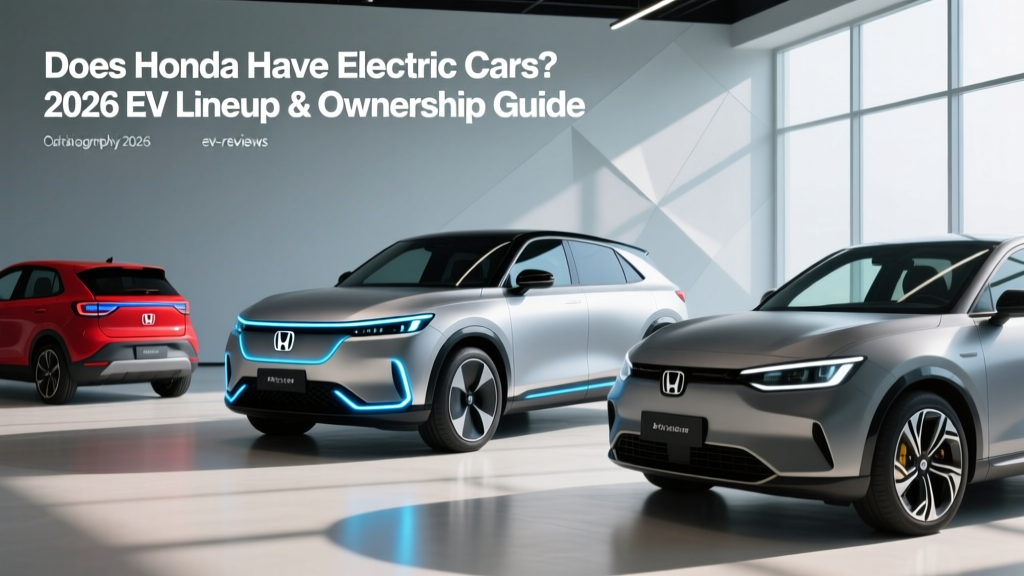
Yes. As of 2026, Honda sells one fully electric vehicle in the U.S.: the Honda Prologue, a midsize SUV built on General Motors' Ultium platform with up to 308 miles of EPA range, DC fast charging up to 150 kW, and a starting MSRP around $47,400. Honda has also announced a next-generation EV lineup built on its own dedicated EV architecture, expected to begin arriving in late 2026 and 2027. For now, if you want a fully electric Honda today, the Prologue is your only option — but Honda's hybrid lineup (CR-V Hybrid, Accord Hybrid, Civic Hybrid) remains a strong alternative for buyers not ready to go full EV.
The Honda Prologue: What You Get in 2026
The Honda Prologue is essentially a re-skinned Chevrolet Blazer EV underneath, sharing GM's Ultium battery platform and BEV3 architecture. That's not a knock — it means Honda leapfrogged years of R&D by leveraging a proven system, and the result is a competitive midsize electric SUV that slots into the popular two-row crossover segment.
| Spec | FWD EX | AWD EX-L | AWD Elite |
|---|---|---|---|
| EPA Range | 308 mi | 294 mi | 283 mi |
| Battery (usable) | 85 kWh (NMC, Ultium) | ||
| Horsepower | 212 hp | 288 hp | 288 hp |
| 0-60 mph | ~7.8 sec | ~6.2 sec | ~6.2 sec |
| Max DC Fast Charge | 150 kW (CCS) | ||
| 10-80% DC Charge | ~35 min | ||
| Level 2 (240V) Rate | 11.5 kW (~37 mi/hr) | ||
| MPGe (combined) | 98 MPGe | 95 MPGe | 93 MPGe |
| Starting MSRP | $47,400 | $50,400 | $56,900 |
| Battery/Powertrain Warranty | 8 yr / 100,000 mi | ||
Source: fueleconomy.gov and Honda Newsroom.
Real-World Range vs. EPA Sticker
The FWD Prologue's 308-mile EPA figure is achievable in mild conditions with mixed city/highway driving. Expect ~250-270 miles on sustained highway trips at 70+ mph, and ~220-240 miles in freezing temperatures (below 32°F). The AWD Elite's lower 283-mile EPA rating reflects its heavier curb weight and larger 21-inch wheels. Plan road trips around 200-220 mile segments to maintain a comfortable buffer.
Honda's Upcoming EV Roadmap: What's Next After the Prologue
Honda has publicly committed to launching a new series of EVs built on its proprietary 0 Series platform — a dedicated EV architecture featuring thinner battery packs, lighter weight, and improved aerodynamics. The first models from this platform, previewed by the Saloon and Space-Hub concepts, are expected to begin production in late 2026 for the Japanese and Chinese markets, with U.S. models following in 2027-2028.
Honda has also partnered with Sony on the AFEELA brand, though that vehicle targets a different market segment and timeline. For U.S. buyers shopping today, these future models are announced but not yet available — and pricing/specs remain preliminary.
The practical takeaway: if you want a Honda EV now, the Prologue is your car. If you can wait 18-24 months, Honda's in-house platform promises meaningfully better efficiency and potentially more competitive pricing.
Prologue vs. Honda Hybrids: The Real Cost Comparison
Many Honda shoppers cross-shop the Prologue against the CR-V Hybrid or Accord Hybrid. The math isn't as simple as "EV saves money." Here's a realistic five-year breakdown comparing the Prologue AWD EX-L against the CR-V Hybrid AWD, assuming 15,000 miles/year, $0.14/kWh home charging, and $3.40/gallon gas.
| Category | Prologue AWD EX-L | CR-V Hybrid AWD (Sport Touring) | |
|---|---|---|---|
| Base MSRP | $50,400 | $40,350 | |
| Estimated Federal Tax Credit (§30D) | $0 - $7,500* | $0 | |
| Fuel/Energy (5 yr / 75k mi) | $3,675 (home charging) | $8,925 (38 MPG combined) | |
| Maintenance (5 yr) | ~$1,200 | ~$3,000 | |
| Insurance (5 yr est.) | ~$9,500 | ~$7,800 | |
| Estimated 5-yr Depreciation | ~$22,000 | ~$16,000 | |
| Total 5-yr Cost (before credit) | ~$86,775 | ~$76,075 | |
| Total 5-yr Cost (with max $7,500 credit) | ~$79,275 | ~$76,075 |
*The Prologue's federal tax credit eligibility under IRS §30D depends on battery component and critical mineral sourcing requirements, MSRP caps (must be under $80,000 for SUVs), and buyer income limits ($300K joint / $150K single AGI). As of 2026, the Prologue — built on GM's Ultium platform with North American assembly — may qualify for partial or full credit, but sourcing rules tighten annually. Confirm eligibility at the point of sale and consult a tax professional.
The Prologue narrows the gap significantly if you qualify for the full $7,500 credit and charge primarily at home. But the CR-V Hybrid still wins on total cost for buyers who can't access home charging or who don't meet income/sourcing requirements. This is the core trade-off: EVs save on fuel and maintenance, but carry higher purchase prices, insurance premiums, and depreciation risk.
Charging the Prologue: Home, Public, and What to Expect
The Prologue uses the CCS1 connector for DC fast charging and J1772 for Level 2 AC charging. Honda does not currently include NACS (Tesla-style) compatibility, though adapters may become available as the industry transitions.
| Level | Power | Miles Added per Hour | Use Case |
|---|---|---|---|
| Level 1 (120V) | ~1.4 kW | ~4-5 mi/hr | Overnight trickle (emergency/top-up) |
| Level 2 (240V, 48A) | 11.5 kW | ~37 mi/hr | Home daily charging (full charge ~8.5 hr) |
| DC Fast Charge | Peak 150 kW | ~250+ mi/hr at peak | Road trips; 10-80% in ~35 min |
A critical note on the Prologue's DC fast charging: the 150 kW peak rate is competitive but not class-leading. Rivals like the Hyundai Ioniq 5 (peak 240 kW, 10-80% in ~18 min) and Tesla Model Y (peak 250 kW, 10-80% in ~15 min) charge significantly faster. The Prologue's charge curve tapers noticeably above 80% State of Charge, so plan to unplug at 80% on road trips to avoid long waits at the top of the battery.
Home Charging Installation: What It Costs
If you're buying a Prologue, budget for a Level 2 home charger. Here's what a typical installation looks like:
| Component | Low End | High End |
|---|---|---|
| Level 2 Charger (hardwired, 48A) | $400 | $750 |
| Electrician Labor (240V circuit run) | $500 | $2,000 |
| Electrical Permit | $50 | $250 |
| Panel Upgrade (if needed: 100A → 200A) | $1,500 | $4,000 |
| Total (no panel upgrade) | $950 | $3,000 |
| Total (with panel upgrade) | $2,450 | $7,000 |
Most homes with a modern 200A electrical panel can add a 240V/50A circuit for a Level 2 charger without a panel upgrade. Older homes or those with 100A service will likely need an upgrade. Always get a quote from a licensed electrician before committing to a purchase — the installation cost is a real factor in the EV ownership equation.
Common Honda EV Misconceptions — Fact vs. Fiction
| Myth | Fact |
|---|---|
| "Honda doesn't make real EVs." | The Prologue is a fully electric, 308-mile SUV on GM's Ultium platform. It's real, it's on sale, and it's competitive in its segment. |
| "The Prologue will get Honda's hybrid fuel economy." | No. The Prologue gets 93-98 MPGe — roughly equivalent to 3.4-3.6 gallons per 100 miles in energy terms. That's excellent, but MPGe is not directly comparable to a hybrid's MPG number. |
| "I can charge at any Tesla Supercharger." | Not natively. The Prologue uses CCS, and Tesla's Supercharger network requires a NACS connector. Some Tesla stations now offer a Magic Dock CCS adapter, but universal access requires an adapter or the ongoing NACS transition. |
| "EV batteries need replacing every few years." | Honda warrants the Prologue's battery for 8 years / 100,000 miles against capacity loss below 70%. Real-world Ultium degradation data from GM vehicles suggests ~5-8% loss over 100K miles — far from needing replacement. |
| "I'll save $10,000 over gas in 5 years." | Fuel savings are real (~$5,250 over 5 years at 75K miles), but higher insurance, faster depreciation, and the purchase premium eat into that. Net savings depend heavily on tax credit eligibility and home charging access. |
Decision Framework: Is a Honda EV Right for You?
Choose the Honda Prologue EV If:
- You have reliable home charging (garage or driveway with 240V access) and drive under 300 miles/day.
- You qualify for the §30D federal tax credit (check income caps and sourcing rules with your dealer and tax professional).
- You want a midsize SUV with a proven battery platform (GM Ultium) and Honda's interior quality and dealer network.
- You're willing to accept slower DC fast charging (150 kW peak vs. 240+ kW for competitors) on road trips.
- Your daily commute is under 60 miles round-trip, making home charging the primary energy source.
Choose a Honda Hybrid (CR-V Hybrid, Accord Hybrid) If:
- You cannot install a home charger (apartment, street parking, no 240V access).
- You frequently drive in extreme cold (below 20°F), where EV range drops 20-30%.
- You take regular road trips exceeding 400 miles and don't want to plan around DC fast chargers.
- You want the lowest total cost of ownership without relying on tax credit qualification.
- You'd rather wait for Honda's in-house 0 Series EVs arriving in 2027-2028.
Wait for Honda's 0 Series If:
- You want a Honda-designed EV (not a rebadged GM product) with potentially better efficiency and faster charging.
- Your current vehicle still has 1-2 years of useful life and you're not in a rush.
- You want more body style options (sedan, larger SUV) beyond the Prologue's midsize crossover format.
Frequently Asked Questions
Does Honda have any other electric cars besides the Prologue?
Not in the U.S. market as of 2026. Honda previously sold the Honda e (a small city EV) in Europe and Japan, but it was discontinued. The Honda Clarity EV was discontinued after the 2022 model year. The Prologue is currently Honda's only new battery-electric vehicle available stateside.
Is the Honda Prologue eligible for the $7,500 federal tax credit?
Potentially. Under IRS §30D rules, the Prologue qualifies on MSRP (under the $80,000 SUV cap) and is assembled in North America. However, battery component and critical mineral sourcing requirements tighten each year. Your individual eligibility also depends on AGI limits ($300K joint, $150K single). Honda dealers can verify point-of-sale credit eligibility at purchase. Always confirm with a tax professional before relying on the credit.
How does the Prologue compare to the Hyundai Ioniq 5 or Tesla Model Y?
The Prologue offers competitive range (308 mi FWD) and a familiar Honda driving experience, but falls behind on DC fast charging speed (150 kW vs. 240 kW for Ioniq 5, 250 kW for Model Y) and cargo space. The Model Y also has access to the full Tesla Supercharger network natively. The Prologue's advantage is Honda's dealer network, brand loyalty, and a more conventional SUV design that appeals to traditional buyers. If charging speed on road trips is a priority, the Ioniq 5 or Model Y are stronger picks.
What happens if I buy a Honda Prologue and the battery degrades?
Honda covers the high-voltage battery for 8 years or 100,000 miles (whichever comes first) against capacity loss below 70% of original capacity. Based on GM Ultium platform data from the Cadillac Lyriq and Chevrolet Blazer EV, real-world degradation at 100K miles is typically 5-8%, well above the warranty threshold. Full battery replacement out of warranty would cost an estimated $12,000-$18,000, but this scenario is rare within the vehicle's normal lifespan.
Can I charge the Honda Prologue at Tesla Superchargers?
Not directly. The Prologue uses the CCS1 connector, while Tesla Superchargers use NACS. Some Tesla Supercharger locations have installed the "Magic Dock" CCS adapter for non-Tesla EVs, and Honda has indicated future models will adopt NACS. For now, Prologue owners rely on the Electrify America, EVgo, and ChargePoint networks for DC fast charging. Check NHTSA and network apps for station availability on your routes.
Is a Honda hybrid better than the Prologue for a first-time electrified vehicle buyer?
For many first-time buyers, yes — a Honda hybrid like the CR-V Hybrid (40 MPG combined, ~$40K starting) eliminates range anxiety, requires no charging infrastructure, and costs $10K+ less upfront. You get meaningful fuel savings without lifestyle changes. The Prologue makes more sense if you have home charging, a predictable commute, and want to maximize fuel cost savings and reduce emissions. The hybrid is the lower-risk entry point to electrification.