Quick Answer: Honda Electric Dirt Bikes for Adults in 2026
Honda does not currently sell a full-size electric dirt bike for adults in the United States as of early 2026. The closest Honda product is the CRF-Electric concept (unveiled at EICMA 2024), which Honda has confirmed is in development but has not yet entered production or received an MSRP. For adult riders seeking an electric off-road motorcycle today, the market is served by brands like KTM (Freeride E-XC), Zero Motorcycles (FX/FXE), Sur-Ron/Sur-X, and Stark Varg. Honda's existing electric two-wheeler offerings remain limited to the small-displacement EM1 e: urban scooter, which is not a dirt bike and is not widely available in the U.S.
If Honda does bring a production CRF-Electric to market, expect a battery capacity in the 4–6 kWh range, a top speed around 55–70 mph, and an MSRP likely between $8,000 and $12,000 based on competitor pricing and Honda's historical CRF gas model positioning.
Why Honda's Electric Dirt Bike Lineup Matters to Adult Riders
Honda dominates the gas-powered off-road segment with the CRF250R, CRF450R, CRF250F, and CRF450RX — machines that have defined motocross and trail riding for decades. The transition to electric off-road motorcycles is happening, but Honda has moved cautiously compared to European competitors.
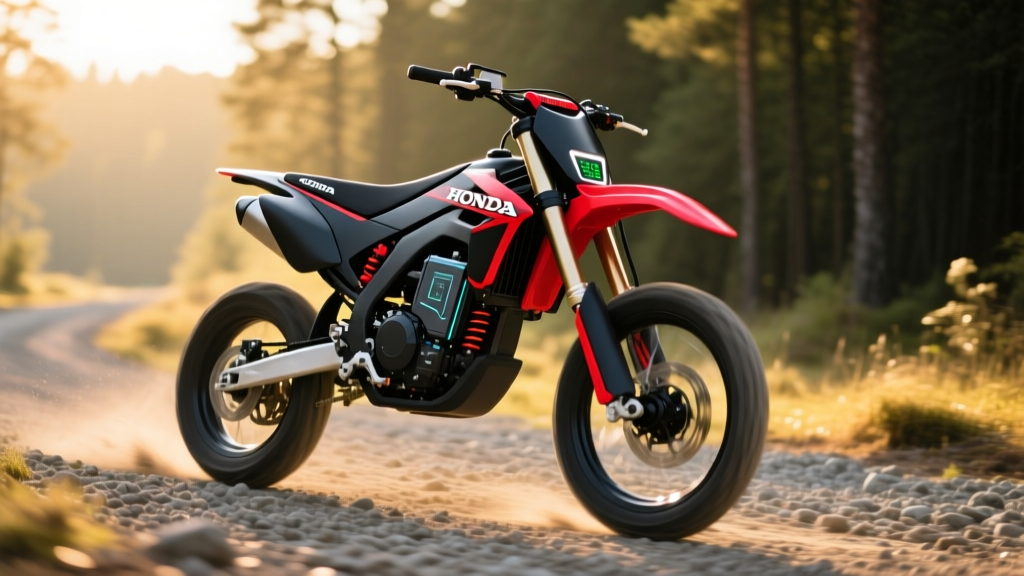
At EICMA 2024 in Milan, Honda displayed the CRF-Electric prototype, signaling serious intent to enter the adult electric dirt bike market. The prototype featured a trellis frame, a compact electric powertrain, and styling cues borrowed directly from the CRF450R. Honda executives confirmed it was "close to production" but provided no firm timeline.
For adult riders — particularly those aged 28–55 who grew up on gas CRFs and are now considering electric — the wait raises practical questions: What will it cost? How far can it go on a charge? How does it compare to a $9,000 gas CRF250F that runs all day on a gallon of fuel?
What We Know About the Honda CRF-Electric (Announced/Prototype)
Because the CRF-Electric remains in pre-production status, all specifications below are estimated or preliminary based on Honda's EICMA disclosures, patent filings, and industry analysis. Honda has not published official specs as of 2026.
| Specification | Estimated Value |
|---|---|
| Battery Capacity | ~4.5–6.0 kWh (estimated, likely NMC chemistry) |
| Motor Output | ~25–35 kW peak (33–47 hp equivalent) |
| Top Speed | ~55–70 mph (trail-oriented gearing) |
| Range (Trail Riding) | ~40–60 miles (moderate trail use, estimated) |
| Charge Time (Level 1, 120V) | ~3–5 hours (0–100%) |
| Charge Time (Level 2, 240V) | ~1–2 hours (0–100%) |
| DC Fast Charging | Not expected (small battery, no DC port likely) |
| Weight | ~240–270 lbs (estimated) |
| Seat Height | ~35–37 inches (trail bike geometry) |
| Estimated MSRP | $8,000–$12,000 (based on competitor analysis) |
| Availability | TBD — not confirmed for U.S. market |
Key terminology note: kW (kilowatts) measures power output — how much energy the motor delivers at any moment. kWh (kilowatt-hours) measures energy capacity — how much total energy the battery stores. A 5 kWh battery delivering 25 kW continuously would deplete in about 12 minutes at full throttle, which is why real-world trail range depends heavily on riding style.
Electric Dirt Bikes vs. Gas Dirt Bikes: The Real Numbers
For adult riders weighing electric versus gas, the comparison goes beyond sticker price. Here's how a typical electric dirt bike (using the KTM Freeride E-XC and Zero FX as benchmarks, since the Honda CRF-Electric isn't yet available) compares to Honda's gas CRF250F trail bike:
| Factor | Electric (KTM Freeride E-XC / Zero FX) | Gas (Honda CRF250F) |
|---|---|---|
| Base MSRP | $8,295–$9,995 | $8,899 |
| Power Output | 18–33 kW (24–44 hp) | ~24 hp (249cc 4-stroke) |
| Range (Trail Use) | 40–60 miles (varies by battery size) | 80–120 miles (2.1-gal tank) |
| Refuel/Recharge Time | 1–5 hours (depending on charger) | 2 minutes (fill tank) |
| Fuel/Energy Cost per Ride | $0.50–$1.50 (home charging at $0.15/kWh) | $6–$10 (premium fuel, ~2 gal/ride) |
| Annual Maintenance | $100–$200 (chain, brake pads, tires) | $400–$800 (oil, filters, valves, chain) |
| Noise Level | ~60–70 dB (whirring motor) | ~94–100 dB (exhaust) |
| Trail Access | Allowed on many quiet-use and e-MTB trails | Restricted to designated OHV areas |
| Weight | 240–295 lbs | 243 lbs (CRF250F) |
| Cold-Weather Impact | 15–25% range loss below 40°F | Minimal (choke start, slightly richer mix) |
Real-World Ownership Costs: Electric Dirt Bike Breakdown
Let's model the 3-year cost of owning an electric dirt bike versus a gas equivalent, assuming 50 trail rides per year averaging 30 miles each:
| Cost Category | Electric ($9,500 MSRP) | Gas Honda CRF250F ($8,899 MSRP) |
|---|---|---|
| Purchase Price | $9,500 | $8,899 |
| Energy/Fuel (150 rides) | $150 (at $0.15/kWh, ~5 kWh/ride) | $1,125 (at $7.50/gal, ~1.5 gal/ride) |
| Maintenance (3 years) | $450 | $1,800 |
| Insurance (off-road, 3 yrs) | $300–$600 | $300–$600 |
| Battery Replacement Reserve | $0 (under warranty; $2,000–$4,000 out of warranty) | N/A |
| 3-Year Total | $10,400–$10,700 | $12,124–$12,424 |
| Cost per Ride | $69–$71 | $81–$83 |
The electric dirt bike breaks even on total cost within roughly 2 years of regular riding, driven primarily by fuel and maintenance savings. However, this model assumes home charging access. Riders who must rely on public Level 2 chargers (at $0.30–$0.50/kWh) will see energy costs double or triple, extending the payback period.
Battery Chemistry, Degradation, and What Adult Riders Should Expect
Electric dirt bikes in this class typically use NMC (nickel manganese cobalt) battery cells rather than LFP (lithium iron phosphate). The reason is energy density: NMC packs more kWh into a lighter, smaller package — critical for a dirt bike where every pound matters on the trail.
The trade-off is that NMC batteries degrade somewhat faster than LFP. For off-road use, expect:
- 80% capacity retention after approximately 500–800 full charge cycles
- At 50 rides/year, that translates to 10–16 years before hitting 80% capacity
- Most manufacturers offer a 2-year battery warranty (some extend to 3–5 years)
- Out-of-warranty battery replacement: $2,000–$4,000 depending on capacity and brand
Cold-weather reality check: Lithium-ion batteries lose 15–25% of usable capacity in temperatures below 40°F. If you ride year-round in northern states, plan for a 40-mile range dropping to 30–34 miles in winter conditions. Preconditioning the battery (warming it while still plugged in) can recover some of this loss, but most electric dirt bikes do not include active battery thermal management — a feature found in electric cars but not yet standard in off-road motorcycles.
Charging at Home: What You Need Before You Buy
Electric dirt bikes charge on standard household power. Here's what that looks like in practice:
- Level 1 (120V household outlet): Charges at roughly 0.5–1.0 kW. A 5 kWh battery takes 5–10 hours from empty. This is the default method for most dirt bike owners — plug in after a ride, fully charged by morning.
- Level 2 (240V, like a dryer outlet): Charges at 2–3 kW. Same 5 kWh battery charges in 1.5–3 hours. Requires a 240V outlet in your garage or a dedicated EV charger installation ($500–$2,000 including electrician labor).
- DC Fast Charging: Not available on electric dirt bikes. The batteries are too small to justify the infrastructure, and the charge port standards (CCS, NACS) are designed for 50+ kWh car batteries.
Critical ownership consideration: If you live in an apartment or lack garage access, charging an electric dirt bike becomes a serious logistical challenge. Unlike electric cars, which can use public DC fast chargers in 20–40 minutes, a dirt bike on a standard outlet requires hours of unattended charging. Riders without private parking should weigh this limitation carefully before purchasing.
Alternatives Available Now: Electric Dirt Bikes You Can Buy in 2026
Since the Honda CRF-Electric remains unreleased, here are the leading electric dirt bikes for adults currently on the U.S. market:
| Model | Battery (kWh) | Power (kW/hp) | Range (mi) | Weight (lbs) | MSRP |
|---|---|---|---|---|---|
| KTM Freeride E-XC | 3.9 (swappable) | 18 kW / 24 hp | ~40–50 | 245 | $8,295 |
| Zero FX (Z-Force 7.2) | 7.2 | 33 kW / 44 hp | ~60–82 | 295 | $11,995 |
| Stark Varg MX | 6.0 | 60 kW / 80 hp | ~45–60 (motocross) | 234 | $13,900 |
| Sur-Ron Light Bee X | 2.0 | 6 kW / 8 hp | ~40–50 | 110 | $4,100 |
| Kawasaki KX-E (announced) | TBD | TBD | TBD | TBD | TBD |
The Zero FX offers the longest range and highest power for trail riders who need distance. The KTM Freeride E-XC is the lightest full-size option and has swappable batteries — a significant advantage for all-day riding if you invest in a second pack (~$3,000). The Stark Varg MX targets motocross riders who prioritize peak power over range. The Sur-Ron Light Bee occupies a unique niche as a lightweight electric motorcycle that bridges the gap between e-bikes and dirt bikes, though it lacks the power and suspension travel for aggressive adult trail riding.
Federal Tax Credits and Incentives: Do Electric Dirt Bikes Qualify?
Under current IRS §30D rules, the federal clean vehicle tax credit applies to four-wheeled vehicles with a gross vehicle weight rating under 14,000 pounds. Electric motorcycles, including dirt bikes, do not qualify for the $7,500 new clean vehicle credit or the $4,000 used clean vehicle credit.
However, electric dirt bikes may qualify for:
- State-level rebates: Some states (California, Colorado, Oregon) offer off-road EV incentives or e-bike rebates that may cover lightweight electric motorcycles. Check your state energy office for current programs.
- Utility company rebates: Certain electric utilities offer $200–$500 rebates for electric off-road vehicles as part of demand-management programs.
- Alternative fuel vehicle credits: A limited number of states offer registration fee waivers or HOV access for electric motorcycles — these vary by jurisdiction and change frequently.
Always verify current eligibility with a tax professional or your state's official energy incentive database before making a purchase decision based on projected incentives.
Common Misconceptions About Electric Dirt Bikes
| Myth | Fact |
|---|---|
| "Electric dirt bikes have no power" | Modern models produce 24–80 hp with instant torque delivery. The Stark Varg MX produces 80 hp — comparable to a 450cc gas motocross bike. |
| "The battery will die in 2 years" | NMC batteries retain ~80% capacity after 500–800 cycles. At typical off-road use (50 rides/year), that's 10–16 years of service life. |
| "You can't ride in the rain" | All major electric dirt bikes carry IP67 or IP68 water resistance ratings for the battery and motor. They handle rain, mud, and creek crossings like gas bikes. |
| "Electric dirt bikes are silent" | They produce 60–70 dB of motor and tire noise — quieter than gas (94–100 dB) but not silent. This is actually an advantage for trail access in noise-restricted areas. |
| "You can't do long rides" | With a swappable battery system (KTM) or a larger pack (Zero FX at 7.2 kWh), 60–80 mile trail rides are achievable. All-day 150-mile rides still favor gas. |
| "Charging takes too long for trail days" | A Level 2 (240V) setup charges a 5 kWh battery in ~2 hours. Many riders charge during lunch breaks or between morning and afternoon sessions. |
Decision Framework: Should You Wait for Honda or Buy Now?
Choose to wait for the Honda CRF-Electric if:
- You're a loyal Honda rider who values dealer support, parts availability, and Honda's proven reliability record
- You don't need an electric dirt bike within the next 12–18 months
- You want Honda's CRF chassis geometry and suspension tuning, which are benchmarked for trail comfort
- You expect Honda to price aggressively (potentially $8,000–$9,000) to gain market share
Choose to buy an available electric dirt bike now if:
- You want to ride electric this season and can't wait for an unconfirmed release date
- You need swappable batteries (KTM Freeride E-XC) for all-day trail riding
- You want maximum range now (Zero FX at 7.2 kWh / 60–82 miles)
- You ride in noise-restricted areas where electric access is already a practical advantage
- You want established dealer support and a known warranty track record
Choose to stick with gas (Honda CRF250F/450F) if:
- You regularly ride 100+ mile days in remote areas with no charging access
- You ride in extreme cold (below 20°F) where battery range loss is severe
- You need 2-minute refueling for competitive enduro or multi-day events
- Your budget is under $5,000 (the used gas market offers far more options at that price point)
What First-Time Electric Dirt Bike Buyers Should Know
If you're transitioning from gas to electric off-road, prepare for these ownership differences:
- Range planning is mandatory. Unlike gas, where you carry extra fuel in a jug, an electric dirt bike's range is fixed by battery capacity. Map your rides to stay within 70% of rated range to account for terrain, temperature, and aggressive throttle use.
- Regenerative braking changes your riding technique. Most electric dirt bikes offer adjustable regen. At high settings, you can ride trails with minimal brake use — similar to one-pedal driving in an electric car. This takes practice but reduces brake pad wear significantly.
- Instant torque requires throttle discipline. Electric motors deliver peak torque at 0 RPM. On loose or technical terrain, a heavy right hand will break traction instantly. Most bikes offer multiple power modes — start in the lowest setting and work up.
- Home charging access is non-negotiable. If you can't charge at home (garage outlet or installed 240V circuit), electric dirt bike ownership becomes impractical for most riders. Public charging infrastructure does not exist at trailheads.
- Insurance costs are similar to gas. Off-road motorcycle insurance typically runs $100–$200/year regardless of powertrain. However, some insurers are unfamiliar with electric models and may require specialty carriers.
Frequently Asked Questions
Does Honda make an electric dirt bike for adults?
Not yet. Honda displayed the CRF-Electric prototype at EICMA 2024 and confirmed it is in development, but no production model is available for purchase as of 2026. Honda's only current electric two-wheeler is the EM1 e: urban scooter, which is not a dirt bike.
How much will the Honda CRF-Electric cost when it launches?
Honda has not announced pricing. Based on competitor benchmarks (KTM Freeride E-XC at $8,295, Zero FX at $11,995) and Honda's gas CRF pricing ($8,899 for the CRF250F), expect an MSRP between $8,000 and $12,000 depending on battery size and trim.
How far can an electric dirt bike go on a single charge?
Current models offer 40–82 miles of trail range depending on battery size (3.9–7.2 kWh), rider weight, terrain, and temperature. Real-world range is typically 20–30% below the manufacturer's optimistic estimates, especially in cold weather or aggressive riding conditions.
Can I charge an electric dirt bike at a regular outlet?
Yes. All major electric dirt bikes charge on a standard 120V household outlet, though charging takes 5–10 hours for a full charge. A 240V Level 2 setup cuts this to 1.5–3 hours but requires electrical installation ($500–$2,000).
Do electric dirt bikes qualify for the $7,500 federal tax credit?
No. The IRS §30D clean vehicle credit applies only to four-wheeled vehicles. Electric motorcycles and dirt bikes are excluded. Some state and utility rebates may apply — check local programs.
Are electric dirt bikes allowed on public trails?
Trail access varies by jurisdiction. Many national forests and state parks restrict motorized vehicles to designated OHV areas regardless of powertrain. However, electric dirt bikes are increasingly allowed on quiet-use trails and some e-MTB trail networks where gas bikes are banned. Always check local land management rules before riding.
How long do electric dirt bike batteries last?
NMC lithium-ion batteries in electric dirt bikes typically retain 80% of original capacity after 500–800 full charge cycles. At 50 rides per year, that translates to 10–16 years of usable life. Out-of-warranty replacement costs $2,000–$4,000.