Tesla's Referral Program in 2026: What Buyers and Owners Need to Know
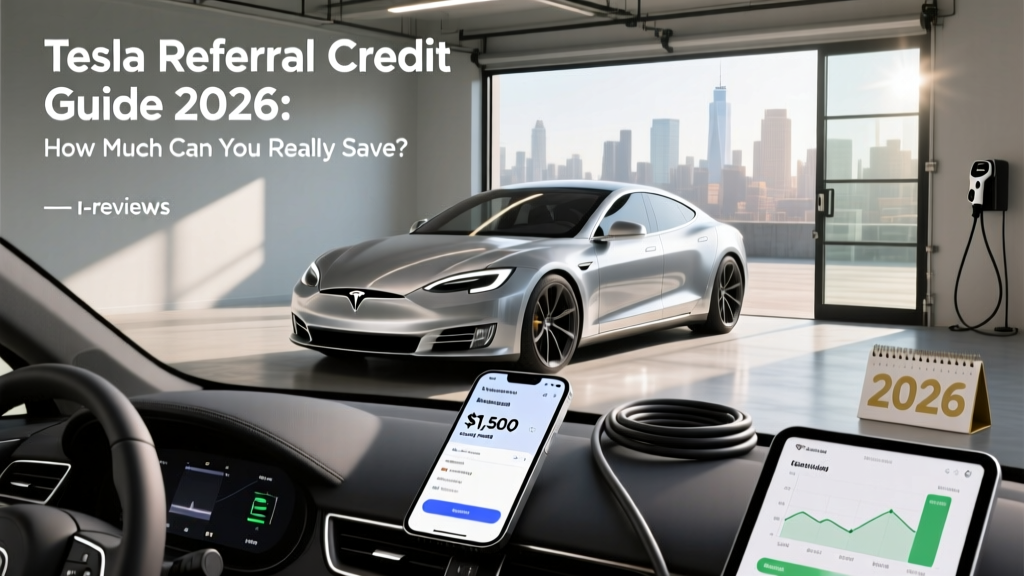
If you've been researching a Tesla purchase, you've likely encountered the Tesla referral credit — a rewards program that lets existing Tesla owners share benefits with new buyers. Unlike the federal §30D tax credit, which is governed by IRS rules on income, MSRP caps, and battery sourcing, the referral credit is a Tesla-controlled incentive that changes frequently in structure and value. In 2026, the program continues to offer modest but meaningful savings for both the referrer and the referee, typically applied as a discount on the vehicle purchase or as Tesla Credits redeemable for Supercharging, accessories, or future purchases.
This guide breaks down exactly how the Tesla referral credit works right now, what you can expect to save, and how it stacks on top of federal and state incentives. We'll also use the best-selling 2026 Tesla Model Y as our reference vehicle to show the full picture — from EPA range and charging speeds to real ownership costs — so you can decide whether a Tesla makes financial sense for your driveway.
- New buyer (referee): Typically $500–$1,000 off the vehicle purchase price or equivalent Tesla Credits, depending on the active program terms at time of order.
- Existing owner (referrer): Earns Tesla Credits (often $500–$1,000 equivalent) usable for Supercharging, Powerwall, accessories, or vehicle upgrades.
- Eligibility: Referrer must own a Tesla product; new buyer must use the referral link at time of order. Cannot be combined with certain promotional pricing.
- Stacking: The referral credit can generally stack with the federal §30D tax credit and state incentives, but confirm at checkout.
Program terms change frequently. Always verify current terms on Tesla's referral page before ordering.
2026 Tesla Model Y: Full Spec Breakdown
The Model Y remains Tesla's volume leader and the most common vehicle purchased through the referral program. Here's the complete spec sheet for the 2026 model year across all available trims.
| Spec | Long Range RWD | Long Range AWD | Performance |
|---|---|---|---|
| EPA Range | 320 mi | 300 mi | 277 mi |
| Battery (usable) | ~75 kWh, NMC | ~75 kWh, NMC | ~75 kWh, NMC |
| Drivetrain | Rear-Wheel Drive | Dual-Motor AWD | Dual-Motor AWD |
| Horsepower | ~295 hp | ~384 hp | ~456 hp |
| 0–60 mph | 6.5 sec | 4.8 sec | 3.5 sec |
| Max DC Fast Charge | 250 kW (peak) | 250 kW (peak) | 250 kW (peak) |
| 10–80% DCFC Time | ~27 min | ~27 min | ~27 min |
| Level 2 Home Rate | 11.5 kW (~44 mi/hr) | 11.5 kW (~44 mi/hr) | 11.5 kW (~44 mi/hr) |
| Efficiency (MPGe) | 123 MPGe combined | 116 MPGe combined | 111 MPGe combined |
| Cargo Volume | 76.2 cu ft (rear seats folded) | 76.2 cu ft | 76.2 cu ft |
| Base MSRP | $44,990 | $47,990 | $52,490 |
Source: fueleconomy.gov and Tesla.com. Specs reflect 2026 model year. MPGe = miles per gallon equivalent — a way to compare EV energy consumption to gas vehicles. 1 gallon of gasoline ≈ 33.7 kWh of electricity.
Real-World Range: What the EPA Sticker Doesn't Tell You
EPA Estimated: 300 miles
Real-World Highway (70–80 mph, moderate temps): ~250–270 miles
Real-World Highway (below 32°F / 0°C): ~210–240 miles
City / Stop-and-Go with Regen: ~280–300 miles (often near EPA)
The EPA test cycle includes significant low-speed and stop-and-go driving where regenerative braking recovers energy. Sustained highway speeds above 70 mph and cold weather are the two biggest range killers. Tesla's heat pump helps mitigate winter losses compared to resistive heating, but expect 15–25% range reduction in sub-freezing conditions. Plan road trips around 200–230 miles between Supercharger stops for a comfortable buffer.
Tesla's onboard navigation and trip planner are among the best in the industry for range prediction. When you enter a destination, the car calculates elevation changes, temperature, wind, and traffic to project your state of charge on arrival. In our experience, Tesla's arrival SoC estimates are typically accurate within 2–3 percentage points when you follow the suggested route and speed — a significant advantage over competitors whose range estimators are less sophisticated.
Charging Speeds: Supercharger Network and Home Setup
Charging speed is where Tesla still holds a meaningful edge over most competitors, not because of the vehicle's peak charge rate — 250 kW is now matched or exceeded by Hyundai/Kia's E-GMP platform — but because of the Supercharger network's reliability and density.
| Charging Level | Power (kW) | Speed (miles/hr added) | Best Use Case |
|---|---|---|---|
| Level 1 (120V household) | ~1.4 kW | ~3–5 mi/hr | Emergency / trickle top-up |
| Level 2 (240V home, 48A) | 11.5 kW | ~44 mi/hr | Daily home charging (~7–8 hrs for full charge) |
| DC Fast Charge (Supercharger V3/V4) | Up to 250 kW peak | ~1,000+ mi/hr at peak | Road trips — 10–80% in ~27 minutes |
Understanding the charge curve: The 250 kW peak only applies at low state of charge (roughly 10–30% SoC). As the battery fills, charge speed tapers — typically dropping to ~150 kW around 50% SoC and ~75 kW around 70% SoC. This is why manufacturers quote 10–80% times rather than 0–100%. Charging from 80% to 100% on DC fast charge is painfully slow and unnecessary for road trips. The Model Y's NMC battery chemistry delivers a respectable charge curve, though it doesn't quite match the flat, sustained curve of 800V architectures like the Hyundai Ioniq 5.
Home charging note: The Model Y's onboard charger accepts up to 11.5 kW on Level 2 (48 amps). To get this rate, you'll need a 60-amp circuit and a hardwired Tesla Wall Connector or a NACS-compatible Level 2 EVSE. A typical home installation with a 240V/60A circuit runs $800–$2,000 depending on panel proximity and local permitting. Always have a licensed electrician assess your panel capacity before installation.
Pricing, Trims, and the Federal Tax Credit Picture
Here's where the Tesla referral credit intersects with broader incentive programs. The 2026 Model Y lineup starts at $44,990, and depending on your income, filing status, and the vehicle's battery sourcing, you may qualify for the federal §30D Clean Vehicle Credit — up to $7,500, now available as a point-of-sale reduction at the dealer (or directly from Tesla) rather than only as a tax-time refund.
| Trim | Base MSRP | Est. After §30D Credit* | Est. After Referral Credit† |
|---|---|---|---|
| Long Range RWD | $44,990 | ~$37,490 | ~$36,490–$36,990 |
| Long Range AWD | $47,990 | ~$40,490 | ~$39,490–$39,990 |
| Performance | $52,490 | ~$44,990 | ~$43,990–$44,490 |
*§30D credit eligibility depends on buyer income (AGI caps: $150K single, $225K head of household, $300K joint), vehicle MSRP cap ($80K for SUVs/trucks/vans), and battery critical-mineral/component sourcing requirements. Verify current eligibility at IRS.gov and with Tesla at order time.
†Referral credit amounts vary by active program terms. Shown as estimated range based on recent program structures.
- ✅ Vehicle MSRP: Must be ≤ $80,000 for SUVs, vans, and pickup trucks (Model Y qualifies as an SUV)
- ✅ Buyer AGI: ≤ $150,000 (single) / $225,000 (head of household) / $300,000 (married filing jointly)
- ✅ Battery sourcing: Must meet escalating critical-mineral and battery-component requirements (check fueleconomy.gov for current qualifying vehicles)
- ✅ Final assembly: Must occur in North America (Model Y assembled in Fremont, CA and Austin, TX — qualifies)
- ✅ Point-of-sale transfer: You can elect to transfer the credit to Tesla at purchase, reducing your out-of-pocket cost immediately
- ⚠️ One credit per vehicle, per taxpayer: You can only claim §30D once every 3 years for new EVs
Consult a tax professional to confirm your specific eligibility. Rules are subject to legislative changes.
Interior, Tech, and Driver Assistance
The 2026 Model Y continues Tesla's minimalist interior approach — a 15.4-inch center touchscreen dominates the dashboard, controlling everything from climate to navigation to media. There are no physical buttons for HVAC or audio; everything runs through the screen or voice commands. The refreshed "Juniper" interior (introduced in 2025) added ventilated front seats, ambient lighting, a rear-seat touchscreen, improved sound insulation, and a power-folding second row — addressing many of the comfort complaints from earlier model years.
Cargo space is a genuine strength: 30.2 cubic feet behind the second row and 76.2 cubic feet with seats folded, plus a small front trunk (frunk) for additional storage. This makes the Model Y one of the most practical compact electric SUVs for families and road-trippers alike.
Driver assistance: Every Model Y ships with Tesla's Basic Autopilot (adaptive cruise control + lane centering). Full Self-Driving (Supervised) remains an $8,000 add-on (or available as a monthly subscription). To be clear, FSD is a SAE Level 2 driver-assist system — it does not make the car self-driving. The driver must remain attentive, keep hands on the wheel, and be prepared to take over at any moment. Tesla's camera-only "Tesla Vision" approach has improved significantly, but it still requires active supervision, especially in construction zones, heavy rain, and unmapped areas.
Tesla Autopilot and FSD (Supervised) are Level 2 systems. The vehicle can manage steering and acceleration/deceleration simultaneously under certain conditions, but the human driver is fully responsible for monitoring the environment and intervening immediately. This is the same SAE level as GM Super Cruise, Ford BlueCruise, and Hyundai Highway Driving Assist. True "self-driving" (Level 4) is currently only available via commercial robotaxi services like Waymo in limited metro areas.
Warranty, Ownership Costs, and Long-Term Value
Tesla's warranty coverage is adequate but not class-leading:
- Basic Vehicle: 4 years / 50,000 miles
- Battery & Drive Unit: 8 years / 120,000 miles (Long Range/Performance) with a minimum 70% capacity retention guarantee
- Roadside Assistance: 4 years / 50,000 miles
The 70% retention threshold is important context: if your battery degrades to 69% of original capacity within 8 years or 120,000 miles, Tesla will repair or replace it. In practice, NMC batteries in Tesla vehicles have shown roughly 10–12% degradation over the first 100,000 miles based on aggregated fleet data, meaning most owners stay well within warranty. Out-of-warranty battery replacement for a Model Y currently ranges from $12,000–$16,000 depending on the pack and labor.
Insurance remains a pain point for Tesla owners. Average annual premiums for the Model Y run 15–30% higher than comparable gas-powered compact SUVs, though Tesla's own insurance product (available in most states) uses real-time driving data and can be competitive for safe drivers. Always get an insurance quote before purchasing.
Charging cost vs. gas: At the national average electricity rate of ~$0.17/kWh, charging a Model Y at home costs roughly $0.045 per mile. A comparable 28 MPG gas SUV at $3.40/gallon costs ~$0.12 per mile. Over 15,000 miles/year, that's a fuel savings of roughly $1,125 annually — or $5,625 over five years. Supercharger pricing varies by location and time but typically ranges from $0.25–$0.48/kWh.
Pros, Cons, and the Verdict
- Access to the Supercharger network — still the most reliable and extensive DC fast-charging network in North America
- Industry-leading energy efficiency (kWh/mile) in its class
- Best-in-class cargo capacity for an electric compact SUV
- Over-the-air updates continuously add features
- Strong resale value relative to most EVs
- Heat pump standard — better cold-weather range retention
- Insurance premiums significantly above class average
- No physical buttons — everything through the touchscreen
- FSD (Supervised) costs $8,000 extra and is still Level 2
- Ride quality firm; road noise improved but still noticeable
- 250 kW peak charge rate is now outpaced by 800V competitors
- Service center wait times can be long in some markets
Who Should Buy the Model Y (And Who Shouldn't)
Choose the Model Y if:
- You take regular road trips and want reliable, widespread DC fast-charging infrastructure
- You need maximum cargo space in a compact electric SUV (family gear, strollers, camping)
- You value energy efficiency and want the lowest cost-per-mile in the segment
- You want a vehicle that improves over time via OTA updates
- You have home Level 2 charging access and can benefit from low overnight electricity rates
Look elsewhere if:
- You want the fastest possible DC charging — the Hyundai Ioniq 5 and Kia EV6 (800V architecture) charge from 10–80% in ~18 minutes
- You prefer physical buttons and a more traditional cockpit layout
- Insurance costs in your state make Tesla ownership prohibitively expensive
- You need a third row — consider the Kia EV9 or Rivian R1S instead
Frequently Asked Questions
How do I use a Tesla referral credit when ordering?
When ordering through Tesla.com or the Tesla app, you'll be prompted to enter a referral code (or click a referral link shared by an existing Tesla owner) during the checkout process. The credit is applied to your order — typically as a reduction in the purchase price or as Tesla Credits added to your account. The referrer must own a Tesla product, and the credit must be applied at the time of order; it cannot be added retroactively.
Can I stack the Tesla referral credit with the $7,500 federal tax credit?
Generally, yes. The referral credit is a Tesla promotional incentive, while the §30D federal tax credit is a government program. They operate independently and can typically be combined. However, program terms change, and Tesla may restrict stacking during certain promotional periods. Confirm at order time.
Does the Tesla referral credit expire?
Referral program terms, including credit expiration, are set by Tesla and have changed multiple times. Tesla Credits earned through referrals typically have an expiration window (often 6–12 months from issuance). Check your Tesla account and the current program terms for specifics.
Is the Model Y still the best-selling EV in America?
The Model Y remains one of the top-selling electric vehicles in the U.S. by a wide margin, though competition from the Chevrolet Equinox EV, Hyundai Ioniq 5, and Ford Mustang Mach-E has increased. Its combination of range, Supercharger access, cargo space, and pricing (especially after incentives) keeps it at the top of most buyer shortlists.
What's the actual cost to charge a Model Y at home vs. Supercharging?
At the U.S. average residential electricity rate (~$0.17/kWh), a full 75 kWh charge costs about $12.75 for ~300 miles of range. Supercharger costs vary widely by location and time of day — expect $0.25–$0.48/kWh, or roughly $18.75–$36.00 for a full charge. For daily driving, home charging is dramatically cheaper and more convenient.
Should I get the Long Range RWD or AWD?
If you live in a mild climate with minimal snow and prioritize maximum range and lowest price, the Long Range RWD (320 mi EPA, $44,990) is the value pick. If you deal with snow, rain, or mountain roads regularly, the dual-motor AWD ($47,990) provides meaningful traction and stability advantages for a $3,000 premium and only 20 miles of range sacrifice. For most buyers in the northern U.S., AWD is worth the cost.