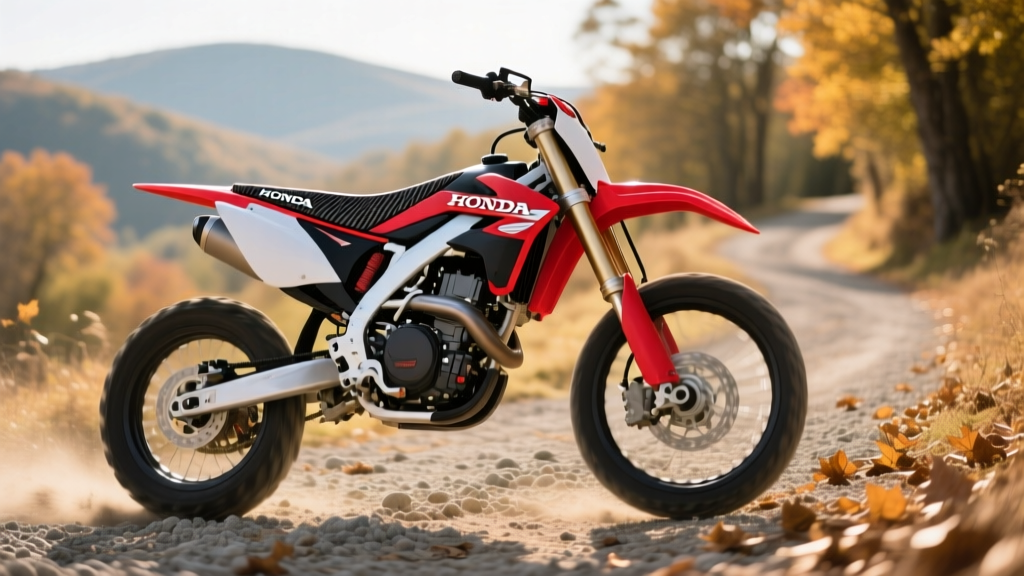
The Honda CRF-E2 is not a street-legal EV and falls outside the scope of federal §30D EV tax credits, which apply only to on-road vehicles with four wheels. If you're evaluating the CRF-E2 as a trail or off-road electric motorcycle, expect a base MSRP in the range announced by Honda, a removable battery system, and trail ride times measured in hours rather than highway miles. For buyers specifically searching for the Honda CRF-E2 electric dirt bike, this guide breaks down the practical ownership picture — and explains why most EV buying guides you'll find online won't cover it.
Why the Honda CRF-E2 Doesn't Fit Standard EV Buying Frameworks
The Honda CRF-E2 occupies a category that most electric vehicle resources — including ours at AutoEdgeView — don't typically address. Our core coverage spans four-wheeled BEVs, PHEVs, and HEVs: commuter cars, SUVs, trucks, and the charging infrastructure, battery chemistry, and tax-credit rules that surround them. Electric dirt bikes and off-road motorcycles operate under a fundamentally different set of constraints, regulations, and purchasing considerations.
That said, the search interest is real, and if you're cross-shopping the CRF-E2 against Honda's gas-powered CRF lineup or considering it as an entry point into electric powertrains, you deserve honest, data-grounded context rather than marketing copy. Here's what we can confirm and what buyers should investigate directly with Honda Powersports before committing.
CRF-E2 vs Gas CRF: What Changes When You Go Electric Off-Road
The fundamental trade-off between an electric dirt bike and a gas equivalent like the Honda CRF250F or CRF450R centers on three variables: energy density, refueling speed, and maintenance burden.
| Factor | Electric Dirt Bike (CRF-E2 class) | Gas CRF250F (baseline) |
|---|---|---|
| Energy storage | ~4–5 kWh battery pack | ~1.6 gallon fuel tank (~50 kWh equivalent energy in gasoline) |
| Ride time (moderate trail) | ~1–2 hours depending on throttle use | ~2–4 hours per tank |
| Refuel / recharge | ~60+ minutes on standard outlet; faster with dedicated charger | ~2 minutes at a gas can |
| Maintenance | No oil changes, no air filter, no valve adjustments, no exhaust | Regular oil, filter, valve checks, chain, sprockets, exhaust repack |
| Noise | Near-silent — trail access advantage | Loud — restricted on many trails and private land |
| Instant torque | Full torque from 0 RPM | Torque builds with RPM; clutch modulation required |
The energy density gap is the single biggest practical limitation. Gasoline contains roughly 33.7 kWh of energy per gallon. Even with an electric drivetrain's far superior efficiency (electric motors convert ~85–90% of energy to motion vs ~25–30% for internal combustion), a 4.3 kWh battery simply cannot match the ride duration of a full gas tank on aggressive terrain. For casual trail riding and shorter sessions, the gap narrows considerably.
Real-World Ownership Costs: Electric Dirt Bike vs Gas
Where electric dirt bikes recover ground — and sometimes leap ahead — is in ongoing operating costs. Here's a realistic annual breakdown assuming ~50 riding days per year at moderate intensity:
| Cost Category | Electric (CRF-E2 class) | Gas CRF250F |
|---|---|---|
| Fuel / electricity per year | ~$40–$80 (at $0.15/kWh, ~50 full charges) | ~$400–$600 (at $4.00/gal, ~100–150 gallons) |
| Annual maintenance | ~$50–$100 (chain lube, brake pads, tire) | ~$300–$600 (oil, filters, valves, top-end) |
| Estimated annual operating cost | ~$90–$180 | ~$700–$1,200 |
| 5-year operating cost | ~$450–$900 | ~$3,500–$6,000 |
The maintenance gap widens further if you ride hard. Gas motocross and trail bikes demand frequent top-end rebuilds, clutch replacements, and carburetor or fuel-injection servicing. An electric powertrain eliminates most of that — there are no valves to adjust, no oil to change, and no exhaust to repack. What remains is suspension, brakes, tires, chain/sprocket, and battery health monitoring.
Charging, Battery Care, and Trail Logistics
Unlike a four-wheeled EV where Level 2 home charging and DC fast-charging networks are well-established, electric dirt bike charging is a more basic affair. Expect the following:
- Level 1 (standard 120V outlet): Primary charging method. A full charge from empty typically takes 60–90 minutes with the OEM charger, depending on battery capacity and charge rate.
- No DC fast charging: Off-road electric motorcycles do not use CCS, NACS, or CHAdeMO connectors. There is no public charging network for trail bikes.
- Removable battery: The CRF-E2's battery pack is designed to be removable, meaning you can charge it separately from the bike — useful if your garage outlet isn't near where you store the bike.
- Trail-side charging: If you have access to a generator or a power outlet at a trailhead or pit area, you can top up between sessions. This is a significant logistical consideration for all-day rides.
Battery longevity: Lithium-ion packs in powersports applications typically carry a warranty of 1–3 years. Degradation is a function of charge cycles, depth of discharge, and thermal exposure. Expect 70–80% capacity retention after 500–800 full cycles under normal use — translating to several years of regular riding before noticeable range loss. Store the battery at ~50% state of charge during off-season months; never leave it fully depleted or fully charged for extended storage.
Tax Credits, Incentives, and Registration Reality
| Common Assumption | Reality |
|---|---|
| "I'll get the $7,500 federal EV tax credit" | The IRS §30D credit applies to on-road, four-wheeled vehicles meeting MSRP, income, and battery-sourcing requirements. Dirt bikes do not qualify. Verify current rules at irs.gov. |
| "It's street legal" | The CRF-E2 is an off-road vehicle. It lacks DOT-required lighting, mirrors, and emissions equipment for street registration in virtually all US states. |
| "No registration or insurance needed" | Off-road vehicles may still require OHV registration, state trail permits, and liability insurance depending on your jurisdiction. Check your state's OHV/DNR requirements. |
| "There's a used-EV credit" | The §25E used clean vehicle credit also applies only to qualifying four-wheeled on-road vehicles under $25,000 MSRP. |
The absence of federal incentives means the CRF-E2's purchase price is the purchase price — no point-of-sale credit transfer, no income-phaseout analysis. Some states and local utilities offer rebates for electric powersports or outdoor equipment, but these are highly jurisdiction-specific. Contact your state energy office or local utility for current programs.
Decision Framework: Is the CRF-E2 Right for You?
Choose the Honda CRF-E2 if:
- You ride trails where noise restrictions limit or ban gas-powered bikes
- Your typical ride sessions are 1–2 hours, not all-day endurance events
- You value near-zero maintenance and are willing to accept shorter ride times
- You have reliable access to a 120V outlet for charging between sessions
- Instant, clutch-free torque delivery appeals to your riding style
Stick with a gas CRF250F/CRF450R if:
- You ride all day at motocross tracks or remote trails with no power access
- You need 3+ hours of continuous hard riding per fuel stop
- You compete in events where refueling speed matters
- You want maximum aftermarket parts availability and established race support
- You need a bike that can be quickly refueled from a gas can at the truck
What First-Time EV Buyers Should Know — Even for Off-Road
If the CRF-E2 is your first electric vehicle of any kind, several ownership habits differ from gas:
- Plan around energy, not just time. Before a ride day, know your charging logistics. Can you charge at the trailhead? How many sessions can you get from one charge?
- State of charge matters for storage. Unlike a gas tank you can leave half-full indefinitely, lithium-ion batteries degrade faster at extreme states of charge. Store at 40–60% SoC.
- Cold weather reduces range. Just as with electric cars, cold temperatures (below 40°F / 4°C) reduce battery output. Expect 15–30% less ride time in winter conditions.
- Replacement batteries cost real money. When the pack eventually degrades beyond acceptable capacity (typically 5–8 years depending on use), replacement battery packs for electric dirt bikes can run $1,500–$3,000+. Factor this into long-term cost projections.
- Resale value is uncertain. The electric off-road motorcycle market is still maturing. Depreciation curves for these bikes are less predictable than for established gas models with decades of market data.
Frequently Asked Questions
What is the Honda CRF-E2's top speed and power output?
Honda has positioned the CRF-E2 as a trail-oriented electric dirt bike. Exact horsepower and top-speed figures vary by model year and market specification. Check the current spec sheet on Honda Powersports for the latest published numbers. Expect trail-appropriate power delivery optimized for torque rather than peak speed.
Can I charge the CRF-E2 from a portable power station?
Yes, provided the power station has a standard 120V AC outlet and sufficient capacity (typically 1,000+ Wh to deliver a meaningful charge). Brands like Jackery, EcoFlow, and Bluetti make stations suitable for this use. This is a practical solution for trail-side top-ups if you don't have grid access.
Does the CRF-E2 qualify for any federal EV tax credit?
No. The IRS §30D new clean vehicle credit and §25E used clean vehicle credit both require the vehicle to have four wheels and be primarily for on-road use. Electric dirt bikes and off-road motorcycles are excluded. Always verify current eligibility at irs.gov, as rules can change.
How does the CRF-E2 compare to the KTM Freeride E-XC or Zero FX?
The KTM Freeride E-XC and Zero FX are established competitors in the electric off-road segment, each with different battery capacities, power outputs, and price points. The Zero FX offers a larger battery (~7.2 kWh) and dual-sport capability, while the Freeride E-XC targets the trials/enduro niche. The CRF-E2 enters as Honda's answer to this space, leveraging the brand's dominant off-road reputation and dealer network. Cross-shop all three on ride time, weight, and dealer support in your area.
What maintenance does an electric dirt bike actually need?
Far less than gas. Expect to maintain: chain tension and lubrication, sprocket wear, brake pads and fluid, tire pressure and tread, suspension service (fork and shock oil on manufacturer intervals), and battery health monitoring. There is no engine oil, no coolant, no air filter, no spark plug, no valve shim, and no exhaust system to service.