The Short Answer on the Honda CR-V Electric
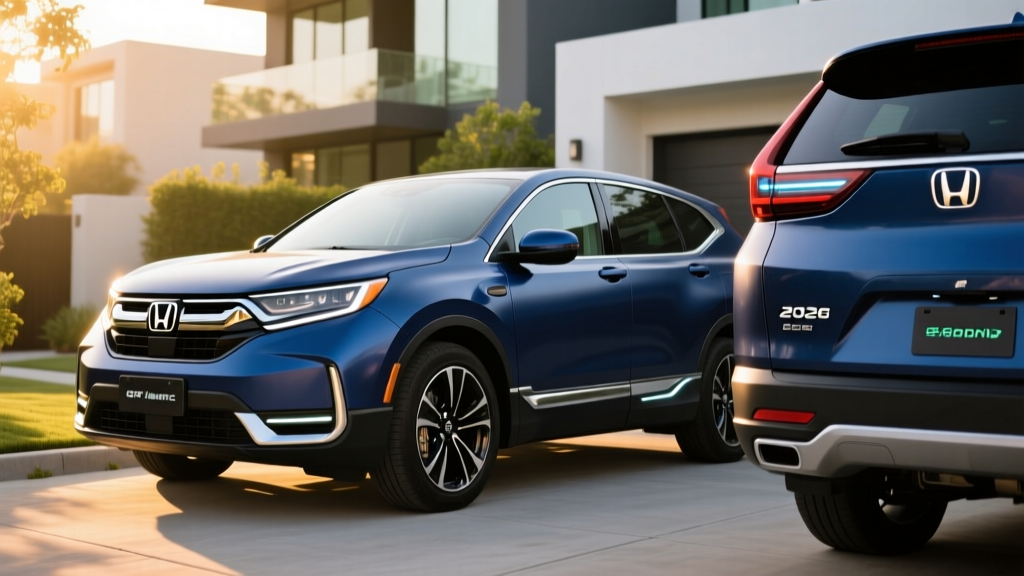
As of early 2026, Honda has not released a fully electric CR-V (BEV) for the U.S. market. What you can buy is the Honda CR-V Hybrid (HEV) and the CR-V e:PHEV (plug-in hybrid, available in select markets). Honda's global EV strategy centers on its new 0 Series platform, with EV SUVs expected for North America around 2027–2028. If you're searching for a "Honda CR-V Electric" today, your closest options are the CR-V Hybrid, the CR-V e:PHEV (if available in your region), or competing electric compact SUVs like the Hyundai Ioniq 5, Tesla Model Y, or the Honda Prologue (which is mechanically a Chevrolet Equinox EV underneath).
What Honda Actually Offers in 2026: CR-V Powertrain Lineup
Honda's CR-V lineup for the 2026 model year gives buyers two electrified choices — neither of which is a battery-electric vehicle. Understanding the distinction matters before you walk into a dealership expecting a plug-in BEV.
| Specification | CR-V Hybrid (HEV) | CR-V e:PHEV (where available) | Honda Prologue (EV SUV) |
|---|---|---|---|
| Powertrain Type | Series-parallel hybrid | Plug-in hybrid | Battery electric (BEV) |
| Combined Output | 204 hp / 247 lb-ft | ~204 hp combined | 288 hp (AWD) |
| EPA Combined MPG / MPGe | 40 MPG combined | ~38 MPG + ~30 mi EV range | 95 MPGe combined |
| Electric-Only Range | N/A (motor assist only) | ~30 miles (est.) | 296 miles (EPA, AWD Elite) |
| Battery | ~1.06 kWh lithium-ion | ~17.7 kWh lithium-ion | 85 kWh usable (NMC) |
| External Charging | No | Yes — Level 1/Level 2 | Yes — Level 1/2/DC fast |
| DC Fast Charge Rate | N/A | N/A | Peak 150 kW (10-80% ~32 min) |
| Base MSRP (2026) | ~$36,000 | Not sold in U.S. | ~$48,795 |
| Federal Tax Credit (§30D) | Not eligible | Not eligible (U.S.) | Up to $7,500 (eligibility varies) |
The CR-V Hybrid is a conventional HEV — it recovers energy through regenerative braking and uses a small battery to assist the 2.0L Atkinson-cycle engine. You never plug it in, and it cannot drive on electric power alone for meaningful distances. The CR-V e:PHEV, sold in Europe and China, offers roughly 30 miles of electric-only driving before the gas engine takes over, but Honda has not brought this variant to the United States as of the 2026 model year.
Honda CR-V Hybrid vs. Gas CR-V vs. Competing EVs: The Cost Picture
Most shoppers searching for a "Honda CR-V electric" are weighing whether to go hybrid, plug-in, or fully electric. Here's how the numbers stack up across a realistic 5-year ownership horizon at 15,000 miles per year.
| Cost Factor | CR-V Hybrid (HEV) | CR-V Gas (1.5T AWD) | Hyundai Ioniq 5 (EV) |
|---|---|---|---|
| Purchase Price (base MSRP) | $36,000 | $32,000 | $43,000 |
| Federal Tax Credit | $0 | $0 | Up to $7,500* |
| Effective Purchase Price | $36,000 | $32,000 | ~$35,500 |
| Fuel/Energy (5 yrs) | ~$6,750 | ~$9,750 | ~$4,500** |
| Maintenance (5 yrs) | ~$2,800 | ~$3,500 | ~$1,800 |
| Insurance (5 yrs, avg.) | ~$8,500 | ~$8,000 | ~$9,200 |
| Estimated Depreciation | ~$14,400 | ~$14,000 | ~$17,200 |
| 5-Year Total (approx.) | ~$68,450 | ~$67,250 | ~$68,200 |
* Federal §30D credit eligibility depends on MSRP caps ($80,000 for SUVs), buyer income limits ($300K MFJ / $150K single), and battery-sourcing requirements that change annually. Verify at IRS.gov before purchasing. Point-of-sale transfer is available through registered dealers.
** EV energy cost assumes 70% home charging at $0.16/kWh national average and 30% public DC fast charging at $0.40/kWh. Your mileage — literally — will vary based on local electricity rates and charging habits.
The takeaway: the CR-V Hybrid and a comparable EV SUV land in a similar 5-year cost range, but they get there differently. The hybrid costs less upfront and avoids charging-infrastructure concerns. The EV saves more on fuel and maintenance but carries higher depreciation risk and insurance premiums. The gas CR-V is cheapest to buy but most expensive to fuel.
Why There's No Honda CR-V Electric Yet — And What's Coming
Honda's EV strategy has been turbulent. The brand's first U.S. EV SUV, the Honda Prologue, is built on General Motors' Ultium platform and is essentially a rebadged Chevrolet Equinox EV with Honda styling. Sales have been modest, and the Prologue's eligibility for the full $7,500 federal tax credit has fluctuated based on evolving IRS battery-sourcing rules.
Honda's long-term plan pivots to its proprietary 0 Series platform, announced at CES 2024. This dedicated EV architecture promises:
- Thinner, lighter battery packs with improved energy density
- A new electric AWD system
- Targeted 300+ mile EPA ranges across the lineup
- DC fast charging at 200+ kW peak rates
- Next-gen ADAS called "Honda SENSING 360+"
The first 0 Series vehicles are expected to debut in Japan in 2026, with North American models — likely including a compact/midsize SUV that would effectively be the "electric CR-V" — arriving in 2027 or 2028. Until then, Honda's U.S. EV offering remains the Prologue, and the CR-V remains hybrid-only.
Common Misconceptions About a Honda CR-V Electric
| Myth | Fact |
|---|---|
| "The CR-V comes in a full-electric version in the U.S." | No. The 2026 CR-V is available as a gas model and a conventional hybrid (HEV). The e:PHEV is sold in Europe/China only. |
| "The Honda Prologue is just an electric CR-V." | The Prologue is a separate model built on GM's Ultium platform. It's similar in size but shares no mechanical components with the CR-V. |
| "Honda hybrids can plug in and drive on electricity." | The U.S.-spec CR-V Hybrid cannot plug in. Its small ~1 kWh battery charges only through regen braking and the gas engine. |
| "An electric CR-V would qualify for the full $7,500 tax credit." | Credit eligibility depends on battery sourcing, MSRP caps, and buyer income — not just the badge. Even the Prologue's eligibility has shifted year to year. |
Real-World Ownership Considerations Before You Choose
Whether you end up in a CR-V Hybrid, a Prologue, or a competitor's EV, these practical factors will shape your satisfaction more than any spec sheet.
Home Charging Access
If you can install a Level 2 (240V) home charger — typically a 48-amp hardwired unit on a 60-amp circuit — EV ownership is dramatically easier. You wake up every morning with a full battery, and your per-mile energy cost drops to roughly $0.04–$0.06/mile depending on your utility rate. Installation costs range from $500 (simple outlet near the panel) to $2,500+ (panel upgrade, long conduit runs). Without home charging, you'll rely on public DC fast chargers and Level 2 destination chargers, which cost $0.10–$0.15/mile and require time investment. According to fueleconomy.gov, home charging is the single biggest factor in EV satisfaction.
Climate and Range Impact
Battery-electric vehicles lose 20–30% of their EPA-rated range in sustained sub-freezing temperatures. A 296-mile EV SUV might deliver only 210–235 miles in January in Minnesota. Hybrids are far less affected because the gas engine provides cabin heat and the small battery isn't tasked with long-distance propulsion. If you live in a cold climate and can't charge at home, a hybrid is the lower-risk choice.
Driving Patterns
If your typical week involves commuting 30–50 miles round trip with weekend errands, both a hybrid and an EV handle it easily. If you regularly drive 300+ miles in a day (road trips, rural routes), the hybrid eliminates charging logistics entirely. An EV can do road trips too, but you'll add 25–40 minutes of DC fast charging every 200–250 miles — and that assumes functioning chargers along your route.
If You Want an Electric Honda SUV Today: The Prologue
Since the "Honda CR-V Electric" doesn't exist, here's what Honda does sell for EV-curious buyers: the 2026 Honda Prologue.
| Attribute | Prologue (AWD Elite) | CR-V Hybrid (Sport Touring) |
|---|---|---|
| Powertrain | Dual-motor BEV, AWD | 2.0L + 2-motor hybrid, AWD |
| Horsepower | 288 hp | 204 hp |
| 0-60 mph | ~5.9 seconds | ~7.6 seconds |
| EPA Range / MPG | 296 mi / 95 MPGe | 40 MPG combined |
| Battery Capacity | 85 kWh usable (NMC) | ~1.06 kWh |
| Max DC Fast Charge | 150 kW peak | N/A |
| 10-80% DC Charge Time | ~32 minutes | N/A |
| Level 2 Charge Rate | 11.5 kW (~7.7 hrs full) | N/A |
| Cargo Volume | 57.7 cu ft (rear seats folded) | 76.5 cu ft (rear seats folded) |
| Base MSRP | $48,795 | $39,845 |
| Warranty (powertrain/battery) | 5 yr/60K mi + 8 yr/100K mi battery | 5 yr/60K mi |
The Prologue is a competent EV SUV, but it's larger and heavier than the CR-V, with less cargo space and a higher price. Its 150 kW peak DC charging rate is adequate but trails competitors like the Hyundai Ioniq 5 (which peaks at ~240 kW on 800V architecture). On a real-world road trip, expect the Prologue's 296-mile EPA range to drop to roughly 240–260 miles at highway speeds in moderate weather, and closer to 200–220 miles in winter. The charge curve tapers significantly above 80% SoC, which is typical for NMC chemistry — plan your stops around 10-80% charges rather than topping off to full.
Decision Framework: Which Electrified SUV Should You Buy?
Choose Based on Your Situation
Choose the CR-V Hybrid if:
- You cannot install a home Level 2 charger (apartment, street parking, HOA restrictions)
- You live in a cold climate where EV range loss would be painful
- You regularly take 300+ mile road trips and don't want to plan around chargers
- Your budget tops out around $40,000
- You want Honda reliability with minimal new-technology risk
Choose the Honda Prologue (or a competing EV SUV) if:
- You have reliable home Level 2 charging access
- Your daily driving is under 80 miles round trip
- You want stronger acceleration (288 hp, ~5.9s 0-60) and a quieter cabin
- You qualify for the §30D tax credit, narrowing the price gap
- You want zero tailpipe emissions and lower per-mile energy costs
Wait for the 0 Series Honda EV SUV if:
- You specifically want a Honda-branded dedicated EV in the CR-V size class
- You can defer your purchase to 2027–2028
- You want next-gen charging speeds (200+ kW) and improved energy density
Frequently Asked Questions
Is Honda making an all-electric CR-V?
Not yet. Honda's 0 Series platform will underpin future electric SUVs for North America, likely arriving in 2027–2028. Whether Honda brands it as a "CR-V Electric" or gives it a new name remains unconfirmed. The current CR-V is available only as a conventional hybrid (HEV) in the U.S.
Does the Honda CR-V Hybrid need to be plugged in?
No. The CR-V Hybrid is a self-charging HEV. Its small lithium-ion battery recharges through regenerative braking and the gasoline engine. There is no plug, no external charging port, and no meaningful electric-only driving range. This is fundamentally different from a PHEV or a BEV.
How does the Honda Prologue compare to the CR-V in size and practicality?
The Prologue rides on a longer wheelbase and is physically larger than the CR-V, but its cargo volume (57.7 cu ft with rear seats folded) is notably less than the CR-V Hybrid's 76.5 cu ft. The Prologue's Ultium battery pack sits under the floor, which raises the load floor and reduces usable space. If cargo capacity is a priority, the CR-V Hybrid wins.
What's the real-world range of the Honda Prologue?
The EPA rates the 2026 Prologue AWD at 296 miles. In real-world highway driving at 70 mph in moderate temperatures (65–75°F), expect roughly 240–260 miles. In cold weather (below 32°F), that drops to approximately 200–220 miles. These figures assume you're driving the full battery; most road-trip charging stops target 10–80% SoC to avoid the slow taper above 80%.
Does the Prologue qualify for the $7,500 federal EV tax credit?
Eligibility under IRS §30D depends on the specific model year's battery sourcing, your adjusted gross income (capped at $300,000 for married filing jointly, $150,000 for single filers), and the vehicle's MSRP (capped at $80,000 for SUVs). The Prologue's credit status has shifted as Honda and GM adjust supply chains. Check the latest eligibility at IRS.gov and confirm with your dealer before purchase. The credit can be transferred to the dealer as a point-of-sale discount if all requirements are met.
Should I wait for Honda's 0 Series electric SUV?
If your current vehicle is functional and you're not under time pressure, waiting makes sense. The 0 Series promises dedicated EV architecture with better efficiency, faster charging, and Honda's own engineering rather than a GM partnership. However, "announced" vehicles are not guaranteed to meet timelines or preliminary specs. If you need a vehicle in the next 12 months, the CR-V Hybrid or Prologue are available now with known specs and pricing.
Sources: EPA efficiency data via fueleconomy.gov; IRS §30D credit rules at irs.gov; Honda product information via American Honda Motor Co. press materials.