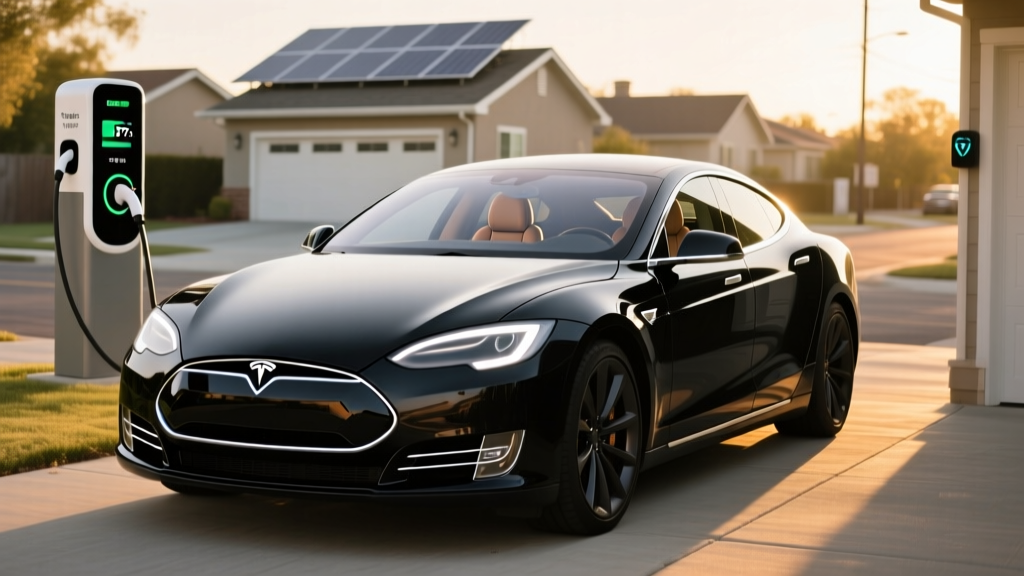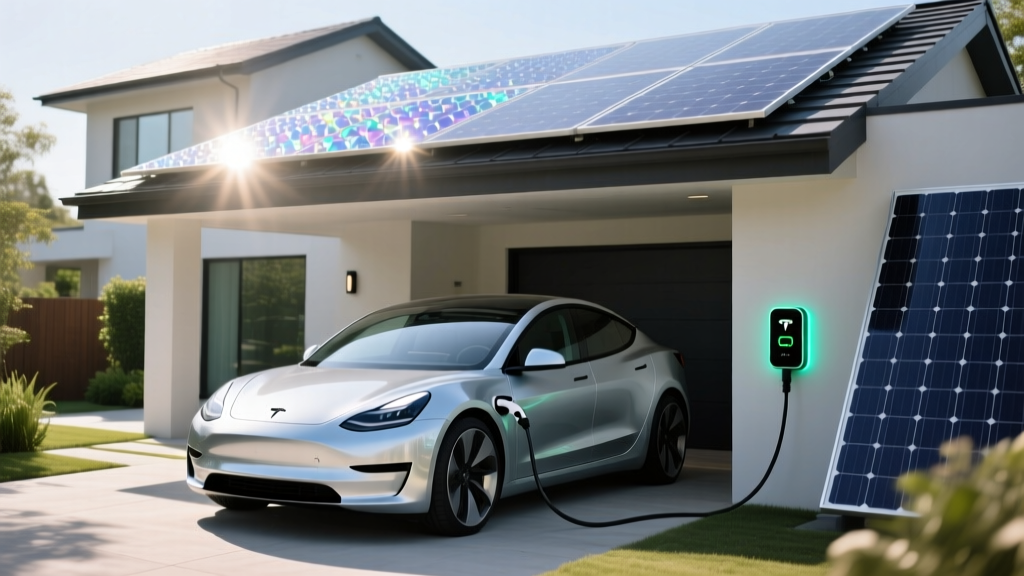
If you own an electric vehicle and are researching Tesla roof tiles — officially called the Tesla Solar Roof — you're likely trying to answer one question: Can I generate enough home solar to offset my EV charging and actually save money?
This guide approaches the Tesla Solar Roof from an EV-owner's perspective. We'll cover what the system actually costs in 2026, how its energy output compares to conventional solar panels, whether it can realistically power daily EV charging, and what the installation process looks like. We'll also include a practical EV-charging calculation so you can estimate how many tiles you'd need for your specific vehicle.
Quick Verdict
The Tesla Solar Roof is a premium product with a premium price — roughly 2× the cost of conventional solar panels per watt. For EV owners who are already planning a full roof replacement and prioritize aesthetics, it can make sense. For those who simply want to offset EV charging costs, standard solar panels paired with a Tesla Powerwall deliver more watts per dollar.
What Are Tesla Roof Tiles (and How Do They Differ From Panels)?
Tesla's Solar Roof uses tempered-glass tiles with integrated solar cells that replace your existing roofing material entirely. Unlike traditional rack-mounted solar panels that sit on top of shingles, Tesla tiles are the roof. The system includes both active tiles (which generate electricity) and inactive tiles (which match visually but contain no cells), creating a uniform appearance.
As of 2026, Tesla offers the Solar Roof in a single textured-glass style. The active tiles use monocrystalline silicon cells, and the system is designed to integrate directly with the Tesla Powerwall battery for energy storage — which is where the EV-charging value proposition gets interesting.
Key Specs at a Glance
| Specification | Tesla Solar Roof (2026) | Conventional Solar Panels |
|---|---|---|
| Tile Efficiency | ~22–23% (active tiles) | 20–23% (premium panels) |
| Warranty — Tiles | 25 years (weatherization) | N/A (separate roof warranty) |
| Warranty — Power Output | 25 years (≥80% output) | 25 years (typically ≥80%) |
| Installed Cost (avg.) | $45,000–$75,000+ (10–15 kW system) | $22,000–$38,000 (10–15 kW system) |
| Cost per Watt (before incentives) | $3.80–$5.50/W | $2.20–$3.20/W |
| Aesthetics | Integrated, low-profile | Visible rack-mounted panels |
| Roof Replacement Included? | Yes (full tear-off + install) | No (requires existing good roof) |
Sources: Tesla Solar Roof estimator, NREL solar cost benchmarks. Actual costs vary significantly by roof complexity, pitch, and region.
Real-World Energy Output: What EV Owners Need to Know
The most important number for an EV owner isn't the tile efficiency rating — it's the total annual kWh production of the system as installed on your specific roof. Tesla's online estimator typically projects a 10 kW system in a sunbelt state (e.g., Arizona, California) to produce roughly 14,000–16,000 kWh per year. The same 10 kW system in the Pacific Northwest or Northeast might produce 10,000–12,000 kWh annually.
EV Charging Math: How Far Can Tesla Roof Tiles Take You?
Assume a 12 kW Tesla Solar Roof producing 15,000 kWh/year in a moderate-sun region:
- Tesla Model Y (~3.5 miles/kWh): ~52,500 solar-powered miles/year
- Ford F-150 Lightning (~2.0 miles/kWh): ~30,000 solar-powered miles/year
- Chevrolet Equinox EV (~3.3 miles/kWh): ~49,500 solar-powered miles/year
For context, the average American drives ~13,500 miles/year. Most 10–15 kW solar roofs produce enough energy to fully offset one EV's annual mileage — with surplus for household use.
Seasonal and Weather Impact
Solar production isn't uniform. In winter months at northern latitudes, daily production can drop 40–60% compared to summer peaks. If you're in Minnesota and driving a large-battery EV like the Rivian R1T (128.9 kWh usable, NMC), you'll likely need grid supplementation from November through February even with a 15 kW system. Snow cover on tiles further reduces output until it melts or slides off — Tesla's glass surface sheds snow faster than asphalt shingles, but it's not instantaneous.
Charging Your EV With a Tesla Solar Roof: Setup and Speeds
Pairing a Tesla Solar Roof with EV charging typically involves three components: the solar array itself, a Tesla Powerwall 3 (or multiple units), and a Tesla Wall Connector Level 2 home charger. Here's how the energy flows and what charging speeds look like:
| Charging Level | Power (kW) | Miles Added per Hour (Model Y est.) | Source |
|---|---|---|---|
| Level 1 (120V outlet) | 1.4 kW | ~3–4 mi/hr | Standard outlet |
| Level 2 — Wall Connector (48A) | 11.5 kW | ~32–44 mi/hr | Solar + grid + Powerwall |
| Level 2 — Wall Connector (32A) | 7.7 kW | ~22–30 mi/hr | Lower-amperage circuit |
| DC Fast Charge (Supercharger V4) | Up to 250–325 kW | ~750+ mi/hr (peak) | Grid only (off-site) |
The Wall Connector at 48 amps is the practical sweet spot for home charging. Most EV owners with a 200-amp electrical panel can support this circuit. If your solar system is actively producing during the day, you can configure the Wall Connector (via the Tesla app) to prioritize solar-only charging — meaning your EV charges exclusively from excess solar production without pulling grid power. This feature requires the Powerwall as an intermediary.
The Powerwall Factor for EV Owners
The Powerwall 3 (13.5 kWh usable capacity, ~11.5 kW continuous output) is nearly mandatory if you want to maximize solar-powered EV charging. Without a battery, excess solar production during midday flows back to the grid (often at low net-metering credit rates), and you buy grid power at night to charge your car. With a Powerwall, you store midday surplus and discharge it into your EV overnight.
One Powerwall 3 can fully charge a smaller-battery EV like the Chevrolet Bolt EV (65 kWh usable, LFP) from 10% to ~30% SoC overnight from stored solar. For larger batteries, two or three Powerwalls stacked together are increasingly common among EV-owning households.
Tesla Roof Tiles Cost Breakdown and Tax Incentives
Pricing a Tesla Solar Roof is complex because it includes both a new roof and a solar energy system in one contract. Here's a representative breakdown for a mid-size home with a 12 kW system:
| Cost Component | Estimated Range |
|---|---|
| Tesla Solar Roof (tiles + installation, 12 kW) | $48,000–$65,000 |
| Powerwall 3 (1 unit, installed) | $9,000–$12,000 |
| Permitting, utility interconnection | $1,500–$3,500 |
| Electrical panel upgrade (if needed, 200A→400A) | $2,000–$5,000 |
| Total before incentives | $60,500–$85,500 |
| Federal Solar Tax Credit (30%, IRC §25D) | –$18,150 to –$25,650 |
| Net cost after federal credit | $42,350–$59,850 |
Important incentive distinction: The Tesla Solar Roof qualifies for the Residential Clean Energy Credit (IRC §25D), which covers 30% of the total solar + battery cost with no dollar cap. This is not the same as the EV tax credit (IRC §30D), which has MSRP caps, income limits, and battery-sourcing requirements. The solar credit (§25D) has no income cap and no equipment-sourcing restrictions as of 2026, but it is non-refundable — you need sufficient tax liability to claim it. Consult IRS guidance on §25D and a tax professional for your specific situation.
Some states and utilities offer additional rebates or performance-based incentives (SRECs). California's NEM 3.0 rules, for example, have significantly reduced the value of grid export credits, making the Powerwall battery nearly essential for financial payback — a factor Tesla's system is designed to address.
Tesla Solar Roof vs. Conventional Panels for EV Owners
This is the comparison every prospective buyer should run before committing:
Choose Tesla Solar Roof If:
- Your existing roof needs full replacement within 1–2 years anyway
- Aesthetics and low-profile integration are high priorities (HOA, historic district, resale value)
- You want a single contractor for roof + solar + battery + EV charger
- You're willing to pay a ~40–80% premium per watt for integrated design
Choose Conventional Panels + Separate Roof If:
- Your current roof has 10+ years of life remaining
- Minimizing cost per watt is the top priority
- You want faster installation (1–2 days vs. 1–3 weeks for Solar Roof)
- You prefer choosing from multiple solar installers for competitive bids
From a pure EV-charging economics standpoint, conventional panels win on payback period. A 12 kW conventional system at $2.70/W costs ~$32,400 before incentives, or ~$22,680 after the 30% federal credit. That same energy output from a Tesla Solar Roof might cost $55,000+ after credit. The electrons are identical — only the delivery method differs.
However, if you're budgeting for a $15,000–$25,000 roof replacement plus solar panels separately, the combined cost narrows the gap with Tesla's all-in-one approach.
Installation Timeline and What to Expect
Tesla Solar Roof installations have historically had long lead times. As of early 2026, expect:
- Design consultation and site survey: 2–4 weeks from initial order
- Permitting and utility approval: 4–12 weeks (varies wildly by jurisdiction)
- Installation: 5–15 business days on-site for a typical home (complex roofs with many penetrations, valleys, or steep pitch take longer)
- Utility interconnection and PTO (Permission to Operate): 2–6 weeks after install
Total timeline from order to charging your EV on solar: 3–6 months is realistic. This is longer than conventional panel installs, which often complete in 4–8 weeks total.
Roof Complexity Matters
Tesla's pricing algorithm heavily penalizes complex roofs. A simple gable or hip roof with few skylights and vents will be at the low end of cost estimates. A roof with multiple dormers, valleys, skylights, chimneys, and steep pitch can push costs 30–50% higher. Tesla requires a virtual or in-person roof assessment before finalizing pricing.
Pros and Cons of Tesla Roof Tiles for EV Owners
Pros
- Integrated aesthetics — no visible panels, clean roofline
- Single ecosystem: Solar Roof + Powerwall + Wall Connector + Tesla EV app integration
- Solar-only charging mode via Tesla app (with Powerwall)
- 25-year tile and power output warranty
- Tempered glass tiles rated for Class 3 hail impact (ANSI FM 4473)
- Qualifies for 30% federal solar tax credit (§25D, no income cap)
- Includes full roof replacement — no separate roofing contractor needed
Cons
- Cost per watt is 40–80% higher than conventional panels
- Long installation timeline (3–6 months typical)
- Limited installer network — Tesla-certified crews only
- Active tile coverage is less than 100% of roof area (inactive tiles fill gaps)
- Output can be lower than equivalent-watt conventional panel systems due to tile orientation constraints
- Powerwall essentially required for EV solar-charging optimization (~$10K+ added)
- Customer service and communication complaints remain common in owner forums
Who Should Consider Tesla Roof Tiles?
The Tesla Solar Roof makes the most sense for EV owners who fall into one or more of these profiles:
- The roof-replacement buyer: Your asphalt shingle roof is 20+ years old and needs replacing. Bundling the new roof with solar in one project simplifies logistics and may justify the premium.
- The design-conscious homeowner: You live in an area with strict HOA guidelines, a historic district, or simply value a clean roofline. Tesla tiles are the most aesthetically integrated residential solar option available.
- The Tesla ecosystem loyalist: You already own a Tesla vehicle, use the Tesla app, and want unified control of solar, battery, charging, and vehicle from one platform. The integration is genuinely seamless.
- The high-electricity household: You're electrifying everything — EV, heat pump, induction stove — and need a large solar system (15+ kW) paired with multiple Powerwalls. At scale, the per-watt premium becomes a smaller percentage of total home-improvement spend.
If your primary goal is simply to reduce your EV charging bill and your roof is in good condition, conventional panels with a dedicated EV charger will deliver faster ROI.
Frequently Asked Questions
How many Tesla roof tiles do I need to charge my EV?
It depends on your vehicle's efficiency and annual mileage. A typical EV consuming 30 kWh/100 miles driven 12,000 miles/year needs ~3,600 kWh annually. A 10–12 kW Tesla Solar Roof in most US regions produces 12,000–18,000 kWh/year — more than enough for one EV plus household electricity. Tesla's online estimator factors in your specific address, roof orientation, and energy usage.
Does the Tesla Solar Roof qualify for the federal EV tax credit (§30D)?
No. The Solar Roof qualifies for the Residential Clean Energy Credit (IRC §25D), which is a separate 30% tax credit covering solar panels, solar roofs, and home battery storage. The EV tax credit (§30D) applies only to vehicle purchases. You can claim both credits in the same tax year if you buy a qualifying EV and install a Solar Roof — they don't conflict. See IRS §25D guidance for details.
Can I charge my non-Tesla EV using a Tesla Solar Roof?
Yes. The Tesla Wall Connector includes a NACS (North American Charging Standard) connector, which is now the dominant standard in North America. Most non-Tesla EVs from 2025 onward ship with NACS ports or include CCS-to-NACS adapters. You can also install any J1772 Level 2 charger alongside the Solar Roof system — the solar energy flows through your home's electrical panel regardless of which charger brand you use.
How does the Tesla Solar Roof perform in cold or cloudy climates?
Solar production drops in cloudy and low-sun-angle conditions, but doesn't stop. In states like Washington, Oregon, or New York, expect 30–45% less annual production compared to Arizona or Southern California for the same system size. Cold temperatures actually improve solar cell efficiency — the real production killer is short winter days and cloud cover. For EV owners in northern climates, a larger system (15+ kW) and Powerwall storage help bridge winter gaps.
What happens to the Solar Roof if I need to sell my house?
Tesla Solar Roofs are owned outright (no leases in the current program), so they transfer with the home sale like any other home improvement. Studies from NREL and Lawrence Berkeley National Lab have shown that home solar systems add resale value roughly proportional to their energy production. The integrated aesthetics of Tesla tiles may appeal to buyers who would reject conventional panels, potentially broadening your buyer pool.
Is the Tesla Solar Roof worth it compared to regular panels for EV charging?
On pure economics, conventional panels deliver the same kWh at roughly half the installed cost per watt. If your roof is in good shape and aesthetics aren't a priority, standard panels are the financially rational choice for offsetting EV charging. The Tesla Solar Roof becomes competitive when you factor in the cost of a simultaneous roof replacement, value the integrated look, and want the unified Tesla app ecosystem for solar + battery + EV charging management.
Disclaimer: Solar production estimates, costs, and incentive rules vary by location, roof characteristics, and tax situation. All pricing reflects 2026 averages and is subject to change. Consult a licensed solar installer and tax professional before making purchasing decisions. Tesla Solar Roof availability varies by region.