The Short Answer
Honda canceled three planned US electric vehicle models — large SUVs originally developed on GM's Ultium battery platform — in late 2024, with the decision carrying forward into 2026. The cancellation followed weak EV demand forecasts and the high cost of the GM partnership. Honda is now pivoting to its own dedicated EV platform (the "0 Series") and leaning harder into its hybrid lineup. If you were waiting for a Honda electric SUV, your best current options are the Honda Prologue (still in production, built on GM's Ultium platform) or Honda's expanding hybrid models like the CR-V Hybrid and Accord Hybrid.
Why Honda Canceled Three Planned US Electric Vehicle Models
In October 2024, Honda confirmed it was scrapping three large electric SUVs that had been jointly developed with General Motors. These models were intended to slot above the Honda Prologue and Acura ZDX in size and price, targeting the family-hauler segment where the Chevrolet Traverse EV and GMC Acadia-derived electric models were expected to compete.
The reasons were financial and strategic:
- Weak demand projections: US EV adoption growth slowed in 2024–2025, with buyers gravitating toward hybrids and plug-in hybrids over pure battery-electric vehicles.
- Platform economics: The GM Ultium partnership meant Honda was paying a premium for a platform it didn't own, limiting margin control and differentiation.
- Competition reality: Competing against Tesla's Model Y, Hyundai Ioniq 5, and Ford Mustang Mach-E — all with dedicated EV architectures and aggressive pricing — on a shared GM platform was a losing proposition.
Honda CEO Toshihiro Mibe acknowledged that the company needed to "fundamentally review" its EV strategy in North America. The result: a pivot toward Honda's proprietary "0 Series" EV platform, with new dedicated models expected starting in 2026–2027, and a much heavier emphasis on hybrid powertrains in the interim.
What's Still Available: The 2026 Honda Prologue
Despite the cancellations, the Honda Prologue — Honda's first US-market EV, also built on GM's Ultium platform — remains in production for the 2026 model year. Here's what you're actually buying if you choose it today:
| Spec | 2026 Honda Prologue EX (FWD) | 2026 Honda Prologue Touring (AWD) |
|---|---|---|
| EPA Range | 296 miles | 273 miles |
| Battery | 85 kWh usable, NMC (Ultium) | 85 kWh usable, NMC (Ultium) |
| Peak DC Fast Charge | 150 kW | 150 kW |
| 10–80% Charge Time | ~32 minutes | ~32 minutes |
| Level 2 Charge Rate | 11.5 kW (~37 mi/hr) | 11.5 kW (~37 mi/hr) |
| Motor Output | 212 hp / 236 lb-ft | 288 hp / 333 lb-ft |
| 0–60 mph | ~7.2 sec | ~5.9 sec |
| Efficiency (MPGe) | 107 MPGe combined | 95 MPGe combined |
| Base MSRP | $48,795 | $57,395 |
| Battery Warranty | 8 years / 100,000 miles | 8 years / 100,000 miles |
The Prologue qualifies for the §30D federal tax credit — up to $7,500 — but eligibility depends on your income (AGI caps: $150K single / $300K joint), the vehicle's MSRP (must be under $80K for SUVs), and battery mineral sourcing compliance. As of 2026, the Prologue's Ultium battery meets critical-mineral and battery-component thresholds, but always verify current-year sourcing requirements on the IRS website or with a tax professional before purchase. The credit can now be transferred as a point-of-sale discount at participating dealers.
EV vs Hybrid: What Actually Saves You More in 2026?
Honda's cancellation of three EV models reflects a broader market truth: for many US buyers, a hybrid delivers more practical value than a pure EV right now. Here's how Honda's own lineup compares on total cost:
| Factor | 2026 Honda Prologue (EV) | 2026 Honda CR-V Hybrid (AWD) | 2026 Honda CR-V (Gas, AWD) |
|---|---|---|---|
| Base MSRP | $48,795 | $36,395 | $33,395 |
| After $7,500 Fed Credit | ~$41,295 | N/A | N/A |
| EPA Efficiency | 107 MPGe / 3.0 kWh/mi | 40 MPG combined | 29 MPG combined |
| Annual Fuel/Energy Cost* | ~$540 (home charging) | ~$1,575 | ~$2,170 |
| Annual Maintenance | ~$300 | ~$550 | ~$650 |
| 5-Year Fuel + Maint. Total | ~$4,200 | ~$10,625 | ~$14,100 |
| 5-Year Total Cost (Purchase + Fuel + Maint.) | ~$45,495 | ~$47,020 | ~$47,495 |
*Based on 12,000 miles/year, $0.15/kWh home electricity, $3.50/gal gas. Public DC fast charging would raise Prologue costs significantly — to ~$1,000–$1,400/year if relying exclusively on public chargers at $0.35–$0.48/kWh.
The math is close, but context matters enormously:
- If you have home charging (Level 2, 240V): The Prologue's operating cost advantage is real, saving ~$1,000/year over the CR-V Hybrid. Over 5 years, the EV breaks even with the hybrid even before the tax credit.
- If you rely on public charging only: The Prologue's "fuel" cost can exceed the CR-V Hybrid's gas cost. DC fast charging at Electrify America or EVgo averages $0.35–$0.48/kWh — erasing the EV's efficiency advantage entirely.
- If you drive >15,000 miles/year: The EV's per-mile cost advantage compounds. High-mileage drivers benefit most from electrification.
- If you live in a cold climate (Upper Midwest, Northeast): The Prologue will lose 20–30% range in winter. The CR-V Hybrid loses only ~5–8% fuel economy. For pure winter practicality with no range compromise, the hybrid wins.
Honda's Hybrid Lineup: The Practical Alternative
With three EV models off the table, Honda has doubled down on hybrids for 2026. If the Prologue's price or charging logistics don't work for you, these are the strongest Honda electrified options:
| Model | Type | EPA MPG Combined | Electric-Only Range | Base MSRP |
|---|---|---|---|---|
| CR-V Hybrid AWD | HEV | 40 MPG | N/A | $36,395 |
| Accord Hybrid | HEV | 48 MPG | N/A | $34,295 |
| CR-V e:PHEV (if available) | PHEV | 42 MPG / 87 MPGe | ~37 miles | ~$40,000 (est.) |
Honda's two-motor hybrid system is one of the best in the industry — smooth, efficient, and proven over millions of miles. The CR-V Hybrid delivers crossover utility with sedan-like fuel economy, and the Accord Hybrid achieves numbers that rival small hatchbacks. For buyers who can't charge at home or who face long highway commutes, these hybrids eliminate range anxiety entirely while still cutting fuel costs 25–40% versus a gas-only equivalent.
What About Honda's "0 Series" EV Platform?
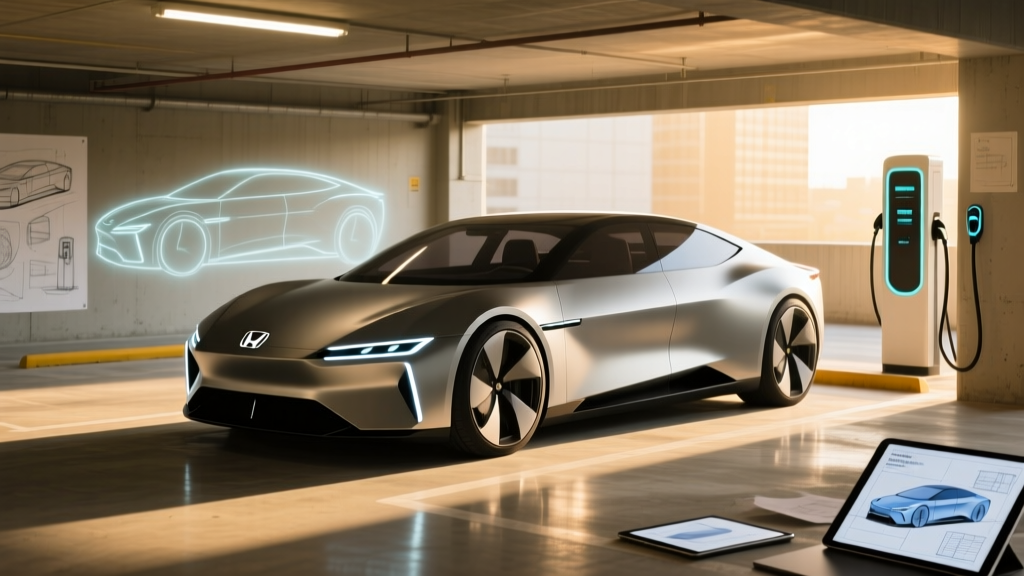
Honda's next-generation dedicated EV architecture — branded the "0 Series" — is expected to debut vehicles in North America starting in 2027. Honda has previewed concept designs suggesting a thin, lightweight, aerodynamic approach with proprietary battery packs and advanced driver-assistance targeting SAE Level 3 capability on highways.
The 0 Series represents Honda's attempt to own its EV destiny — no longer paying GM for platform access, and building vehicles optimized from the ground up for electric propulsion. But "coming in 2027" means waiting 12–18+ months, with no guarantee on pricing, tax credit eligibility, or whether initial production volumes will meet demand.
Decision Framework: What Should You Buy?
Choose the Honda Prologue (EV) if:
- You have Level 2 home charging (garage or driveway with 240V access)
- Your daily commute is under 80 miles round-trip
- You qualify for the $7,500 federal tax credit (income + sourcing rules)
- You want zero tailpipe emissions and minimal maintenance
- You're comfortable with ~240–260 miles of real-world highway range
Choose a Honda CR-V Hybrid or Accord Hybrid if:
- You lack reliable home charging access
- You regularly drive 300+ miles in a single day
- You live in a region with harsh winters and limited public charging
- You want lower upfront cost ($12,000–$15,000 less than the Prologue)
- You don't want to plan trips around charging stops
Wait for Honda's 0 Series if:
- Your current vehicle has 2+ years of life left
- You want a Honda-designed EV platform (not GM-derived)
- You're willing to risk first-model-year pricing and availability uncertainty
Look at competitors if:
- You want faster charging: Hyundai Ioniq 5 peaks at 240 kW (10–80% in ~18 min) vs Prologue's 150 kW (~32 min)
- You want more range: Tesla Model Y Long Range offers 320 miles EPA at a similar price point
- You want a lower price: Chevrolet Equinox EV starts at ~$33,000 with 319 miles of range
Common Misconceptions About Honda's EV Cancellations
| Myth | Fact |
|---|---|
| "Honda is abandoning EVs entirely." | False. Honda canceled three Ultium-based SUVs but continues selling the Prologue and is developing its own 0 Series EV platform for 2027+. |
| "The Prologue is being discontinued too." | As of 2026, the Prologue remains in production. Honda has not announced an end date, though its long-term future on the GM platform is uncertain. |
| "Hybrids are just a step backward." | Honda's hybrids deliver 40–48 MPG with zero lifestyle compromise — no charging needed, no range loss in cold, and lower upfront cost. For many buyers, they're the rational choice. |
| "I'll get the $7,500 tax credit no matter what." | The §30D credit has strict requirements: buyer income caps ($300K joint / $150K single), MSRP caps ($80K for SUVs), and battery sourcing rules. Always verify on IRS.gov before assuming eligibility. |
First-Time EV Buyer Essentials
If Honda's EV shuffle has you considering an electric vehicle for the first time — whether the Prologue or a competitor — here are the non-negotiable realities:
- Home charging is the make-or-break factor. A Level 2 home charger (240V, 32–48 amps) adds ~25–37 miles of range per hour of charging. Installation costs $800–$2,500 depending on your electrical panel. Without home charging, EV ownership becomes significantly more expensive and inconvenient.
- kW vs kWh — know the difference. kW (kilowatts) measures charging speed — like the flow rate of a gas pump. kWh (kilowatt-hours) measures battery capacity — like the size of a gas tank. The Prologue's 85 kWh battery holds energy; its 150 kW peak charge rate determines how fast that energy flows in.
- Charging slows above 80%. DC fast charging follows a curve: the Prologue may peak at 150 kW from 10–40% SoC, but it tapers to 50–80 kW above 60%, and drops further above 80%. This is why manufacturers quote 10–80% times — the last 20% takes disproportionately longer.
- Cold weather is real. Expect 20–30% range loss below freezing. The Prologue's heat pump helps, but physics is physics — cold batteries are less efficient, and cabin heating draws significant energy.
- Insurance costs more. EVs typically cost 15–25% more to insure than equivalent gas cars due to higher repair costs and specialized parts. Get quotes before buying.
Frequently Asked Questions
Did Honda cancel all of its electric vehicles?
No. Honda canceled three planned large SUVs that were to be built on GM's Ultium platform. The Honda Prologue (also Ultium-based) remains on sale for 2026, and Honda is developing its own dedicated EV platform ("0 Series") for future models.
Is the Honda Prologue a good EV for 2026?
It's competent but not class-leading. With 296 miles of EPA range (FWD), 150 kW peak charging, and a starting price near $49K, it trails the Hyundai Ioniq 5 (240 kW charging, ~$42K) and Tesla Model Y (320 mi range, Supercharger network) on key metrics. It's a solid choice for Honda loyalists who want a familiar dealership experience, but shop the competition before committing.
Should I buy a hybrid instead of an EV?
If you can't install a home charger, frequently drive 300+ miles in a day, or live in extreme cold, a hybrid like the CR-V Hybrid (40 MPG, $36,395) is a lower-risk, lower-cost choice. If you have home charging and mostly drive under 80 miles daily, an EV's lower operating costs and tax incentives can make it cheaper over 5 years.
When will Honda release its own electric vehicles?
Honda's "0 Series" EV platform is expected to debut production vehicles in North America around 2027. Specific models, pricing, and specs have not been confirmed. Treat any pre-announcement figures as preliminary.
Can I still get the $7,500 federal tax credit on the Honda Prologue?
As of 2026, the Prologue is expected to qualify for up to $7,500 under §30D, subject to buyer income limits ($300K joint / $150K single), MSRP caps ($80K for SUVs), and battery sourcing requirements. The credit can be applied as a point-of-sale discount at participating dealers. Always verify current eligibility on IRS.gov or consult a tax professional.